
红利重估

Search documents
11月央行信贷收支表要点解读:存款搬家股市放缓,中小行储蓄回流大行
KAIYUAN SECURITIES· 2025-12-18 01:41
Investment Rating - The industry investment rating is "Overweight" (maintained) [2] Core Insights - The report highlights a slowdown in non-bank deposit growth, indicating a reduced diversion of deposits to the stock market, with large banks experiencing a net inflow of deposits while smaller banks see a decline [5][6] - The report suggests that the upcoming quarter (Q1 2026) will present challenges for banks in terms of asset-liability matching due to the maturity of high-interest deposits and fluctuating deposit growth [7] - The investment strategy emphasizes balancing asset quality and pricing power, with a focus on large state-owned banks and leading comprehensive banks as key investment targets [8] Summary by Sections Deposit Trends - In November, large banks saw a decrease of 83.3 billion yuan in non-bank deposits, reflecting a weakening effect of the stock market on deposit diversion [5] - Non-bank deposit growth remains higher than that of resident fixed deposits, indicating a shift of funds into wealth management products [6] - Smaller banks experienced a year-on-year decrease of 478.9 billion yuan in fixed deposits, while large banks saw an increase of 419.4 billion yuan, suggesting a trend of deposit migration back to larger institutions [6] Credit and Investment Dynamics - Credit demand, particularly in consumer sectors, remains weak, leading to a continued slowdown in lending growth [7] - The report anticipates that banks may increase bond investments to fill year-end balance sheet requirements, especially as high-interest fixed deposits mature [7] Investment Recommendations - The report recommends a focus on large state-owned banks as foundational investments, with specific mentions of Agricultural Bank of China and Industrial and Commercial Bank of China as beneficiaries [8] - Core investments should target leading comprehensive banks like China Merchants Bank and Industrial Bank, with a recommendation for CITIC Bank as a key stock [8] - For more flexible investments, banks such as Jiangsu Bank and Chongqing Bank are highlighted as potential beneficiaries [8]




银行股再“逆袭”,走强并非偶然丨每日研选
Shang Hai Zheng Quan Bao· 2025-11-21 01:17
Core Viewpoint - The banking sector is experiencing a significant inflow of funds, indicating a potential new cycle of stable profitability, driven by a combination of favorable policies, improving performance, and changing market conditions [1][2][3]. Group 1: Market Performance - On November 20, the banking sector saw a net inflow of 2.16 billion yuan, leading all sectors in the Shenwan first-level industry classification [1]. - The overall trading volume for banking stocks reached 42.51 billion yuan, with main funds flowing in at 23.30 billion yuan and flowing out at 21.14 billion yuan [1]. - High dividend yields in the banking sector are attracting funds as a reliable "safe haven" amid market volatility [1]. Group 2: Policy Environment - The central bank aims to maintain relatively loose social financing conditions and strengthen the execution and transmission of monetary policy [2]. - There is an expectation of a reasonable slowdown in loan growth due to structural changes in social financing and economic development [2]. - Structural monetary policy tools are being implemented to support key areas of the economy, enhancing the banking sector's ability to operate steadily [2]. Group 3: Performance Improvement - By Q3 2025, commercial banks' net profit increased by 2% year-on-year, with large commercial banks and city commercial banks seeing profit growth of 4% and 9%, respectively [2]. - The optimization of credit structure and consumer policy support are expected to further improve banks' asset quality and profitability [2]. Group 4: Future Outlook - Analysts believe the banking sector is entering a new cycle of stable profitability, with long-term capital still actively entering the market [3]. - A favorable macro environment, including potential improvements in PPI and long-term interest rates, could enhance the banking sector's profitability [3]. - The strategy of combining leading banks with smaller banks is expected to elevate valuations, with specific banks like Industrial Bank and CITIC Bank showing potential for price elasticity [3]. Group 5: Valuation and Investment Appeal - The banking sector's valuation remains low historically, making it attractive for medium to long-term investments [4]. - High dividend assets represented by state-owned banks offer significant value compared to risk-free rates [4]. - Recommended stocks include CITIC Bank, Construction Bank, Agricultural Bank, and others, highlighting their investment appeal [4].


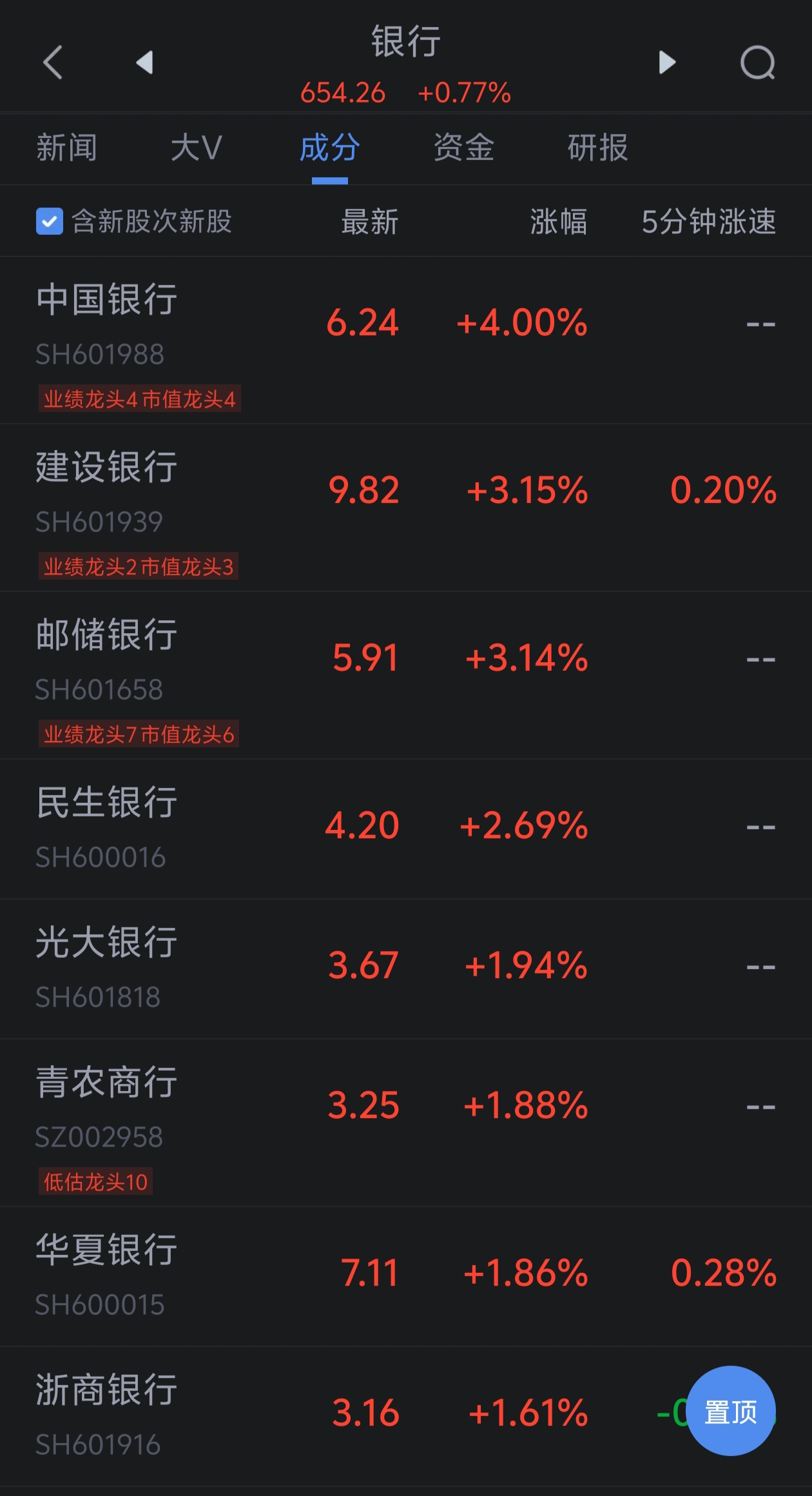
银行股狂飙!中行最高涨幅5.17%,建行市值重回2万亿大关
Xin Lang Cai Jing· 2025-11-21 00:37
Core Viewpoint - The A-share market continues to see a strong performance in the banking sector, with significant gains in bank stocks despite a generally mixed market environment [3][4]. Group 1: Stock Performance - On November 20, the banking sector in the A-share market showed robust growth, with China Bank reaching a maximum increase of 5.17%, marking its second consecutive day of historical highs and an annual increase of over 18%, with a market capitalization of 1.85 trillion yuan [4][7]. - Other major banks also experienced notable gains, with China Construction Bank and Postal Savings Bank both rising over 4%, while Minsheng Bank and Everbright Bank increased by over 3% [6][7]. - The market capitalization of China Construction Bank has returned to over 2 trillion yuan, while Agricultural Bank of China remains the largest by market cap at 2.77 trillion yuan, despite a slight decline in its stock price [7]. Group 2: Dividend Distribution - There is a growing trend of mid-term dividends among A-share listed banks, with over 25 banks confirming mid-term dividends for 2025 [10][11]. - Recent dividend distributions include Suzhou Bank distributing 2.1 yuan per 10 shares, totaling 9.39 billion yuan, and Hangzhou Bank distributing 0.38 yuan per share, totaling 27.55 billion yuan [10]. - Notably, Industrial and Commercial Bank of China leads in total dividend distribution with 503.96 billion yuan, while other major banks like China Construction Bank and Agricultural Bank of China are also set to distribute significant amounts [11].


红利股发力!港A银行股联动暴走,中国银行创历史新高
Ge Long Hui· 2025-11-20 06:30
Group 1 - The A-share market sees a collective rise in bank stocks, with China Bank standing out, experiencing a peak increase of over 5% and reaching a historical high, with a market capitalization surpassing 2 trillion yuan [1][2] - Other banks such as Construction Bank, Postal Savings Bank, and Minsheng Bank also saw increases of over 3% [1] - Since October 9, China Bank has accumulated a rise of 20% [2] Group 2 - In the Hong Kong stock market, Minsheng Bank led the gains with an increase of over 3%, while Zhejiang Bank and Postal Savings Bank also rose by more than 2%, indicating a synchronized upward trend in bank stocks across both markets [4][5] - The November LPR (Loan Prime Rate) remains unchanged, with the 1-year LPR at 3.0% and the 5-year LPR at 3.5%, maintaining stability for six consecutive months [6][7] - Analysts suggest that the stability of the LPR helps alleviate pressure on banks' net interest margins, which have been under strain due to declining market rates and rigid deposit costs [7] Group 3 - A "dividend wave" is occurring as 24 out of 42 listed banks have announced mid-term dividends, totaling nearly 263.8 billion yuan, with the pace of dividends being notably earlier than in previous years [8][9] - Major state-owned banks are the primary contributors to dividends, with Industrial and Commercial Bank of China leading with a proposed distribution of 50.4 billion yuan [9] - The overall performance of the banking sector remains robust, with the six major banks achieving revenue and net profit growth in the first three quarters, collectively surpassing 2.7 trillion yuan in revenue [10] Group 4 - The banking sector is viewed positively for its dividend revaluation logic, with analysts highlighting the attractiveness of state-owned banks as dividend assets compared to risk-free rates [12] - The banking sector is expected to enter a new cycle of stable profitability, with long-term funds continuing to flow into the market, making it an optimal choice for balanced investment strategies [12]
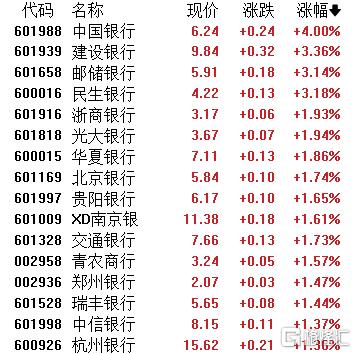
银行ETF指数(512730)涨超1.6%,银行估值仍处于历史偏低水平
Xin Lang Cai Jing· 2025-11-20 03:43
Group 1 - The core viewpoint indicates a strong performance in the banking sector, with the China Securities Bank Index rising by 1.73% and individual stocks like Bank of China and Construction Bank showing significant gains [1] - The banking sector is experiencing a defensive style resurgence, with the total market capitalization of A-shares surpassing 2.25 trillion [1] - Current credit growth is slowing down, and social financing growth is also retreating from high levels, although policies are in place to support demand recovery [1] Group 2 - The banking sector's retail risk has increased but remains manageable, supported by substantial provisioning and stable dividend policies [1] - The advantages of banks in areas such as gold markets, wealth management, and investment banking contribute to differentiated valuations within the sector [1] - The valuation of banks is still at historically low levels, and there is potential for medium to long-term capital allocation, making increased investment in the banking sector a favorable choice [1] Group 3 - The Bank ETF Index closely tracks the China Securities Bank Index and serves as an analytical tool for investors [2] - As of October 31, 2025, the top ten weighted stocks in the China Securities Bank Index account for 64.87% of the index, highlighting the concentration of investment in major banks [2]




非银化增长,波动率加大
KAIYUAN SECURITIES· 2025-11-19 06:38
Investment Rating - Investment rating: Positive (maintained) [1] Core Views - The current credit growth continues to slow down, and social financing growth is also declining from high levels. Although policies are in place to support the market, their impact on demand recovery has not yet been reflected due to time lags. The retail risk for listed banks has increased but remains manageable, supported by substantial provisioning and stable dividend policies, which together form a "stable anchor" for the "dividend revaluation" logic of banks. The banks' advantages in capital markets, wealth management, and investment banking create a "growth sail" for differentiated valuations. Bank valuations are still at historically low levels, and medium to long-term funds have the potential for allocation, making increased allocation to the banking sector a favorable choice under the "high cut low" and balanced allocation strategy. It is recommended to invest in state-owned banks as they still offer good value compared to risk-free interest rates. Specific recommendations include CITIC Bank, benefiting from China Construction Bank, Agricultural Bank of China, China Merchants Bank, Jiangsu Bank, Chongqing Bank, Hangzhou Bank, and Chongqing Rural Commercial Bank [7]. Summary by Sections Deposit and Loan Growth - The deposit and loan growth rates for small and medium-sized banks continued to recover, with the national large banks' deposit-loan growth rate difference at -1.31% at the end of October, a decrease of 0.33 percentage points from the end of September. The four major banks' deposit-loan growth rate difference narrowed by 0.02 percentage points to -2.10%. Small and medium-sized banks recorded a deposit-loan growth rate difference of 3.74%, an increase of 0.08 percentage points [3][4]. Deposit Structure - In October, both large and small banks saw an acceleration in deposit growth, with large banks and small banks' deposit growth rates at 7.40% and 9.33%, respectively, increasing by 0.16 and 0.22 percentage points month-on-month. However, corporate deposits faced pressure, with both large and small banks experiencing negative growth in corporate deposits for the month. The increase in deposits was primarily driven by non-bank contributions, indicating a trend of "deposit migration" [4][5]. Credit Demand and Supply - The overall credit volume and structure remain poor, with small and medium-sized banks increasing lending. The total loans from deposit-taking financial institutions to residents and enterprises saw a year-on-year decrease. The credit growth is under pressure due to unfulfilled demand and other factors, including banks completing most of their annual credit targets in the first three quarters and a lack of actual credit demand conversion from policy measures [6]. Investment Recommendations - Given the current environment, increasing allocation to the banking sector is recommended as it presents a favorable opportunity for investors. The report emphasizes the potential of state-owned banks and suggests specific banks for investment based on their performance and market conditions [7].

行业点评报告:社融延续降速,存款“搬家”部分流向理财
KAIYUAN SECURITIES· 2025-11-14 09:43
Investment Rating - The industry investment rating is "Positive" (maintained) [1] Core Viewpoints - The report highlights a continued slowdown in social financing and a shift of deposits towards wealth management products, indicating a need for observation regarding the recovery of resident confidence and corporate operational activity [5][6] - The report notes that the credit growth is slowing down, with new RMB loans added in October amounting to 220 billion yuan, a year-on-year decrease of 280 billion yuan, reflecting seasonal demand factors and constraints on credit expansion [3][4] - Government bonds remain the main contributor to social financing growth, with new government bonds issued in October at 489.3 billion yuan, marking the lowest monthly level for the year [4] Summary by Sections Credit Market Analysis - In October, the new RMB loans were 220 billion yuan, with a year-on-year decrease of 280 billion yuan, and the balance growth rate was 6.5%, down 0.1 percentage points from September [3] - The report indicates that corporate loans increased by 220 billion yuan year-on-year, primarily supported by a 331.2 billion yuan increase in bills, while residential borrowing intentions decreased [3][4] Social Financing Trends - In October, social financing increased by 815 billion yuan, a year-on-year decrease of 597 billion yuan, with a stock growth rate of 8.5%, down 0.2 percentage points from September [4] - The report emphasizes that while social financing growth has been declining since July, the overall downward trend has been limited, with government bonds continuing to play a significant role [4] Deposit and Liquidity Dynamics - The M2 money supply grew by 8.2% year-on-year, while M1 grew by 6.2%, indicating a shift towards demand deposits [5] - There is a notable trend of deposits moving from residents to non-bank financial institutions, with a significant increase of 770 billion yuan in non-bank deposits, suggesting a migration of funds towards wealth management products [5][6] Investment Recommendations - The report suggests that despite the ongoing slowdown in credit growth and social financing, the retail risk for listed banks remains manageable, supported by robust provisioning and stable dividend policies [6] - It recommends increasing allocations to the banking sector, particularly state-owned banks, which are seen as offering value relative to risk-free rates, highlighting specific banks such as CITIC Bank and others as beneficiaries [6]
晨会纪要:开源晨会 1107-20251107
KAIYUAN SECURITIES· 2025-11-07 00:50
Group 1: Market Overview - The performance of the CSI 300 and ChiNext indices over the past year shows significant fluctuations, with a notable increase in the last few months [1] - The top five industries by yesterday's performance include non-ferrous metals, electronics, communications, basic chemicals, and automobiles, with gains ranging from 1.784% to 3.051% [1][2] Group 2: Fund Management Insights - In October 2025, the performance of industry rotation-type fund advisory products was relatively strong, with stock-type advisory products outperforming mixed equity funds [5] - The average returns for different types of fund advisory products in October were 0.31% for pure bond, 0.41% for fixed income+, 0.01% for mixed equity, and -0.90% for stock-type products [5][6] - Fund advisory products showed a shift in asset allocation, with an increase in exposure to non-bank financials and non-ferrous metals, while reducing exposure to the pharmaceutical and biological sectors [7] Group 3: Banking Sector Analysis - The banking sector is characterized by a low interest rate environment and a focus on stable high-dividend assets, highlighting the scarcity of such investments [12] - The investment strategy emphasizes buying high-dividend, defensive stocks while also considering the growth potential and long-term value of banks [12][16] - Recommendations include a three-tiered approach: large state-owned banks for core holdings, banks with strong wealth management capabilities for core configurations, and high-growth regional banks for flexible allocations [16] Group 4: Non-Bank Financials - The Hong Kong Stock Exchange reported a significant increase in revenue and profit for the first three quarters of 2025, with total revenue reaching HKD 218.5 billion, a year-on-year increase of 37% [18] - The trading and settlement fees, which are directly linked to ADT, saw substantial growth, indicating a robust performance in the trading sector [19] - The outlook for the Hong Kong Stock Exchange remains positive, with expectations of continued growth driven by the return of quality assets and sustained inflows from southbound capital [18][19] Group 5: Retail Sector Insights - The baby products retailer reported steady growth in its main business, with revenue for the first three quarters of 2025 reaching CNY 2.725 billion, a year-on-year increase of 10.4% [23] - The company is expanding its store network and enhancing its product offerings through partnerships, which are expected to drive future growth [25] - The jewelry retailer experienced a decline in revenue but improved profitability due to adjustments in product and channel strategies, focusing on enhancing operational quality [28][29] Group 6: Supermarket Sector - The supermarket chain faced significant revenue decline in the first three quarters of 2025, with total revenue of CNY 42.434 billion, down 22.2% year-on-year [32] - The company is undergoing a transformation towards quality retail, with ongoing supply chain reforms and store optimization efforts [32][34] - Despite short-term challenges, the long-term outlook remains optimistic as the company aims to improve operational efficiency and adapt to changing consumer habits [32][34]



银行行业2026年度投资策略:“稳健锚”与“增长帆”,从红利重估到能力定价
KAIYUAN SECURITIES· 2025-11-05 15:17
Core Views - The report emphasizes the importance of stable high-dividend assets in a low-interest-rate environment, highlighting the scarcity of such assets as a key investment opportunity [4][12] - It discusses the regulatory cycle and the reduction of potential credit risks through local debt resolution, reinforcing the concept of a "stable anchor" for banks [4][15] - The economic transformation from land credit to technology and consumption-driven growth is seen as providing a "growth sail" for banks, particularly in corporate deepening and wealth management [4][18] Policy Background and Investment Context - The low interest rate environment and asset scarcity highlight the attractiveness of stable high-dividend assets, with bank stocks favored for their strong performance stability and high dividend yields [4][12] - The ongoing resolution of local government debt is expected to reduce systemic credit risks, thereby solidifying banks' "stable anchor" [4][15] - The shift towards technology and consumption is anticipated to enhance banks' growth potential, particularly in wealth management and corporate services [4][18] Deep Revaluation of "Stable Anchor" - Bottom Line of Value - The report identifies the stability of earnings, attractiveness of dividends, and sustainability of payouts as key components of dividend value [5] - It notes that the expansion of bank balance sheets and the potential recovery of net interest margins are crucial for long-term value [5] - Enhanced investment capabilities in financial markets and asset circulation are highlighted as factors contributing to banks' stability [5] "Growth Sail" Capability Breakthrough - Elasticity of Value - The report emphasizes the importance of stable and high risk-adjusted return on capital (RAROC) for banks, which reflects their efficiency in capital usage [6] - It points out the advantages of wealth attributes and customer base, as well as strong non-performing asset management capabilities [6] - The ability to adjust and manage financial market investments effectively is seen as a significant strength for banks [6] Medium to Long-term Incremental Capital Drivers - Good Wind with Favorable Conditions - The report suggests a potential trend shift in insurance capital allocation towards bank equities, with a target dividend yield of 3.5%-4% seen as a reasonable baseline [7] - It notes that actively managed equity funds are currently underweight in bank stocks, while asset management companies (AMCs) are accelerating their investments in this sector [7] Investment Recommendations: Hold "Stable Anchor" and Raise "Growth Sail" - The report recommends a foundational allocation in large state-owned banks, with H-shares offering better value than A-shares, particularly for Agricultural Bank and Industrial and Commercial Bank [8] - Core allocations should focus on banks that combine stability with strong wealth management capabilities, such as China Merchants Bank and CITIC Bank [8] - For flexible allocations, it suggests high-quality regional banks with unique characteristics in specific areas or business lines, such as Jiangsu Bank and Chongqing Bank [8] Dividend Value Analysis - The report indicates that the operating income of listed banks grew by 0.91% year-on-year in the first three quarters of 2025, with net profit growth of 1.48% [28] - It highlights the significant performance differentiation among banks, with state-owned banks showing stable revenue growth while smaller banks face challenges [28][30] - The report notes that the dividend sustainability of banks is influenced by profitability, dividend policies, and capital considerations, with larger banks maintaining a more stable dividend distribution [41][43]
