Intel

Search documents
When Will Intel Reinstate Its Dividend?
The Motley Fool· 2025-06-19 10:28
Core Insights - Intel has significantly reduced its dividend in 2023 and completely suspended it in 2024 due to ongoing financial struggles and poor performance [1][2] - The company is undergoing a leadership change and cost-cutting measures, but a return of the dividend is not expected in the near future [2][14] Financial Performance - Intel has invested heavily in new manufacturing facilities and technologies to regain its competitive edge against TSMC, which has led to a cash-intensive process with minimal initial revenue from its foundry business [4] - The client computing business has suffered from a downturn in PC demand and competition from AMD, while the data center segment has also faced challenges due to strong competition and a shift towards AI spending [5] - As of the first quarter of 2025, Intel had approximately $21 billion in cash and short-term investments but over $50 billion in debt, which has been increasing for the past 15 years [6][8] Profitability and Cash Flow - The products business remains profitable, generating an operating income of $2.9 billion on $11.7 billion in revenue in the first quarter [9] - The foundry business, however, reported an operating loss of $2.3 billion with less than $1 billion in revenue, contributing to a total operating loss of $301 million for the quarter [10] - Capital expenditures have significantly outpaced depreciation, leading to an adjusted free-cash-flow loss of approximately $3.7 billion in the first quarter [11] Strategic Moves - Intel is divesting non-core businesses and has reduced its gross capital spending target for 2025 by $2 billion to $18 billion, which may help improve its financial situation [12] - Under new CEO Lip-Bu Tan, the company is focusing on cost reduction, management restructuring, and enhancing engineering capabilities to attract major foundry customers [13] Future Outlook - A potential turnaround for Intel could begin to take shape in 2026, but the dividend is unlikely to return until the company stabilizes and grows its CPU market share and external foundry revenue [14][15] - Improving the balance sheet and reducing debt will be prioritized before any consideration of restarting dividend payments [15]


摩根士丹利:台积电-2026 年亚太地区晶圆价格将会上涨,同时强劲的人工智能需求可能抵消外汇波动的影响,维持 “增持(OW)” 评级。
摩根· 2025-06-19 09:46
Investment Rating - The report rates TSMC as a "Top Pick" with an "Overweight" rating [4][67]. Core Insights - TSMC is expected to increase global wafer prices by 3-5% on average in 2026, driven by strong AI demand, which may offset the negative impact of foreign exchange fluctuations [1][32]. - The stock has risen 31% over the past three months, but concerns remain regarding its underperformance compared to NVIDIA, which has increased by 53% in the same period [1][23]. - The report anticipates a 20% year-over-year revenue growth in 2026, with capital expenditures remaining flat at US$40 billion [2][50]. Summary by Sections Investment Outlook - TSMC's price target remains NT$1,288, indicating a 25% upside from the current price of NT$1,030 [4][67]. - The expected EPS for 2026 is NT$64.61, with a P/E ratio projected at 15.9 [4][67]. Financial Performance - TSMC's gross margin is expected to be between 55-56% in 2025 due to the impact of TWD appreciation, which affects margins by 40 basis points for every 1% change [2][25]. - The report revises the EPS estimates for 2025 and 2026 down by 6% and 12%, respectively, due to foreign exchange impacts [2][28]. Market Dynamics - The demand for TSMC's 2nm node is projected to be strong, with capacity expected to reach 90kwpm by the end of 2026 [53][59]. - AI revenue is anticipated to grow at a mid-40% CAGR, contributing approximately 34% of TSMC's total revenue by 2027 [41][50]. Strategic Developments - TSMC is expected to benefit from Intel's outsourcing of CPU production, which could account for 33% of Intel's COGS by 2025 [64][66]. - The company is also positioned to capture demand from the Chinese AI market, contingent on regulatory approvals for shipping AI GPUs [41][50].
2 Artificial Intelligence (AI) Stocks Built for Long-Term Wealth, Buffett Style
The Motley Fool· 2025-06-19 08:35
Core Viewpoint - AI stocks are gaining attention on Wall Street, with rising valuations, but there are still undervalued opportunities in the tech sector, particularly in companies that align with value investing principles [1][2]. Group 1: Alphabet - Alphabet is a leader in AI, having prioritized it for over eight years and made significant advancements, including the acquisition of DeepMind and the launch of Google Gemini [4][5]. - The stock is currently trading at a price-to-earnings ratio of 20, which is over 20% lower than the S&P 500, indicating an attractive valuation [5]. - Despite regulatory pressures and competition from generative AI chatbots, Alphabet has maintained steady growth, with Google Cloud becoming profitable and overall competitive advantages intact [6][9]. Group 2: TSMC - Taiwan Semiconductor Manufacturing Company (TSMC) is the largest semiconductor manufacturer globally, producing chips for major companies like Apple and Nvidia, and holds over 50% of the third-party chip production market [10][11]. - TSMC has experienced significant growth, with Q1 revenue increasing by 35.3% year-over-year to $25.5 billion and net income rising 60% to $10.9 billion, showcasing its strong pricing power with an operating margin of 48.5% [12]. - The stock trades at a price-to-earnings ratio of 25.6, which is in line with the S&P 500, and TSMC is well-positioned for long-term growth due to its technological strength and diversification efforts [12][13].



Intel set to lay off around 10,000 workers — despite getting $2.2B in CHIPS Act funds under Biden
New York Post· 2025-06-18 17:20
Core Viewpoint - Intel is preparing to lay off up to 20% of its global workforce, approximately 10,000 employees, despite receiving over $2 billion in federal funding under the CHIPS Act [1][4]. Group 1: Layoff Details - The layoffs are expected to begin in the coming weeks and will primarily affect Intel Foundry, the division responsible for manufacturing semiconductors for external customers [2][4]. - The company had previously announced a reduction of 15,000 jobs across its global operations last year, coinciding with the receipt of CHIPS Act funds [4]. - The layoffs will not involve voluntary buyouts; decisions will be based on performance evaluations and operational needs [7][8]. Group 2: Financial Context - Intel has faced declining demand for PCs and servers, as well as challenges in developing high-end chips for artificial intelligence applications [4]. - The company’s stock has decreased nearly 30% over the past year, trading around $21.50 [4]. - Intel received $7.9 billion in federal subsidies last year to support U.S.-based semiconductor manufacturing, with $2.2 billion frozen pending a review by the Trump administration [3]. Group 3: Operational Impact - The factory workforce in Oregon, where Intel is the largest private employer with 20,000 workers, may be particularly affected by the layoffs [10][12]. - Intel operates major manufacturing facilities in several locations, including Arizona, New Mexico, Israel, Ireland, and Malaysia [15]. - The company has postponed the opening of its $10 billion factory in Ohio until 2030 due to insufficient demand [4].
Intel Stock's Make-Or-Break Catalyst Approaches
Seeking Alpha· 2025-06-18 11:05
Core Viewpoint - Intel Corporation has faced challenges such as an uncertain product timeline, governance issues, and potential layoffs, which have made investors cautious despite a generally positive market sentiment. However, the company's valuation remains attractive [1]. Company Summary - Intel's recent performance has been stagnant, with various internal and external factors contributing to investor wariness [1]. - The company is navigating through governance upheaval and is preparing for potential layoffs, which adds to the uncertainty surrounding its future [1]. - Despite these challenges, Intel's valuation is considered appealing, indicating potential investment opportunities [1].
Making Intel Great Against AMD: Don't Fear The Latter's Share Gain
Seeking Alpha· 2025-06-17 16:12
Don’t just invest—dominate with Tech Contrarians' realized return on closed positions of 65.8% since inception. You’ll get exclusive insights into high-focus stocks, curated watchlists, one-on-one portfolio consultations, and everything from live portfolio tracking to earnings updates on 50+ companies. Subscribe today for 20% off.Markets are rallying this week after taking a sharp hit Friday on trouble in the Middle East between Israel and Iran that sent oil up and semis down for the day. The top performer ...
Is Intel Stock a Buy or Sell?
The Motley Fool· 2025-06-17 09:50
Core Viewpoint - Intel is facing significant challenges in its core CPU markets due to market-share losses, missed opportunities in AI, and costly investments in becoming a foundry, yet it remains a potential long-term buy for patient investors [1]. Market Position and Competition - Intel's market dominance has declined, with its desktop CPU market share dropping below 80% and server CPU market share around 75% as of mid-2024, largely due to competition from AMD [4]. - In 2017, Intel held nearly 90% of the desktop CPU market and over 98% of the server CPU market, showcasing its previous stronghold [3]. Financial Performance - Intel's annual revenue has decreased from over $75 billion to approximately $53 billion, with profits disappearing [6]. Strategic Changes - Under new CEO Lip-Bu Tan, Intel plans to reduce costs through layoffs and streamline its organization by eliminating middle management to refocus on engineering [8][9]. - The company aims to adapt its foundry business to attract external customers, which is crucial for recouping its substantial manufacturing investments [9]. Technological Advancements - The completion of the Intel 18A manufacturing process, set for volume production, promises significant performance and efficiency improvements, potentially giving Intel a competitive edge with its upcoming Panther Lake PC chips [10][11]. - The 18A process has already attracted some external customers, but more are needed to validate Intel's manufacturing capabilities [11]. Valuation and Investment Potential - Intel's stock is currently valued at around 0.9 times book value, indicating it is trading below its net asset value, which is at a multidecade low [12]. - Despite the challenges, Intel's low valuation and new leadership focused on necessary changes could lead to market-beating gains if the turnaround shows progress [14].
Intel to cut manufacturing jobs in July as CEO Tan reshapes strategy
Proactiveinvestors NA· 2025-06-16 14:23
About this content About Angela Harmantas Angela Harmantas is an Editor at Proactive. She has over 15 years of experience covering the equity markets in North America, with a particular focus on junior resource stocks. Angela has reported from numerous countries around the world, including Canada, the US, Australia, Brazil, Ghana, and South Africa for leading trade publications. Previously, she worked in investor relations and led the foreign direct investment program in Canada for the Swedish government ...
Intel's Price Spikes: Noise, or the First Notes of a Turnaround?
MarketBeat· 2025-06-13 13:06
Core Viewpoint - Intel is experiencing significant stock volatility, reflecting a divided investor sentiment amid signs of strategic turnaround and ongoing competition concerns [1][2]. Group 1: Strategic Developments - Intel has secured a commitment from Microsoft to utilize its advanced 18A manufacturing process for future chips, validating its ambitions in the foundry space [2][3]. - The new Xeon 6 processors have been selected to power a supercomputer at Imperial College London, showcasing their competitiveness in scientific and AI research [4]. - Intel has expanded its ecosystem by including Draper in its Chiplet Alliance, enhancing its position in the U.S. government and aerospace sectors [5]. Group 2: Financial Focus - Intel is emphasizing financial discipline, aiming for future products to achieve gross margins above 50% before production [7][8]. - The company is implementing aggressive cost-cutting measures, targeting non-GAAP operating expenses of approximately $17 billion in 2025 and $16 billion in 2026 [9]. - This dual focus on higher-margin products and cost reduction aims to improve earnings per share (EPS) [9]. Group 3: Competitive Landscape and Risks - Intel faces fierce competition from AMD and Nvidia in the data center and AI markets, alongside execution risks related to manufacturing expansion [10]. - The end of support for Intel-based Macs by Apple marks a significant shift, emphasizing the need for Intel to succeed in its new strategic direction [11]. - Analysts maintain a cautious stance, reflected in a consensus Reduce rating, as they monitor Intel's ability to navigate these challenges [11][12]. Group 4: Market Sentiment and Future Outlook - Despite current headwinds, Intel's scale and IDM 2.0 strategy are seen as counterweights to competitive threats, supported by CHIPS Act funding [12][14]. - The recent volatility in Intel's stock may indicate the early stages of a turnaround, with upcoming catalysts such as volume manufacturing on the 18A process anticipated in 2025 [18]. - The current dividend yield of approximately 2.4% offers a modest return for long-term investors willing to wait for the company's strategy to fully materialize [19].
Intel XEON 6 Gaining Solid Market Traction: Will the Uptrend Persist?
ZACKS· 2025-06-12 16:30
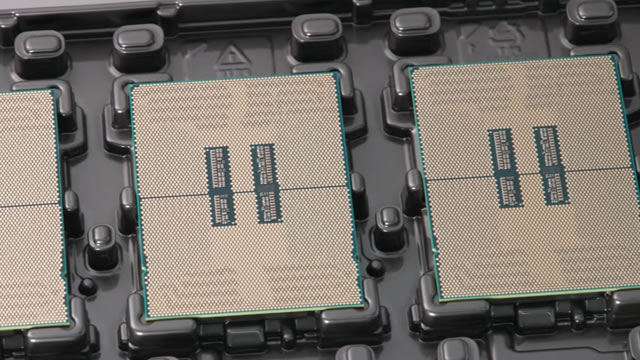
Core Insights - Intel Corporation (INTC) is experiencing strong demand for its Xeon 6 processors, particularly in high-performance computing (HPC) and AI workloads, driven by the need for advanced processing capabilities across various sectors [1][9] - The Xeon 6 processors feature Performance-cores and built-in accelerators that enhance performance for AI, media, and network security applications, aligning with the increasing demand for network and edge solutions in the AI ecosystem [1][2] - Intel's competitive edge is bolstered by the integration of Priority Core Turbo (PCT) technology and Intel Speed Select Technology – Turbo Frequency (SST-TF), which optimizes CPU resource utilization for demanding AI workloads [2][4] Performance Comparison - The Xeon 6 processors demonstrate significantly faster memory performance in high-capacity configurations compared to AMD's EPYC processors, with up to 128 P-cores per CPU facilitating balanced workload distribution for AI tasks [3][4] - Despite Intel's advancements, AMD's EPYC 9005 series is gaining traction, supported by partnerships with major hyperscalers like Oracle Cloud Infrastructure and Google Cloud [5][9] Strategic Initiatives - Intel is actively pursuing initiatives to strengthen its position in the AI sector, which encompasses cloud and enterprise servers, networks, and edge environments, through the introduction of innovative features in its Xeon 6 processors [6][9] - The Xeon 6 has been selected as the host CPU for NVIDIA's DGX B300 AI-accelerated systems and is powering Imperial College London's HX2 supercomputer, enhancing Intel's credibility in AI applications [7][9] Market Performance and Estimates - Intel's stock has declined by 32.4% over the past year, contrasting with the industry's growth of 7.3% [8][10] - Earnings estimates for Intel for 2025 and 2026 have decreased by 40.8% to $0.29 per share and by 31.2% to $0.77, respectively, over the past year [11][12] - The company's shares currently trade at a price/book ratio of 0.85, lower than the industry average of 31.35, indicating potential undervaluation [10]