芯朋微

Search documents
芯朋微(688508.SH):股东张立新共减持31.21万股公司股份
Ge Long Hui A P P· 2025-09-17 12:29
Core Points - Chipone Microelectronics (688508.SH) announced a share reduction by shareholder Zhang Lixin, who sold 312,100 shares from September 15 to September 16, 2025 [1] - Following the transaction, Zhang Lixin's shareholding decreased from 26.12% to 25.88%, marking a change that touches the 1% integer threshold [1]

芯朋微:张立新减持31.21万股 持股降至25.88%
Xin Lang Cai Jing· 2025-09-17 12:05
Core Viewpoint - The controlling shareholder of Chipone Microelectronics, Zhang Lixin, is set to reduce his shareholding through a centralized bidding process, impacting the overall ownership structure of the company [1] Summary by Relevant Sections - **Shareholding Changes** - Zhang Lixin will reduce his holdings by 312,100 shares, decreasing his ownership percentage from 26.12% to 25.88% [1] - The total number of shares held will drop from 34,301,000 to 33,988,900 [1] - This change in equity triggers a shift that touches upon a 1% integer multiple [1]
芯朋微(688508) - 关于持股5%以上股东减持股份进展暨权益变动触及1%整数倍的提示性公告
2025-09-17 12:03
证券代码:688508 证券简称:芯朋微 公告编号:2025-046 无锡芯朋微电子股份有限公司 3.一致行动人信息 上述信息披露义务人无一致行动人。 关于持股 5%以上股东减持股份进展暨权益变动触及 1%整数倍的提示性公告 股东张立新先生保证向本公司提供的信息真实、准确、完整,没有虚假记载、误 导性陈述或重大遗漏。 本公司董事会及全体董事保证公告内容与信息披露义务人提供的信息一致。 一、 信息披露义务人及其一致行动人的基本信息 1.身份类别 | | 控股股东/实际控制人及其一致行动人 | | --- | --- | | 投资者及其一致行动 | □其他 5%以上大股东及其一致行动人 | | | □合并口径第一大股东及其一致行动人(仅适用于无控 | | 人的身份 | | | | 股股东、实际控制人) | | | □其他______________ | 2.信息披露义务人信息 | 信息披露义务人名称 | | 投资者身份 | 统一社会信用代码 | | | --- | --- | --- | --- | --- | | | 控股股东/实控人 | | | 不适用 | | | □ | 控股股东/实控人的一致 | ...
目前家电国产芯片的占比整体已达70~80%
Di Yi Cai Jing· 2025-09-17 01:13
9月16日,第一财经记者从家电芯片代理商、分析师和专家处获悉,目前家电用的模拟芯片的国产化率 已较高。据产业在线的统计数据,截至2024年底,中国家电模拟芯片的国产化率已达65%。 据西安理工大学可靠性研究院创院院长陈建民介绍,家电芯片涵盖数字芯片、模拟芯片和功率半导体器 件。数字芯片包括MCU(微控制单元)、EEPROM(带电可擦可编程只读存储器)等;模拟芯片包括 运算放大器芯片、比较器芯片、电源芯片等;功率半导体器件包括IPM、IGBT、FRD等。目前家电国 产芯片的占比整体已达70~80%,模拟芯片的国产化率约为90%,功率半导体器件的国产化率已超 70%。 产业在线芯片分析师欧阳怀表示,近年在家电业,芯朋微、晶丰明源、圣邦股份、必易微、士兰微等的 模拟芯片加快国产替代进程。它们的AC-DC(交流-直流)、DC-DC(直流-直流)电源管理芯片,主要 用于节能的变频家电,市场份额已达65%,一颗芯片的价格约0.1~0.3元,一般比进口同类芯片便宜 15%~20%,性能差异不大。目前PI(美国电源管理技术公司)的份额超过10%。 "国内家电企业均在做芯片纯国产方案,反倾销调查预计将会加快家电用芯片的国产化进 ...
国产模拟芯片提速,“家电领域占65%”
第一财经· 2025-09-17 01:02
2025.09. 17 本文字数:1197,阅读时长大约2分钟 作者 | 第一财经 王珍 9月16日,第一财经记者从家电芯片代理商、分析师和专家处获悉,目前家电用的模拟芯片的国产化 率已较高。据产业在线的统计数据,截至2024年底,中国家电模拟芯片的国产化率已达65%。 产业在线芯片分析师欧阳怀表示,近年在家电业,芯朋微、晶丰明源、圣邦股份、必易微、士兰微等 的模拟芯片加快国产替代进程。它们的AC-DC(交流-直流)、DC-DC(直流-直流)电源管理芯 片,主要用于节能的变频家电,市场份额已达65%,一颗芯片的价格约0.1~0.3元,一般比进口同类 芯片便宜15%~20%,性能差异不大。目前PI(美国电源管理技术公司)的份额超过10%。 一位家电芯片代理商亦透露,国产芯片基本可以满足普通家电产品的需求,主流家电企业都已做好芯 片国产化的备份方案。空调、冰箱、洗衣机等大家电的外机变频板要用模拟芯片,目前国产模拟芯片 占比不低于60%。小家电都用国产芯片。运算放大器芯片、电源类芯片,圣邦微、华润微、思瑞 浦、坤元微、芯朋微、必易微等都可以供应,仍有少量进口。"国产芯片的价格更优,性能可以满足 要求。技术的先进性方 ...


国产模拟芯片提速,机构称家电领域份额占比已达65%
Di Yi Cai Jing· 2025-09-17 00:39
Core Insights - The domestic production rate of analog chips for home appliances in China is projected to reach 65% by the end of 2024, with the overall domestic chip share in home appliances at 70-80% [4] - The domestic analog chip production rate is approximately 90%, while the power semiconductor devices exceed 70% [4] - Major domestic companies like Chipone Microelectronics, Jingfeng Mingyuan, and others are accelerating the replacement of imported analog chips, capturing a market share of 65% in power management chips [4] Group 1 - The domestic analog chips can meet the needs of ordinary home appliances, with a minimum of 60% share in major appliances like air conditioners and refrigerators [5] - The price of domestic chips is about 0.1-0.3 yuan, which is 15%-20% cheaper than imported counterparts, with similar performance [4][5] - Domestic companies are developing pure domestic chip solutions, and the anti-dumping investigation is expected to accelerate the domestic chip production process [5][6] Group 2 - The anti-dumping investigation aims to deter unfair competition from foreign companies leveraging their technological and market advantages [6] - The final market share of domestic chips will depend on comprehensive factors such as product performance, price, and service [6] - The domestic analog chip industry is expected to undergo a phase of competition, leading to a survival of the fittest scenario [5]




反倾销落地,国产模拟芯片迎转机
Tai Mei Ti A P P· 2025-09-15 11:21
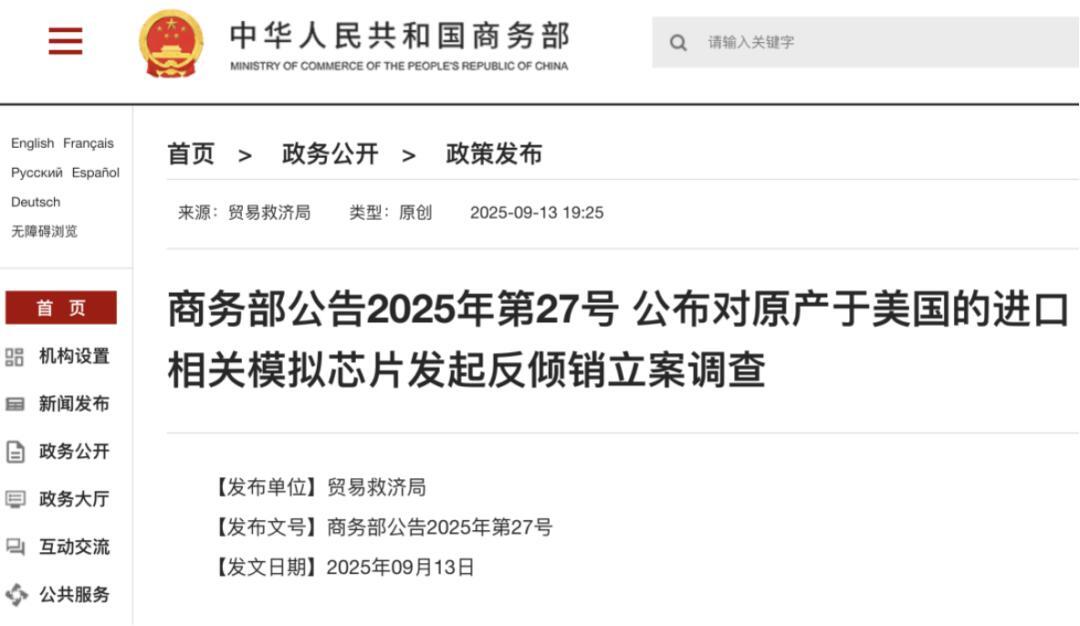
Core Viewpoint - The Chinese Ministry of Commerce has initiated anti-dumping investigations against imported analog chips from the United States, responding to domestic industry applications and aligning with WTO rules. The investigations focus on general interface and gate driver chips, revealing a significant increase in import volume and a drastic decrease in import prices, which have negatively impacted domestic sales prices and operations [1][2][4]. Group 1: Market Overview - The global semiconductor market reached $346 billion in the first half of 2025, marking an 18.9% year-on-year growth, with analog chips growing by 4% [4]. - In the A-share market, the semiconductor industry reported revenues of 321.2 billion yuan and a net profit of nearly 24.5 billion yuan, reflecting a year-on-year growth of approximately 30% [4]. - The demand for analog chips, particularly in mobile fast charging and power management, is significantly increasing, with domestic products rapidly capturing market share [4]. Group 2: Company Performance - Companies like Xilin Micro and Chipone reported substantial revenue growth, with Xilin Micro achieving a 36.83% increase and a 131.25% rise in net profit [6]. - Chipone's revenue grew by 40.32%, with net profit increasing by 106.02%, driven by new product categories and market expansion [7]. - Jiewa Tech reported a 58.2% revenue increase, primarily from power and signal chain chips, with a total revenue of 11.87 billion yuan [7]. Group 3: Profitability and Margins - The analog chip industry's gross margin improved, with the median gross margin rising from 34.72% in Q1 to 35.05% in Q2 of 2025 [11]. - Leading companies like Saimo Micro and Shengbang Co. maintain gross margins above 50%, showcasing their competitive advantage in the market [11]. - Companies such as Naxin Micro and Aiwai Electronics reported significant improvements in gross margins due to high-value product offerings and operational efficiencies [12][13]. Group 4: Inventory Management - The inventory turnover days for most analog chip companies decreased significantly in 2025 compared to 2024, indicating improved inventory management efficiency [16]. - Companies like Jiewa Tech and Xilin Micro saw their inventory turnover days reduced by over 100 days, reflecting enhanced operational performance [16]. Group 5: Mergers and Acquisitions - The anti-dumping investigations have prompted domestic analog chip companies to pursue mergers and acquisitions to enhance their technological capabilities and market presence [17][19]. - Recent acquisitions include Biyimei's purchase of Shanghai Xingan Semiconductor for approximately 295 million yuan and Jingfeng Mingyuan's acquisition of Yichong Technology for 3.283 billion yuan [18][19]. - These strategic moves aim to consolidate resources, fill technological gaps, and improve competitiveness against international giants [19].


芯片大战,再次爆发
水皮More· 2025-09-15 09:26
Core Viewpoint - The article discusses the new round of competition between China and the United States in the semiconductor sector, particularly focusing on the implications of the U.S. adding 23 Chinese companies to its export control entity list, which includes several semiconductor firms [4][5][8]. Semiconductor Industry Impact - Among the 23 companies listed, 13 are related to semiconductors and integrated circuits, including notable firms like Fudan Microelectronics and Shanghai Hualing Integrated Circuit [7]. - The U.S. Department of Commerce's announcement indicates that these semiconductor companies will be unable to access supplies from the overseas industry chain, effectively cutting off their supply [8]. - The article highlights the significance of analog chips, which are crucial for processing continuous signals and are widely used across various sectors, including consumer electronics and automotive [11]. Market Opportunities - The U.S. anti-dumping investigation may create market opportunities for domestic analog chip companies such as Sanan Optoelectronics, Nanjing Semiconductor, and others, as it raises the import costs and barriers for U.S. analog chips [12]. - The article suggests that the current geopolitical climate may allow Chinese companies to gain a competitive edge in the semiconductor market, potentially leading to a more self-sufficient industry in the next decade [12]. Strategic Signals - The ongoing competition signals a broader trend of decoupling in core technology sectors, with China beginning to establish its own market barriers to foster domestic growth [12]. - The article posits that within ten years, China may achieve parity with the U.S. in the semiconductor field, as non-100% self-controlled chips will gradually be replaced by fully autonomous solutions [12]. Upcoming Negotiations - A significant upcoming meeting between Chinese and U.S. officials is scheduled to discuss trade issues, including unilateral tariffs and export controls, indicating ongoing diplomatic efforts despite the competitive landscape [14][16].

电子行业点评:商务部对美产模拟芯片展开反倾销调查事件点评
Ping An Securities· 2025-09-15 04:44
Investment Rating - The industry investment rating is "Outperform the Market" [1][8]. Core Viewpoints - The Ministry of Commerce of China has initiated an anti-dumping investigation against imported simulation chips from the United States, which is expected to reshape a healthier development environment for the industry [4][7]. - The simulation chip sector is experiencing a mild recovery, with a reported revenue of 24.502 billion yuan in the first half of 2025, representing a year-on-year growth of 13.16%, and a net profit of 503 million yuan, up 280.46% [7]. - The global simulation chip market is projected to reach 84 billion USD in 2025, with the Chinese market expected to exceed 350 billion yuan, indicating significant market potential [7]. Summary by Sections Industry Overview - The anti-dumping investigation covers simulation chips produced in the U.S., specifically targeting commodity interface IC chips and gate driver IC chips using 40nm and above process technology [4]. Market Performance - The simulation chip sector's gross margin stands at 35.34%, with a net margin of 1.91%, indicating a gradual recovery, although profits remain below the peak levels seen in 2021 [7]. Domestic Market Potential - The domestic market for simulation chips is anticipated to have a localization rate of approximately 22% in 2025, suggesting substantial room for growth in domestic production [7]. Investment Recommendations - The report suggests focusing on domestic simulation chip companies such as Shengbang Co., SIRUI, Nanchip Technology, and others, as well as core semiconductor manufacturing firms like SMIC and Huahong [7].
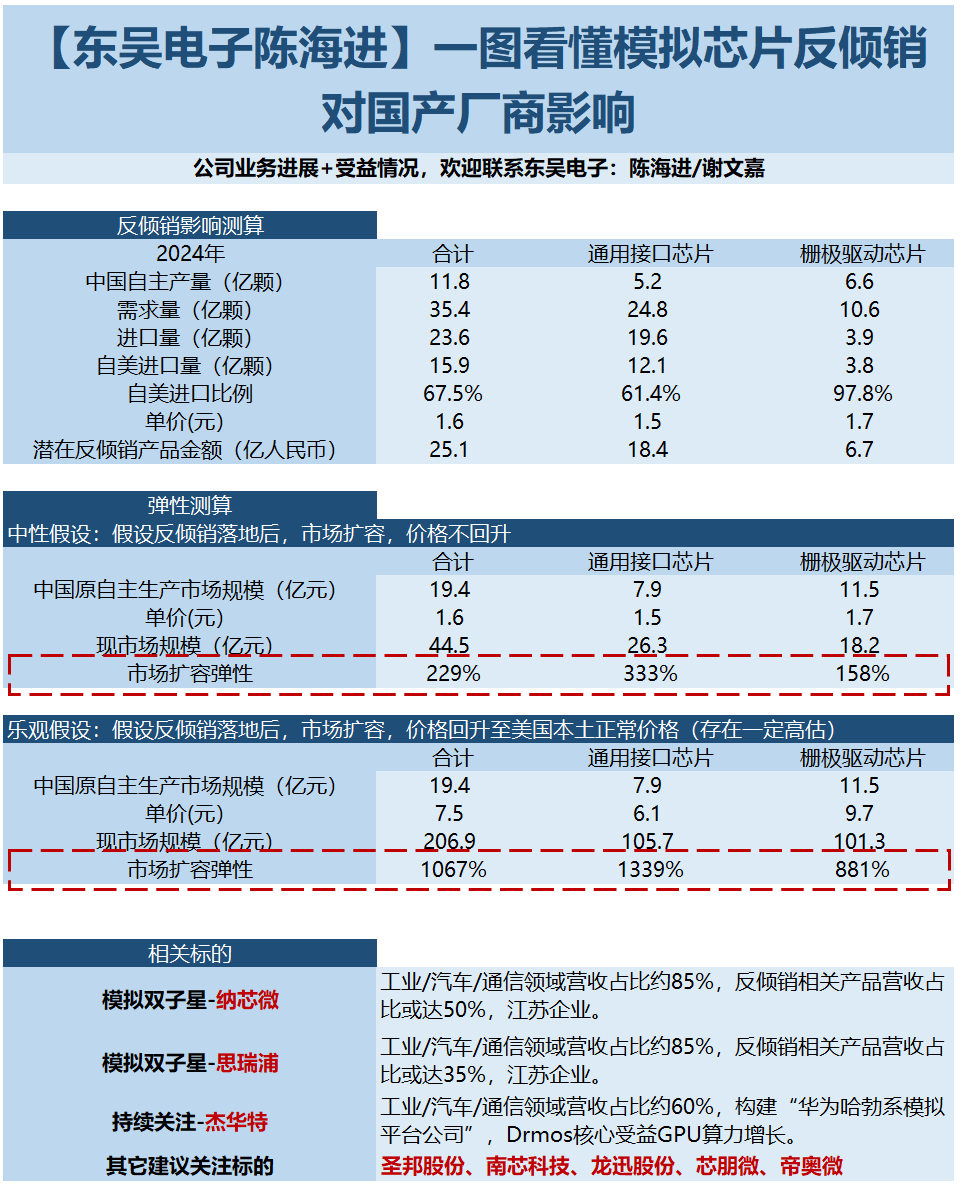
一图看懂模拟芯片反倾销对国产厂商影响
Xuan Gu Bao· 2025-09-15 00:42
Core Viewpoint - The article discusses the potential impact of anti-dumping measures on the Chinese semiconductor market, specifically focusing on general interface chips and gate driver chips, highlighting production, demand, import statistics, and market elasticity under different scenarios [1]. Group 1: Production and Demand - In 2024, China's self-produced quantity of general interface chips is projected to be 520 million units, while gate driver chips are expected to reach 660 million units, totaling 1.18 billion units [1]. - The demand for general interface chips is estimated at 2.48 billion units, and for gate driver chips, it is 1.06 billion units, leading to a total demand of 3.54 billion units [1]. - Imports of chips are expected to be 2.36 billion units, with 1.59 billion units coming from the U.S., representing 67.5% of total imports [1]. Group 2: Pricing and Market Size - The average price for general interface chips is 1.6 yuan, while gate driver chips are priced at 1.7 yuan [1]. - The potential value of products affected by anti-dumping measures is estimated at 2.51 billion yuan, with 1.84 billion yuan for general interface chips and 670 million yuan for gate driver chips [1]. Group 3: Market Elasticity Scenarios - Under a neutral assumption where the anti-dumping measures lead to market expansion without price recovery, the market size for self-produced chips is projected at 1.94 billion yuan, with a market expansion elasticity of 229% for total chips [1]. - In an optimistic scenario where prices recover to U.S. domestic levels, the market size could reach 20.69 billion yuan, with an elasticity of 1067% for total chips [1]. Group 4: Related Companies - Companies such as Naxin Micro and Sirepu are highlighted, with significant revenue from industrial, automotive, and communication sectors, and a substantial portion of their revenue linked to anti-dumping affected products [1]. - Other companies to watch include Shengbang Co., Nanchip Technology, Longxun Co., Chipbond Micro, and Diaomicro, which are also involved in the semiconductor sector [1].