L'Oreal

Search documents
国货离成为“中国欧莱雅”,还差多少个第二品牌?
3 6 Ke· 2025-10-09 01:52
Core Insights - The Chinese beauty industry is experiencing a significant transformation, with many brands exiting the market while others are rapidly launching new sub-brands to adapt to changing consumer demands and market conditions [1][8][24]. Group 1: Industry Trends - The beauty industry is facing a "winter" period, leading to the exit of several brands such as Qiaodi Shanghui and Jing Sheng Zhi Yuan [1]. - Despite the challenges, there is a surge in new brand launches, indicating a robust response from leading companies [1][8]. - Major players like Shangmei Co., Beitaini, and Polaroid are actively developing multiple sub-brands to enhance their market presence [8][24]. Group 2: Company Strategies - Shangmei Co. has launched three new brands this year, including NAN beauty, a high-end anti-aging brand Tazu, and a baby care brand [10][11]. - Beitaini is set to introduce a new acne treatment brand, Ansta, which has been in development for three years [15][16]. - Polaroid is considering overseas acquisitions to fill gaps in its product offerings, targeting markets such as baby care and men's grooming [17][24]. Group 3: Market Positioning - The multi-brand strategy allows companies to cater to diverse consumer needs across different demographics, enhancing their competitive edge [24][29]. - Companies are focusing on leveraging their main brand strengths to create differentiated sub-brands that address specific market segments [27][30]. - The trend of building a multi-brand matrix is becoming standard among leading beauty companies in China, moving away from a single-brand dominance [28][39]. Group 4: Growth Strategies - Companies are employing both internal brand incubation and external acquisitions as primary methods for expanding their brand portfolios [29][33]. - Internal incubation allows companies to innovate and meet emerging consumer demands effectively, while acquisitions provide immediate access to established brands and markets [32][38]. - The balance between these strategies is crucial for sustained growth and market relevance in a competitive landscape [39].


CAC 40 Climbs To Six-month High; Stellantis, WorldLine Post Strong Gains
RTTNews· 2025-10-02 10:55
Group 1: Market Performance - French stocks are experiencing a positive trend, with the benchmark CAC 40 reaching a six-month high at 8,060.52, up 93.57 points or 1.17% [1] - The rise in the CAC 40 is attributed to strong buying in the auto sector and easing concerns about a potential U.S. government shutdown [1] Group 2: Company-Specific Developments - Stellantis shares increased by 7.1% following stronger than expected U.S. sales figures, alleviating concerns over potential tariff impacts on demand [2] - Morgan Stanley noted a turnaround in Stellantis' market share, with U.S. sales momentum strengthening in September [2] - Other companies such as Thales, LVMH, Renault, and Airbus also saw gains ranging from 1.4% to 4.2% [2] - Worldline shares surged by 9.3% after announcing a strategic partnership with YeePay, a Chinese payment provider in the airline and travel sector [3] - Companies like Capgemini, Michelin, Societe Generale, and Accor also reported impressive gains [3] Group 3: Economic Indicators - Euro Area's seasonally adjusted unemployment rate rose to 6.3% in August from a record low of 6.2% in July, indicating a slight increase in unemployment [4]


自然堂获欧莱雅4.4亿元“战略卡位”,家族控股仍超八成
Xin Lang Cai Jing· 2025-10-02 10:15
Core Viewpoint - The Chinese beauty brand Chando, after 24 years of establishment, is making its debut in the Hong Kong capital market, having recently completed a financing round that valued the company at over 7.1 billion yuan [1][2]. Group 1: Company Overview - Chando has received significant investments from L'Oréal's Meiting, which invested 442 million yuan for a 6.67% stake, and Huachuang Capital, which invested 300 million yuan for a 4.20% stake [1][2]. - The company is primarily controlled by the Zheng family, with the four family members holding over 80% of the voting rights prior to the IPO [1][4]. Group 2: Financial Performance - Chando's net profit has shown volatility, with a 117% increase in 2023 to 302 million yuan, followed by a 37.1% decrease in 2024 to 190 million yuan, and a recovery in the first half of 2025 with a net profit of 191 million yuan [5][8]. - The company's revenue heavily relies on its main brand, Chando, which accounted for over 94% of total revenue from 2022 to the first half of 2025 [3][5]. Group 3: Market Position and Strategy - Chando is the third-largest domestic cosmetics group in China by retail sales as of 2024 [4]. - The brand's online sales channel has been increasing, with its revenue share rising from 59.7% in 2022 to 68.8% in the first half of 2025, while offline sales have decreased from 32% to 16.9% [4]. Group 4: Investment and Governance - The entry of strategic investors like L'Oréal is expected to enhance market confidence in Chando, although investors will ultimately focus on the company's fundamentals and growth potential [3][8]. - Concerns exist regarding the governance structure of the family-controlled company, as the concentrated ownership may pose challenges for minority shareholders [8].
自然堂启动赴港IPO!2025年获欧莱雅、加华资本超7亿元投资丨港美股看台·IPO观察
Zheng Quan Shi Bao· 2025-10-01 09:36
Core Viewpoint - The Chinese domestic cosmetics brand, Chando Global Holdings Limited, is set to list on the Hong Kong Stock Exchange, following the successful debut of another domestic brand, Mao Geping, which saw a first-day increase of over 70% and a subsequent fourfold rise from its issue price [1]. Industry Overview - China is the second-largest cosmetics market globally, with a market share of approximately 11.4% of the global cosmetics industry retail sales in 2024. The market size of China's cosmetics industry is projected to grow from RMB 779.4 billion in 2019 to RMB 934.6 billion in 2024, reflecting a compound annual growth rate (CAGR) of 3.7% [2]. - The domestic cosmetics industry is expected to maintain a stable growth trajectory, with an anticipated CAGR of 6.6% from 2024 to 2029, which is about twice the growth rate of the global cosmetics market during the same period [2]. - Factors driving the expansion of domestic cosmetics brands include a deep understanding of local culture, confidence in domestic brands due to the "Guochao" trend, increased investment in research and development, and the growth of online platforms enhancing brand exposure [2]. Company Overview - Chando, established in 2001, has become one of the most recognized brands in China's cosmetics industry, ranking as the second-largest domestic cosmetics brand by retail sales in 2024 [4]. - The company has a diversified brand portfolio that includes five main brands: Chando, Pofuyan, MAYSU, Spring Summer, and 1GB, covering skincare, makeup, personal care, and children's products [6]. - Chando is the first domestic cosmetics company in China to own proprietary rights to yeast ingredients and to conduct space skincare research projects [7]. Financial Performance - Chando's revenue has shown consistent growth, with figures of RMB 42.92 billion, RMB 44.42 billion, RMB 46.01 billion, and RMB 24.48 billion for the years 2022, 2023, 2024, and the first half of 2025, respectively. Net profits for the same periods were RMB 1.39 billion, RMB 3.02 billion, RMB 1.9 billion, and RMB 1.91 billion [8]. - The company has established three major research systems: skin science, raw material science, and product science, enhancing its innovation and product development capabilities [8]. Investment and Strategic Moves - Chando has received over RMB 700 million in investments from global cosmetics giant L'Oréal and well-known institution Cahua Capital prior to its listing [1][14]. - The company plans to strengthen its offline channel presence by opening flagship stores in major shopping centers, with the first store launched in Shenzhen in July 2025, followed by others in Shanghai, Wuhan, and Chongqing [10][12]. - The funds raised from the IPO will primarily be used to enhance direct-to-consumer (DTC) capabilities, improve online and offline sales network synergy, enrich the multi-brand matrix, invest in research and development, and strengthen digital capabilities in membership and supply chain management [14].

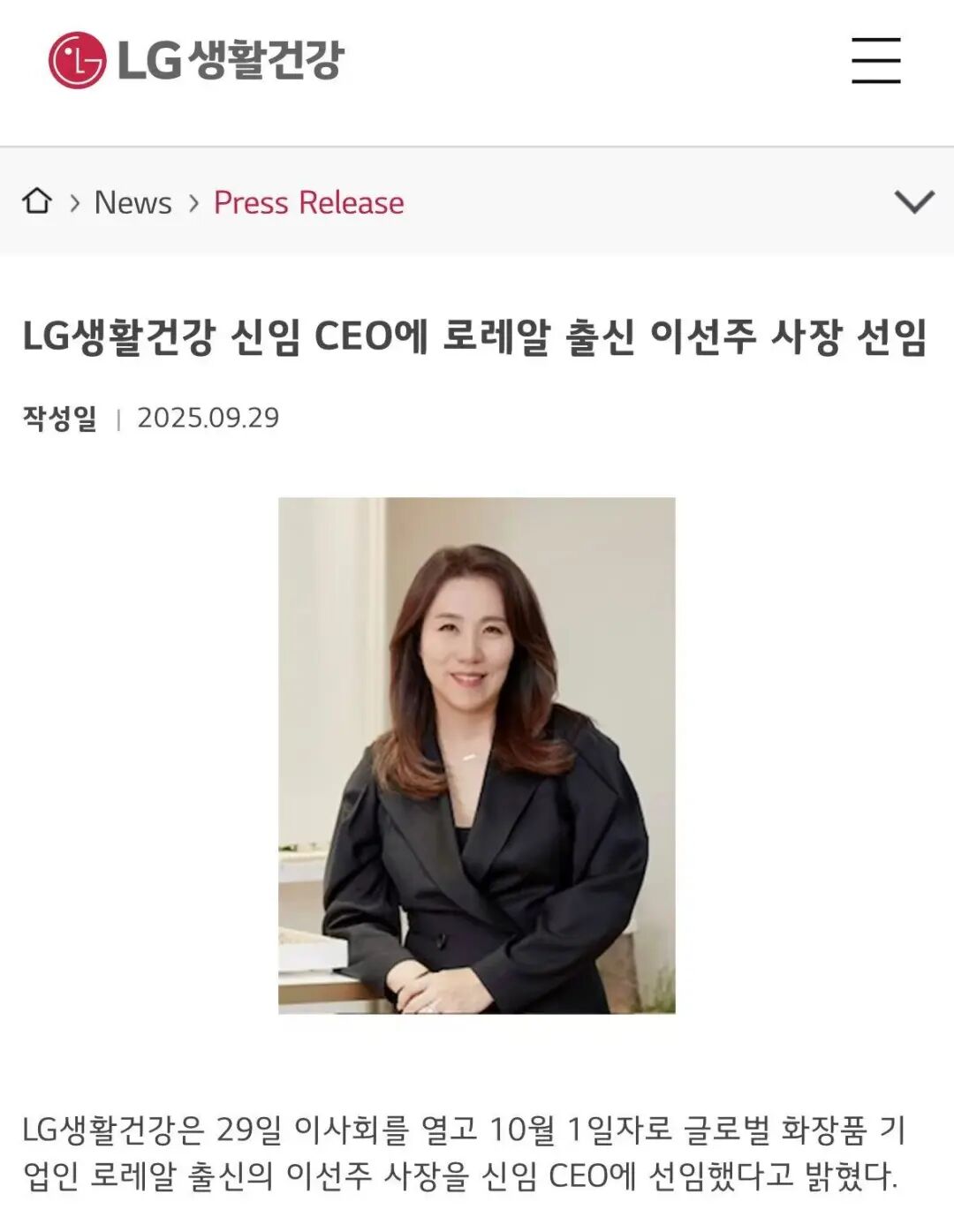
前欧莱雅总裁转投老对手
3 6 Ke· 2025-09-29 23:16
Core Insights - The beauty industry is undergoing significant personnel changes, with executives from L'Oréal being highly sought after by various companies [1] - LG Household & Health Care appointed Lee Sun-joo, former president of L'Oréal Korea, as its new CEO effective October 1 [1][4] - Lee Sun-joo is recognized for her diverse brand marketing and business experience, which LG believes will help elevate its beauty and health sectors [4] Company Background - Lee Sun-joo has nearly 20 years of experience in the beauty industry, having started her career at L'Oréal in 2002 [8] - She held various significant positions at L'Oréal, including managing the Kiehl's brand, which became the second-largest luxury brand for L'Oréal during her tenure [7][8] - Prior to joining LG, she also served in leadership roles at L&P and Unilever, enhancing her credentials in the beauty sector [8] Current Challenges - LG Household & Health Care is facing severe challenges, with its latest financial report indicating a 47.4% drop in operating profit, nearly halving [10][14] - The beauty and cosmetics division has seen an 11.5% revenue decline and a staggering 70% drop in operating profit [10][14] - In contrast, competitors like Amorepacific have reported significant profit increases, highlighting LG's struggles in the market [10][12] Market Performance - LG's revenue in South Korea fell by 8.5% in the first half of 2025, and it was the only major Korean beauty company to experience a decline in the Chinese market, down 6% [10][12] - In North America, LG's performance was also underwhelming compared to competitors, with only a 4.8% growth, while others like APR saw a 236.3% increase [12][14] - The appointment of Lee Sun-joo is seen as a strategic move to address these challenges and revitalize the company's performance [14]
欧莱雅高管洗牌;雅诗兰黛大幅降薪丨二姨看时尚
2 1 Shi Ji Jing Ji Bao Dao· 2025-09-29 11:59
Group 1: Major Corporate Changes - L'Oréal announced significant adjustments to its executive committee, with new appointments set to take effect in January 2026, aiming to enhance its strategic focus in the U.S. market [2] - Estée Lauder is undergoing a substantial salary reduction for its executive team, with a total annual compensation decrease of 28% for FY2025, reflecting a collective compromise amid poor performance and declining stock prices [3] - Burberry's global procurement and marketing director has left the company, indicating challenges in retaining key executives during its transformation strategy [11] Group 2: Market Performance and Reactions - H&M reported better-than-expected Q3 results for FY2025, with net sales increasing by 2% year-on-year, leading to a 10% surge in stock price [6][5] - Brunello Cucinelli's stock plummeted by 15% following allegations of regulatory violations in the Russian market, highlighting the fragility of luxury brand valuations [7] - LVMH continues to expand its media asset portfolio, indicating a strategic move to enhance its influence in the media landscape [9] Group 3: Strategic Developments - Ralph Lauren secured a significant legal victory in China, confirming its "POLO" trademark as a well-known brand, which strengthens its position in the market [4] - LVMH's Kendo has sold its beauty brand KVD Beauty to Windsong Global, marking its first brand sale and a shift in strategy to streamline its offerings [9] - Reports suggest that L'Oréal is primarily interested in retaining only the profitable beauty business of Armani, with a licensing agreement extended until 2050 [13]

欧莱雅巨变
3 6 Ke· 2025-09-26 00:10
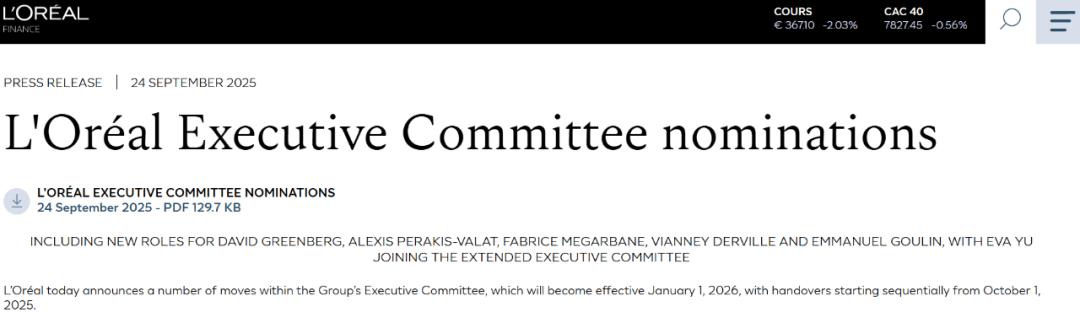
Core Insights - L'Oréal is undergoing significant executive changes aimed at strengthening its leadership in key markets, particularly the U.S. and Asia-Pacific, to sustain business growth and enhance digital transformation [1][3][26] Group 1: Executive Changes - L'Oréal announced multiple personnel changes within its executive committee, effective January 1, 2026, with transitions starting from October 1, 2025 [1][4] - The adjustments involve six key positions, primarily through internal promotions or cross-assignments, affecting regions such as North America, Europe, and Hong Kong [4][15] - David Greenberg has been appointed as the new Chairman of L'Oréal USA, emphasizing the importance of the U.S. market for future growth [7][10] Group 2: Market Focus - The company aims to enhance its leadership in the U.S. market through a dual management structure, with Greenberg collaborating with the CEO of L'Oréal USA [7][10] - L'Oréal is also focusing on expanding its travel retail business in the Asia-Pacific region, with Eva Yu appointed as the new Travel Retail President [19][21] Group 3: Performance Context - L'Oréal's sales for the first half of 2025 reached €22.473 billion (approximately ¥186.46 billion), showing a slight year-on-year increase of 1.6% [22][30] - The North American market, however, has shown slow growth, with a year-on-year increase of only 0.4%, indicating potential challenges in this key region [23][26] Group 4: Industry Trends - The executive reshuffling at L'Oréal reflects a broader trend in the beauty industry, with other major companies like Estée Lauder and Shiseido also announcing significant personnel changes amid ongoing market pressures [30]
欧莱雅又有新的收购目标?
3 6 Ke· 2025-09-25 00:11
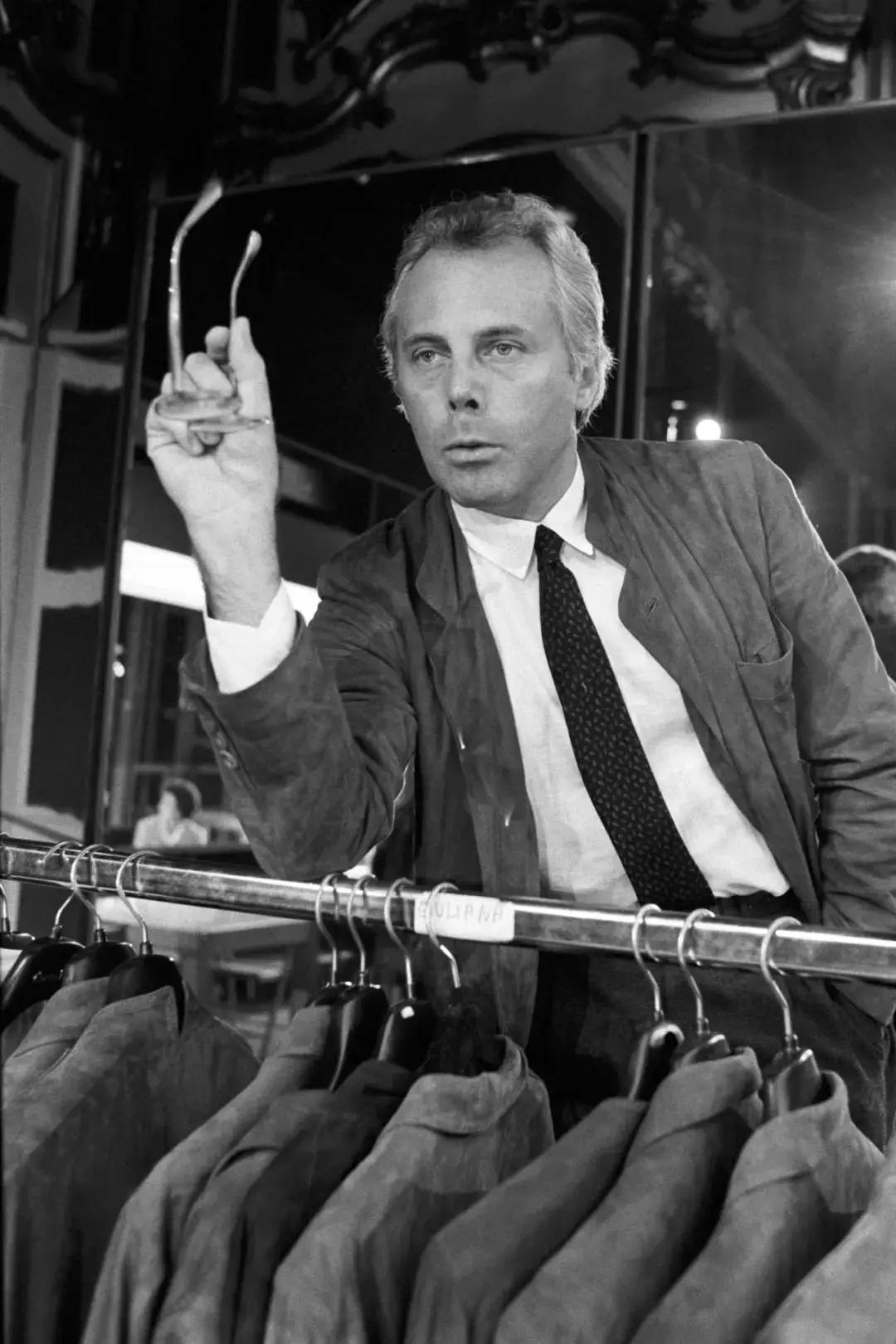
Group 1 - The core point of the news is that L'Oréal is planning to acquire the beauty business of the late Italian designer Giorgio Armani, which includes cosmetics, perfumes, and skincare, but excludes fashion and accessories [1][3][5] - The acquisition plan consists of two steps: initially acquiring a 15% stake as per Armani's will, followed by increasing the stake to a majority ownership [5][6] - L'Oréal has a long-standing partnership with Armani Beauty since 1988, which has allowed them to collaborate on product development and market expansion [6][10] Group 2 - Armani Beauty's revenue surpassed €1 billion (approximately ¥83.75 billion) in 2017, with annual sales of around €1.5 billion (approximately ¥125.59 billion) for its fragrance and beauty products [6][11] - The acquisition could help L'Oréal strengthen its position in the high-end beauty market and enhance its brand portfolio amid slowing growth in its existing brands [10][11] - The acquisition is seen as a win-win situation, as L'Oréal needs established brands for growth, while Armani Beauty faces challenges following the founder's passing [21]
X @Bloomberg
Bloomberg· 2025-09-24 17:28
L’Oreal appointed Alexis Perakis-Valat as chief executive officer of its US and North America business, turning to a company veteran to drive growth in the largest cosmetics market https://t.co/FGvHZuoGy0 ...
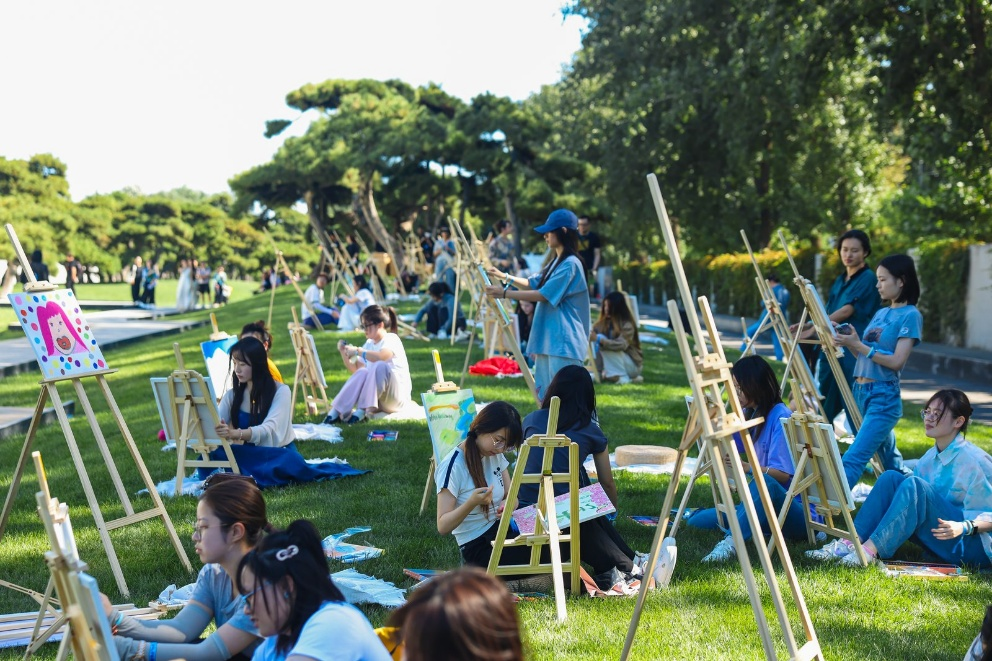
欧莱雅携手松美术馆聚焦青年美育项目
Jing Ji Wang· 2025-09-22 10:37
近日,欧莱雅中国携手松美术馆举办的"美之道・读者与作者" 沉浸式青年美育项目在北京正式启动。 "美之道・读者与作者"活动中由资深艺评人鞠白玉主持,邀请到艺术家张晓刚、策展人崔灿灿、欧莱雅北亚及中国公共事务总裁兰珍珍、读书博 主都靓展开跨界对谈。四位嘉宾从各自的专业领域出发,围绕着"美的启迪""美的升华""美的共生"展开,探讨"美"在绘画、策展、文学与生活中 的多重呈现,以及在全球化与个人身份认同的交汇点,如何找到并表达独特的文化之美。 "美之道沙龙"现场。嘉宾从左至右:资深艺评人鞠白玉、艺术家张晓刚、欧莱雅北亚及中国公共事务总裁兰珍珍、读书博主都靓、策展人崔灿灿 松美术馆执行馆长李克非表示:"松美术馆专注中国当代艺术的传播和美育,和欧莱雅对于'美之道'的系统思考,以及积极连接大众、传播美的 实践是高度契合的。此次与欧莱雅、张晓刚先生的合作,正是一次各方发挥各自优势的绝佳实践。我们期待通过这样的携手,能让更多人走进艺 术、感受美的力量,让美真正融入大众生活,推动美育不断向前。" 欧莱雅相关负责人表示,此次"美之道・读者与作者"沉浸式美育体验,是欧莱雅中国"美之道"系列实践的关键一环。此前,欧莱雅集团已携手中 国 ...