常熟银行

Search documents
密集落地!6家银行,敲定首席合规官!
券商中国· 2026-01-05 04:43
Core Viewpoint - The establishment of Chief Compliance Officer (CCO) positions in Chinese banks has intensified in 2025, driven by regulatory requirements aimed at enhancing compliance management within financial institutions [2][4]. Group 1: Regulatory Background - In March 2025, the Financial Regulatory Administration implemented the "Compliance Management Measures for Financial Institutions," mandating that financial institutions appoint a CCO at their headquarters, who must be a senior management member [2][4]. - The year 2025 serves as a critical transitional period for compliance management, with many banks already appointing CCOs and obtaining regulatory approval for their qualifications [8]. Group 2: Appointment Trends - Several banks, including Jiangyin Bank, Ping An Bank, and Minsheng Bank, have recently appointed CCOs, with many of these positions filled by existing senior executives such as presidents or vice presidents [4][5][6]. - The trend shows that many banks are opting for current executives to take on the CCO role, which may help mitigate internal communication costs associated with having too many specialized positions [4][7]. Group 3: Compliance Management Practices - The unique nature of financial institutions necessitates a higher standard of compliance management compared to general enterprises, emphasizing the need for a robust compliance culture [4]. - The "Compliance Management Measures" also allow for the CCO to concurrently hold other executive roles, which is particularly beneficial for smaller banks [4][8]. Group 4: Recruitment Initiatives - Some regional banks, such as Jiangxi Bank and Shangrao Bank, have actively sought to recruit CCOs, indicating a proactive approach to compliance management [9]. - Recruitment criteria for these positions often prioritize candidates with judicial experience or previous roles in compliance departments of major banks [9].


125股连续5日或5日以上获主力资金净买入
Zheng Quan Shi Bao Wang· 2026-01-05 02:57
Group 1 - The core point of the article highlights that as of December 31, 2025, there are 125 stocks in the Shanghai and Shenzhen markets that have received net buying from main funds for five consecutive days or more [1] - The stock with the longest consecutive net buying days is Tianlong Co., which has seen net buying for 14 consecutive trading days [1] - Other stocks with significant consecutive net buying days include Dongfang Electric, Huaneng Water Power, Jingwang Electronics, Leao Planning, Jiajia Yue, Meike Home, Aohua Endoscope, and Changshu Bank [1]



多行业联合红利资产12月报:股息率年关盘点-20260104
Huachuang Securities· 2026-01-04 06:46
证 券 研 究 报 告 【策略月报】 股息率年关盘点 ——多行业联合红利资产 12 月报 策略研究 策略月报 2026 年 01 月 04 日 华创证券研究所 证券分析师:姚佩 邮箱:yaopei@hcyjs.com 执业编号:S0360522120004 证券分析师:吴一凡 邮箱:wuyifan@hcyjs.com 执业编号:S0360516090002 证券分析师:徐康 电话:021-20572556 邮箱:xukang@hcyjs.com 执业编号:S0360518060005 证券分析师:欧阳予 邮箱:ouyangyu@hcyjs.com 执业编号:S0360520070001 证券分析师:韩星雨 邮箱:hanxingyu@hcyjs.com 执业编号:S0360525050001 证券分析师:单戈 邮箱:shange@hcyjs.com 执业编号:S0360522110001 证券分析师:马野 邮箱:maye@hcyjs.com 执业编号:S0360523040003 相关研究报告 《【华创策略】杠杆&ETF 资金分化趋势逆转—— 流动性&交易拥挤度&投资者温度计周报》 2025-12-01 《【华 ...
银行:银行2026年展望:稳中求进
2025-12-31 16:02
Summary of the Conference Call Transcript Industry Overview - The banking sector is entering a phase of high-quality development, with a focus on absolute and relative returns from bank stocks, driven by high dividend yields and asset quality [3][4][20]. Key Points Financial Performance Projections - Expected revenue growth for listed banks in 2026 and 2027 is +2.5% and +3.6% respectively, with net profit growth of +1.9% and +2.6% [4][20]. - Revenue and profit growth are anticipated to improve due to: 1. Narrowing net interest margin pressure 2. Quality-focused credit issuance amid weak demand [4][20]. 3. Stabilization of fee income growth after several years of fee reductions [4][20]. 4. Stable or improving net non-performing loan generation rates [4][11]. 5. Accelerated supply-side reforms leading to a reduction in the number of bank licenses, improving competition and operational landscape [4][11]. Customer Demand and Market Dynamics - The low-interest-rate environment has shifted customer demand, with government and state-owned enterprises becoming significant contributors to leverage, affecting the structure of new social financing [5][10]. - Regulatory policies are influencing the development of inclusive finance, focusing on risk compensation rather than merely increasing customer numbers [5][10]. Risk Factors - Risks associated with real estate developers and retail sectors are highlighted, with potential for greater-than-expected exposure [6][11]. Profitability and Valuation Adjustments - Adjustments to profitability forecasts for 2025 and 2026 have been made, with a focus on net interest income recovery and fee income growth [20][21]. - The expected net interest margin for 2026 is projected to be approximately 1.34%, a decrease of 6 basis points from 2025 [21][22]. - Fee income is expected to grow by 3.6% and 4.9% in 2026 and 2027 respectively, indicating a positive trend in non-interest income [21][22]. Asset Quality and Credit Costs - The net non-performing loan generation rate is expected to stabilize or slightly decline, with structural characteristics of retail and corporate lending continuing [11][21]. - Credit costs are projected to remain stable at around 0.58% for 2026 and 2027, reflecting the balance between corporate and household debt servicing capabilities [21][22]. Investment Recommendations - The report suggests a continued positive outlook for bank stocks, emphasizing the importance of dividend yield and asset quality in investment decisions [3][4][20]. Additional Insights - The banking sector is undergoing a transformation towards high-quality development, with a shift in focus from scale to quality, driven by macroeconomic pressures and regulatory changes [12][20]. - The reduction in the number of banking licenses over the past five years indicates successful risk management efforts within the sector [11][12]. - The report emphasizes the need for banks to adapt their strategies to maintain competitiveness in a changing regulatory and economic environment [12][20].


中小金融机构“提质”闯关
Guo Ji Jin Rong Bao· 2025-12-31 12:54
Core Viewpoint - The reform of small and medium-sized financial institutions in China is accelerating, with a focus on reducing quantity while improving quality, as highlighted by the central economic work conference's directive for 2025 [1][5]. Group 1: Reform Progress - By the end of 2025, over 100 small and medium-sized banks are expected to close, paving the way for reform, with seven provincial-level "giant" banks opening [1]. - As of December 30, 2025, 13 provincial-level associations have completed the establishment of provincial legal entities, with seven provinces launching new financial institutions [2]. - The restructuring of village banks has led to a significant reduction, with 99 village banks closed in 2024, accounting for nearly 50% of the total reduction in banking institutions that year [2]. Group 2: Challenges and Strategies - The small and medium-sized banks face challenges such as high risk concentration in economically lagging regions, with some institutions still having high non-performing loan rates [4]. - The government emphasizes a dual approach of risk management and transformation for local small and medium-sized financial institutions, aiming for both quantity reduction and quality enhancement [5]. - Experts suggest that successful reform hinges on improving corporate governance and operational stability within these institutions [5][6]. Group 3: Future Outlook - The reform of small and medium-sized banks is expected to deepen in 2026, with a focus on risk prevention becoming a regular practice [5]. - Recommendations for 2026 include completing provincial-level association reforms, optimizing ownership structures, and enhancing risk monitoring mechanisms [5]. - There is a call for a collaborative financial ecosystem where various types of financial institutions work together effectively, avoiding the pitfalls of focusing solely on larger entities [6].
中小金融机构“提质”闯关 | 前瞻2026
Guo Ji Jin Rong Bao· 2025-12-31 10:26
Core Viewpoint - The reform of small and medium-sized financial institutions in China is accelerating, with a focus on reducing quantity while improving quality, as highlighted by the central economic work conference's emphasis on "deepening the reduction and quality improvement of small and medium financial institutions" [1][7]. Group 1: Reform Progress - By the end of 2025, over a hundred small and medium-sized banks are expected to close, paving the way for reform, with seven provincial-level "giant" banks opening [1]. - As of December 30, 2025, 13 provincial-level associations have completed the establishment of provincial legal entities, with significant progress in reforms across various provinces [3]. - The restructuring of village banks has led to a reduction of 99 village banks in 2024, accounting for nearly 50% of the total reduction in banking institutions that year [3]. Group 2: Risk Management and Structural Reforms - The reform paths for small and medium-sized financial institutions are becoming increasingly diverse, with various models being tested, such as the "village reform branch" initiated by major banks [4]. - The central government has set higher requirements for the reform of small and medium-sized financial institutions, emphasizing the need for both quantity reduction and quality enhancement [7]. - Experts suggest that the key to improving quality lies in enhancing the institutions' operational stability and service capabilities, with a focus on sound corporate governance [7][8]. Group 3: Future Outlook - The reform of small and medium-sized banks is expected to deepen in 2026, with ongoing risk prevention becoming a norm [7]. - Recommendations for future reforms include optimizing the ownership structure of small banks, enhancing risk monitoring mechanisms, and improving policy support to create a favorable external environment [7].
农商行板块12月31日涨0.94%,渝农商行领涨,主力资金净流入1263.96万元
Zheng Xing Xing Ye Ri Bao· 2025-12-31 09:06
Group 1 - The agricultural commercial bank sector increased by 0.94% on December 31, with Chongqing Rural Commercial Bank leading the gains [1] - The Shanghai Composite Index closed at 3968.84, up 0.09%, while the Shenzhen Component Index closed at 13525.02, down 0.58% [1] - The trading volume and turnover for Chongqing Rural Commercial Bank were 791,700 shares and 509 million yuan, respectively, with a price increase of 2.38% [1] Group 2 - The net inflow of main funds into the agricultural commercial bank sector was 12.64 million yuan, while retail investors experienced a net outflow of 39.35 million yuan [1] - The main net inflow for Changshu Bank was 22.32 million yuan, accounting for 13.28% of its trading volume [2] - Zhangjiagang Bank saw a main net inflow of 15.00 million yuan, representing 11.93% of its trading volume [2]

江苏异地村镇银行“收编”再落子,跨行吸收合并路径清晰
Hua Xia Shi Bao· 2025-12-30 14:44
本报(chinatimes.net.cn)记者张萌 卢梦雪 北京报道 江苏省内村镇银行改革再现新进展。 12月29日,苏州农商银行召开临时会议,审议通过了关于吸收合并江苏张家港渝农商村镇银行股份有限 公司(下称"张家港渝农商村镇银行")并设立分支机构的议案。该议案尚需提交该行股东会审议。 此前,重庆农商银行作为主发起行,曾以2.41亿元挂牌转让其持有的张家港渝农商村镇银行全部90%股 权。如今,该项交易即将落地。 据Wind数据显示,这将是江苏省内第8家由异地主发起行设立、后被省内农商银行吸收合并的村镇银 行。 据Wind数据,截至目前,江苏省内已有8家由异地主发起行设立的村镇银行启动或完成改革。 2.41亿元挂牌转让 12月19日,重庆农商银行在重庆市公共资源交易网披露,拟挂牌转让其持有的张家港渝农商村镇银行全 部1.8亿股股份,占该行总股本的90%,转让底价为2.41亿元。 从经营数据来看,张家港渝农商村镇银行仍保持盈利状态。挂牌信息显示,该行2024年实现营业收入 2457.67万元,净利润达2032.94万元;2025年前10个月,该行营业收入和净利润分别为1909.92万元和 780.75万元。不过 ...


农商行板块12月30日跌0.07%,瑞丰银行领跌,主力资金净流出7332万元
Zheng Xing Xing Ye Ri Bao· 2025-12-30 09:08
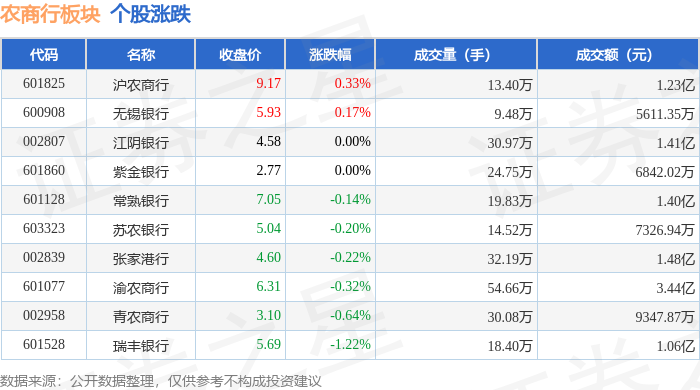
证券之星消息,12月30日农商行板块较上一交易日下跌0.07%,瑞丰银行领跌。当日上证指数报收于 3965.12,下跌0.0%。深证成指报收于13604.07,上涨0.49%。农商行板块个股涨跌见下表: | 代码 | 名称 | 收盘价 | 涨跌幅 | 成交量(手) | 成交额(元) | | --- | --- | --- | --- | --- | --- | | 601825 | 沪农商行 | 9.17 | 0.33% | 13.40万 | 1.23 乙 | | 600908 | 无锡银行 | 5.93 | 0.17% | 9.48万 | 5611.35万 | | 002807 | 江阴银行 | 4.58 | 0.00% | 30.97万 | 1.41亿 | | 601860 | 紫金银行 | 2.77 | 0.00% | 24.75万 | 6842.02万 | | 601128 | 常熟银行 | 7.05 | -0.14% | 19.83万 | 1.40亿 | | 603323 | 苏农银行 | 5.04 | -0.20% | 14.52万 | 7326.94万 | | 002839 | 张家港行 | 4 ...
银行金融投资如何摆布记账?
GF SECURITIES· 2025-12-30 05:34
Investment Rating - The report provides a "Buy" rating for all listed banks analyzed, indicating a positive outlook for their stock performance [6]. Core Insights - The report focuses on the classification of financial investments, the current allocation of listed banks, and how related revenues are accounted for under new accounting standards [5]. - As of Q3 2025, the financial investments of 42 listed banks total approximately 101.5 trillion CNY, with 87% allocated to the configuration portfolio and 13% to the trading portfolio [5][23]. - The bond market is the primary investment direction for listed banks, accounting for 87.6% of their financial investments, with government bonds making up 59.5% of this total [5]. Summary by Sections 1. Classification of Financial Investments - Financial assets are classified into three categories under the new accounting standards: FVTPL (fair value through profit or loss), AC (amortized cost), and FVOCI (fair value through other comprehensive income) [12][13]. - The classification is based on the business model for managing financial assets and the cash flow characteristics of the financial assets [14]. 2. Accounting for Market Revenues - FVTPL assets reflect market fluctuations through "fair value changes" in profit or loss, while AC assets do not reflect fair value changes and primarily generate income from interest [5]. - FVOCI assets account for market fluctuations in other comprehensive income, with interest income recognized in profit or loss [5]. 3. Financial Investment Structure - The configuration portfolio is dominant, with state-owned banks showing the highest allocation to AC, while joint-stock banks and city commercial banks have a higher proportion of trading assets [23][24][25]. - The report notes a structural shift where FVOCI is becoming the main growth area, as banks seek flexibility in their investment strategies [5][23].