
中小金融机构减量提质

Search documents
——非银金融行业周报(2026/3/1-2026/3/7):东吴证券拟收购东海证券控制权,耀才证券金融纳入港股通标的-20260309
Hua Yuan Zheng Quan· 2026-03-09 07:41
Investment Rating - The investment rating for the non-bank financial sector is "Positive" (maintained) [1] Core Views - The report highlights that the insurance sector's recent performance has been average, but the outlook remains positive due to rising PPI, a stable equity market, and potential fund inflows from bank deposits [7] - In the securities sector, the report anticipates a recovery in investment banking and equity business due to the upcoming reforms in the ChiNext board and optimization of refinancing mechanisms, benefiting leading brokerage firms [7] Summary by Sections Insurance Sector - Recently, China British Life Insurance launched a new dividend product with a 1.25% guaranteed interest rate, which is a 50 basis point reduction from the market average of 1.75%. This is seen as an isolated case rather than a trend for the entire industry [3] - The report expects that the guaranteed interest rates for dividend insurance products will remain stable at around 1.75% in the current fluctuating interest rate environment [3] Securities Sector - The government work report emphasizes the need for financial institutions to improve quality while reducing quantity, indicating a trend towards consolidation among smaller financial institutions [4] - The report notes that East Wu Securities plans to acquire control of Donghai Securities, which is expected to enhance regional competitiveness and improve capital strength, potentially raising its ranking among listed brokerages [6] - The inclusion of Yaocai Securities in the Hong Kong Stock Connect is expected to broaden its investor base and improve liquidity [7] - The report recommends leading brokerage firms such as Huatai Securities, CITIC Securities, and Guangfa Securities, anticipating they will benefit from the recovery in investment banking and changes in industry dynamics [7]

1.4万亿资产整合启动,云南农商行组建确立新掌门
Xin Lang Cai Jing· 2026-02-06 11:26
Group 1 - The core point of the article is the appointment of Chen Jianjun as the Deputy Secretary of the Party Committee of the Yunnan Provincial Credit Union, with plans to assume the role of Director of the Provincial Credit Union, marking a significant personnel adjustment in the context of the reform of the rural credit system in Yunnan [2][3][12] - Chen Jianjun, born in August 1979, has a master's degree and previously held positions in the National Development Bank and as Deputy Mayor of Yuxi City, indicating a strong background in finance and governance [3][11] - The Yunnan Provincial Credit Union is in the process of establishing the Yunnan Rural Commercial Bank, with all internal governance procedures completed for the merger of 122 rural credit institutions, signaling a new phase in the reform of rural financial systems [12][15] Group 2 - As of the end of 2025, the asset scale of Yunnan's rural credit system reached 1.4 trillion yuan, with nearly 2 trillion yuan in deposits and loans, highlighting the significant size and importance of this financial sector [15] - The reform of the rural credit system is part of a broader national trend, with at least 13 provinces implementing similar reforms, which aim to enhance the governance and risk management of local financial institutions [16] - The establishment of provincial rural commercial banks is expected to reshape local financial landscapes and improve access to financial services in rural areas, aligning with national strategies for rural revitalization and economic service enhancement [8][16]


中央一号文件未再提农信社改革,中小银行减量提质仍受关注
Di Yi Cai Jing· 2026-02-04 12:43
Core Viewpoint - The recent "Opinions" issued by the Central Committee of the Communist Party and the State Council outline significant tasks and key work for the agricultural and rural sectors in 2023, marking a shift in focus regarding rural financial institution reforms compared to previous years [1][2]. Financial Sector Summary - The 2023 "Opinions" do not specifically mention the reform of provincial credit cooperatives or the restructuring of village and town banks, which contrasts with previous central documents that emphasized these areas [1][2]. - Experts suggest that the reduction in the number of village and town banks will continue as the reform of small and medium-sized financial institutions progresses, with the key to successful reform being the stimulation of internal motivation within these banks [1][3]. - Approximately half of the provinces have completed or clarified new reform plans for provincial credit cooperatives, with an acceleration expected from 2025 onwards [1][4]. Institutional Changes - The reform of provincial credit cooperatives has advanced significantly, with nearly half of the provinces establishing new provincial management institutions, while the number of village and town banks has decreased by nearly 80 [3][4]. - As of the end of 2025, the number of banks participating in deposit insurance has dropped to 3,112, a reduction of 649 from the previous year, marking the highest reduction rate in recent years [4][6]. - In 2025, 86 banks have been approved for mergers, dissolutions, or cancellations, with village banks accounting for 77 of these, indicating a significant increase compared to previous years [6][7]. Future Outlook - The focus on "reducing quantity" through mergers and restructuring aims to eliminate high-risk and inefficient institutions rather than simply shutting them down [7]. - Future reforms will adopt a more diversified approach, avoiding excessive concentration of financial resources that could weaken services to vulnerable regions and industries [7].
广东中小银行“减量提质”加速:兼并重组潮起,差异化谋突围
2 1 Shi Ji Jing Ji Bao Dao· 2026-01-27 05:25
Core Viewpoint - The banking sector in Guangdong is undergoing significant structural adjustments, with a focus on mergers and acquisitions among small and medium-sized banks to enhance financial stability and service capabilities [1][2]. Group 1: Mergers and Acquisitions - Shunde Rural Commercial Bank has been approved to acquire Shenzhen Longhua Xinhua Village Bank, while Guangzhou Rural Commercial Bank will absorb Shenzhen Pingshan Zhujiang Village Bank, extending their service networks into Shenzhen [1]. - Since 2024, over 10 village banks in Guangdong have completed mergers and entered dissolution procedures, indicating a trend towards consolidation in the banking sector [1][3]. - The integration of village banks is seen as a key strategy for reforming small and medium-sized banks, with Guangdong's pace of integration aligning with national trends and accelerating since 2024 [2][3]. Group 2: Financial Health and Capital Adequacy - Capital adequacy is crucial for banks to withstand risks and achieve sustainable development, with Guangdong's small and medium-sized banks enhancing their capital base through various channels, including issuing special bonds [4][5]. - Guangdong has issued a total of 200 billion yuan in special bonds to support small and medium-sized banks, with the latest issuance in July 2023 aimed at bolstering South Guangdong Bank's capital [5]. - As of June 2025, the average core Tier 1 capital adequacy ratio for five city commercial banks in Guangdong was 9.81%, while rural commercial banks averaged 17.4%, both exceeding regulatory requirements [6]. Group 3: Regulatory Environment and Future Directions - The "14th Five-Year Plan" emphasizes the need for small financial institutions to reduce risks and improve quality, with ongoing regulatory support for the restructuring of high-risk institutions [7]. - Experts suggest that the focus on "reducing" high-risk institutions through market-driven mergers and "improving" governance and service capabilities is essential for the sector's development [7]. - Moving forward, small and medium-sized banks in Guangdong are encouraged to leverage regional economic characteristics and innovate in areas like inclusive finance and supply chain finance to avoid homogenized competition [8].
一年“消失”649家存款保险银行创新高
Di Yi Cai Jing Zi Xun· 2026-01-26 11:56
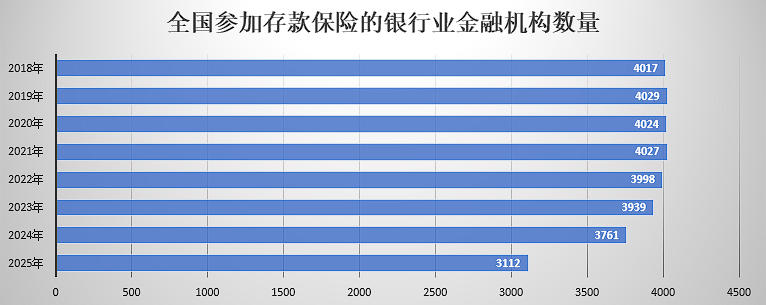
Core Viewpoint - The number of banks participating in deposit insurance in China has significantly decreased, indicating a regulatory push for the "reduction and quality improvement" of small financial institutions [2][5]. Group 1: Trends in Deposit Insurance Participation - As of the end of 2025, there are 3,112 banks participating in deposit insurance, a decrease of 649 from 3,761 at the end of 2024, marking a reduction rate 3.6 times higher than the previous year [2][3]. - The decline in participating banks has accelerated since 2022, with a total reduction of 915 banks since then [3]. Group 2: Types of Banks Affected - The majority of the 649 banks that ceased participation in deposit insurance by 2025 are rural commercial banks, village banks, and rural credit cooperatives, with a combined reduction of 569 banks, accounting for 88% of the total decrease [5]. - The number of rural commercial banks participating in deposit insurance is 1,423, down by 135; rural credit cooperatives are at 316, down by 114; and village banks are at 1,222, down by 320 [5]. Group 3: Regulatory and Market Dynamics - The reduction in small banks is driven by their weak risk resistance, governance issues, and increased competition from state-owned banks, leading to ongoing market consolidation and exit strategies [5][6]. - Since the Central Committee's meeting in July 2023, there has been a push for financial regulation and reform of high-risk small financial institutions, with specific tasks outlined for 2026 [5][7]. Group 4: Risk Management and Future Outlook - The People's Bank of China has reported that the overall financial risk is manageable, with a focus on early identification and correction of risks in non-"red zone" banks [7][8]. - The trend of decreasing small banks is expected to continue, with ongoing reforms and consolidation efforts, particularly in rural financial institutions [8].

一年“消失”649家存款保险银行创新高
第一财经· 2026-01-26 11:30
Core Viewpoint - The number of banks participating in deposit insurance in China has significantly decreased, indicating a regulatory push for the "reduction and quality improvement" of small financial institutions [3][4]. Group 1: Trends in Deposit Insurance Participation - As of the end of December 2025, there are 3,112 banks participating in deposit insurance, a decrease of 649 from the end of 2024, marking a reduction rate 3.6 times higher than the previous year [3][4]. - The decline in the number of banks participating in deposit insurance has accelerated since 2022, with a total reduction of 915 banks from 2022 to 2025 [4][6]. Group 2: Types of Banks Affected - The majority of the 649 banks that exited deposit insurance in 2025 were rural commercial banks, village banks, and rural credit cooperatives, with these three categories accounting for 88% of the total reduction [6]. - Specifically, rural commercial banks decreased by 135, rural credit cooperatives by 114, and village banks by 320 in 2025 [6]. Group 3: Regulatory Environment and Reforms - Since July 2023, the Chinese government has emphasized strengthening financial regulation and reforming high-risk small financial institutions, leading to accelerated risk management efforts [6][9]. - The central economic work conference in December 2025 outlined clear tasks for the financial sector, focusing on the "reduction and quality improvement" of small financial institutions [6][9]. Group 4: Future Outlook - The trend of decreasing small banks is expected to continue, driven by mergers and market exits, with stronger banks likely to lead the consolidation process [9]. - The ongoing reforms in the rural credit system and the establishment of provincial-level banking institutions are part of the strategy to enhance the stability and governance of small banks [7][9].

一年“消失”649家存款保险银行创新高,中小金融机构化险持续
Di Yi Cai Jing· 2026-01-26 10:56
Core Insights - The number of banks participating in deposit insurance in China has significantly decreased, with a total of 3,112 banks as of the end of 2025, down from 3,761 at the end of 2024, marking a reduction of 649 banks, which is 3.6 times the decrease in 2024 [1][2] Group 1: Trends in Deposit Insurance Participation - From 2018 to 2021, the number of banks in the deposit insurance scheme remained stable at over 4,000, but it dropped to 3,998 in 2022 and has continued to decline sharply since then [2] - The total reduction in banks participating in deposit insurance since 2022 amounts to 915 [2] Group 2: Types of Banks Affected - The majority of the 649 banks that exited the deposit insurance scheme in 2025 were rural commercial banks, village banks, and rural credit cooperatives, with a total reduction of 569 banks from these categories, accounting for 88% of the total decrease [3] - The number of rural commercial banks participating in deposit insurance decreased to 1,423, rural credit cooperatives to 316, and village banks to 1,222 by the end of 2025 [3] Group 3: Regulatory Environment and Reforms - The decline in the number of participating banks is driven by regulatory efforts to improve the quality of small financial institutions, with ongoing reforms aimed at risk management and consolidation [3][7] - The central government has emphasized the need for financial regulation and the reform of high-risk small financial institutions since July 2023, with specific tasks outlined for 2026 [3][6] Group 4: Mergers and Acquisitions - The acquisition of Jinzhou Bank by Industrial and Commercial Bank of China has provided a new model for the consolidation of small banks, leveraging the strengths of larger banks to improve management and operational standards [5] - Analysts suggest that the ongoing consolidation of small banks will continue, driven by stronger banks acquiring weaker ones and reforms within the rural credit system [3][7]
切实提高金融业高质量发展水平
Jin Rong Shi Bao· 2026-01-22 02:07
Core Viewpoint - The financial regulatory authority emphasizes the need to enhance the high-quality development capabilities of the financial industry to support China's modernization and the establishment of a strong financial nation [1] Group 1: High-Quality Development - The financial industry must focus on high-quality development as a requirement for modernization and building a strong financial nation [1] - The regulatory authority plans to implement comprehensive measures to guide industry reform and transformation, including promoting the integration of insurance reporting and operations, adjusting preset interest rates, and enhancing the efficiency of the banking sector [1] - By 2025, the regulatory authority aims to support financial institutions in diversifying capital sources to ensure sustainable development [1] Group 2: Small and Medium Financial Institutions - Small and medium financial institutions play a crucial role in supporting local economic development but face challenges in credit asset quality and risk prevention [2] - Since the 14th Five-Year Plan, regulatory authorities have effectively promoted risk resolution in small financial institutions through mergers and restructuring [2] - As of June 2025, the number of various types of small financial institutions has shown significant structural optimization, with urban commercial banks decreasing by 11 and rural commercial banks increasing by 27 since the end of 2019 [2] Group 3: Quality Improvement and Risk Management - The focus of future policies should shift from quantity adjustment to quality enhancement, emphasizing the need for improved governance to stimulate the internal motivation of small banks [3] - The "reduction and quality improvement" strategy aims to enhance the stability and sustainable operational capacity of financial institutions [3] - The approach involves optimizing the regional and business layout of financial institutions and eliminating inefficient, high-risk market participants [3] Group 4: Orderly Competition - High-quality development in the financial sector requires a layered, categorized, and coordinated competitive environment [4] - The dual approach of "reduction and quality improvement" alongside "order restructuring" is essential for promoting industry development [4] - The regulatory authority aims to address issues of disorderly competition and promote a focus on core business areas among banks and insurance institutions [5] Group 5: Regulatory Measures - Future regulatory efforts will target disruptive market behaviors such as high-interest deposit solicitation and irrational expansion [6] - Financial institutions are encouraged to return to their core business areas and strengthen capital constraints and internal management [6] - The regulatory framework will support differentiated supervision and encourage innovation in specific areas for small financial institutions [7]
广东金融监管新年划重点!将出台普惠金融高质量发展工作方案
Nan Fang Du Shi Bao· 2026-01-21 12:52
Core Points - The Guangdong Financial Regulatory Bureau held a meeting to summarize 2025's work and outline key tasks for 2026, focusing on risk prevention, enhancing high-quality development, improving financial regulation, and promoting strict governance [2][6] Group 1: Risk Prevention and Management - The meeting emphasized the need for collaboration with local governments to strengthen risk disposal mechanisms and deepen reforms in small and medium-sized financial institutions [3][4] - A "Financial Anti-Illegal Volunteer + Grassroots Liaison Officer" model was introduced to combat illegal financial activities, showcasing a new approach to risk management [3][4] Group 2: Enhancing Industry Development - The focus on "reducing and improving small and medium-sized financial institutions" aims to support the growth of local entities and encourage diverse capital sources [3][5] - The regulatory body has already approved the dissolution of 12 village banks and the absorption of 11 others, indicating ongoing efforts to streamline the sector [4] Group 3: Regulatory Improvements - The meeting called for enhanced coordination in combating "black and gray industries" in finance and the development of innovative regulatory data applications [6] - A joint plan for promoting high-quality development in inclusive finance was announced, indicating a commitment to cross-departmental collaboration [6][7] Group 4: Governance and Compliance - The meeting highlighted the importance of strict governance, including the implementation of a "first agenda" system and comprehensive training on the spirit of the 20th Central Committee [7][8] - Continuous efforts to uphold the central government's eight regulations and to foster a clean and responsible regulatory team were emphasized [7][8]

今年仅半月减少超70家银行 “减量提质”持续推进
Xin Jing Bao· 2026-01-19 06:20
Core Viewpoint - The banking industry is undergoing a significant structural adjustment, with many rural banks being acquired and transformed into branches of larger state-owned banks, reflecting a trend towards consolidation and quality improvement in the financial sector [1][2][5]. Group 1: Bank Acquisitions - Several rural banks are being acquired by major state-owned banks, such as Chang'an Bank acquiring Shaanxi Taibai Changyin Rural Bank and Bank of Communications acquiring Zhejiang Anji Jiaoyin Rural Bank [1][3]. - In just the first half of this year, over 70 banks are set to be integrated, a stark increase from only 8 during the same period last year [1]. - The acquisitions are part of a broader strategy to enhance the quality of financial institutions by eliminating weaker competitors and optimizing regional financial supply [1][5]. Group 2: Structural Reforms - The central economic work conference has emphasized the need to "deeply promote the reduction and quality improvement of small and medium-sized financial institutions," indicating a shift towards a more efficient banking structure [11]. - The consolidation of smaller banks into larger entities is seen as a necessary step to mitigate regional financial risks and improve the management and operational standards of these institutions [5][11]. - The approach of merging smaller banks into larger ones is being recognized as a new model for enhancing the quality of financial services in rural areas [5]. Group 3: Governance and Quality Improvement - The focus on "reduction" is aimed at achieving "rebirth," with the ultimate goal being quality enhancement rather than merely reducing the number of institutions [10][11]. - The ongoing reforms are expected to lead to a decrease in the number of high-risk institutions, thereby laying a foundation for deeper reforms and risk management [11]. - The success of these reforms hinges on improving governance and ensuring that financial institutions can effectively meet the diverse financial needs of the real economy [11][12]. Group 4: Customer Impact - Bank customers' deposits will remain unaffected during the transition, as the assets and liabilities are typically assumed by the acquiring bank or newly established institution [12]. - The consolidation is expected to enhance the overall competitiveness of banks, thereby providing greater security for customer deposits [12].

