
药明生物

Search documents
创新药授权交易2.0时代:如何从单向引进走向联合开发?
2 1 Shi Ji Jing Ji Bao Dao· 2025-07-10 12:14
Core Insights - The development of innovative drugs in China has been significantly promoted by continuous improvement in national policies and increasingly stringent regulations, leading to a notable increase in both the quantity and quality of drugs [1][2] - The innovative drug research and development (R&D) process is lengthy and costly, typically requiring around ten years and over one billion dollars in investment, with a shift from quantity to quality in China's drug R&D capabilities [2][3] - The CRDMO (Contract Research, Development, and Manufacturing Organization) sector is evolving from a service provider to a value co-creation partner, enhancing revenue through early-stage R&D services and milestone payments [5][9] Industry Trends - The CXO industry in China has formed a multi-layered and differentiated competitive landscape, with WuXi Biologics leading the market with projected revenues of 18.68 billion yuan in 2024 [3] - New technology platforms are emerging, such as the peptide chip and AI screening platform by Carbon Cloud, which is globally leading in its field [4] - The CRDMO sector is experiencing a transformation, with companies like WuXi Biologics redefining their roles to provide comprehensive support throughout the drug development process [4][5] Market Dynamics - The number of clinical trials globally is steadily increasing, with China showing particularly strong growth, driven by unmet patient needs and a favorable market environment [1][2] - The innovative drug licensing transaction process is complex, but there is a growing trend of early-stage projects attracting attention from licensing transactions, indicating increasing market recognition and demand for innovative drugs [7][8] - In the past three to five years, over 60% of the assets that achieved licensing transactions through WuXi Biologics were ultimately acquired by multinational companies, highlighting the synergy between small biotech firms and larger corporations [8]
创新药审批“超高速时代”,如何告别“割青苗式”投资?
2 1 Shi Ji Jing Ji Bao Dao· 2025-07-10 09:36
Core Insights - The Chinese innovative drug industry has transitioned from imitation to breakthrough innovation over the past decade, marking a significant development phase [1] - By 2025, the approval process for innovative drugs in China is expected to enter a "super-fast era," with approval times nearing those of the FDA, indicating a shift towards becoming a global dual-engine for innovative drug launches [1][2] - The number of license-out transactions by Chinese companies reached a record high in 2024, with 94 deals totaling $51.9 billion, reflecting a growing interest from multinational corporations (MNCs) [2][3] Group 1: Market Dynamics - The Chinese biotech sector saw a 78% increase in the first half of 2025, significantly outperforming global peers, although the overall market capitalization remains only 14%-15% of that of U.S. counterparts [4] - The "DeepSeek moment" in the Chinese biopharmaceutical industry signifies a shift towards achieving high-quality innovation at lower costs, challenging established global players [4] - Despite geopolitical and regulatory risks, interest from overseas MNCs in Chinese innovative drugs remains strong, particularly in the U.S. market [5] Group 2: NewCo Model - The NewCo model has emerged as a mainstream approach for Chinese companies to enter overseas markets, allowing them to retain equity and share future value with investors [6][7] - As of Q1 2025, 13 NewCo transactions have been completed by Chinese pharmaceutical companies, totaling over $10 billion, indicating a robust trend towards this model [6] - The NewCo structure helps mitigate financial pressures and enhances competitiveness in international markets by focusing resources on pipeline development [7] Group 3: Financing Challenges - The Chinese innovative drug sector is facing a financing winter, with a significant decline in IPOs and funding amounts in 2024 compared to previous years [8][9] - The number of financing cases in the healthcare sector decreased by 17% in 2024, although total funding increased by 9%, indicating a shift in investor focus [8] - The average funding amount per project in China has dropped by 71% from its peak in 2020, highlighting the challenges faced by early-stage projects [8] Group 4: Strategic Shifts - The trend of "selling seedlings" reflects a strategic necessity for many Chinese innovative drug companies to quickly recoup funds for ongoing research and development [13][14] - The proportion of preclinical projects in license-out transactions has increased from 28% in 2020 to 61% in 2024, driven by areas like oncology and neuroscience [13] - Companies are urged to build independent innovation systems and avoid over-reliance on licensing, which could lead to a loss of competitive edge in the long term [14][15]
7月10日电,香港交易所信息显示,贝莱德在药明生物的持股比例于07月04日从5.26%降至4.91%。


news flash· 2025-07-10 09:05
智通财经7月10日电,香港交易所信息显示,贝莱德在药明生物的持股比例于07月04日从5.26%降至 4.91%。 ...
37家港股公司回购 斥资11.29亿港元
Zheng Quan Shi Bao Wang· 2025-07-10 01:53
Summary of Key Points Core Viewpoint - On July 9, 37 Hong Kong-listed companies conducted share buybacks, totaling 49.01 million shares and an amount of 1.129 billion HKD [1][2]. Group 1: Buyback Details - Tencent Holdings repurchased 1.005 million shares for 500 million HKD, with a highest price of 504.000 HKD and a lowest price of 495.200 HKD, accumulating a total buyback amount of 39.543 billion HKD for the year [1][2]. - WuXi Biologics repurchased 11.5 million shares for 298 million HKD, with a highest price of 26.150 HKD and a lowest price of 25.650 HKD, accumulating a total buyback amount of 1.708 billion HKD for the year [1][2]. - AIA Group repurchased 4 million shares for 274 million HKD, with a highest price of 68.950 HKD and a lowest price of 68.050 HKD, accumulating a total buyback amount of 16.935 billion HKD for the year [1][2]. Group 2: Buyback Rankings - The highest buyback amount on July 9 was from Tencent Holdings at 500 million HKD, followed by WuXi Biologics at 298 million HKD [1][2]. - The largest number of shares repurchased on July 9 was by WuXi Biologics at 11.5 million shares, followed by Ying Group and China Aluminum Can with 8 million shares and 5 million shares, respectively [1][2]. Group 3: Additional Buyback Information - China Feihe conducted its first buyback of the year, while Tencent Holdings has conducted multiple buybacks totaling 39.543 billion HKD for the year [2]. - A detailed table of buybacks on July 9 includes various companies, their stock codes, number of shares repurchased, buyback amounts, highest and lowest prices, and cumulative buyback amounts for the year [2][3].


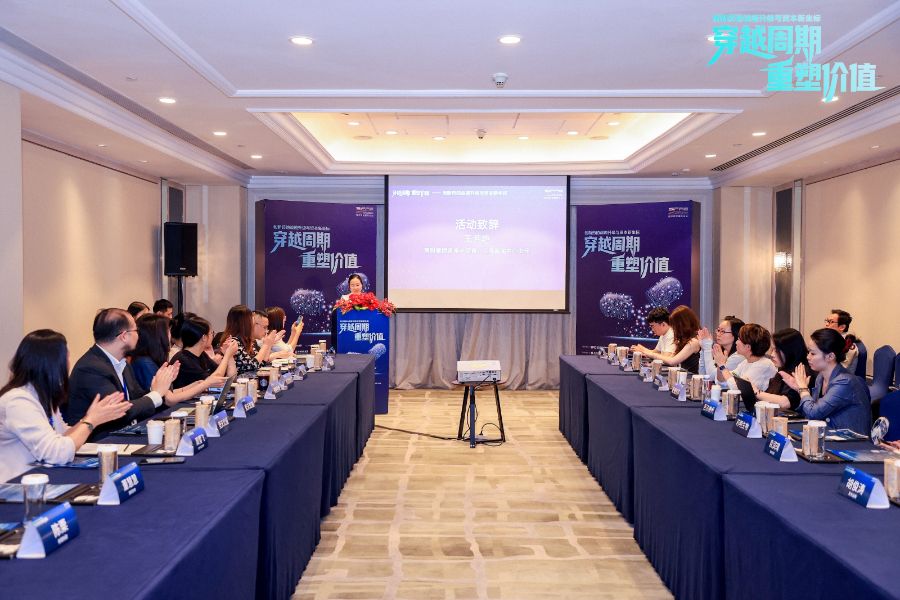
共探产业进阶路径,创新药“穿越周期,重塑价值”闭门会成功举办
2 1 Shi Ji Jing Ji Bao Dao· 2025-07-09 12:32
Core Insights - The Chinese innovative pharmaceutical industry has transitioned from imitation to breakthrough innovation over the past decade, facing a critical transformation point influenced by policy, capital cycles, and global competition [1][2][4]. Policy Influence - Policies serve as a guiding force for the innovative pharmaceutical industry, directly impacting resource allocation and value evolution [4]. - Comprehensive policy support across drug development, insurance payment, regulatory approval, and financial backing is essential for the breakthrough development of innovative drugs [4]. Capital Dynamics - The capital landscape is undergoing significant changes, with trends of "internal acceleration" and "BD transformation" emerging in the innovative pharmaceutical sector [4]. - Despite challenges, the innovative drug sector is experiencing a surge in patent procurement by multinational pharmaceutical companies, indicating the competitiveness of Chinese innovative drugs [5][6]. - The current valuation environment in the capital market is complex, necessitating a balanced approach to maintain core competitiveness while adapting to market realities [4][6]. Globalization Trends - The trend of internationalization is becoming a critical factor for the innovative pharmaceutical industry, with significant improvements in molecular design diversity and global clinical trial activities [6]. - The Chinese innovative drug market has become the second largest globally, reflecting enhanced recognition of Chinese pharmaceutical companies in international markets [6][7]. Industry Consensus - The industry is currently in a cyclical adjustment phase, requiring differentiated strategies to overcome homogenized competition and effectively advance drug pipelines [7]. - A consensus emerged during the closed-door meeting that emphasizes the need for policy guidance, capital support, and a global perspective to navigate cyclical fluctuations and achieve value creation [7].

港股创新药ETF(159567)涨1.08%,成交额23.52亿元
Xin Lang Cai Jing· 2025-07-09 07:10
Core Viewpoint - The Hong Kong Innovative Drug ETF (159567) has shown significant growth in both share volume and fund size since its inception, indicating strong investor interest in the innovative drug sector [1]. Group 1: Fund Performance - As of July 9, 2024, the Hong Kong Innovative Drug ETF (159567) closed with a gain of 1.08% and a trading volume of 2.352 billion yuan [1]. - The fund's share volume increased by 419.87% from 3.95 million shares at the end of 2023 to 20.55 million shares by July 8, 2024 [1]. - The fund's size grew by 749.27%, from 378 million yuan at the end of 2023 to 3.209 billion yuan by July 8, 2024 [1]. Group 2: Liquidity and Trading Activity - Over the last 20 trading days, the cumulative trading amount for the ETF reached 42.082 billion yuan, with an average daily trading amount of 2.104 billion yuan [1]. - Since the beginning of the year, the ETF has recorded a total trading amount of 100.143 billion yuan over 124 trading days, averaging 808 million yuan per day [1]. Group 3: Fund Management - The current fund manager, Ma Jun, has managed the Hong Kong Innovative Drug ETF since its inception on January 3, 2024, achieving a return of 56.11% during the management period [1]. Group 4: Top Holdings - The ETF's top holdings include WuXi Biologics (11.47%), BeiGene (10.87%), and Innovent Biologics (9.60%), among others, indicating a focus on leading companies in the innovative drug sector [2]. - The fund's holdings are diversified across several key players in the biotechnology and pharmaceutical industries, with significant positions in companies like China Biologic Products and CSPC Pharmaceutical Group [2].


港股创新药50ETF(513780)午后拉升近2%,博安生物涨超11%!对医药板块反转行情抱有强烈信心
Jin Rong Jie· 2025-07-09 06:43
Group 1 - The core viewpoint of the articles highlights the strong performance of the Hong Kong innovative pharmaceutical sector, with significant gains in the Hong Kong Innovative Drug 50 ETF and individual stocks like Boan Biotechnology and Tigermed [1][2] - As of July 8, the top ten constituents of the CSI Hong Kong Stock Connect Innovative Drug Index account for 68% of the total weight, including high-quality A-share companies like Innovent Biologics and CSPC Pharmaceutical Group [2] - The National Medical Products Administration reported that in the first half of the year, 43 innovative drugs and 45 innovative medical devices were approved, representing year-on-year increases of 59% and 87% respectively, indicating a positive trend in the industry [1] Group 2 - The innovative pharmaceutical sector in China is at a new historical starting point, with domestic companies enhancing their competitiveness and expanding overseas, supported by strong policy backing [2] - The net inflow into the Hong Kong Innovative Drug 50 ETF reached 573 million yuan in the last three months and 851 million yuan year-to-date, reflecting investor confidence in the sector [1] - Guotai Junan Securities expresses strong confidence in a reversal in the pharmaceutical sector by 2025, emphasizing investment opportunities in innovative drugs addressing unmet clinical needs and medical devices [1]
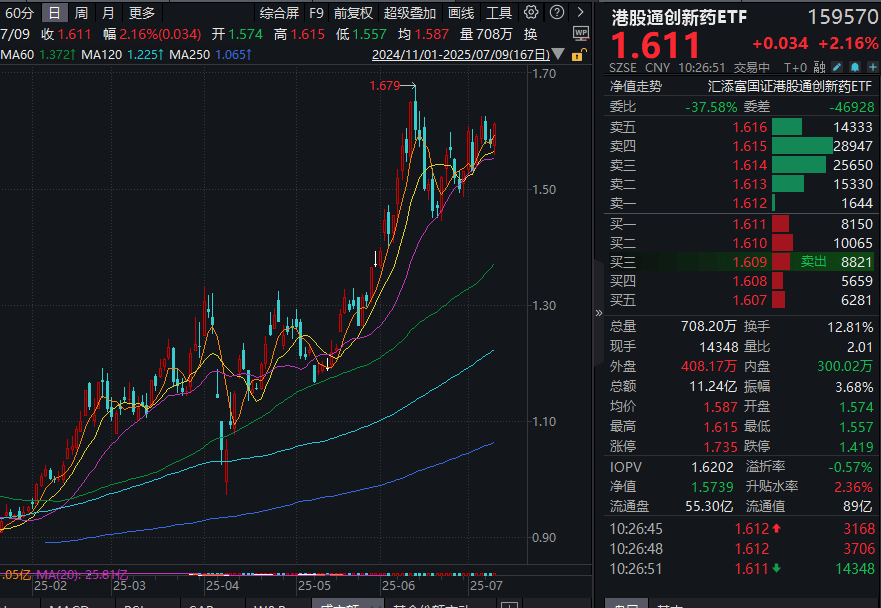
蓄力再冲锋!港股通创新药ETF(159570)再度大涨超2%,融资余额保持高位!创新药全球化加速!
Sou Hu Cai Jing· 2025-07-09 02:54
Group 1 - The core viewpoint of the news highlights the strong performance of the Hong Kong Stock Connect Innovative Drug ETF (159570), which has seen a significant inflow of funds and a notable increase in trading volume, indicating positive market sentiment towards innovative drug assets [1][5]. - The ETF has experienced a net inflow of over 5 billion yuan in the last 60 days, with its latest scale exceeding 8.7 billion yuan, leading its peers in the same category [1][9]. - The underlying index of the ETF has shown a strong performance, with major constituent stocks like BioNTech and China Biopharmaceuticals seeing substantial gains, reflecting a positive trend in the innovative drug sector [3][9]. Group 2 - CITIC Securities believes that Chinese innovative drug assets are gaining global recognition, with clinical data increasingly featured in academic conferences and a rise in business development (BD) licensing agreements [4][6]. - The report emphasizes the competitive advantages of China's pharmaceutical industry, including population and domestic demand, manufacturing and supply chain strengths, and rapid innovation capabilities [6][7]. - The focus for the second half of 2025 includes optimizing drug procurement policies, diversifying payment methods, and reforming medical service pricing, which are expected to support high-quality growth in the industry [6][8]. Group 3 - The ETF's top ten holdings account for nearly 72% of its weight, with significant representation from leading companies in the innovative drug sector, indicating a concentrated investment strategy [9][10]. - The ETF has achieved a remarkable 62.78% increase in the first half of 2025, outperforming other healthcare indices, showcasing its strong market position [10][11]. - The report suggests that the innovative drug sector is poised for accelerated globalization, with more BD transactions expected to occur in the next 2-3 years, further enhancing the growth prospects of domestic innovative drug companies [6][8].
中泰国际:特朗普公布25%新的对等关税率调整报告
ZHONGTAI INTERNATIONAL SECURITIES· 2025-07-09 01:47
Market Overview - The Hang Seng Index rose by 260 points or 1.1%, closing at 24,148 points, driven by a rebound in technology stocks[1] - The Hang Seng Tech Index increased by 1.8%, closing at 5,325 points, with a total market turnover exceeding HKD 213.3 billion[1] - Net inflow into Hong Kong Stock Connect was HKD 386 million, indicating positive sentiment in the market[1] Sector Performance - Cathay Financial International (1788 HK) surged by 28.5%, becoming the most actively traded stock with a turnover of HKD 12.8 billion[1] - Other notable performers included Kuaishou (1024 HK), which rose by 5.2%, reaching a three-month high[1] - The gaming, cultural tourism, brokerage, and consumer electronics sectors showed strong performance, with major tech stocks like Alibaba (9988 HK) and Meituan (3690 HK) rising by 1.5% and 3.6% respectively[1] Economic Indicators - The new housing transaction volume in 30 major cities reached 1.89 million square meters, a year-on-year decline of 1.1%, showing improvement compared to the previous week's 23.1% drop[5] - The inventory-to-sales ratio for major cities was 63.1, higher than last year's 59.7 but lower than the previous week's 68.2[7] - Land transaction volume in 100 major cities increased by 15.3% year-on-year, totaling 2.063 million square meters[8] Policy and Market Outlook - The market is expected to maintain high-level fluctuations, with a focus on technology stocks for further upward movement[2] - Long-term capital is improving, suggesting no need for significant reduction in positions[2] - The government is expected to implement supportive policies to stabilize the real estate market, which may benefit both state-owned and local enterprises[11]
35家港股公司回购 斥资11.40亿港元
Zheng Quan Shi Bao Wang· 2025-07-09 01:39
Summary of Key Points Core Viewpoint - On July 8, 35 Hong Kong-listed companies conducted share buybacks, totaling 29.03 million shares and an aggregate amount of HKD 1.14 billion [1][2]. Group 1: Share Buyback Details - Tencent Holdings repurchased 995,000 shares for HKD 500 million, with a highest price of HKD 505.00 and a lowest price of HKD 500.00, bringing its total buyback amount for the year to HKD 39.04 billion [1][2]. - AIA Group repurchased 4.5 million shares for HKD 309 million, with a highest price of HKD 68.90 and a lowest price of HKD 68.20, totaling HKD 16.66 billion in buybacks for the year [1][2]. - WuXi Biologics repurchased 11.68 million shares for HKD 299 million, with a highest price of HKD 25.80 and a lowest price of HKD 25.20, accumulating HKD 1.41 billion in buybacks for the year [1][2]. Group 2: Buyback Rankings - The highest buyback amount on July 8 was from Tencent Holdings at HKD 500 million, followed by AIA Group at HKD 309 million [1][2]. - In terms of share quantity, WuXi Biologics led with 11.68 million shares repurchased, followed by AIA Group with 4.5 million shares [1][2].