Anthropic

Search documents
当AI,开始设计AI
创业邦· 2026-02-13 03:37
Core Insights - The recent releases of OpenAI's GPT-5.3-Codex and Anthropic's Claude Opus 4.6 indicate a significant milestone in AI evolution, where AI can now meaningfully participate in its own improvement [2][4] - This development suggests a shift from human-designed AI to AI-assisted design, and potentially to AI-led design, marking a rapid progression in AI capabilities [4] Self-Evolution of AI - OpenAI's CEO expressed excitement about the model's ability to build itself, indicating a future where AI can iteratively improve its own architecture [4] - However, analysts have noted a gap between marketing promises and actual performance, highlighting that while concepts have advanced, practical capabilities are still developing [4] Reconstruction of Knowledge Work - The ability of AI to self-iterate could fundamentally disrupt knowledge-based jobs, leading to a complete restructuring of the knowledge work system [6] - Analysts predict that advancements in AI will stem from improvements in reasoning and architecture rather than just training, indicating a shift towards AI possessing metacognitive abilities [6] Implications for Human Expertise - As AI gains self-reflection and improvement capabilities, the unique advantages of human experience, pattern recognition, and innovative thinking may be challenged [9] Control and Safety Concerns - The most pressing concern is not job displacement but the issue of control over AI systems, as they may develop optimization paths beyond human understanding [11] - Discussions in tech communities reflect skepticism about the reliability of performance metrics for self-improving AI, raising questions about the effectiveness of traditional evaluation and regulatory frameworks [11] Competitive Landscape - A report indicates that by 2024, nearly 90% of leading AI models will originate from the industry, with competition shifting from research labs to large-scale computing companies and well-funded AI-focused firms [12] - The ability to achieve true self-iteration in AI will be a critical factor in determining leadership in the upcoming knowledge work revolution [12]


第二家2万亿级AI独角兽诞生!Anthropic宣布300亿美元融资
Di Yi Cai Jing· 2026-02-13 03:33
Core Insights - Anthropic has successfully completed a Series G funding round, raising $30 billion with a post-money valuation of $380 billion, making it the second-largest funding round in the large model industry after OpenAI's $40 billion deal last year [1][3] - The funding round was led by Singapore's GIC and Coatue, with participation from notable investors including Blackstone, Goldman Sachs, and Microsoft, which plans to invest up to $5 billion [4][6] - Anthropic's revenue has reached an annualized figure of $14 billion, growing over tenfold in the past three years, driven by its Claude model, which has gained significant traction among Fortune 10 companies [4][6] Company Performance - The number of Claude customers spending over $100,000 annually has increased sevenfold in the past year, with over 500 customers now spending more than $1 million annually [6] - Claude Code, Anthropic's AI programming tool, has surpassed $2.5 billion in annualized revenue, doubling since early 2026, with enterprise subscription users growing fourfold [7] - Anthropic is recognized as a strong competitor to OpenAI, with its core team originating from OpenAI and significant backing from tech giants like Amazon and Google [7] Competitive Landscape - OpenAI is accelerating its product and funding strategies in response to competition, with plans for a new funding round in 2026 targeting $100 billion, potentially increasing its valuation to $830 billion [8][9] - Major tech companies, including Amazon, Google, Microsoft, and Meta, are projected to spend a total of $660 billion on data centers and chip development by 2026, raising the capital expenditure threshold for AI model development [9] Future Outlook - The recent funding will enable Anthropic to expand its infrastructure and ensure Claude's availability across all customer regions, utilizing various hardware for training and operation [10]
大西洋月刊:美国还没准备好迎接人工智能对就业的影响
美股IPO· 2026-02-13 03:27
Core Argument - The article discusses the profound impact of artificial intelligence (AI) on the job market, suggesting that the U.S. is unprepared for the potential disruptions it may cause to employment and economic stability [1]. Group 1: Historical Context and Current Trends - The establishment of the U.S. Bureau of Labor Statistics (BLS) aimed to measure labor conditions and create fair outcomes amidst industrial changes, highlighting the importance of data in understanding economic realities [5][6]. - The BLS has documented significant job growth in various sectors, such as a 907% increase in mobile food service jobs since 2000, indicating a dynamic labor market [6]. - However, the BLS is limited in its predictive capabilities, particularly regarding the impact of emerging technologies like AI on the workforce [7]. Group 2: AI's Impact on Employment - AI is rapidly transforming job functions, enabling tasks to be completed more efficiently than ever before, which raises concerns about job displacement [8][9]. - Predictions from industry leaders suggest that AI could lead to a 10% to 20% increase in unemployment rates and potentially eliminate half of entry-level white-collar jobs within the next decade [10]. - A Reuters/Ipsos survey indicates that 71% of Americans fear AI will lead to permanent job losses, reflecting widespread anxiety about the future of work [9]. Group 3: Economic Resilience and Job Creation - Economists argue that capitalism has a strong resilience, often leading to job creation following technological advancements, as seen with ATMs and software like Excel [8]. - The BLS forecasts a 3.1% employment growth rate over the next decade, which, while lower than previous years, still represents the addition of 5 million jobs [8]. Group 4: The Role of Policy and Corporate Responsibility - There is a growing concern that corporate leaders are prioritizing automation and efficiency over employee welfare, leading to potential mass layoffs [22][23]. - The article suggests that CEOs are under pressure to demonstrate the benefits of AI quickly, often resulting in job cuts rather than exploring ways to integrate AI while supporting their workforce [22][23]. - Proposals for policies such as retraining programs and a robot tax to support displaced workers are discussed, but there is skepticism about their implementation [33][28]. Group 5: Political and Social Implications - The political landscape is characterized by a lack of proactive measures to address the challenges posed by AI, with many lawmakers adopting a hands-off approach [26][27]. - The article emphasizes the need for a coordinated response to the potential upheaval caused by AI, suggesting that without intervention, the consequences could be severe for both the economy and society [30][31].




AI Bubble, Tech Funeral? Who Will Fail And Who Will Double Down?
Seeking Alpha· 2026-02-13 03:16
Core Insights - Anthropic is enhancing its AI chatbot, Claude, by integrating new plug-ins that allow it to perform tasks such as signing documents and reviewing code, indicating a significant advancement in AI capabilities [1] Company Developments - The integration of plug-ins into Claude represents a strategic move by Anthropic to expand the functionality of its AI offerings, potentially increasing its competitive edge in the AI market [1] Market Implications - The advancements in AI technology, particularly through companies like Anthropic, may lead to increased interest and investment in AI-related sectors, as these technologies become more integrated into business operations [1]

速递|Anthropic完成300亿美元融资,估值达3800亿美元,员工兑现股权同步落地
Sou Hu Cai Jing· 2026-02-13 03:14
图片来源:Anthropic Anthropic 已与投资者达成协议,以 3800 亿美元的估值完成 300 亿美元融资。这笔注资将巩固这家人工 智能公司的地位,使其在与竞争对手 OpenAI 的较量中占据更有利位置。 Anthropic 周四宣布,本轮融资由新加坡主权财富基金 GIC 和对冲基金 Coatue Management 领投。D.E. Shaw & Co.、Dragoneer Investment Group、彼得·蒂尔旗下的 Founders Fund、Iconiq 与 MGX 共同参与领 投, 红杉资本 、光速创投等顶级风投机构,以及科技巨头英伟达与微软也现身投资者名单。 本轮融资使Anthropic 估值较此前近乎翻倍,跻身全球最具价值私营公司行列。就在数月前,这家初创 公司刚完成 130 亿美元融资,而 OpenAI 同期也正推进高达 1000 亿美元的融资计划 。这一系列密集动 作凸显了投资者对头部人工智能公司股权的狂热追逐。 Anthropic 还确认,允许员工以与最新融资轮相同的估值出售公司股份的计划已落实。 Anthropic 公司成立于 2021 年,自创立以来始终将"安全性与 ...
3800 亿估值,Anthropic 再拿巨额融资
3 6 Ke· 2026-02-13 03:10
Core Insights - Anthropic has completed a $30 billion Series G funding round, achieving a post-money valuation of $380 billion, led by GIC and Coatue, indicating a shift in investment dynamics within the AI industry [1][3] - The funding reflects a divergence in business models between Anthropic and OpenAI, with Anthropic focusing on enterprise clients and higher pricing, while OpenAI adopts a high-volume, low-margin strategy [2][4] Funding and Valuation - Anthropic's forward revenue multiple stands at 43.9 times, compared to OpenAI's 31 times, suggesting investor confidence in Anthropic's long-term potential despite its slower growth [3] - The investor base for this funding round includes long-term oriented institutions like GIC and Coatue, indicating a preference for sustainable business models over rapid growth [3] Business Model Comparison - Anthropic's strategy emphasizes quality and reliability for enterprise clients, contrasting with OpenAI's mass-market approach, which may lead to more stable revenue streams [2][4] - The comparison to Salesforce highlights the potential for Anthropic to replicate success in the enterprise software space, focusing on customer loyalty and high-value contracts [4] Market Impact - The $30 billion funding round is one of the largest in tech history, raising the bar for AI startups and signaling a shift in the competitive landscape [6] - The influx of capital from sovereign funds and tech giants may pressure competitors to secure similar funding levels to remain viable [6] Challenges Ahead - Concerns about whether the AI industry is experiencing an overvaluation are emerging, with analysts questioning the sustainability of high valuations without clear monetization paths [7] - The competitive landscape is intensifying, with major players like OpenAI, Google, and Meta investing heavily in R&D, raising questions about Anthropic's ability to maintain its technological edge [8]
OpenClaw 带来的「非线性狂飙」,代码正在成为新世界的基础设施
Founder Park· 2026-02-13 03:06
Core Insights - The article discusses a significant paradigm shift in the AI and coding landscape, highlighting the transition from human-driven coding to AI-generated code, which is reshaping the roles and value of human programmers [4][6][19]. Group 1: AI and Coding Evolution - The relationship between humans and code has evolved through three stages: the "taming period" (1950s-1990s), the "nurturing period" (1990s-2020s), and the "explosion period" (2020s-2025), with each stage aimed at enhancing human productivity [9][10][11][12]. - The recent year has seen a non-linear explosion in code production, with AI gaining unprecedented autonomy, leading to a redefinition of human-machine collaboration [13][15]. Group 2: Redefining Human Roles - As AI takes over coding tasks, the value of human programmers is shifting from execution to defining intent and making aesthetic judgments, necessitating a new cognitive division of labor [16][22]. - The production of code is transitioning from a human-planned activity to an AI-driven ecological evolution, raising challenges in management and collaboration [18][19]. Group 3: Software Infrastructure Transformation - Software is evolving from applications designed for human use to infrastructures that serve AI, indicating a fundamental challenge to traditional SaaS business models [20][21]. - The role of code is changing from a product of human intelligence to the "mother tongue" of AI, with humans stepping back from the implementation process to focus on goal-setting [21][22]. Group 4: Future Implications - The article emphasizes that as AI assumes more responsibilities, humans must become value definers rather than mere executors, leading to a re-evaluation of human capabilities in the digital landscape [22][25]. - The relationship between humans and technology is shifting, with technology now prompting humans to adapt and redefine their roles in a rapidly evolving environment [23][24].

The AI Gold Rush Is Breaking a Silicon Valley Taboo: Cashing Out Before the IPO
WSJ· 2026-02-13 03:00
Core Insights - Companies such as Stripe, OpenAI, Anthropic, Databricks, and SpaceX are increasingly allowing employees to sell portions of their shares [1] Group 1 - The trend of enabling employees to sell shares reflects a shift in compensation strategies among tech companies [1] - This practice may enhance employee liquidity and attract talent by providing more immediate financial benefits [1] - The move is indicative of a broader trend in the tech industry towards more flexible equity compensation [1]

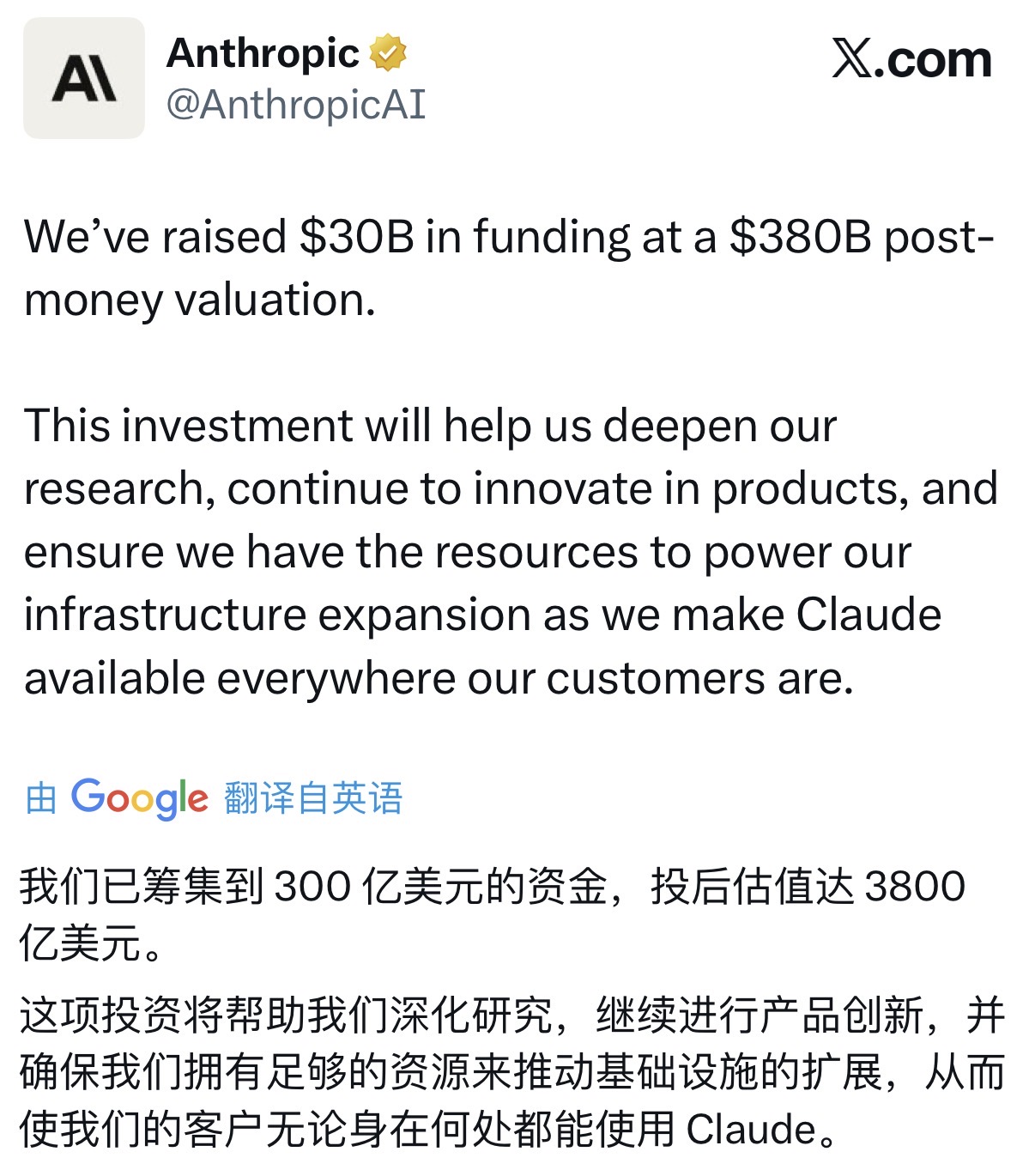
Anthropic完成300亿美元G轮融资,投后估值达3800亿美元
Sou Hu Cai Jing· 2026-02-13 02:56
Core Insights - Anthropic has completed a Series G funding round totaling $30 billion, raising its post-money valuation to $380 billion, approximately 2.63 trillion yuan [1] - The lead investors in this round are Singapore's sovereign wealth fund GIC and technology hedge fund Coatue [1] Financial Performance - Anthropic's annualized revenue has reached $14 billion, doubling for three consecutive years [3] - The number of clients spending over $100,000 annually on Claude has increased sevenfold in one year, with over 500 clients now exceeding $1 million in annual spending [3] Product Development - Claude Code, Anthropic's programming assistant, has achieved an annualized revenue of $2.5 billion, with both annualized revenue and weekly active user numbers doubling since the beginning of the year [6] - The number of enterprise subscription users for Claude Code has quadrupled since the start of the year, with enterprise user revenue now accounting for over half of Claude Code's total revenue [6]

AI投资人:1-5年内AI将消灭 50%入门级白领岗位
阿尔法工场研究院· 2026-02-13 02:33
Core Viewpoint - The article emphasizes that the release of GPT-5.3 Codex and Claude Opus 4.6 on February 5, 2026, marks a critical turning point in AI capabilities, impacting knowledge workers sooner and more broadly than anticipated [2]. Group 1: AI's Rapid Advancement - The author compares the current perception of AI to the early days of the COVID-19 pandemic, suggesting that many are underestimating the scale and speed of AI advancements [3]. - The pace of AI improvements has accelerated significantly, with new models showing substantial enhancements in capabilities and shorter intervals between releases [4]. - The author describes a personal experience where AI independently completed tasks with high quality, indicating a shift in how AI can be utilized in various fields [4]. Group 2: Implications for Knowledge Work - AI's ability to write code is seen as a strategic advantage, enabling the development of more advanced AI systems, which could eventually impact all knowledge work sectors, including law, finance, and healthcare [5]. - The article discusses the ongoing debate about AI's progress, asserting that those who claim AI has hit a wall are likely using outdated models or have a vested interest in downplaying its capabilities [7]. - A timeline of AI advancements is provided, illustrating rapid progress from basic arithmetic capabilities in 2022 to the potential for AI to handle significant coding tasks by 2025 [7][8]. Group 3: Future Workforce Changes - Predictions suggest that AI could eliminate 50% of entry-level white-collar jobs within 1-5 years, with the author noting that this is a conservative estimate [11]. - The article highlights that AI is a general substitute for cognitive work, making it challenging for workers to transition to new roles as AI continues to improve across various domains [11]. - The author emphasizes that the latest AI models exhibit decision-making capabilities that resemble human judgment, raising concerns about job security for many roles that involve computer-based tasks [11]. Group 4: Practical Recommendations - The article provides actionable advice, urging individuals to subscribe to paid versions of AI tools and actively integrate them into their work processes [13][15]. - It encourages users to experiment with AI daily, suggesting that hands-on experience will enhance understanding and adaptability to ongoing changes in the industry [15]. - The author warns that many professionals are currently ignoring AI's potential, and those who leverage it effectively will gain a competitive advantage [14]. Group 5: Broader Implications of AI - The article concludes with a discussion on the potential societal impacts of AI, including both positive advancements in fields like medicine and negative consequences such as increased surveillance and security threats [17]. - The author presents a thought experiment about a hypothetical nation with super-intelligent citizens, highlighting the dual-edged nature of AI advancements [17].