翔宇医疗

Search documents
强脑科技 20 亿融资紧随 Neuralink,脑机接口赛道双线发力
Huafu Securities· 2026-01-10 11:04
Investment Rating - The industry rating is "Outperform the Market," indicating that the overall return of the industry is expected to exceed the market benchmark index by more than 5% in the next 6 months [14]. Core Insights - Strong Brain Technology has completed approximately 2 billion yuan in financing, making it the second-largest in the global brain-computer interface (BCI) sector, following Neuralink. This financing round was led by IDG Capital and Huaden International, with participation from industry chain companies, enabling product scaling through a "capital + manufacturing" model [4][6]. - The company focuses on non-invasive technology, with its core product, the "Super Sensor," capable of capturing brain electrical signals without the need for surgery. This technology has already assisted individuals with disabilities in performing complex movements, with plans to help one million disabled individuals regain mobility and assist ten million patients in rehabilitation over the next 5-10 years [4][6]. - Neuralink, a key player in the BCI field, is set to initiate large-scale production of BCI devices in 2026 and is advancing fully automated surgical solutions. This invasive technology complements Strong Brain Technology's non-invasive approach, collectively driving the commercialization of global BCI technology [5][6]. - The global BCI market is projected to grow rapidly, with an estimated market size of approximately 2.62 billion USD in 2024, expected to reach 2.94 billion USD in 2025, and potentially grow to 12.4 billion USD by 2034, reflecting a compound annual growth rate (CAGR) of 17.35% over the next decade. In China, the BCI market is anticipated to reach 3.2 billion yuan in 2024 and 6.14 billion yuan by 2028 [6]. Summary by Sections Financing and Market Position - Strong Brain Technology has secured around 2 billion yuan in financing, ranking second globally in the BCI sector, just behind Neuralink [4]. - The financing round was led by IDG Capital and Huaden International, with contributions from various industry chain companies [4]. Technology and Product Development - The company's non-invasive "Super Sensor" technology captures brain signals without surgery, aiding individuals with disabilities [4]. - Plans are in place to assist one million disabled individuals and ten million patients in rehabilitation over the next 5-10 years [4]. Market Growth Projections - The global BCI market is expected to grow from 2.62 billion USD in 2024 to 12.4 billion USD by 2034, with a CAGR of 17.35% [6]. - The Chinese BCI market is projected to grow from 3.2 billion yuan in 2024 to 6.14 billion yuan by 2028 [6].
翔宇医疗:手功能热电治疗仪入选优秀国产医疗设备产品目录
Zheng Quan Shi Bao Wang· 2026-01-10 10:16
人民财讯1月10日电,据翔宇医疗消息,近日,由翔宇医疗研发生产的手功能热电治疗仪(型号:XY-K- SRD-I),成功入选第十一批《优秀国产医疗设备产品目录》。它不仅突破了传统手功能康复设备无法直 接作用于指神经的难题,并且创新性地融合了三种康复疗法,为广大康复医师与治疗师提供了一款融合 创新与实用的专业治疗工具。 ...

又一地明确价格!脑机接口收费路径逐渐清晰
财联社· 2026-01-10 07:01
Core Insights - The article discusses the establishment of pricing for brain-computer interface (BCI) medical services in various provinces in China, highlighting the integration of these services into the healthcare system and the support from government policies [4][5][10]. Pricing and Policy Developments - The Sichuan Provincial Medical Insurance Bureau has set a maximum price for BCI services, effective from April 30, 2026, with different pricing based on hospital levels for invasive procedures [4]. - Other provinces, including Hubei, Zhejiang, and Jiangsu, have also established pricing for BCI services, with costs for invasive procedures ranging from approximately 6,000 to 6,600 yuan per procedure [5][6][7]. - The pricing structure includes insertion fees, removal fees, and adaptation fees, with some provinces incorporating non-invasive adaptation fees into insurance coverage [5][8]. Government Support and Strategic Planning - The Chinese government has outlined a strategic plan to support the BCI industry through policies that focus on planning, payment, and standards, aiming for significant advancements by 2030 [10][11]. - Multiple provinces have released action plans to promote BCI innovation and commercialization, with specific targets for clinical applications and production [11]. Technological Advancements and Market Potential - The article notes that while invasive BCI products are still in clinical trials, non-invasive products have begun to enter the market, indicating a growing application space [12]. - The industry is at a critical juncture where technological breakthroughs are expected to lead to commercial viability, supported by favorable policies and anticipated production from companies like Neuralink [15][17]. Investment Opportunities - Analysts suggest focusing on key segments of the BCI industry, including hardware suppliers, companies with core patents, and those involved in rehabilitation and industrial applications [15][16]. - Specific companies are highlighted as potential beneficiaries of the BCI market growth, including Aipeng Medical, Lepu Medical, and Xiangyu Medical, among others [16].

脑机接口的“身份证”来了?新晋顶流,最强马斯克概念!
Jin Rong Jie· 2026-01-09 06:34
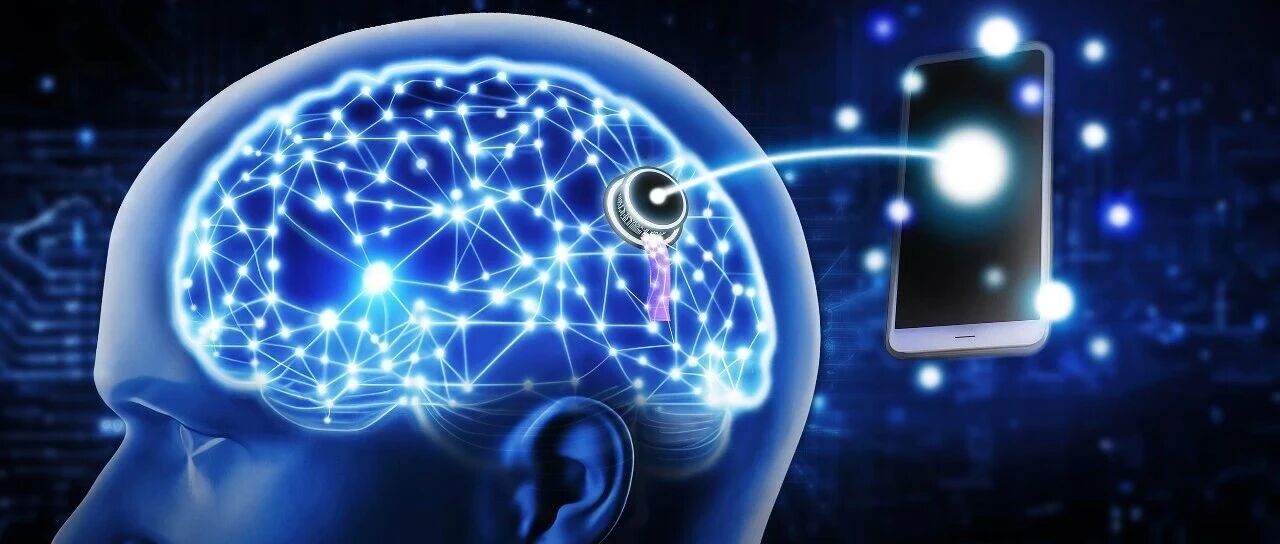
Core Insights - The announcement of the first non-invasive brain-computer interface (BCI) medical device registration in China marks a significant shift from laboratory research to clinical and market applications, indicating a new growth trajectory for the industry [1][2] - The medical device sector is experiencing a surge, with companies like Dean Diagnostics and Kingmed Diagnostics hitting their upper trading limits, reflecting strong market interest in BCI technologies [1][3] - The BCI sector is seen as a promising investment opportunity, with a clean chip structure and lower entry points compared to other tech sectors like satellites and chips [1] Industry Developments - The Chinese government has included BCI in its new five-year plan as a key future industry, signaling ongoing support for research and approval processes [2][3] - Major players in the industry are accelerating their efforts, with Neuralink announcing plans for large-scale production by 2026 and significant investments being made domestically [2][3] - Technological advancements in China, such as the ability for paralyzed patients to drink water using their thoughts, demonstrate the country's leadership in BCI technology [2] Market Dynamics - The BCI technology is categorized under medical devices, which are essential for addressing real and painful issues faced by patients, such as stroke recovery and spinal cord injuries [3][4] - The medical device index ETF (159898) includes approximately 24% of companies with substantial BCI business operations, providing an efficient investment vehicle for this emerging sector [3][4] - The medical device sector, which has faced declines over the past four years, is expected to see a turnaround driven by advancements in BCI technology [4]
国内首张非侵入式脑机接口证出炉!医疗器械指数ETF(159898)午后拉升、标的指数“含脑量”约24%
Sou Hu Cai Jing· 2026-01-09 06:21
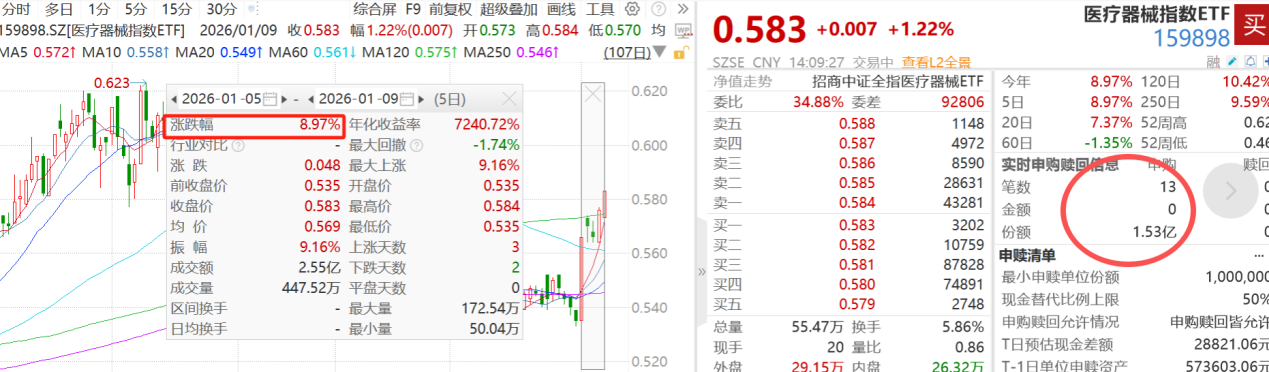
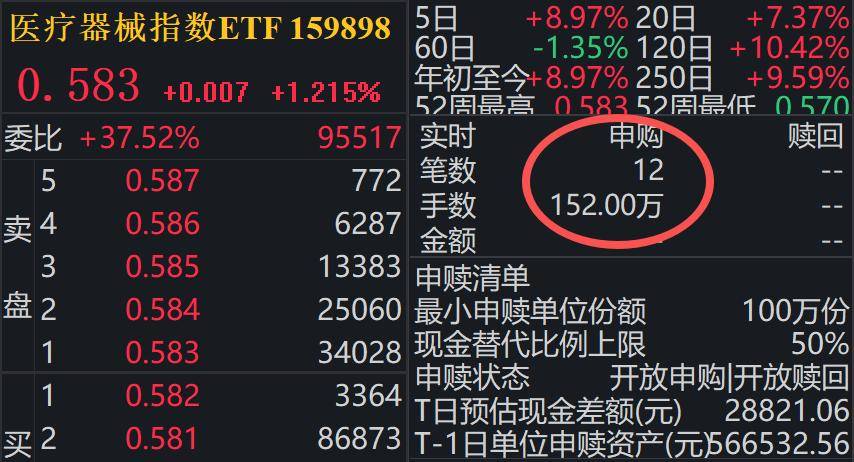
Group 1 - The medical device sector is experiencing a significant rally, with the Medical Device Index ETF (159898) seeing a net inflow of over 88 million yuan during intraday trading on January 8, following a previous inflow of over 116 million yuan [1] - Key stocks such as Di'an Diagnostics and Kingmed Diagnostics reached their daily limit, while others like Anbiping and Xiangsheng Medical saw gains exceeding 10% and 9% respectively [1] - The Medical Device Index ETF (159898) has a current scale of 659 million yuan, with approximately 24% of its holdings related to the brain-computer interface (BCI) concept [2][3] Group 2 - The brain-computer interface industry is highlighted as a key development area in the new five-year plan, with supportive policies for clinical trials, registration, and pricing [1] - Strong Brain Technology, a leading BCI company, recently completed a financing round of about 2 billion yuan, marking it as the second-largest financing in the BCI field globally, after Neuralink [2] - The Medical Device Index ETF (159898) includes several companies with substantial involvement in the BCI sector, making it a convenient and efficient tool for investment in this emerging field [3]
卓越新能涨停 13只科创板股涨超10%
Zheng Quan Shi Bao Wang· 2026-01-09 03:28
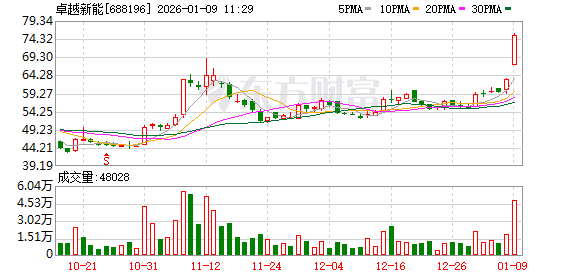
Group 1 - The core point of the article highlights the significant performance of Zhuoyue New Energy on the STAR Market, with its stock price reaching a limit-up of 75.74 yuan and a trading volume of 230 million yuan, indicating strong investor interest [2] - Among STAR Market stocks, 440 stocks were reported to be rising, with 13 stocks experiencing an increase of over 10%, including Zhuoyue New Energy, while 145 stocks were declining, with notable drops from Xinyuan Micro, Bibet-U, and Xiangyu Medical, which fell by 7.21%, 6.04%, and 4.66% respectively [2] - The stock saw a net inflow of 3.43 million yuan from main funds on the previous trading day, but there was a net outflow of 11.03 million yuan over the last five days [3] Group 2 - As of January 8, the margin trading balance for Zhuoyue New Energy was reported at 83.88 million yuan, with a financing balance of 83.52 million yuan, which increased by 14.23 million yuan, representing a growth of 20.54% from the previous trading day [3] - The margin trading balance increased by a total of 12.08 million yuan over the last ten days, reflecting a growth rate of 16.82%, with financing balance growth at 16.83% and a 15.14% increase in the securities lending balance [3]

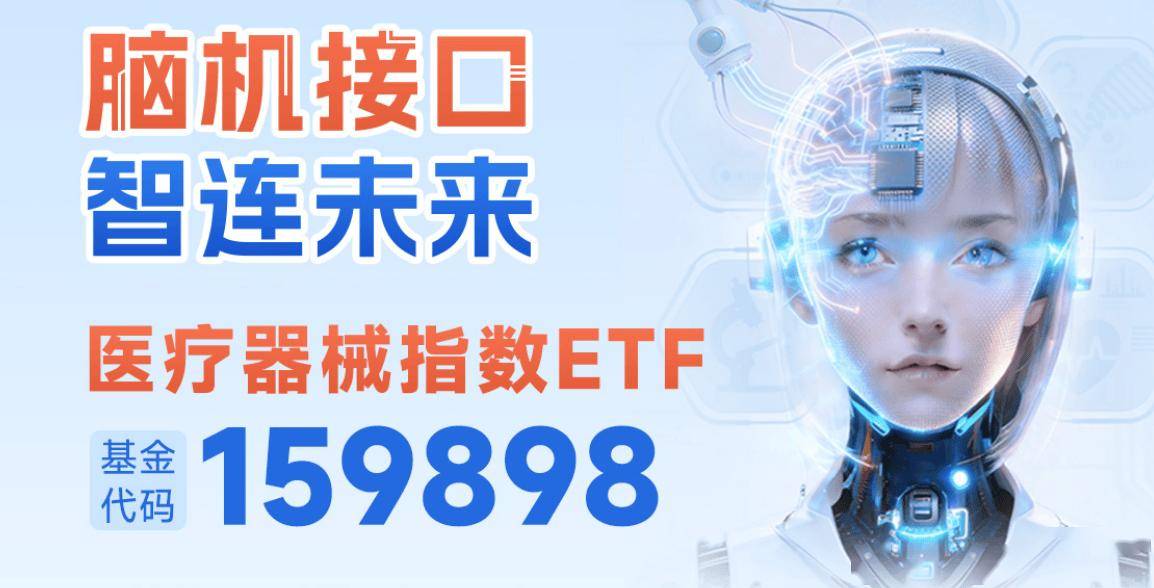
脑机接口量产临界,医疗器械指数ETF(159898)连续4日获资金净流入、规模站上新高
Sou Hu Cai Jing· 2026-01-09 03:24
Group 1 - The core viewpoint of the article highlights the increasing market and funding attention towards brain-computer interfaces (BCIs), which are seen as a cutting-edge technology with significant future industry potential [2] - The medical device index ETF (159898) has seen a net inflow of over 170 million yuan in the last four trading days, with a single-day inflow exceeding 116 million yuan on January 8, marking a new high in its scale [2] - The medical device index ETF (159898) includes approximately 24% of companies with substantial involvement in the BCI sector, making it a convenient and efficient tool for investment in this emerging field [2][3] Group 2 - BCIs are interdisciplinary technologies that integrate neuroscience, computer science, and medicine, enabling direct communication between the brain and external devices [4] - Current applications of BCI technology are primarily in medical rehabilitation, particularly for patients recovering from strokes and spinal cord injuries, with potential future applications in education, entertainment, and industry [4] - The BCI sector is expected to experience strong growth driven by simultaneous advancements in policy, industry, and technology, with significant milestones anticipated by 2026 [7] Group 3 - The domestic BCI "unicorn" company, Qiangnao Technology, recently completed approximately 2 billion yuan in financing, becoming the second-largest financing in the BCI field globally, following Neuralink [7] - The Chinese government is actively supporting the BCI industry through various policies, emphasizing its importance as a key development area in the new five-year plan [7] - Recent breakthroughs in domestic BCI technology include successful clinical trials of fully implanted, wireless BCI products, indicating rapid advancements in the field [9] Group 4 - China's BCI market size grew from approximately 1 billion yuan in 2020 to about 1.73 billion yuan in 2023, representing a 12.5% share of the global BCI market [10] - Different institutions have varying growth forecasts for the BCI industry, with estimates suggesting the global market could reach 7.63 billion USD by 2029 [11] - The global BCI market is projected to grow to approximately 12.4 billion USD by 2034, with a compound annual growth rate (CAGR) of 17% from 2025 to 2034 [14] Group 5 - BCIs are considered a potential key catalyst for driving upward trends in the medical device sector, supported by innovation and policy backing [15] - The medical device index ETF (159898) tracks the entire A-share medical device sector, with a pure representation of the industry and a 24% inclusion of BCI concepts, making it suitable for capturing opportunities in this emerging market [15]
翔宇医疗股价跌5.01%,大成基金旗下1只基金重仓,持有9685股浮亏损失4.12万元
Xin Lang Cai Jing· 2026-01-09 01:54
Group 1 - The core point of the news is that Xiangyu Medical's stock price dropped by 5.01% to 80.50 yuan per share, with a total market capitalization of 12.88 billion yuan as of the report date [1] - Xiangyu Medical, established on March 20, 2002, specializes in the research, production, and sales of rehabilitation medical devices, with its main revenue sources being rehabilitation therapy equipment (67.79%), rehabilitation training equipment (22.13%), and other related products [1] Group 2 - From the perspective of major fund holdings, Dachen Fund has a significant position in Xiangyu Medical, with its Dachen Zhihui Quantitative Multi-Strategy Mixed A Fund holding 9,685 shares, unchanged from the previous period, representing 3.76% of the fund's net value [2] - The Dachen Zhihui Quantitative Multi-Strategy Mixed A Fund has a total asset size of 8.42 billion yuan, with a year-to-date return of 2.37% and a one-year return of 28.86% [2][3]
是风口还是泡沫? 多家公司提示风险
Shen Zhen Shang Bao· 2026-01-08 18:02
Group 1 - The core focus of the news is the surge in stock prices of companies involved in brain-computer interface (BCI) technology, reminiscent of the AI boom following AlphaGo's victory over Lee Sedol in 2016, with a notable increase in the sector's stock prices exceeding 12% on the first trading day of 2026 [1] - Companies like Sanbo Neuroscience and Xiangyu Medical have experienced consecutive trading halts, with Xiangyu Medical and Weisi Medical achieving two 20% trading halts in four trading days, indicating strong market interest [1] - The market's enthusiasm is driven by the perceived potential of the BCI sector, with Morgan Stanley predicting that the U.S. market for BCI implant devices could reach $80 billion by 2035 [1] Group 2 - Despite the excitement, experts caution that medical-grade applications of BCI are expected to take 3 to 5 years for approval, while consumer-grade products face challenges such as bulkiness, low user engagement, and high costs [2] - Historical precedents raise concerns about the sustainability of the current hype, with past instances like the metaverse index and AI stocks experiencing significant volatility [2] - Investment in the BCI sector has seen 16 financing events totaling 983 million yuan in 2025, but no products have been commercially launched yet, indicating that many startups are still in the concept validation stage [2] Group 3 - Sanbo Neuroscience clarified that it does not engage in the research, production, or sales of BCI products, and the revenue from neuro-regulation technology is minimal, having little impact on overall performance [3] - Xiangyu Medical acknowledged its investment in BCI technology but noted that related products have not achieved significant sales volume as of the end of 2025 [3] - Some companies, like Yahui Long, faced regulatory warnings for inaccurate disclosures related to BCI partnerships, highlighting the risks of speculative trading in this sector [3]




脑机接口"独角兽"强脑科技斩获20亿融资,全球融资规模仅次于Neuralink!
机器人圈· 2026-01-08 10:13
Core Viewpoint - BrainCo, a leading company in the brain-computer interface (BCI) sector, has successfully completed a financing round of approximately 2 billion RMB, marking it as the second-largest financing in the global BCI market, following Neuralink [2] Financing and Investment - The recent financing attracted a prestigious lineup of investors, including IDG, Huaden International, and major industry players like Lens Technology and Lingyi iTech [2] - BrainCo's financing history shows a consistent increase in capital recognition, with significant rounds including 400 million USD in Series A in 2019 and 30 million USD in Pre-B and 20 million USD in Series B in 2025 [3] - The company is preparing for an IPO, potentially in Hong Kong or mainland China, with a valuation exceeding 1.3 billion USD anticipated for the upcoming round [3] Company Background and Product Development - Founded in February 2015 by Han Bicheng, BrainCo focuses on non-invasive BCI technology, having developed products like smart prosthetics and sleep improvement devices [3][4] - The company has received FDA and CE certifications, making it one of the few globally to achieve large-scale production of BCI products [4] Future Plans and Market Potential - BrainCo aims to assist 1 million individuals with physical disabilities and 10 million patients suffering from Alzheimer's, autism, and insomnia over the next 5 to 10 years [5] - The company is committed to advancing non-invasive BCI solutions for mental health issues like depression and Alzheimer's, aligning with China's increased investment in brain science [5] Industry Landscape - Neuralink remains the highest-valued BCI company globally, with a valuation of 9 billion USD post-E round financing in 2025 [5] - The BCI sector is gaining traction in the capital market, with several A-share companies experiencing significant stock performance related to BCI concepts [6] - Companies like Aihuilong and Kefu Medical are entering the BCI space, indicating a growing interest and investment in this emerging field [6] Investment Opportunities - The BCI industry is in its early commercialization phase, with a focus on thematic investment strategies [6] - There is potential for significant revenue generation in non-invasive BCI products, as well as opportunities in software, hardware, and experimental materials related to BCI [6]