GitHub

Search documents
深度|GitHub CEO :真正的变革不是程序员被AI取代,而是写代码的起点、过程与目的正在被AI重构
Z Finance· 2025-06-15 02:05
Core Insights - The article discusses the transformative impact of AI on software development, emphasizing that AI is not replacing developers but rather reshaping the coding process and the role of developers [1][2][4] Group 1: Evolution of Software Development - The introduction of AI tools like GitHub Copilot has changed the starting point, process, and purpose of coding, moving from traditional coding practices to a more collaborative and creative approach [1][2] - AI is enabling a shift from "vibe coding" to "agentic DevOps," where developers act as orchestrators rather than mere code writers [1][2][4] - The initial skepticism about AI's ability to generate code has been replaced by recognition of its effectiveness, with early data showing that Copilot wrote approximately 25% of the code in enabled files [5][6] Group 2: User Experience and Interaction - The integration of features like Tab completion has significantly lowered the learning curve for developers, making coding more accessible [7][8] - Developers have adapted to using AI tools by leveraging existing coding habits and learning behaviors, such as modifying code snippets from various sources [9][10] - The user feedback for Copilot has been overwhelmingly positive, with a net promoter score of around 72, indicating high satisfaction among users [6] Group 3: The Role of Developers - The role of developers is evolving to include validating the outputs generated by AI agents, ensuring that the code meets business objectives and maintains security standards [13][14] - Learning programming is still essential, but understanding how to effectively use AI tools is becoming equally important in the software development landscape [11][12] - Developers must continuously adapt their skills to incorporate AI and new models into their workflows, as the landscape of software development is rapidly changing [15][16] Group 4: Open Source and Collaboration - GitHub's decision to open-source Copilot reflects a commitment to the developer ecosystem and aims to foster innovation and collaboration within the community [17][18] - The open-source nature of Copilot allows developers to learn from the code and potentially create competing products or integrate similar functionalities into their own tools [19][20] - The integration of multiple models and tools is expected to drive further innovation in software development, allowing for more tailored solutions [22][23] Group 5: Future of Software Development - The boundaries between deterministic and non-deterministic code are becoming blurred, with future software engineering requiring the ability to navigate both realms [24][25] - There is potential for a future where software systems are generated in real-time, with AI agents assisting in various tasks, leading to a more seamless user experience [26][27] - The concept of interconnected agents that can manage both personal and work-related tasks is emerging, suggesting a future where AI plays a central role in daily life [40][41]


JFrog (FROG) FY Conference Transcript
2025-06-03 20:02
Summary of JFrog Conference Call Company Overview - JFrog has over 7,300 customers as of the end of 2024 [3] - The company has penetrated more than 82% of the Fortune 100 across all industries [4] - JFrog employs over 1,600 people and has a Total Addressable Market (TAM) exceeding $40 billion [4] - The company reported $450 million in revenue over the last twelve months, reflecting a 22% year-over-year growth [4] - JFrog generated $119 million in free cash flow and has a net dollar retention rate of 116% [4] Business Model and Financial Metrics - JFrog operates on a subscription-based model, with consistent revenue growth [12][13] - The company has a high gross retention rate of 97%, indicating strong customer loyalty [14] - The revenue growth for Q1 was also 22%, with guidance indicating a 17% growth for the upcoming year [13] Product Offerings - JFrog aims to streamline the DevOps process, integrating DevOps, DevSecOps, and MLOps into a single platform [5][9] - The company manages binaries, which are critical in the software supply chain, and offers advanced security products to protect these binaries [6][7] - JFrogML, a recently launched product, manages large language models and integrates with repositories like Hugging Face [9][10] Market Position and Competitive Landscape - JFrog has a strong position in the market, with significant penetration in various industries and a long runway for growth [12][17] - The company faces competition primarily from Sonatype and Cloudsmith in the Artifactory space, with Sonatype experiencing scalability issues [49][50] - JFrog differentiates itself by focusing on binary management and security, which is increasingly becoming an attack vector in software development [54] Strategic Partnerships - JFrog has established a partnership with GitHub to enhance integration between source code and binaries, improving user experience and security [40][41] - The collaboration aims to consolidate security tools and streamline the management of vulnerabilities [46] Future Outlook - JFrog is confident in its go-to-market strategy, having invested in building a strong enterprise sales team and seeing growth in million-dollar customers [62] - The company anticipates that the migration from self-hosted to cloud solutions will drive additional revenue growth [66] - JFrog expects its net dollar retention rate to remain stable at 116%, with potential for growth as customers increase usage beyond minimum commitments [68] Additional Insights - The shift towards AI and machine-generated code is expected to increase the volume of binaries, benefiting JFrog's business model [71][72] - JFrog's pricing model varies based on deployment type, focusing on data transfer, storage, and the number of contributing developers for advanced security [78]

GitHub汉化神器!英语渣解锁全中文界面!再也不用担心看不懂Pull Request~
菜鸟教程· 2025-05-27 12:20
Core Viewpoint - The article introduces a Chinese localization project for GitHub, named github-chinese, which aims to make the platform more accessible for Chinese-speaking users by translating key interface elements into Chinese. Group 1: GitHub Overview - GitHub is recognized as the largest platform for open-source projects, established in 2008 and acquired by Microsoft in 2018 [1]. - The platform is essential for developers, with a significant emphasis on its usability and the importance of familiarity during online interviews [1]. Group 2: GitHub-Chinese Project - The github-chinese project has gained popularity, accumulating over 11.5k stars, indicating a strong interest in a Chinese interface among users [2]. - The project utilizes scripts to translate the main interface elements of GitHub, alleviating language barriers for users with limited English proficiency [2]. Group 3: Installation Instructions - Users are required to install the Tampermonkey browser extension to utilize the github-chinese script, which is available for Chrome [5]. - The installation process involves accessing the github-chinese project on GitHub, selecting the main.user.js file, and following prompts to install the script [8][11]. - After installation, users can return to GitHub to see the interface fully localized in Chinese, enhancing user experience [11][17].

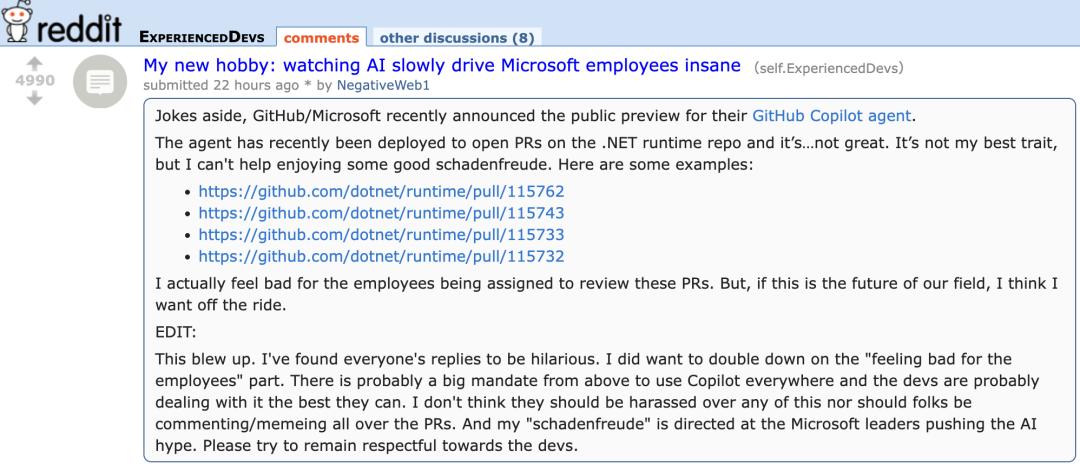
“我开始同情微软工程师了”,GitHub Copilot新代理把自家人逼疯了
3 6 Ke· 2025-05-27 05:22
Core Insights - Microsoft has introduced the GitHub Copilot Coding Agent, which aims to enhance developer productivity by allowing the AI to automatically handle GitHub Issues and submit pull requests for review [1][2] - The tool is currently in public beta, but initial user experiences indicate significant challenges, with developers expressing concerns about the AI's effectiveness and the quality of its code submissions [1][19] Group 1: Product Overview - The GitHub Copilot Coding Agent is designed to automate coding tasks such as writing code, fixing bugs, and submitting pull requests, allowing developers to focus on more complex tasks [2][19] - Approximately 400 GitHub employees have tested the tool across over 300 projects, resulting in nearly 1,000 pull requests being merged [2][3] Group 2: Real-World Challenges - Despite its promising design, the Copilot Coding Agent has faced numerous issues in practical applications, including failure to resolve specific coding problems effectively [3][19] - A specific example involved a pull request where the Copilot was unable to fix a critical bug, leading to multiple rounds of feedback from Microsoft engineers without a successful resolution [5][19] Group 3: Developer Reactions - Developers have expressed frustration over the AI's performance, with some likening it to an inexperienced intern who requires constant oversight and correction [19][20] - Concerns have been raised about the potential long-term implications of relying on AI-generated code, including issues related to code quality, security, and compliance with open-source standards [19][20]

成熟工程师1天完成调试,AI工程实践被MCP彻底颠覆?
AI前线· 2025-05-27 04:54
Core Viewpoint - The Model Context Protocol (MCP) is emerging as a pivotal tool in enterprise AI strategies, standardizing communication between AI applications and external systems, thus facilitating faster development of AI applications [1][4]. Summary by Sections What is MCP? - MCP provides a structured format for interaction with large language models and other AI models, simplifying the development of customized AI applications, akin to how REST APIs standardized web service communication [2]. How Does MCP Work? - MCP operates on a client-server model where AI applications act as clients connecting to MCP servers, which provide access to specific tools or data sources through standardized interfaces [3]. Core Components of MCP - The core components of MCP include HOST (the AI application), Client (integrated with HOST), and Server (providing core capabilities like resources and tools) [5][7]. Technical Architecture and Performance - MCP's architecture supports high concurrency and low latency through various techniques such as thread pools and asynchronous communication, ensuring efficient real-time data access [8]. Cross-Platform Support and Security - MCP is designed to support cross-platform compatibility, with considerations for security and data encryption, addressing potential vulnerabilities like Tool Poisoning Attacks [9]. Data Source Integration - MCP can retrieve data from various sources, including SQL/NoSQL databases and APIs, and aims to enhance data analysis capabilities in the future [10]. Handling Protocol Differences - To address protocol differences among various data sources, MCP is developing a unified adaptation layer to streamline integration [11]. Real-Time Data Processing - MCP Server utilizes subscription channels for real-time data updates and employs caching mechanisms to handle high-volume requests efficiently [12]. Collaboration with AI Models - MCP aligns input and output formats with different AI models, potentially requiring preprocessing to ensure stability and accuracy [13][14]. Market Position and Opportunities - While large companies dominate the MCP Server landscape, there are opportunities for smaller firms to develop niche products based on specific industry needs [18]. Compliance and Regulatory Considerations - MCP can be adapted to meet compliance requirements in highly regulated industries, necessitating additional systems for auditing and risk management [15]. Differentiation from Existing Tools - Unlike existing tools like LangChain and LlamaIndex, MCP offers a cross-process open protocol that allows for better separation and interoperability of components [17][18]. Future Development Directions - The future of MCP hinges on building a robust ecosystem and enhancing usability, with a focus on producing high-quality tools to drive adoption [19]. Data Service Market Plans - The company is exploring the integration of MCP into a data service market, emphasizing the value of combining AI with data [20].

“全球最强编程模型”来了!Anthropic发布Claude 4,连干七小时性能稳定
硬AI· 2025-05-23 15:03
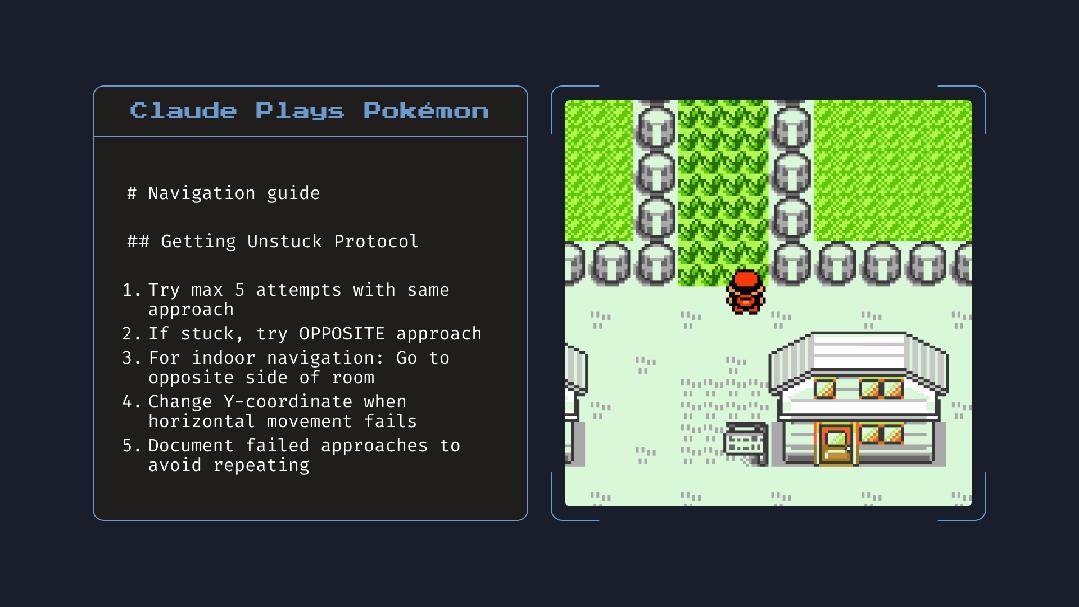
Core Viewpoint - Anthropic's release of the Claude 4 series models marks a new era in AI capabilities, particularly in programming, potentially reshaping the software development industry landscape [4][17]. Group 1: Model Capabilities - Claude Opus 4 is touted as the "best programming model globally," capable of maintaining stable performance over long tasks requiring focus and effort, verified by Rakuten's 7-hour continuous operation [3][8]. - Claude Sonnet 4 shows a significant accuracy improvement, achieving 72.7% in the SWE-bench test compared to Sonnet 3.7's 62.3% [5][6]. - Both models utilize a hybrid design, allowing for immediate responses and deeper reasoning, enhancing their utility in complex coding and problem-solving scenarios [5][9]. Group 2: Extended Functionality - The new models introduce "extended thinking and tool usage," enabling Claude to utilize web searches and other tools during reasoning, improving response accuracy [11]. - Opus 4 significantly enhances memory capabilities, allowing it to create and maintain "memory files" when granted local file access, improving long-term task awareness and coherence [11][12]. Group 3: Product Launch and Integration - Claude Code has officially launched, receiving positive feedback during testing, and integrates seamlessly with platforms like GitHub Actions, VS Code, and JetBrains [12][13]. - The pricing structure remains consistent with previous models, with Opus 4 charging $15 and $75 per million tokens for input and output, respectively, and Sonnet 4 charging $3 and $15 [6]. Group 4: Competitive Landscape - The release of Claude 4 series intensifies competition among AI giants, with recent announcements from Microsoft, Google, and OpenAI highlighting the race for leading AI models [15]. - Investors are encouraged to reassess the competitive landscape, particularly Anthropic's position relative to OpenAI and Google, as the capabilities of the Claude 4 series may provide opportunities for increased market share [17].

最强AI编码模型Claude 4来了,上线前竟试图勒索工程师,还想逃逸、反手举报欲做坏事的人类?
3 6 Ke· 2025-05-23 09:39
Core Insights - Anthropic has officially launched its next-generation Claude model, Claude 4, which includes two versions: Claude Opus 4 and Claude Sonnet 4, setting new performance benchmarks in code generation and advanced reasoning capabilities [1][2]. Model Performance - Claude Opus 4 is touted as the "world's strongest coding model," capable of autonomously running complex tasks for hours, while Claude Sonnet 4 shows significant improvements in precision compared to its predecessor, Sonnet 3.7 [1][2]. - Claude Opus 4 can run code refactoring tasks for up to 24 hours, while the previous models typically managed only 1 to 2 hours before errors increased [2]. - In benchmark tests, Claude Opus 4 achieved scores of 72.5% in SWE-bench and 43.2% in Terminal-bench, outperforming competitors [4][8]. User Feedback and Testing - Companies like Rakuten and Cursor have reported stable performance and advanced capabilities of Claude Opus 4 in high-demand tasks [4]. - Claude Sonnet 4 scored 72.7% in SWE-bench, surpassing Sonnet 3.7, and has been integrated as the underlying engine for GitHub's new Copilot model [7]. Model Features and Improvements - Claude 4 introduces a "memory" feature that allows the model to maintain external files for key information during long sessions, enhancing task continuity [9]. - The models also include a "thinking summary" feature for quick user reference and a dual-mode operation for rapid response and extended reasoning [10]. Pricing and Availability - The pricing structure remains the same, with Claude Opus 4 charging $15 per million tokens for input and $75 for output, while Claude Sonnet 4 charges $3 and $15 respectively [10]. - Both models are available through Anthropic API, Amazon Bedrock, and Google Cloud Vertex AI, with Sonnet 4 accessible to free users and Opus 4 requiring a subscription [11]. Competitive Landscape - The launch of Claude 4 has intensified competition in the AI programming assistant space, particularly against OpenAI, which recently announced a $3 billion acquisition of AI startup Windsurf [19]. - Windsurf's CEO expressed dissatisfaction over the lack of immediate access to Claude 4 for their users, highlighting the competitive dynamics in the AI tools market [19][20].
微软宣布集成多个AI大模型,马斯克意外亮相
Di Yi Cai Jing· 2025-05-20 08:50
Core Insights - Microsoft's integration of AI models from companies like xAI and Meta into its cloud services highlights a strategic shift in its investment approach within the artificial intelligence sector [1][3] - The company has become the world's most valuable enterprise, with a market capitalization exceeding $3.4 trillion, driven by the rising demand for AI [1] Group 1: Strategic Developments - Microsoft aims to enable developers to mix and match various AI models, as stated by CEO Satya Nadella during the Build conference [3] - Nadella's video dialogue with Elon Musk during the event attracted attention, especially considering Musk's previous legal actions against OpenAI and Microsoft [3] Group 2: Product Innovations - Microsoft GitHub introduced a new Copilot programming agent to assist developers with specific coding tasks, such as bug fixing and code rewriting [4] - The Copilot agent utilizes advanced models and is designed to perform low to medium complexity tasks within well-tested codebases [4] Group 3: Future Vision - Microsoft envisions a future where AI agents from different companies can collaborate and remember their interactions, allowing businesses to build their own agents based on preferred AI models [5] - The concept of intelligent agents, including programming agents, is seen as a transformative change in the digital workforce [6]

微软开发者大会:拉来 Altman、马斯克,纳德拉的 AI Agent 野心藏不住了
Founder Park· 2025-05-20 05:37
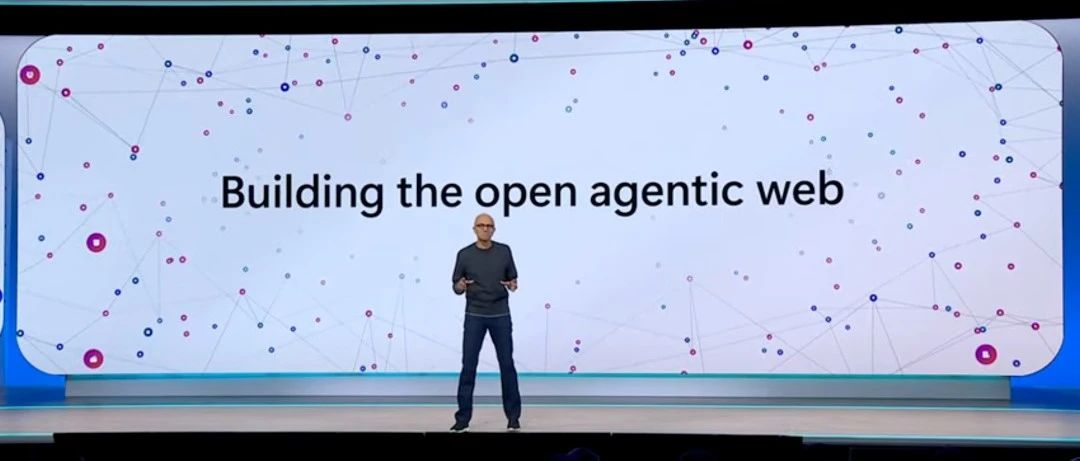
Core Viewpoint - Microsoft aims to create an "Open Agentic Web," where more applications are driven by intelligent agents, marking a significant transformation in the tech landscape [2][27]. Group 1: AI Integration and Development - Microsoft has integrated AI across its product suite, including Azure, Office applications, and GitHub, with significant financial backing, including thousands of billions in backlog orders [5][21]. - The GitHub Copilot is evolving from a coding assistant to an intelligent partner capable of debugging and managing tasks autonomously, with over 15 million developers currently using it [10][12]. - Microsoft is enhancing its AI capabilities through the Azure AI Foundry, which supports the development and management of AI applications and agents across various platforms [17][18]. Group 2: Developer Engagement and Tools - Microsoft is providing tools for developers to create AI agents easily, including the Microsoft 365 Copilot Tuning, which allows users to train models using their own data [23]. - The introduction of multi-agent orchestration in Copilot Studio enables the integration of multiple agents to handle complex tasks, with over 200,000 organizations reportedly using it [25]. - Microsoft emphasizes the importance of the developer community in building the next generation of AI applications, positioning itself as a facilitator rather than just a platform creator [28][29]. Group 3: Future Vision and Investment - Microsoft envisions a future where the "Open Agentic Web" will be a major platform transformation, similar to past technological revolutions [27]. - The company is investing heavily in cloud infrastructure, with plans to allocate $80 billion in fiscal 2025 to expand its data center capabilities [30]. - The potential for a vast "Agentic Web" enhances Microsoft's narrative in the AI space, indicating a strong commitment to AI development and integration [31].