Scale AI

Search documents
a16z 和红杉联合领投 Kalshi 3 亿美金,又一华人挑战 Scale AI 一年 900 万美金 ARR
投资实习所· 2025-10-11 05:22
Core Insights - Kalshi has completed a significant $300 million Series D funding round, led by a16z and Sequoia, with a valuation reaching $5 billion, marking a rapid increase from its previous $2 billion valuation just four months prior [1][2]. Group 1: Company Overview - Kalshi aims to create a unified liquidity pool for prediction markets, facilitating global expansion and connecting traders across over 140 countries [3][4]. - The company has experienced a remarkable growth trajectory, with trading volume increasing 200 times to $50 billion in the past year and a user base expanding 20 times [4]. Group 2: Market Potential - Prediction markets are evolving into a mature financial asset class, allowing direct trading based on real-world events, which could position them as one of the largest asset categories globally [4]. - Kalshi's platform is designed to provide event contracts that cover various sectors, including elections and economic changes, offering businesses and investors a means to hedge risks [9]. Group 3: Economic Theory - The investment in Kalshi is rooted in classical economic theories articulated by Friedrich Hayek, emphasizing the decentralized nature of knowledge and the market's role as an information system [6][7]. - Hayek's insights suggest that markets can aggregate dispersed knowledge, transforming it into actionable information through pricing mechanisms, which Kalshi embodies by applying this concept to future predictions [8][10].


AI造富风暴中的“数据卖铲人”传奇:37岁华裔,登顶全球最年轻富豪
Sou Hu Cai Jing· 2025-10-11 01:35
Core Insights - Edwin Chen, a 37-year-old MIT graduate, has made headlines by debuting on the Forbes American Billionaires list with a net worth of $18 billion, thanks to his company Surge AI, which has reached a valuation of $24 billion in the AI data annotation sector [1][4][7] - Surge AI and Scale AI are positioned as key players in the AI industry, providing essential "data fuel" for algorithms, which is crucial for the development of advanced AI models like ChatGPT and Claude3 [4][6] Company Overview - Surge AI was founded by Edwin Chen in 2020 after he identified a significant gap in the data annotation market, particularly after a failed outsourcing attempt at Facebook [5][6] - The company has achieved remarkable growth, generating eight-digit revenue within 12 months of launching its first product, and has since secured contracts with major tech firms like OpenAI, Google, and Microsoft [6][10] Market Dynamics - The AI industry is experiencing a wealth creation surge, with data annotation companies like Surge AI benefiting from their unique positioning as "pick-and-shovel" providers in the AI gold rush [4][9] - The valuation of Surge AI has led to significant wealth accumulation for its founder, who holds 75% of the company's shares, highlighting the lucrative nature of the AI sector [7] Technological Advancements - Surge AI is developing advanced intelligent annotation systems capable of recognizing cultural nuances in over 200 languages and achieving extremely low error rates in medical image annotation [10] - The company is also working on cognitive annotation to enhance data with philosophical and ethical dimensions, setting it apart from competitors focused on basic classification tasks [10][11] Future Outlook - Despite warnings of a potential AI bubble, Edwin Chen remains focused on building a pathway to Artificial General Intelligence (AGI) through innovative data annotation solutions [11] - Surge AI's contracts emphasize the commercial value of data usage rights, indicating a shift towards viewing data as a critical asset in the evolving digital landscape [11]

“反向收购”让AI创业公司分崩离析
3 6 Ke· 2025-10-10 23:11
Core Insights - Major tech companies are increasingly engaging in "reverse acquisition-style hiring" to acquire top talent and technology from AI startups, often leaving the remaining employees struggling in the aftermath [3][4][5][6][7][8][9][11] Group 1: Reverse Acquisition Trends - Companies like Meta, Google, and Microsoft are prioritizing the acquisition of talent and technology licenses over outright purchases of startups, which helps them avoid regulatory scrutiny [3][4][5][6][7][8][9][11] - Since March of the previous year, there have been six notable instances of this trend, with expectations for more as the competition for AI talent intensifies [3] Group 2: Specific Company Actions - Google DeepMind acquired key personnel and technology from Windsurf for $2.4 billion, without taking equity or control of the startup [4] - Meta's acquisition of Scale AI involved a $15 billion deal for core engineers and a 49% stake, leading to a 14% workforce reduction shortly after [5] - Google spent $2.7 billion on Character.AI, acquiring its founders and technology while shifting the startup's focus to AI character development [6] - Amazon's acquisition of Covariant for $380 million included hiring three founders and a quarter of the staff, while obtaining a non-exclusive license for its robotics technology [8] - Amazon also acquired Adept, hiring its CEO and most of the team, while the startup shifted to a more sustainable business model [9][10] - Microsoft's acquisition of Inflection for approximately $653 million involved hiring its founders and most employees, with a significant portion of the funds allocated for licensing its AI models [11]






37岁天才华裔,问鼎「最年轻亿万富豪」
Sou Hu Cai Jing· 2025-10-10 06:17
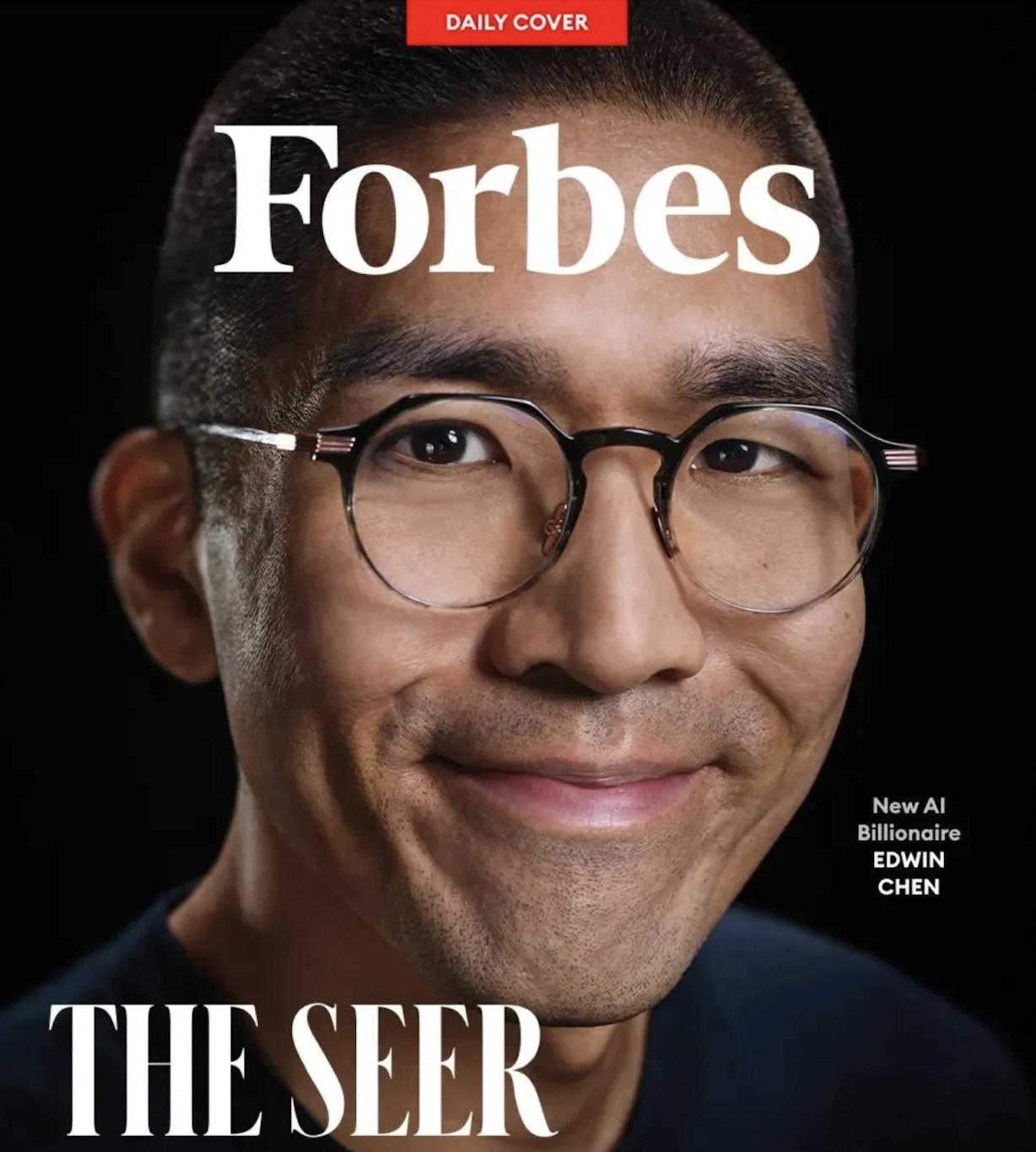
Core Insights - Surge AI, founded by Edwin Chen, is set to raise $1 billion in its first round of financing, potentially valuing the company at approximately $24 billion, with Chen's net worth rising to $18 billion, making him the youngest billionaire on the Forbes 400 list [1][3] Company Overview - Surge AI is a data annotation company that has achieved over $1 billion in annual revenue within five years of its establishment, claiming profitability since its inception [3][5] - The company employs a unique human-AI collaboration model for data annotation, contrasting with traditional methods that rely on low-cost labor from developing countries [7][11] - Surge AI has secured major clients, including Google, Meta, and Microsoft, with Meta alone spending over $150 million on Surge's services [7][11] Industry Context - Data annotation is a critical component of the AI industry, providing essential training data for generative AI models, and is often referred to as the "cyber Foxconn" of the AI sector [5][7] - Surge AI's approach emphasizes high-quality data annotation, aiming to address the complexities of human behavior and language, setting it apart from competitors like Scale AI [10][11] Founder Background - Edwin Chen, a graduate of MIT, has a background in algorithm development and content moderation at major tech companies, which informed his understanding of the importance of quality data annotation [9][10] - Chen's decision to avoid venture capital funding and focus on self-funding reflects a desire to maintain control and prioritize quality over rapid growth [11][12] Future Aspirations - Surge AI aims to position itself as a leader in the AI industry, with plans for Chen to take a more prominent role as a thought leader [8][12] - The company has built a network of elite annotators, requiring rigorous qualifications to ensure high standards in data quality [12] Broader Trends - The rise of AI entrepreneurs like Edwin Chen represents a significant shift in the tech landscape, with younger innovators increasingly taking center stage in global technology advancements [13][14] - The article highlights a growing trend of talented individuals from diverse backgrounds contributing to the AI sector, particularly among the younger generation [14][15]
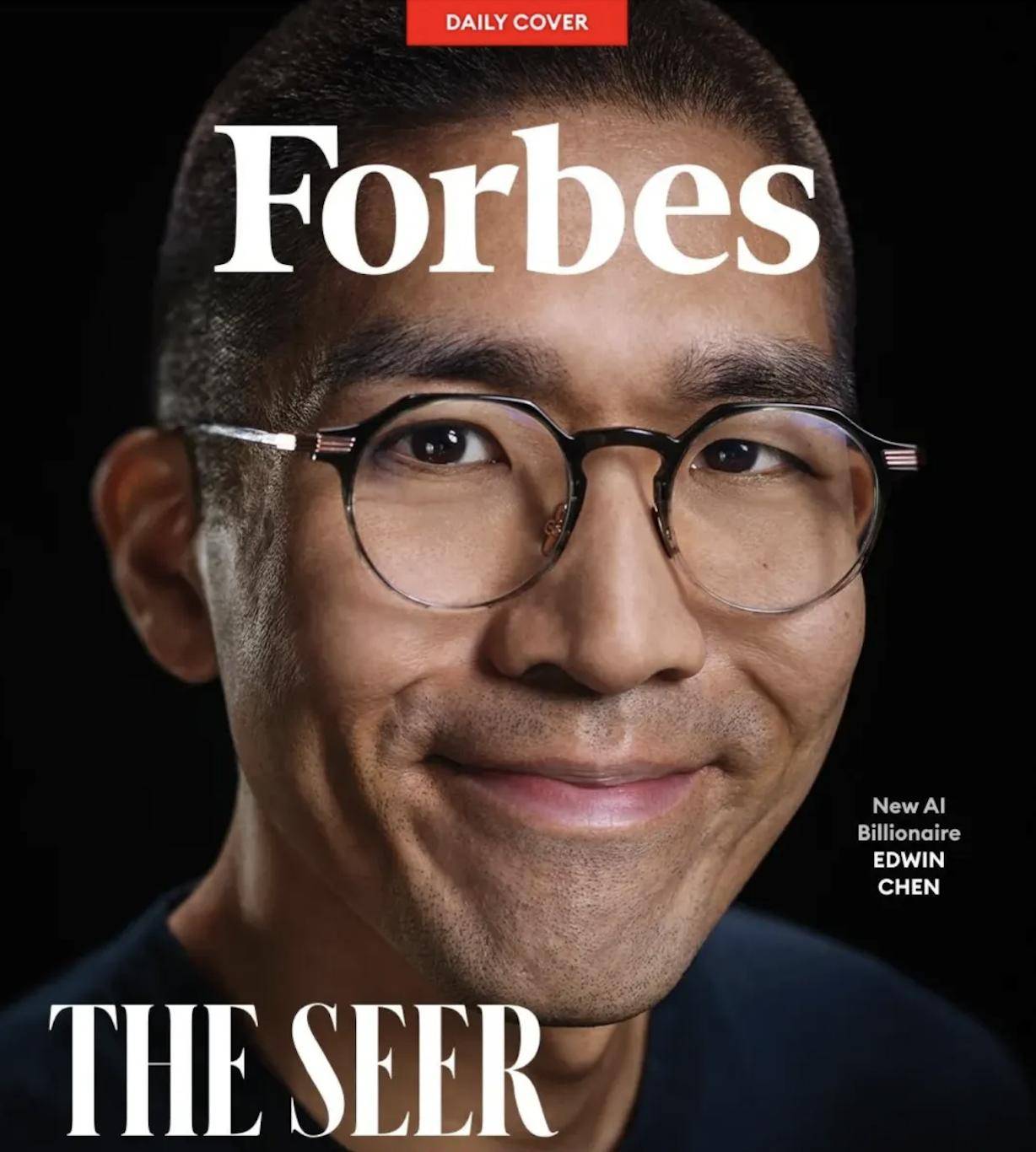
37岁天才华裔,问鼎“最年轻亿万富豪”
3 6 Ke· 2025-10-10 04:06
Core Insights - Surge AI, founded by Edwin Chen, is set to receive a $1 billion Series A funding, potentially valuing the company at approximately $24 billion, making Chen a billionaire with a net worth of $18 billion [1][4] - Edwin Chen, previously low-profile, has emerged as the youngest billionaire on the Forbes 400 list, raising questions about his background and the rapid success of Surge AI [3][4] Company Overview - Surge AI is a data annotation company that has achieved over $1 billion in annual revenue within five years of its establishment, claiming profitability from day one [4][12] - The company employs a unique human-AI collaboration model for data annotation, contrasting with traditional methods that rely on low-cost labor from developing countries [7][13] - Surge AI has secured major clients, including Google, Meta, and Microsoft, with Meta alone spending over $150 million on Surge's services [7][12] Industry Context - Data annotation is a critical component of the AI industry, providing essential training data for generative AI models, and is often referred to as the "cyber Foxconn" of the AI sector [5][7] - Surge AI differentiates itself from competitors like Scale AI by focusing on high-quality data annotation rather than volume, aiming to meet the complex needs of AI models [13][15] Founder Background - Edwin Chen, a graduate of MIT, has a background in algorithm work and content moderation at major tech companies, which informed his understanding of the importance of quality data annotation [9][11] - Chen's entrepreneurial journey began in 2020 when he founded Surge AI, driven by a desire to improve data quality and avoid the pitfalls of traditional outsourcing [12][14] Future Aspirations - Surge AI aims to become a leading force in the AI industry, with plans for Edwin Chen to take a more prominent role as a thought leader [8][16] - The company has adopted a "反硅谷" (anti-Silicon Valley) approach by self-funding and avoiding venture capital, allowing for greater control over its operations and direction [14][16]
AI背后的“调教师”自述:有人月入上万,有人时薪不到2美元
3 6 Ke· 2025-10-10 02:42
Core Insights - The article highlights the crucial yet often overlooked role of AI trainers, who work tirelessly behind the scenes to teach AI systems to understand human nuances like humor and sarcasm [1][2] - It emphasizes the challenges faced by these trainers, particularly those from low-income regions, who endure low pay, job instability, and significant psychological stress [1][4] Group 1: AI Trainers' Work and Challenges - AI trainers engage in various tasks such as recording daily conversations, marking AI responses, and conducting "red team" tests, often needing to review disturbing content repeatedly [4] - Many AI trainers, especially freelancers from low-cost labor countries, face exploitative conditions and low compensation, lacking psychological support [4][24] - The industry is experiencing instability due to reduced collaboration from major tech companies, leading to sudden project suspensions [4][29] Group 2: The Nature of AI Training Projects - Trainers often participate in surreal projects, such as recording conversations for AI training, which can include bizarre prompts [3][6] - The work can be financially rewarding, with some freelancers earning substantial incomes, but it is also characterized by monotony and unpredictability [7][10] - Trainers must navigate a complex entry process, often involving unpaid assessments, to secure positions in this emerging field [9][10] Group 3: Ethical and Psychological Burdens - AI trainers frequently confront disturbing content, raising ethical concerns about the nature of their work and its ultimate applications [18][21] - The lack of transparency regarding the use of their contributions leads to moral dilemmas for many trainers, who question whether they are aiding beneficial projects or harmful technologies [23][28] - The psychological toll of reviewing violent or abusive content is significant, with many trainers expressing concerns about their mental well-being [18][20] Group 4: Industry Dynamics and Future Outlook - The rapid advancement of AI technology is leading to a shift where companies are increasingly internalizing training tasks and seeking more specialized talent [29][31] - The reliance on human feedback for AI training is diminishing as new models become more capable, raising questions about the future need for trainers [31][33] - Despite concerns about job security, some industry experts believe that human input will remain essential for AI development [33][34]

速递|估值四个月翻四倍:David AI获5000万美元融资,英伟达旗下NVentures参投
Z Potentials· 2025-10-09 02:36
Core Insights - David AI Labs, a startup focused on selling audio datasets for AI model training, raised $50 million in a recent funding round, indicating a growing market for foundational components in AI development [1] - The company's valuation reached $500 million after this funding round, a significant increase from $25 million just a few months prior [1] - Investors in this round included Meritech Capital and NVentures, with participation from existing investors such as First Round Capital and Y Combinator [1] Company Overview - David AI was co-founded by Tomer Cohen and Ben Wiley, former employees of Scale AI, and is dedicated to collecting and selling audio data, distinguishing itself from other data annotation startups that primarily focus on text [1][2] - The company has reported an annual recurring revenue exceeding $10 million, which has significantly increased since the announcement [3] Market Demand - There is a surge in demand for audio data, with many large AI companies expanding beyond text-based chatbots into voice assistants and other AI products [2][3] - Meritech partner Alex Kurland noted that the complexity of the audio data business positions David AI as a leader in the field [3] Data Collection Methodology - David AI employs thousands of contributors to record original voice data specifically for training AI models, creating customized audio datasets [2] - The company assesses the performance gaps in leading AI models, often stemming from a lack of high-quality audio data, and pairs strangers to record their conversations over time to capture natural interactions [3][5] Future Plans - David AI plans to use the recent funding to expand its team, currently consisting of about 25 full-time employees [5]

28岁华裔天才成百亿富豪,却献计特朗普封锁中国AI技术,他咋想的
Sou Hu Cai Jing· 2025-10-07 09:38
Core Insights - The article discusses the rise and potential fall of Alexander Wang, a young billionaire and founder of Scale AI, who has taken a controversial stance against Chinese AI competitors, particularly Deep Seek, amid growing geopolitical tensions between the US and China [1][3][45] Company Overview - Scale AI, founded by Alexander Wang, specializes in data annotation for AI models, acting as a "logistics provider" for major tech companies like Google and Microsoft [5][7] - The company employs low-cost labor from regions like Southeast Asia and Latin America to perform data labeling tasks, which has led to criticisms of being a "digital sweatshop" [15][17] Competitive Landscape - Deep Seek, a Chinese AI company, poses a significant threat to Scale AI by offering lower training costs and open-sourcing its core technology, undermining the subscription-based model of competitors like ChatGPT [21][23] - The competitive advantage of Deep Seek lies in its ability to operate at a fraction of the cost of American companies, potentially disrupting the market and threatening the existence of Scale AI [21][25] Geopolitical Context - Wang's actions against Deep Seek are framed as a response to the broader US-China tech rivalry, with his criticisms serving as a "loyalty pledge" to the US [13][30] - His efforts to align with US political interests, including advising former President Trump, reflect a strategy to mitigate risks associated with his Chinese heritage in a tense political climate [30][34] Risks and Challenges - The reliance on low-cost labor and the current stage of AI technology creates a precarious business model for Scale AI, which could be rendered obsolete if AI advances to a point where human data annotation is no longer necessary [17][19] - Wang's aggressive stance against competitors has alienated potential partners in the industry, raising concerns about his reputation and the sustainability of his business model [39][41] Future Outlook - The article suggests that Wang's actions may inadvertently strengthen the Chinese AI sector, as external pressures often catalyze innovation within the country [43][45] - Despite his initial success, Wang's strategy may lead to long-term consequences that could trap him in a precarious position, unable to fully integrate into either the American elite or the Chinese community [45]

CoreWeave's Valuation Soars on Meta Partnership, But Is It Overheating?
The Motley Fool· 2025-10-03 00:33
Group 1 - CoreWeave signed a $14.2 billion deal with Meta for cloud computing capacity through 2032, reflecting Meta's increased investment in AI [3] - CoreWeave's revenue surged 206% to $1.21 billion in Q2, indicating strong demand for its AI computing services [2] - The company has also secured a $6.5 billion agreement with OpenAI, raising its total contract value with OpenAI to $22.4 billion [5] Group 2 - Meta's acquisition of chip start-up Rivos aims to enhance its AI capabilities, complementing its partnership with CoreWeave [4] - CoreWeave's stock experienced a 12% increase following the announcement of the deal with Meta, contributing to a recovery after a previous decline [2][7] - The company is facing significant challenges due to high-interest debt and substantial losses, with interest expenses projected to exceed $1 billion this year [8] Group 3 - CoreWeave's growth potential is substantial, with revenue tripling, but its valuation remains complex due to ongoing losses and high capital expenditures [9][10] - The market cap of CoreWeave stands at $66 billion, suggesting potential for further growth if the AI boom continues [10] - The volatility of CoreWeave's stock is expected to persist, influenced by the overall health of the AI market and the company's ability to secure additional contracts [11]

37岁,他登顶今年最年轻富豪
首席商业评论· 2025-10-02 04:01
Core Viewpoint - The article highlights the rise of Edwin Chen and his company Surge AI as a significant player in the AI industry, achieving a valuation of approximately $24 billion and annual revenues exceeding $1 billion without external funding [4][6][7]. Company Overview - Surge AI, founded by Edwin Chen in 2020, specializes in providing data annotation services essential for AI model training [6][9]. - The company has grown rapidly, achieving over $1 billion in revenue within five years and has not sought external financing during this period [4][6]. - Edwin Chen holds 75% of Surge AI's shares, leading to a personal net worth of $18 billion, making him the youngest billionaire on the Forbes list this year [4][7]. Competitive Landscape - Surge AI competes with other data annotation companies like Scale AI, which recently received a $15 billion investment from Meta, raising its valuation to over $29 billion [6][7]. - The article emphasizes the critical role of data annotation companies in the AI ecosystem, as they provide the necessary "clean" data for model training, which is indispensable regardless of technological advancements [6][7]. Industry Trends - The AI sector is experiencing a wealth creation wave, with numerous startups achieving billion-dollar valuations, such as Perplexity and Mistral AI, which have recently raised significant funding [12][13]. - The stock market reflects this trend, with companies like Nvidia and domestic AI chip firms seeing substantial increases in their market valuations [12][13]. Future Outlook - Edwin Chen expresses optimism about the future of AI, suggesting that advancements could lead to groundbreaking achievements, including solving complex mathematical problems and enhancing human creativity [10]. - The article concludes with a cautionary note about the potential for a market correction in the AI sector, highlighting the historical patterns of technology booms and busts [14].