
锦欣生殖

Search documents
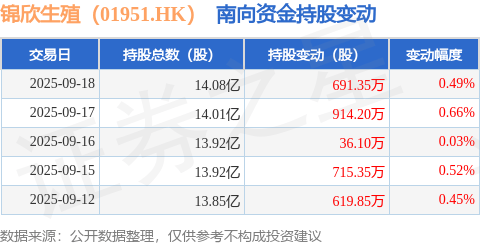
锦欣生殖(01951.HK):9月18日南向资金增持691.35万股
Sou Hu Cai Jing· 2025-09-18 19:34
Group 1 - The core point of the news is that southbound funds have significantly increased their holdings in Jinxin Reproductive Medicine (01951.HK), with a total net increase of 29.76 million shares over the past five trading days [1] - As of September 18, 2025, southbound funds hold a total of 1.408 billion shares of Jinxin Reproductive Medicine, accounting for 51.05% of the company's total issued ordinary shares [1][2] - In the last 20 trading days, there have been 16 days of net increases in holdings by southbound funds, totaling 114 million shares [1] Group 2 - The company, Jinxin Reproductive Medicine, is an investment holding company primarily providing in vitro fertilization (IVF) services [2] - The company offers a range of services through its subsidiaries, including assisted reproductive services, management services, mobile surgical center facilities, auxiliary medical services, and sales of medical consumables and equipment [2] - Jinxin Reproductive Medicine operates mainly in China and the United States [2]

50倍“妖王”坐上跳楼机
财联社· 2025-09-16 15:59
Core Viewpoint - The extreme volatility of the stock price of药捷安康 (02617.HK) has raised concerns in the market, with a significant drop following a sharp rise, indicating potential instability and investor caution [1][5]. Group 1: Stock Price Movement -药捷安康's stock price surged by 63% to 679.5 HKD per share in the morning, before plummeting to 192 HKD per share by the end of the day, resulting in a decline of 53.73% [1]. - The stock's market capitalization fluctuated dramatically, reaching nearly 270 billion HKD at its peak and then shrinking to 76.2 billion HKD, leading to a loss of over 190 billion HKD in a single day [5]. - The stock's trading volume was notably high, with a turnover rate of 4.13%, significantly exceeding the previous day's rate of 1.34% [5]. Group 2: Market Impact - The volatility of药捷安康's stock affected several pharmaceutical ETFs, including the 恒生创新药ETF (159316) and 港股通创新药ETF (520880), which fell by 1.18% and 1.11% respectively [3]. - Following the inclusion of药捷安康 in the Hong Kong Stock Connect and major innovation drug indices on September 8, there was a notable increase in southbound capital, which bought 3.0625 million shares by September 15, accounting for 56% of the company's actual circulating shares [4]. Group 3: Company Fundamentals -药捷安康's core product,替恩戈替尼, is currently in clinical trials, with no drugs yet on the market as of June 30, 2025, and the company reported a net loss of 123 million HKD in the first half of the year [6]. - The company relies heavily on previous financing to support its research and development, with R&D expenses amounting to 98.43 million HKD and management expenses of 27.47 million HKD during the same period [6]. Group 4: Index Adjustments - The recent adjustments to the calculation methods of the 恒生创新药指数 and related indices aim to better reflect companies involved in innovative drug research and development, excluding service providers in the CXO sector [8][9]. - Following these adjustments,药捷安康 was included in multiple key indices, which contributed to its recent stock price movements and the overall performance of related ETFs [9].

华创证券:维持锦欣生殖“推荐”评级 目标价3.23港元
Zhi Tong Cai Jing· 2025-09-16 06:19
Core Viewpoint - The domestic assisted reproduction industry has been fully included in medical insurance, and with additional support policies such as fertility subsidies, the industry penetration rate is expected to accelerate. As an industry leader, Jinxin Fertility (01951) has significant brand and licensing advantages, and short-term business disruptions do not alter the long-term growth trend. The company is projected to achieve revenues of 26.0, 28.6, and 31.8 billion yuan from 2025 to 2027, with adjusted net profit estimates of 2.8, 3.3, and 3.8 billion yuan respectively. The target stock price is set at 3.23 HKD, maintaining a "recommended" rating [1]. Revenue Performance - In the first half of 2025, the company reported revenues of 12.89 billion yuan, a decrease of 10.7%. Regional performance varied, with Chengdu's medical service revenue at 7.68 billion yuan (-13.1%) and a total of 7,111 egg retrieval cycles (-6.1%). The decline in cycles was attributed to a decrease in initial consultations and a significant increase in the proportion of IUI cycles, which saw a threefold increase in patient numbers to 969. The Greater Bay Area reported medical service revenue of 2.06 billion yuan (-14.9%) with 2,539 egg retrieval cycles (-16.0%). In contrast, revenue from Kunming and Wuhan was 1.31 billion yuan (+0.8%), with 2,059 egg retrieval cycles (-3.5%). Overseas medical service revenue was 4.05 billion yuan (+3.7%), with HRC Medical reporting 2,058 egg retrieval cycles (-8.9%) due to delays in patient visits caused by fluctuations in US-China relations and the postponement of California's IVF insurance coverage legislation [2]. Profitability and Cost Structure - The company's gross profit margin for the first half of 2025 was 30.4%, down by 10.0 percentage points. The decline in gross margin was influenced by two main factors: 1) Revenue decline due to an increased proportion of lower-priced IUI patients among ARS patients, a decrease in average single-cycle prices following medical insurance adjustments, and a 24% drop in traditional delivery volumes leading to a 2% reduction in obstetric revenue; 2) Rising operational costs from the expansion of HRC Medical in the US, which added four new clinics, increasing labor and operational costs, as well as accelerated amortization of renovations in Wuhan and depreciation costs related to the relocation of a new building in Shenzhen. Additionally, goodwill and intangible asset impairments significantly contributed to the profit loss, with a total impairment of 9.93 billion yuan related to US and Laos operations in the first half of 2025, including 9.52 billion yuan related to HRC Management Group and 40.17 million yuan related to the suspension of operations in Laos [3].
华创证券:维持锦欣生殖(01951)“推荐”评级 目标价3.23港元
智通财经网· 2025-09-16 06:19
Core Viewpoint - The domestic assisted reproduction industry has been fully included in medical insurance, which, along with fertility subsidies and other supportive policies, is expected to accelerate the industry's penetration rate. As an industry leader, Jinxin Fertility (01951) has significant brand and licensing advantages, and short-term business disruptions do not alter the long-term growth trend. The company is projected to achieve revenues of 2.602 billion, 2.867 billion, and 3.178 billion yuan for 2025-2027, with adjusted net profit estimates of 282 million, 325 million, and 376 million yuan respectively. The target stock price is set at 3.23 HKD, maintaining a "recommended" rating [1]. Group 1: Financial Performance - In the first half of 2025, the company reported revenues of 1.289 billion yuan, a decrease of 10.7%. The net loss attributable to shareholders was 1.04 billion yuan, with adjusted net profit down 68.3% to 82 million yuan. Operating cash flow also declined by 30.2% to 268 million yuan [1][2]. Group 2: Regional Performance - Revenue from the Chengdu region was 768 million yuan, down 13.1%, with the number of egg retrieval cycles at 7,111, a decrease of 6.1%. The decline in cycles was attributed to a reduction in new patients and a significant increase in the proportion of IUI cycles, which saw patient numbers grow over threefold to 969. The VIP penetration rate at Sichuan Jinxin Xinan Hospital reached approximately 20.8% [2]. - The Greater Bay Area reported medical service revenue of 206 million yuan, down 14.9%, with egg retrieval cycles at 2,539, a decrease of 16.0%. Similar to Chengdu, the reduction in cycles was influenced by changes in clinical consultation processes and an increase in IUI cycles [2]. - Revenue from Kunming and Wuhan was 131 million yuan, up 0.8%, with egg retrieval cycles at 2,059, down 3.5%, primarily due to short-term operational impacts from hospital renovations [2]. - Overseas medical service revenue reached 405 million yuan, an increase of 3.7%. HRC Medical reported 2,058 egg retrieval cycles, down 8.9%, affected by fluctuations in US-China relations and delays in the implementation of California's IVF insurance coverage legislation [2]. Group 3: Profitability and Cost Structure - The company's gross margin for the first half of 2025 was 30.4%, a decrease of 10.0 percentage points. The decline in gross margin was influenced by two main factors: a decrease in revenue due to a higher proportion of lower-priced IUI patients, a drop in average single-cycle prices following medical insurance adjustments, and a 24% decline in traditional delivery volumes leading to reduced obstetric income. Additionally, operational costs increased due to the expansion of HRC Medical in the US, which added four new clinics, and accelerated amortization costs related to lease adjustments at Wuhan Jinxin Hospital [3]. - A significant factor contributing to the profit loss was the impairment of goodwill and intangible assets, with a total of 993 million yuan recognized in the first half of 2025 related to US and Laos operations. This included 952 million yuan related to HRC Management Group and 40.17 million yuan related to the suspension of operations in Laos [3].
港股医药行业2025年半年报总结:港股创新药进入盈利期
Southwest Securities· 2025-09-11 05:25
Investment Rating - The report maintains a positive outlook on the Hong Kong pharmaceutical industry, particularly on innovative drugs, indicating that the sector has entered a profitability phase [1]. Core Insights - The report highlights that the total revenue of 149 Hong Kong-listed pharmaceutical companies reached CNY 896.12 billion in the first half of 2025, reflecting a 1% increase, while net profit attributable to shareholders was CNY 61.99 billion, up 29.7% [3][11]. - The innovative drug sector has shown significant growth, with 36 companies reporting a revenue of CNY 28.5 billion, a 15.8% increase, and a net profit of CNY 1.8 billion, marking a turnaround to profitability [4][12]. - The report emphasizes the importance of differentiated products and strong commercialization capabilities for companies in the innovative drug sector, suggesting that these factors will drive future growth [3][4]. Summary by Sections Overall Performance - The total revenue for the Hong Kong pharmaceutical industry in H1 2025 was CNY 896.12 billion, with a net profit of CNY 61.99 billion, indicating a positive trend in profitability [3][11]. - 57% of the companies reported positive net profit growth, while 50% achieved revenue growth [11][6]. Sector Breakdown - **Innovative Drugs**: Revenue of CNY 28.5 billion (+15.8%), net profit of CNY 1.8 billion, indicating a shift to profitability [4][12]. - **Chemical Preparations**: Revenue of CNY 90.8 billion (-7.1%), net profit of CNY 20.8 billion (+52.9%), suggesting a potential industry turning point [4][5]. - **Medical Devices**: Revenue of CNY 22.2 billion (+3.5%), net profit of CNY 1.9 billion, with varied trends across sub-sectors [4][5]. - **CXO**: Revenue of CNY 49.8 billion (+11.2%), net profit of CNY 12.8 billion (+93.7%), showing strong growth [4][5]. - **Traditional Chinese Medicine**: Revenue of CNY 58.5 billion (-1.8%), net profit of CNY 4.3 billion (-11.5%), indicating challenges in the sector [5][6]. R&D and Expenses - R&D expenses totaled CNY 31.4 billion, down 7.8%, with a decreasing trend in R&D expense ratios [16][24]. - Sales expenses reached CNY 77.7 billion, down 1.5%, and management expenses were CNY 58.7 billion, down 7.3% [16][24]. 18A Companies Performance - The report analyzed 50 Hong Kong 18A pharmaceutical companies, which generated CNY 44.9 billion in revenue, a 31.48% increase, and a net profit of CNY 2.727 billion, marking a significant turnaround with a 128.4% growth [29][34]. - Cash and cash equivalents for these companies reached CNY 84.4 billion, up 26.99% year-on-year [34][35]. International Expansion - The report notes that the international recognition of domestic innovative drugs is increasing, with over 20 licensing out projects totaling over USD 2 billion, indicating a growing trend in global market engagement [35][36].
HRC Investment Holding, LLC减持锦欣生殖863.15万股 每股作价约2.82港元
Zhi Tong Cai Jing· 2025-09-10 11:26
Group 1 - HRC Investment Holding, LLC reduced its stake in Jinxin Fertility (01951) by selling 8.6315 million shares at a price of HKD 2.8171 per share, totaling HKD 24.3158 million [1] - After the reduction, HRC Investment Holding's remaining shareholding is approximately 134 million shares, representing a holding percentage of 4.86% [1]
HRC Investment Holding, LLC减持锦欣生殖(01951)863.15万股 每股作价约2.82港元
智通财经网· 2025-09-10 11:25
Group 1 - HRC Investment Holding, LLC reduced its stake in Jinxin Fertility Group Limited (01951) by selling 8.6315 million shares at a price of HKD 2.8171 per share, totaling HKD 24.3158 million [1] - After the reduction, HRC Investment Holding's remaining shareholding is approximately 134 million shares, representing a holding percentage of 4.86% [1]
企业印象100期:锦欣生殖
Xin Lang Cai Jing· 2025-09-08 08:27
Part01: Core Viewpoint - The article provides an overview of Jinxin Reproductive Medicine (01951), highlighting its business model and market position [1]. Part02: Company Overview - Jinxin Reproductive Medicine specializes in reproductive health services, focusing on assisted reproductive technology and related medical services [3]. - The company aims to expand its service offerings and enhance its market presence in the reproductive health sector [3]. Part03: Key Data Indicators - The article includes critical financial metrics and performance indicators relevant to Jinxin Reproductive Medicine, although specific figures are not detailed in the provided text [3]. Part04: Management Analysis - Insights into the management team's strategies and operational effectiveness are discussed, emphasizing their commitment to growth and innovation in reproductive health services [5]. Part05: Competitive Advantages & Economic Outlook - Jinxin Reproductive Medicine possesses competitive advantages such as a strong brand reputation and a comprehensive range of services, positioning it well in the growing reproductive health market [5]. - The economic outlook for the reproductive health industry is positive, driven by increasing demand for assisted reproductive technologies and related services [5].
锦欣生殖_2025 年亚洲领袖会议-核心要点_2025 年上半年减值后聚焦国内核心业务
2025-09-08 06:23
Summary of Jinxin Fertility (1951.HK) Conference Call Company Overview - **Company**: Jinxin Fertility (1951.HK) - **Industry**: Healthcare Services, specifically Fertility Treatments Key Points Strategic Focus - Management emphasized a strategic pivot towards strengthening the domestic core business following impairments recognized in 1H25 for U.S., Laos, and non-core operations in China [1][2][3] Financial Performance - Domestic performance in 1H25 was weak, primarily due to a revenue mix shift towards IUI (Intrauterine Insemination), which is approximately 80-85% cheaper than IVF (In Vitro Fertilization) [1][2] - Management anticipates a more favorable revenue mix in 2H25 and aims to mitigate ASP (Average Selling Price) pressure through enhanced differentiated services [1][2] Impairment Details - Impairments were attributed to: 1. **U.S. Operations**: Delays in treatment due to patients awaiting commercial insurance coverage and staffing adjustments, including onboarding seven new doctors and entering the San Francisco market. Elevated labor costs may impact margins in the short term [2] 2. **Laos Operations**: Although profitable, these operations are likely to be phased out due to limited scalability and business environment constraints [2] 3. **Non-Core Domestic Services**: Certain male reproductive services are deemed non-core, and the company will cease further investments in these areas [2] Treatment Mix and Success Rates - The increase in IUI treatments reflects a cautious strategy due to reimbursement inclusion. However, the high proportion of IUI cycles has been suboptimal, with a success rate of less than 20%, leading to higher overall treatment costs as patients transition to IVF [3][6] - Adjustments are being made, with a noted 8% decline in IUI mix in Shenzhen [3][6] Pricing and Services - A zero markup policy on drugs and medical consumables post-insurance coverage has resulted in approximately a 5% decline in ASP [6] - Management plans to offset pricing pressure through enhanced differentiated services, such as VIP services [6] Financial Projections - The 12-month price target is set at HK$2.83, based on a target P/E multiple of 21x 2025E earnings, reflecting a neutral rating [7][8] - Revenue projections for the upcoming years are as follows: - 2025E: Rmb 2,654.7 million - 2026E: Rmb 2,830.3 million - 2027E: Rmb 3,014.1 million [8] Risks - Key risks include reputational and medical claims risks, integration and ramp-up of M&A, policies related to fertility support, and potential impacts from pandemic and travel policies [7] Market Position - The company has a market cap of HK$7.7 billion (approximately $986.5 million) and an enterprise value of HK$9.6 billion (approximately $1.2 billion) [8] Additional Insights - The management's focus on profitability, deleveraging, and shareholder returns indicates a strategic shift in response to macroeconomic challenges [1][2] - The company's performance and strategic decisions are closely monitored, with potential conflicts of interest noted due to investment banking relationships [17][39]
医药板块中报总结及投资展望
2025-09-02 14:41
Summary of Key Points from the Conference Call Records Industry Overview - The pharmaceutical sector shows a clear performance divergence, with innovative drug companies outperforming generic drug companies. The focus should be on multi-antibody therapies, dual antibodies, and treatments for unmet clinical needs in chronic diseases, such as ADC dual antibodies and small molecule therapies [1][4] - The medical device sector benefits from favorable policies, with a recovery in bidding processes and reduced channel inventory pressure. Leading companies are expected to gain market share, and the infrastructure sector is anticipated to reach a turning point [1][5] - The distribution sector's revenue remains flat, but the net profit excluding non-recurring items has decreased year-on-year. Gross margins have slightly declined, and accounts receivable turnover days have increased, indicating significant collection pressure [1][6] - The formulation sector shows stable overall performance, with net profit growth benefiting from innovative formulation products entering overseas markets. R&D expenses are growing faster than revenue, indicating increased investment in innovation [1][7] - Biotech companies are experiencing rapid revenue growth, driven by the overseas expansion of core products and unique indications. R&D and sales expense ratios are declining, reflecting improved commercial capabilities [1][9] Key Insights on Sub-sectors Innovative Drugs - Innovative drugs represent one of the largest investment opportunities in 2025, particularly in areas with potential for multi-antibodies and dual antibodies, as well as innovative therapies for cancer [4] Medical Devices - The medical device sector is seeing significant policy support, with a notable recovery in bidding trends and reduced inventory pressure for manufacturers. This is expected to drive performance improvements in the infrastructure sector [5][22] Distribution Sector - The distribution sector's performance is under pressure, with a notable decline in net profit. However, leading companies like Guokong, China Resources, and Shanghai Pharmaceuticals are performing relatively well [6] Formulation Companies - Formulation companies are showing steady performance, with a 20% growth in net profit driven by innovative products. Companies with high barriers to entry and rapid transformation are demonstrating stronger profitability [7] Biotech Companies - From 2019 to 2024, the cumulative revenue of 22 representative biotech companies in China grew from 7.7 billion to 66.8 billion, with a compound annual growth rate (CAGR) of 54%. In the first half of 2025, total revenue reached 38.9 billion, reflecting nearly 30% growth [9][10] Performance Trends - The medical device sector's revenue declined by approximately 5% in the first half of 2025, with profits down 24%. This decline is attributed to the impact of centralized procurement and cost control measures [20] - The biotech sector's core products are experiencing significant growth due to overseas sales and unique therapeutic advantages, with some products seeing revenue increases of over 50% [11] - The traditional Chinese medicine sector is under short-term pressure, but several companies are advancing innovative pipelines that may drive future growth [3][27] Future Outlook - The medical device sector is expected to see a turning point in the second half of 2025, with improved bidding data and a recovery in demand anticipated [22] - The distribution sector is likely to stabilize, with leading companies expected to gain market share as the industry undergoes consolidation [40][41] - The overall outlook for the pharmaceutical sector remains positive, with expectations for continued growth driven by innovation and market expansion [12][41] Additional Considerations - The impact of regulatory changes, such as the drug traceability code policy, is expected to enhance compliance within the industry [39] - The performance of the vaccine sector has been under pressure, with many companies transitioning from profit to loss due to market saturation and pricing pressures [17][18] - The blood products sector is experiencing steady revenue but faces challenges due to price declines in key products [19] This summary encapsulates the key insights and performance trends across various sectors within the pharmaceutical and medical device industries, highlighting both opportunities and challenges ahead.