Citadel

Search documents
Billionaire Ken Griffin Sold 48% of Citadel's Stake in Palantir and Nearly Quadrupled His Position in This Cutting-Edge Artificial Intelligence (AI) Stock
Yahoo Finance· 2025-10-12 18:18
Core Insights - Ken Griffin, founder and CEO of Citadel, is recognized for leading a highly successful hedge fund that combines macro strategy with quantitative analysis [2] - Citadel's recent 13F filing revealed a significant reduction in its stake in Palantir Technologies by 48%, while simultaneously increasing its investment in Nvidia by 414% [3][9] Citadel's Investment Strategy - The decision to reduce the position in Palantir may seem bearish, but it reflects a strategic risk management approach rather than a loss of confidence [5] - Palantir's stock has increased over 2,000% in the past three years, leading to concerns about its high valuation, trading at a price-to-sales ratio of 135 [6] - Hedge funds like Citadel often rebalance their portfolios by taking profits from high-performing stocks to manage risk and maintain financial flexibility [8] Market Dynamics - The shift in Citadel's investments indicates a changing perspective on the artificial intelligence landscape, particularly regarding the valuation of AI-related companies [4] - The move to increase the stake in Nvidia, a leader in AI chips, suggests a focus on companies with better risk-adjusted returns in the current market environment [9]
Does Billionaire Ken Griffin Know Something Wall Street Doesn't? The Citadel Chief Sold More than 80% of His Broadcom Stock and Is Piling Into Another Artificial Intelligence (AI) Stock-Split Stock Instead
The Motley Fool· 2025-10-11 07:50
Core Insights - Ken Griffin, founder of Citadel, has a net worth exceeding $50 billion and has established Citadel as one of the largest hedge funds globally [1] - In Q2, Citadel significantly reduced its stake in Broadcom and increased its investment in Nvidia, reflecting a strategic shift towards AI-focused companies [2][7] Group 1: Citadel's Investment Strategy - Citadel sold approximately 82% of its long position in Broadcom, which has seen a 91% increase in stock price over the past year, now valued at around $1.63 trillion [3][6] - The decision to sell Broadcom may be influenced by its high valuation at 50 times forward earnings and a limited customer base in its custom chip business [6] - Citadel's investment in Nvidia increased more than fourfold, with the fund now holding over 8 million shares, indicating a strong belief in Nvidia's potential in the AI sector [7] Group 2: Broadcom's Market Position - Broadcom specializes in application-specific integrated circuits (ASICs) for AI workloads, catering to major companies like OpenAI, Alphabet, and Meta Platforms [4] - Analysts remain optimistic about Broadcom, with a price target of $410 suggesting a 21% upside, highlighting its position as a leader in AI custom silicon [5] Group 3: Nvidia's Market Dynamics - Nvidia's stock has rebounded over 90% in the last six months, despite challenges related to U.S.-China trade tensions [10] - The company has made significant investments in AI, including a $100 billion commitment to OpenAI, raising questions about the sustainability of AI demand and spending [11] - Nvidia's current valuation stands at over 41 times forward earnings, with a market cap near $4.7 trillion, indicating a premium price amidst ongoing geopolitical uncertainties [12]


Breaking the Cycle: CoinEx’s Jeff Ko on How Institutional Capital and Web3 Innovation Are Redefining Crypto’s Future
Yahoo Finance· 2025-10-10 11:00
Core Insights - The potential advantages of tokenizing shares include increased accessibility through fractional ownership, 24/7 markets, and integration with DeFi protocols, but challenges such as fragmented liquidity and unclear regulations persist [1][4][10] Group 1: Tokenization and Market Trends - The shift from traditional cryptocurrencies like Bitcoin to diversified investments in Ethereum, Solana, and other altcoins is evident, with deal structures varying between cash contributions and in-kind token swaps [2] - The convergence of traditional finance (TradFi) and crypto is accelerating, with tokenized assets expanding beyond equities to include fixed income, gold, and private equity, indicating a blurring of market lines [7][10] - Institutional capital is breaking the historical four-year cycle in crypto, with significant inflows from pension funds and national reserves, marking a structural change in investment strategies [10] Group 2: Stablecoins and Regulatory Landscape - Stablecoins are becoming a crucial part of the crypto infrastructure, with market capitalization exceeding $300 billion, driven by regulatory advancements and yield-seeking behavior from investors [8] - The emergence of new stablecoin models and yield products is shifting investment dynamics, as traditional finance seeks higher returns in the crypto space [8] Group 3: Future of Web3 and User Experience - The success of Web3 hinges on the development of applications that outperform Web2 in usability and trust, which is essential for achieving mainstream adoption [12][13] - The focus should be on enhancing user experience rather than speculation, as better products will drive true mass adoption in the crypto space [13] Group 4: Company Philosophy and Market Position - CoinEx emphasizes a prudent approach to market engagement, focusing on sustainable growth and infrastructure development rather than chasing short-term trends [11][14] - The exchange has maintained its commitment to user safety and accessibility, reflecting its mission to simplify crypto trading for a global audience [14]
Why gold could approach $5,000 next year
Youtube· 2025-10-10 07:33
Now it is time for our moment of the week. And it turns out that all that glitters is gold. The price of the precious metal surged past the $4,000 mark this week for the first time in history amid a dizzing rally that also saw the price of silver rise to levels not seen since 2011.Now year to date, gold prices are up by more than half. Now what makes this rally different. Now, historically, gold has reached key landmarks at times of chaos or uncertainty, such as the CO9 pandemic or just before President Tru ...


2 stats show that gold's rapid rally hasn't caused dollar dominance to wane
Yahoo Finance· 2025-10-09 23:06
Core Insights - The price of gold has rallied 53% this year, raising concerns about its implications for the US dollar's dominance [1][6] - Central banks are diversifying their reserves, increasingly purchasing gold, which some interpret as a sign of diminishing confidence in the dollar [2][4] - Despite the rise in gold prices, the dollar remains the dominant international currency for reserves and transactions [3][8] Central Bank Activity - Central bank buying is a significant factor driving the gold rally, with gold holdings increasing by 52% to $4.6 trillion since the end of 2024 [4] - The share of dollar reserves held by central banks has seen only a slight decrease, attributed to exchange rate fluctuations rather than a reduction in dollar holdings [5][7] Dollar's Status - The dollar is involved in 89% of all foreign exchange trades, highlighting its liquidity and continued dominance in global transactions [7] - The current gold rally does not appear to threaten the dollar's status as the primary international currency [8]
黄金缘何彻底爆发?答案就在六个字
Feng Huang Wang· 2025-10-09 07:53
Core Viewpoint - The recent surge in international gold prices, which broke the $4000 mark, is primarily driven by Western investors, particularly during a period when Chinese investors were absent due to the National Day holiday [1][3]. Group 1: Market Dynamics - The price of spot gold rose nearly $200 from around $3860 to over $4000 during the Chinese holiday, indicating a significant market movement [1]. - The premium for domestic gold in China has shifted from positive to negative, suggesting a decrease in local investor interest compared to Western markets [3]. - The trend of Western investors leading the gold price increase reflects a broader shift in global investment dynamics, with a notable decline in interest from non-US regions [3]. Group 2: Investment Sentiment - The concept of "debasement trade" has gained traction among investors, indicating a strategy to hedge against the depreciation of all fiat currencies, not just the US dollar [3][5]. - The stability of the US dollar since August has not deterred gold's rise, suggesting a loss of confidence in fiat currencies overall [5]. - Political events, such as the election of Japan's new prime minister advocating for economic stimulus, have contributed to currency fluctuations, further driving gold prices [6]. Group 3: Historical Context - The current gold price surge can be divided into three phases, starting from the onset of the Russia-Ukraine conflict, followed by the US-China trade war, and culminating in recent signals from the Federal Reserve regarding interest rate cuts [9][10][12]. - The rise in gold prices is increasingly seen as a speculative trend rather than solely based on fundamental factors, with its traditional role as a safe-haven asset being emphasized [12][13]. Group 4: Debt and Economic Factors - High levels of debt in developed economies, nearing or exceeding 100% of GDP, are creating a backdrop for increased gold investment as a hedge against economic instability [15]. - The sustainability of debt is under scrutiny, with rising interest rates and inflation posing challenges to fiscal health, which could further drive investors towards gold [15][16]. - The political landscape, particularly in the US and Europe, is complicating fiscal measures needed to manage debt, leading to a potential increase in gold's appeal as a safe asset [16][17].


黄金破4000美元!银行狂买、散户追高,现在上车还来得及
Sou Hu Cai Jing· 2025-10-09 01:36
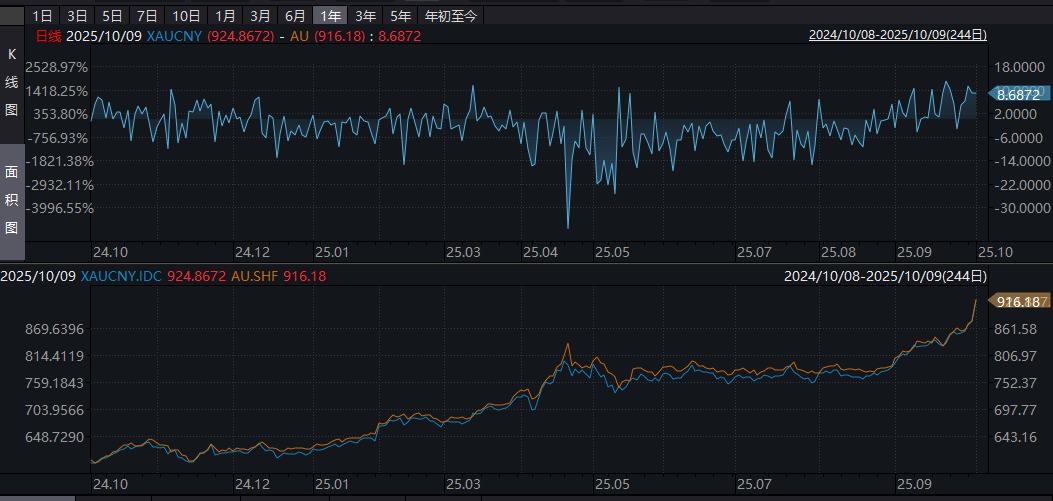
Core Viewpoint - The recent surge in gold prices, surpassing $4000 per ounce, is driven by various factors including geopolitical risks, market uncertainty regarding U.S. monetary policy, and increased demand from central banks and retail investors [3][10][12]. Group 1: Market Dynamics - A notable trend in gold jewelry sales is observed, with customers gravitating towards either small pieces or larger items over 30 grams, leading to a sales increase of over 30% year-on-year during the National Day holiday [3]. - The expectation of a 25 basis point rate cut by the Federal Reserve is anticipated to enhance the appeal of non-yielding assets like gold, as the opportunity cost of holding gold decreases [5][10]. - The ongoing U.S. government shutdown has created uncertainty in economic data releases, further fueling demand for gold as a safe-haven asset [3][12]. Group 2: Central Bank Actions - The People's Bank of China has increased its gold reserves for 11 consecutive months, reaching 74.06 million ounces by the end of September 2025, indicating a cautious approach to reserve optimization [6][8]. - Global central banks have maintained high levels of gold purchases, with significant contributions from countries like China, Poland, Singapore, and India, reflecting a shift towards gold amid concerns over the dollar's dominance [8][9]. - Goldman Sachs has raised its gold price forecast for December 2026 from $4300 to $4900, citing sustained inflows into ETFs and central bank purchases as key drivers [8][9]. Group 3: Economic and Political Influences - Political changes in France and Japan have heightened concerns over fiscal risks, contributing to the recent rebound in gold prices [5][10]. - Historical patterns show that gold prices tend to rise during periods of economic and political stress, with the current situation mirroring past crises [10][12]. - The shift in global monetary policy and geopolitical dynamics is prompting a reevaluation of gold's role as a store of value, suggesting a potential new order in the financial landscape [16].


Ray Dalio says investors should take heed of the 1970s and increase their gold holdings
Yahoo Finance· 2025-10-08 15:04
Ray Dalio urged investors to allocate around 15% of their portfolios to gold, calling it a strong hedge against credit-dependent assets and a key protector of real returns. Speaking at the Greenwich Economic Forum, the Bridgewater Associates founder said the metal’s surge reflects a global shift away from debt assets and fiat currencies, reminiscent of the 1970s. It comes after Citadel CEO Ken Griffin warned gold’s rally signals investor unease with U.S. sovereign risk and growing efforts to “de-dollarize. ...
Tesla went back to basics with its latest big announcement
Business Insider· 2025-10-08 13:01
Core Insights - Tesla has introduced more affordable versions of its popular electric vehicles (EVs), the Model 3 and Model Y, amid a slowdown in the EV market and the end of the EV tax credit [3][4][8] - The price reductions for the Model Y Standard and Model 3 Standard are $39,990 and $36,990 respectively, representing decreases of 11.1% and 12.9% compared to their premium versions [4][5] - The new models will have fewer features compared to their premium counterparts, including the removal of the Autosteer feature and AM/FM radio [5][6] - The market reaction to the announcement was negative, with Tesla's stock dropping nearly 4.5% on the day of the launch, indicating disappointment among analysts and investors [8][10] Pricing and Features - Model Y Standard is priced at $39,990, while Model Y Premium is at $44,990, with a price difference of $5,000 [4] - Model 3 Standard is priced at $36,990, and Model 3 Premium is at $42,490, with a price difference of $5,500 [4] - The price cuts do not fully compensate for the previous $7,500 tax credit that EV buyers received until the end of September [4] Market Context - The introduction of these budget-friendly models comes as the EV industry faces a general slowdown and the expiration of tax incentives [3][8] - The expectation for a more significant announcement was not met, as the launch was perceived as lacking excitement, with only a brief video shared on social media [9][10]