OPPO

Search documents
科技周报| 阿里重新归纳业务板块 智元称现金流至少能撑三年
Di Yi Cai Jing· 2025-08-24 04:36
Group 1: Alibaba's Business Restructuring - Alibaba's official website has redefined its business segments into four main groups: Alibaba China E-commerce Group, Alibaba International Digital Commerce Group, Cloud Intelligence Group, and all other businesses [1] - This change reflects Alibaba's internal resource integration strategy in response to evolving internal and external environments, with a clearer distinction between core and non-core businesses [1] - The CEO of Alibaba's E-commerce Division, Jiang Fan, now oversees two segments, indicating a more centralized approach to e-commerce strategy [1] Group 2: ZhiYuan Robotics' Financial Stability - ZhiYuan Robotics claims its cash flow can sustain operations for three years without any revenue generation [2] - The company plans to invest several billion yuan over the next three years to incubate over 50 early-stage projects [2] - ZhiYuan aims to establish itself as a "chain leader" in the industry by creating a platform that binds upstream and downstream resources [2] Group 3: Apple iPhone Production Season - Apple is entering its production peak for the new iPhone, with expectations for the iPhone 17 series launch in September [3] - Reports indicate a significant increase in hiring at Foxconn, with hourly wages reaching 26 yuan [3] - Apple's global iPhone shipment volume declined by 2% year-on-year in Q2, with a notable drop in the Chinese market [3] Group 4: OPPO's Response to Apple's Lawsuit - OPPO has responded to Apple's lawsuit regarding alleged theft of trade secrets by a former employee, asserting that no evidence links the employee's actions to OPPO [4] - This lawsuit highlights the intensifying competition in the wearable technology sector, particularly in medical-grade sensor technologies [4] Group 5: Honor's Foldable Phone Market Expansion - Honor has launched the Magic V Flip2, a foldable smartphone with a starting price of 5499 yuan, expanding its presence in the foldable phone market [6] - Honor holds a 7.6% market share in China's foldable phone market, ranking second behind Huawei [6] - The entry of Apple into the foldable phone market is prompting domestic brands to enhance their offerings [6] Group 6: Ride-Hailing Platforms Lowering Commission Rates - Major ride-hailing platforms, including Didi and T3, have announced reductions in commission rates to protect driver interests [7] - Didi plans to lower its maximum commission from 29% to 27% by the end of the year [7] - This collective action is in response to regulatory pressures aimed at improving driver rights [7] Group 7: Game Industry Developments - The new game "Black Myth: Zhong Kui" has gained significant attention, with the developer emphasizing innovation and new gameplay experiences [8] - The choice of Zhong Kui as a character allows for creative experimentation while building a strong IP foundation [8] Group 8: Sohu's CEO Physical Challenge - Sohu's CEO Zhang Chaoyang is set to swim across the Nan'ao Island Strait, promoting a message of perseverance and personal challenge [9] - He emphasizes the importance of engaging with audiences in the digital age [9] Group 9: Kinsan Office's AI User Growth - Kinsan Office reported a 10.12% increase in revenue, with AI monthly active users reaching 29.51 million [12] - The growth is attributed to the integration of AI into office processes, enhancing user engagement [12] Group 10: TCL's Financial Performance - TCL Electronics reported a 20.4% increase in revenue, with net profit rising by 67.8% in the first half of 2025 [14] - The company is benefiting from a strong global supply chain and increased demand for large-size and Mini LED TVs [14] Group 11: Deep Tianma's Turnaround - Deep Tianma achieved profitability in the first half of 2025, with a revenue increase of 9.93% [16] - The company is focusing on optimizing its business structure and enhancing its competitive edge in the automotive display sector [17]

科技周报| 阿里重新归纳业务板块,智元称现金流至少能撑三年
Di Yi Cai Jing· 2025-08-24 04:23
Group 1 - Ride-hailing platforms including Didi and T3 have collectively announced a reduction in commission rates to protect driver rights, with Didi lowering its maximum commission from 29% to 27% by year-end [7] - Apple is facing a lawsuit from Apple against a former employee who allegedly stole trade secrets before joining OPPO, highlighting the intense competition in the wearable technology sector [5] - Honor has launched the Magic V Flip2, expanding its presence in the foldable smartphone market, where it holds a 7.6% market share, second only to Huawei [6] Group 2 - Alibaba has restructured its business segments on its official website, reflecting a strategic realignment of its resources amid changing market conditions, with a clearer distinction between core and non-core businesses [2] - Zhiyuan Robotics claims its cash flow can sustain operations for three years without revenue, indicating a significant investment in early-stage projects to build an industrial ecosystem [3] - TCL Electronics reported a 67.8% increase in net profit for the first half of 2025, driven by a strong performance in its television business, which saw a 20.4% revenue growth [14][15] Group 3 - Jinshan Office reported a 10.12% year-on-year increase in revenue for the first half of 2025, with AI monthly active users reaching 29.51 million, up from 19.68 million in 2024 [12] - Deep Tianma achieved profitability in the first half of 2025, with a revenue increase of 9.93% and a net profit of 206 million yuan, supported by a strong position in the small and medium-sized display panel market [17] - The gaming industry is witnessing a surge in interest with the release of the new game "Black Myth: Zhong Kui," which has quickly gained popularity on social media [8]


何同学海外走红,YouTube广告分成年收入或超千万;曝OpenAI奥特曼交出日常运营权;Canva估值飙至420亿美元丨邦早报
创业邦· 2025-08-24 01:09
Group 1 - The article discusses the rising popularity of the Chinese digital content creator "He Tongxue" on YouTube, with his new account "HTX Studio" gaining over 1 million followers in a year and achieving a total view count of over 181 million [3][4] - The estimated annual income from YouTube ads for He Tongxue ranges from $144,000 to $2.34 million, equivalent to approximately 1.03 million to 16.8 million RMB [4] Group 2 - OpenAI's CEO Sam Altman is transferring daily operations to Fidji Simo, the CEO of application business, to focus on fundraising and advanced projects [6] - The U.S. government is investing $8.9 billion to acquire 9.9% of Intel's shares, making it a major shareholder [7] - Huawei Cloud is undergoing organizational restructuring to focus on AI, with multiple departments being merged or eliminated [7] Group 3 - Lantu Motors is set to list on the Hong Kong Stock Exchange, having achieved a cumulative production of over 200,000 vehicles [8] - Elon Musk is recruiting for a new AI software company named "Macrohard," which aims to challenge Microsoft [8] Group 4 - Coca-Cola is considering selling its UK coffee chain Costa Coffee, having hired Lazard to evaluate options [10] - OPPO has responded to Apple's lawsuit regarding alleged theft of trade secrets, asserting that it has not infringed on Apple's business secrets [10] Group 5 - Canva has initiated an employee stock sale plan, raising its valuation to $42 billion [10] - Dongfang Zhenxuan reported a 32.7% decline in net revenue for the fiscal year 2025, while still achieving profitability in its core business [11] Group 6 - Nvidia's CEO Jensen Huang revealed plans to export a new AI chip to China, pending U.S. government approval [11] - I Love My Home announced that its actual controller's shares will be auctioned off, representing 4.88% of the company's total shares [11] Group 7 - Country Garden expects a net loss of between 18.5 billion to 21.5 billion RMB for the first half of the year, attributed to declining project settlements and increased asset impairments [11] - Kweichow Moutai has upgraded its anti-counterfeiting measures for its premium liquor products [11] Group 8 - As of the end of July, China's total installed power generation capacity reached 3.67 billion kilowatts, a year-on-year increase of 18.2% [19]


苹果起诉!前员工跳槽OPPO,U盘拷走63份机密文件
是说芯语· 2025-08-23 23:30
Core Viewpoint - Apple has filed a lawsuit against former employee Chen Shi, accusing him of stealing trade secrets related to the Apple Watch and sharing them with OPPO, a direct competitor [1][6][11]. Group 1: Allegations Against Chen Shi - Chen Shi worked as a Sensor System Architect for Apple from January 2020 to June 2025, gaining access to sensitive information about the Apple Watch [2][14]. - Apple claims that Chen Shi misled the company about his reasons for leaving, stating he was returning to China to care for his elderly parents while actually accepting a position at OPPO [4][17]. - In the days leading up to his departure, Chen Shi allegedly collected sensitive documents and conducted numerous one-on-one meetings with Apple Watch team members to gather information on ongoing research and development [4][18]. Group 2: Specific Actions Taken by Chen Shi - Three days before leaving Apple, Chen Shi downloaded 63 confidential documents from a secure Box folder and transferred them to a USB drive [4][19]. - He searched online for methods to erase data from his MacBook and to check if his file access history was visible, indicating awareness of the inappropriateness of his actions [4][20]. - Chen Shi communicated with OPPO executives about his plans to gather information from Apple, explicitly stating his intention to share this information with them [4][20]. Group 3: OPPO's Involvement - OPPO is accused of encouraging Chen Shi's actions, as evidenced by a message from an OPPO executive responding positively to Chen Shi's plans to collect information from Apple [4][20]. - Chen Shi is currently leading a team at OPPO focused on developing sensor technology, which directly competes with Apple's offerings [5][11]. Group 4: Legal Actions and Implications - Apple seeks a court injunction to prevent OPPO and Chen Shi from using or disclosing its trade secrets, along with monetary damages and legal fees [6][11]. - The lawsuit highlights the potential harm to Apple's innovation commitments and the value of its trade secrets if such actions are allowed to go unpunished [6][11].

苹果起诉跳槽至OPPO前员工,称63份机密文件被窃取
Xin Lang Cai Jing· 2025-08-23 21:18
Core Points - Apple has filed a lawsuit against former Apple Watch sensor architect Chen Shi for allegedly stealing trade secrets before joining OPPO [1][4] - OPPO has denied the allegations, stating that they respect the trade secrets of all companies, including Apple [1] - The lawsuit claims that Chen Shi downloaded 63 confidential files just three days before leaving Apple and transferred them to a USB drive [2] Summary by Sections - **Allegations Against Chen Shi** - Chen Shi is accused of systematically stealing core business secrets to assist OPPO in developing competitive wearable devices [1] - He allegedly concealed his intention to join OPPO while engaging in numerous one-on-one meetings with Apple Watch technology team members [1][4] - The lawsuit states that Chen Shi misled Apple by claiming he was returning to China to care for his elderly parents [3] - **OPPO's Response** - OPPO's legal department claims to have reviewed the lawsuit and found no evidence linking Chen Shi's actions to his employment at OPPO [1] - OPPO asserts that it respects the trade secrets of all companies and has not infringed upon Apple's secrets [1] - **Legal Actions and Implications** - Apple argues that Chen Shi violated confidentiality and intellectual property agreements, and that OPPO was aware of and condoned his actions [4] - The lawsuit highlights that allowing Chen Shi and OPPO to act without consequences would undermine Apple's commitment to innovation and the value of its trade secrets [4] - Apple is seeking an injunction to prevent Chen Shi and OPPO from incorporating Apple's confidential health sensor technology into their competitive products [4]
尚未发布的新系统被泄露?OPPO公开悬赏50万
Guan Cha Zhe Wang· 2025-08-23 15:00
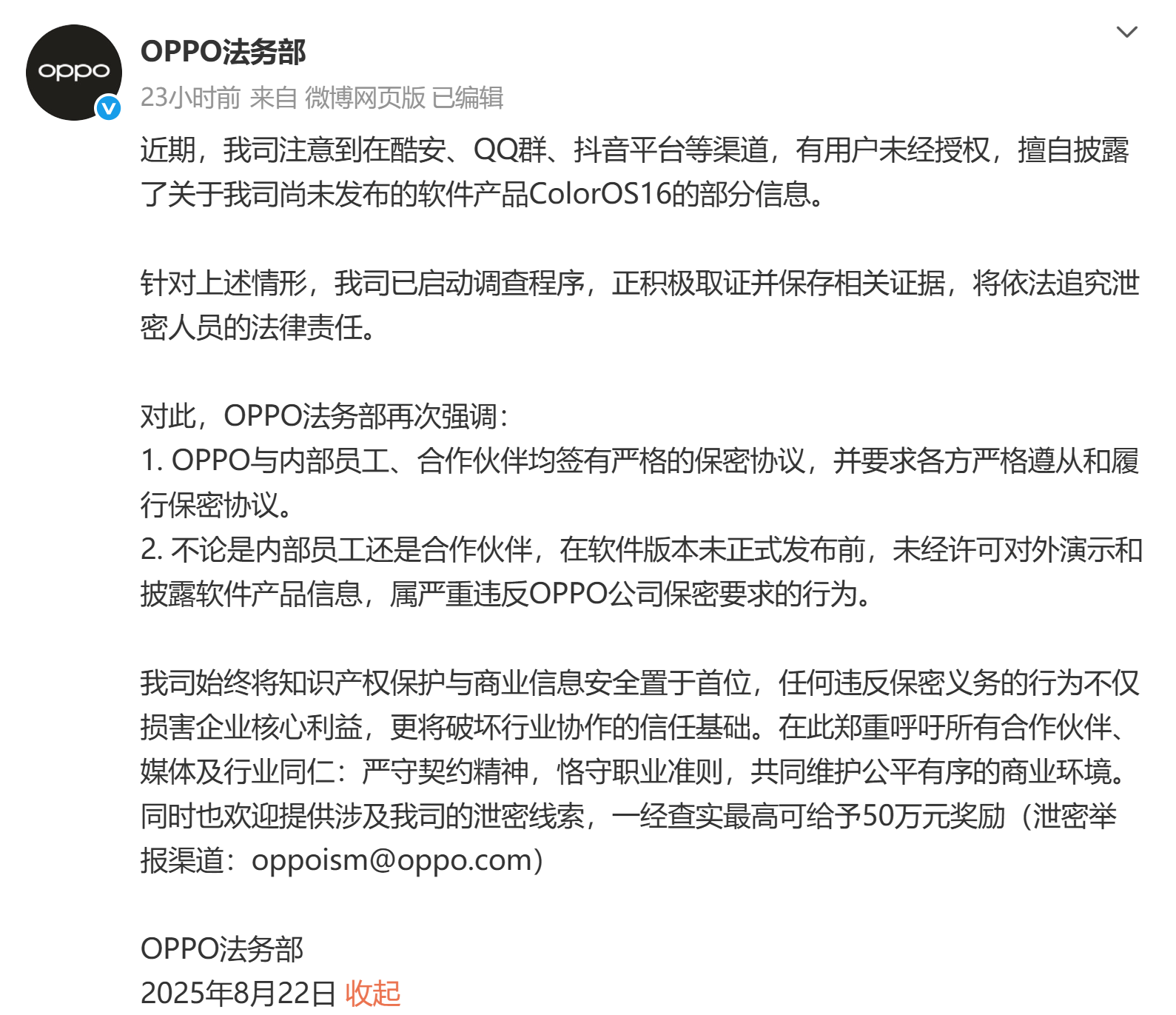
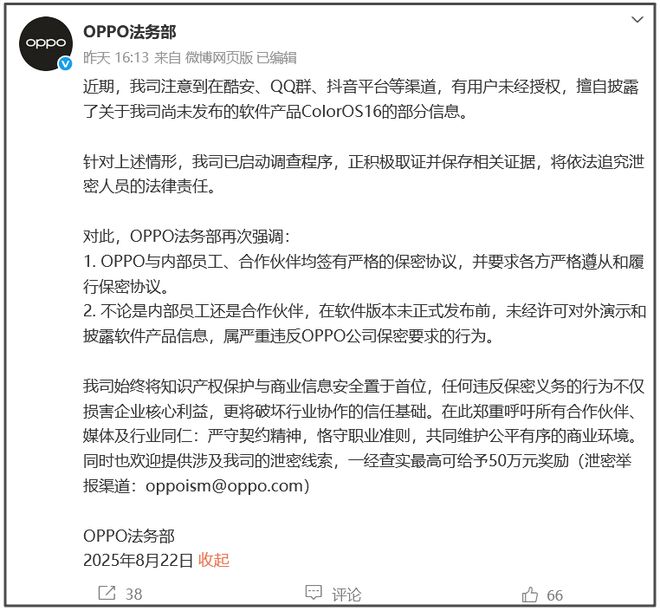
Core Points - OPPO's legal department announced an investigation into unauthorized disclosures of its unreleased software product ColorOS 16, which were found on platforms such as Coolapk, QQ groups, and Douyin [1][2] - The company emphasized the importance of confidentiality agreements with internal employees and partners, stating that any unauthorized disclosure of software information before official release is a serious violation of company policy [1][2] - OPPO is committed to protecting intellectual property and business information security, warning that breaches of confidentiality not only harm the company's core interests but also undermine trust within the industry [1][2] - The company is encouraging partners, media, and industry peers to adhere to professional standards and maintain a fair business environment, offering a reward of up to 500,000 yuan for verified tips related to the leaks [1][2] Summary by Sections Investigation and Response - OPPO has initiated an investigation and is actively collecting evidence regarding the unauthorized disclosures of ColorOS 16 [1][2] - The company has reiterated its strict confidentiality agreements with employees and partners, highlighting the serious nature of any unauthorized disclosures [1][2] Commitment to Confidentiality - OPPO prioritizes the protection of intellectual property and business information security, stating that violations of confidentiality can damage both the company and industry trust [1][2] - A call to action has been made for all stakeholders to uphold contractual obligations and professional ethics [1][2] Reward for Information - OPPO is offering a reward of up to 500,000 yuan for credible information leading to the identification of individuals responsible for the leaks [1][2]
被苹果指控招揽窃密前员工
Xin Lang Cai Jing· 2025-08-23 14:28
被苹果指控招揽窃密前员工 被苹果指控招揽窃密前员工 被苹果指控招揽窃密前员工,#OPPO否认侵犯商业秘密# #OPPO被苹果指控招揽窃密前员工# 特别声明:以上文章内容仅代表作者本人观点,不代表新浪网观点或立场。如有关于作品内容、版权或其它问 题请于作品发表后的30日内与新浪网联系。 ...

OPPO回应苹果起诉员工窃密:并未侵犯苹果公司商业秘密,相信公正的司法审理能够澄清事实
Xin Lang Ke Ji· 2025-08-23 14:22
新浪科技讯 8月23日晚间消息,据外媒报道,苹果近日向加州北区联邦法院提起诉讼,指控前Apple Watch传感器系统华裔架构师在离职前系统性窃取一系列核心商业机密,并跳槽到OPPO,将这些信息 提供给OPPO开发可穿戴设备。 责任编辑:凌辰 针对此事,OPPO法务部回应称:我们已注意到苹果公司近期在加州提交的诉讼,并仔细审查了苹果诉 状中指控的内容,没有发现任何事实能够证明这些指控与该员工在OPPO雇佣期间的行为有关。OPPO 尊重包含苹果公司在内任何公司的商业秘密,并未侵犯苹果公司商业秘密。OPPO将积极配合法律程序 的推进,亦相信公正的司法审理能够澄清事实。 ...
苹果起诉前工程师窃密后加入OPPO,OPPO暂无回应
Xin Lang Ke Ji· 2025-08-23 11:10
Core Viewpoint - Apple has filed a lawsuit against a former architect of its Apple Watch sensor system, accusing him of systematically stealing trade secrets before joining OPPO to assist in developing wearable devices [1] Group 1: Lawsuit Details - The lawsuit was filed in the Northern District of California, alleging that the former employee downloaded 63 confidential files from a protected Box folder before leaving Apple [1] - The downloaded files included critical information such as design schematics for the Apple Watch Ultra 3 chip, FDA certification ECG algorithm processes, and a roadmap for next-generation non-invasive blood glucose monitoring [1] - Apple claims the employee misled the company about his job search intentions and concealed his acceptance of a position at OPPO [1] Group 2: Employee's Role and Actions - The accused employee, Chen Shi, worked as a sensor system architect for the Apple Watch from January 2020 to June 2025, focusing on sensitive projects like heart rate monitoring and ECG [1] - After leaving Apple, he joined OPPO's research center in Silicon Valley, where he is responsible for a team developing sensor technology [1] - Apple is seeking an injunction to prevent both the former employee and OPPO from using its confidential health sensor technologies in competitive products [1]
OPPO法务部:尚未发布的新系统被泄露 已启动调查 举报最高奖励50万元
Mei Ri Jing Ji Xin Wen· 2025-08-23 08:14
Core Viewpoint - OPPO has initiated an investigation regarding unauthorized disclosures of its upcoming software product ColorOS16, which were leaked on various platforms [1] Group 1 - OPPO's legal department announced the unauthorized disclosure of information about ColorOS16 on platforms such as Coolapk, QQ groups, and Douyin [1] - The company is actively collecting evidence and will pursue legal action against those responsible for the leaks [1] - OPPO is offering a reward of up to 500,000 yuan for verified tips regarding the leak and has provided channels for reporting [1]