
BYD Company Limited

Search documents
特斯拉 - 苹果库比蒂诺机器人走向实体化,对特斯拉的竞争影响
2025-10-16 01:48
Summary of Key Points from the Conference Call Industry and Company Involved - **Companies**: Tesla Inc (TSLA) and Apple Inc (AAPL) - **Industry**: Automotive and Robotics Core Insights and Arguments 1. **Apple's Entry into Robotics**: Apple is reportedly developing its first moving product, a motorized tabletop robot, which signifies a major shift for the company into the robotics sector. This could have significant implications for the manufacturing base and supply chain, particularly concerning components like bearings, semiconductors, and rare earth materials [6][2][7] 2. **Physical AI Market Potential**: The transition of AI from digital to physical realms is expected to create a market that could exceed global GDP, estimated at $115 trillion. This shift will likely lead to increased collaboration between tech firms and industrial companies [6][7] 3. **Collaboration with BYD**: Apple is expected to collaborate with BYD for the manufacturing of its AI-enabled robots. This partnership highlights the growing intersection of technology and manufacturing, particularly in the robotics space [6][2] 4. **Competition for Talent**: The entry of major tech firms like Apple into robotics will intensify competition for AI and manufacturing talent, which is crucial for the development of advanced robotics [7] 5. **Implications for Tesla**: Tesla, under Elon Musk's leadership, has been a pioneer in the robotics space with projects like robotaxis and Optimus. The emergence of competitors like Apple in this field could increase competition for resources and talent [7] Additional Important Content 1. **Market Capitalization and Stock Performance**: As of October 14, 2025, Tesla's market capitalization is approximately $1.51 trillion, with a stock price of $429.24 and a price target set at $410.00. The stock has shown a 52-week range of $488.54 to $212.11 [4] 2. **Earnings Projections**: Tesla's projected EPS for the fiscal years ending in 2024, 2025, 2026, and 2027 are $2.41, $1.48, $2.57, and $4.39 respectively, indicating a growth trajectory [4] 3. **Risks and Valuation Methodology**: The valuation for Tesla includes various components such as core auto business, network services, and energy, with a detailed breakdown of potential risks and upside opportunities [16][20] 4. **Technological Advancements**: The need for real-world data for training AI models is emphasized, indicating a growing demand for technology that captures real-world video data for robotic training [6] 5. **Market Dynamics**: The report discusses the competitive landscape in the automotive and robotics sectors, highlighting the potential for increased market share and innovation driven by advancements in AI and robotics [7][6] This summary encapsulates the key points discussed in the conference call, focusing on the implications of Apple's entry into robotics, the competitive landscape for Tesla, and the broader market dynamics in the automotive and technology sectors.

BYD: Irrationally Underpriced
Seeking Alpha· 2025-10-03 12:17
Core Insights - BYD Company Limited reported strong delivery results for September, highlighting significant growth in its core battery-powered passenger EV business [1] Company Performance - BYD has surpassed Tesla, Inc. in terms of market position last year, indicating a competitive edge in the electric vehicle sector [1]


BYD: Irrationally Underpriced (OTCMKTS:BYDDF)
Seeking Alpha· 2025-10-03 12:17
Chinese EV maker BYD Company Limited ( OTCPK:BYDDF ) reported decent delivery results for the month of September this week, with robust growth in its core battery-powered passenger EV business. BYD last year overtook Tesla, Inc. ( TSLA ) as theAnalyst’s Disclosure:I/we have a beneficial long position in the shares of BYD, NIO, LI either through stock ownership, options, or other derivatives. I wrote this article myself, and it expresses my own opinions. I am not receiving compensation for it (other than fro ...


China Market Update: Jack’s Back As “Purchase In China” Effort Outlined
Forbes· 2025-09-16 13:36
Market Overview - Asian equities advanced as the U.S. dollar weakened, indicating a positive market sentiment [2] - The Hong Kong High Court allowed Evergrande's liquidators access to founder Xu Jiayin's $7.7 billion in assets amid ongoing restitution efforts from offshore bondholders [8] Chinese Policy Measures - Following President Xi's article on a "unified national market," the Ministry of Commerce and nine agencies introduced "Several Measures for Expanding Service Consumption" to boost domestic demand [3] - The measures include support for tourism, cultural activities, sporting events, and childcare subsidies, aiming to encourage consumers to "purchase in China" [4] Company Performance - Trip.com Group Limited (TCOM) rose by 4.09% and Meituan gained 3.03%, benefiting from the new consumption policies [4] - Alibaba Group Holding Limited (BABA) was the most heavily traded stock in Hong Kong, declining by 0.71% after announcing a $60 million investment in AI video generation startup Aishi Technology [5] - Tencent Holdings Limited (0700 HK) saw a slight increase of 0.23%, attributed to the success of its AI initiatives, with significant growth in daily average users of its AI assistant [6] Electric Vehicle Sector - Electric vehicle stocks performed well, with BYD Company Limited rising by 1.67%, Li Auto Inc. climbing by 2.61%, and CATL increasing by 2.58% [7] Market Dynamics - The rally in Chinese stocks may pose challenges for active managers who are underweight in this sector as quarter-end reporting approaches [9]


中国股票策略_流动性将推动 A - H 股溢价从此处回归正常化-China Equity Strategy Liquidity to drive a normalisation in A-H premium from here
2025-08-21 04:44
Summary of Key Points from the Conference Call Industry Overview - The focus is on the Chinese equity market, specifically the A-share and H-share markets, with a particular emphasis on the performance of the CSI300 and HSI indices [1][2]. Core Insights and Arguments 1. **Market Performance vs. Fundamentals**: Despite weaker fundamentals and downward revisions in earnings estimates, the equity market has shown resilience, with the CSI300 increasing by 4% and HSI by 2% in August. Retail flows and increased trading volumes are cited as potential drivers of this performance [1][2]. 2. **Historical Deviations**: Historical analysis indicates that share prices in the A-share market can deviate from fundamentals for extended periods (up to 12 months), while H-shares typically see shorter deviations (2-3 months) [1][2]. 3. **Potential for Continued Growth**: Several factors suggest that the current market exuberance could persist, including low margin financing as a percentage of market cap, robust growth in bank deposits, high trading volumes, and relatively inexpensive valuations compared to other regions [2][3]. 4. **Correction Triggers**: Potential triggers for market corrections include regulatory interventions, significant drawdowns in overseas markets, and expectations of policy support in October. However, the likelihood of these events is considered low at this stage [3][4]. 5. **Sector Preferences**: The report highlights a preference for A-share TMT (Technology, Media, and Telecommunications) sectors and brokers, while defensive sectors like consumer goods and utilities are viewed less favorably. Major banks and telecoms are still considered as preferred exposures due to the overall economic environment [4][36]. Additional Important Insights 1. **A-H Premium Dynamics**: The report suggests that the A-H premium may widen again, indicating better upside potential for A-shares compared to H-shares [1][2]. 2. **Market Correlations**: The performance of the HSI is correlated with forward earnings revisions, and historical data shows that divergences between earnings revisions and HSI performance do not last long [6][8]. 3. **Valuation Comparisons**: Chinese equities are noted to be inexpensive relative to global markets, which may attract further investment [22][39]. 4. **Risks to Consider**: Risks facing the Chinese equity market include a potential hard landing in the property market, capital outflows due to currency depreciation, and slow progress in structural reforms. Excessive stimulus policies could also pose risks to the transition from an investment-driven to a consumption-driven economy [39][38]. This summary encapsulates the key points discussed in the conference call, providing a comprehensive overview of the current state and outlook of the Chinese equity market.
《中国制造 2025》任务基本完成-Made in China 2025 Mission largely accomplished
2025-08-18 08:23
Summary of Key Points from J.P. Morgan Perspectives: Made in China 2025 Industry Overview - The report focuses on the **"Made in China 2025" (MIC25)** initiative, which aims to transform China's manufacturing sector and enhance its global competitiveness. [7][14] Core Insights and Arguments 1. **Mission Accomplished with Unintended Consequences**: The MIC25 initiative has largely met its goals, particularly in increasing China's global market share in manufactured value-added sectors, but has also led to structural overcapacity and other unintended consequences. [9][13] 2. **US-China Strategic Competition**: The current dynamic between the US and China is characterized as "transactional stabilization," with ongoing competition in technology and trade. Despite high tariffs, China's trade dominance has increased. [31][34] 3. **Commitment to Trade Multilateralism**: China continues to advocate for multilateral trade practices, contrasting with the US's unilateral approach. China's share of global exports has increased despite trade tensions. [39][42] 4. **Investment in AI**: There is a renewed wave of investment in AI technologies, driven by successful innovations and government support, indicating a shift in China's economic focus. [45][46] 5. **Common Prosperity Goals**: The goal of achieving "Common Prosperity" remains unfulfilled, with projected growth rates slowing to 3-4% from 2025 to 2030. [5][49] 6. **Three-Arrow Approach**: The Chinese government has implemented a coordinated approach involving fiscal stimulus, monetary easing, and structural rebalancing, but this is not seen as a "whatever it takes" moment akin to the 2008 stimulus. [62][63] 7. **Structural Rebalancing**: The focus on structural rebalancing is critical to address excess capacity and restore balance between supply and demand. [70][71] 8. **Boosting Service Consumption**: There is a non-consensus view that China should prioritize boosting service consumption to enhance economic growth, as current levels are significantly lower than in other countries. [72][76] Additional Important Insights - **Self-Sufficiency in Technology**: While some sectors have achieved self-sufficiency, such as new energy vehicles, many key technologies remain reliant on foreign sources, particularly in semiconductors and high-tech equipment. [19][21] - **Economic Challenges**: China faces significant economic challenges, including a declining growth trend, high debt levels, and a need for policy adjustments to stimulate domestic demand. [56][63] - **Policy Coordination Issues**: There are complexities in policy coordination that hinder the effective implementation of economic strategies, particularly in the housing market and service sectors. [51][85] This summary encapsulates the critical themes and insights from the J.P. Morgan Perspectives report on China's economic strategy and the implications of the Made in China 2025 initiative.
BYD July Deliveries: Pullback Offers A GARP Opportunity (Technical Analysis)
Seeking Alpha· 2025-08-06 16:38
Group 1 - The analysis of BYD Company Limited stock was last conducted on April 8, focusing on a comparison with Ford and the impact of tariff disputes [1] - The core investment style emphasizes providing actionable and clear ideas derived from independent research [1] Group 2 - The service has successfully assisted members in outperforming the S&P 500 and avoiding significant losses during periods of high volatility in both equity and bond markets [2] - A trial membership is available to evaluate the effectiveness of the proven investment method [2]

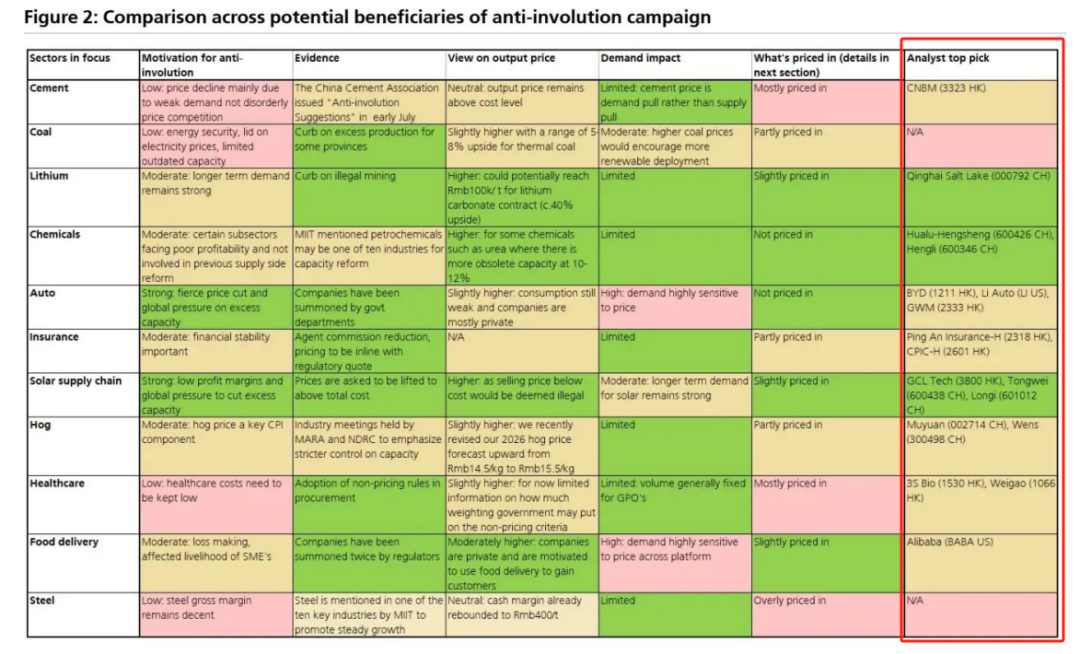
瑞银: 中国股票策略:反内卷-目前选择性参与-UBS-China Equity Strategy Anti-involution-selectively participate for now
瑞银· 2025-08-05 03:15
Investment Rating - The report suggests a selective participation strategy in sectors with attractive risk-reward profiles, specifically highlighting solar, chemicals, and lithium as top picks [1][6]. Core Insights - The anti-involution campaign is broadening into various sectors, including healthcare and financial services, with mixed feedback from analysts regarding its potential impact [1][2]. - Despite skepticism in the market about the effectiveness of the anti-involution initiatives, the motivations behind these initiatives are considered valid, leading to an upside skew in share price risks [3]. - The report emphasizes that the relevant sectors have not significantly outperformed the broader market, and investor expectations are generally low, indicating potential for positive surprises in future policies [3]. Sector Summaries Solar - The solar sector is characterized by very low profitability compared to other sectors, with significant long-term growth potential and external pressures to reduce excess capacity [6][8]. Chemicals - The chemicals sector faces low profitability and is close to historical troughs in valuation, with potential for cutting outdated capacities [6][8]. Lithium - The lithium sector is noted for its strong long-term growth potential and asymmetric risk-return profile, making it an attractive investment opportunity [6][8]. Auto - The auto sector is under pressure from fierce price competition and global excess capacity, with regulatory scrutiny aimed at promoting rational competition [2][8]. Healthcare - In healthcare, the focus is shifting towards non-price conditions in procurement, which may impact pricing strategies in the sector [2][8]. Food Delivery - The food delivery sector is experiencing regulatory pressure to rectify aggressive promotional practices, which may affect demand sensitivity [2][8]. Coal - The coal sector is facing production limits in certain provinces, which could lead to slight price increases [2][8]. Hog - The hog sector is under scrutiny for production capacity controls, with recent upward revisions in price forecasts [2][8].
瑞银中国股票策略:太阳能、化工和锂行业是“反内卷”主题最佳投资板块
Zhi Tong Cai Jing· 2025-08-04 14:56
Core Viewpoint - UBS analysts express mixed feedback on the anti-involution measures, indicating that the market remains skeptical about their potential impact on stock prices [1][4]. Industry Analysis - **Cement**: Price decline mainly due to weak demand, with output prices remaining above cost levels. The sector is mostly priced in, with CNBM (3323 HK) as a top pick [2]. - **Coal**: Limited outdated capacity and energy security concerns lead to a slight price increase, with moderate demand impact. The sector is partly priced in [2]. - **Lithium**: Long-term demand remains strong, with potential price increases for lithium carbonate contracts. The sector is slightly priced in, with Qinghai Salt Lake (000792 CH) as a top pick [2]. - **Chemicals**: Certain subsectors face poor profitability, with potential for capacity reform. The sector is not priced in, with Hualu-Hengsheng (600426 CH) and Hengli (600346 CH) as top picks [2]. - **Auto**: Strong price cuts and global pressure on excess capacity lead to slightly higher consumption. The sector is not priced in, with BYD (1211 HK), Li Auto (LI US), and GWM (2333 HK) as top picks [2]. - **Insurance**: Financial stability is important, with limited demand impact. The sector is partly priced in, with Ping An Insurance-H (2318 HK) and CPIC-H (2601 HK) as top picks [2]. - **Solar Supply Chain**: Low profit margins and global pressure to cut excess capacity lead to higher prices. The sector is slightly priced in, with GCL Tech (3800 HK), Tongwei (600438 CH), and Longi (601012 CH) as top picks [2]. - **Hog**: Hog prices are a key component of CPI, with limited demand impact. The sector is partly priced in, with Muyuan (002714 CH) and Wens (300498 CH) as top picks [2]. - **Healthcare**: Healthcare costs need to be kept low, with limited demand impact. The sector is mostly priced in, with 3S Bio (1530 HK) and Weigao (1066 HK) as top picks [2]. - **Food Delivery**: Companies face loss-making conditions, with high demand sensitivity. The sector is slightly priced in, with Alibaba (BABA US) as a top pick [2]. - **Steel**: Steel gross margins remain decent, with limited demand impact. The sector is overly priced in [2]. Investment Opportunities - UBS identifies solar, chemicals, and lithium industries as the most attractive for selective investment based on their low profitability, growth potential, and valuation risks [4][12].

摩根士丹利:中国汽车与共享出行_5 月市场份额重新洗牌之地
摩根· 2025-06-23 02:09
Investment Rating - Industry View: In-Line [5] Core Insights - Li Auto's May market share increased by 0.6 percentage points month-over-month (MoM) to 4.6%, but year-to-date (YTD) share decreased by 0.4 percentage points year-over-year (YoY) to 4.1% [5][8] - XPeng's market share fell by 0.7 percentage points MoM to 2.8%, while YTD share rose by 2.3 percentage points YoY to 3.5% [8] - NIO's market share decreased by 0.2 percentage points MoM to 2.6%, with a YTD increase of 0.2 percentage points YoY to 2.3% [8] - ZEEKR's market share rose by 0.3 percentage points MoM to 1.7%, but YTD share fell by 0.4 percentage points YoY to 1.6% [8] - BYD's market share dropped by 0.6 percentage points MoM to 26.5%, with a significant YTD decline of 5.0 percentage points YoY to 26.9% [8] Summary by Company Li Auto - May market share: up 0.6 percentage points MoM to 4.6%; YTD share down 0.4 percentage points YoY to 4.1% [5][8] XPeng - May market share: down 0.7 percentage points MoM to 2.8%; YTD share up 2.3 percentage points YoY to 3.5% [8] NIO - May market share: down 0.2 percentage points MoM to 2.6%; YTD share up 0.2 percentage points YoY to 2.3% [8] ZEEKR - May market share: up 0.3 percentage points MoM to 1.7%; YTD share down 0.4 percentage points YoY to 1.6% [8] BYD - May market share: down 0.6 percentage points MoM to 26.5%; YTD share down 5.0 percentage points YoY to 26.9% [8] Tesla - EV market share rose by 0.7 percentage points MoM in May to 4.0%; YTD share down 2.0 percentage points YoY to 4.9% [3]