
Willis Towers Watson Public Limited Company

Search documents
美股下一个“AI受害者”已经出现,市场正在提前定价!
美股研究社· 2026-02-11 11:06
Core Viewpoint - The article discusses the recent internal rotation in the U.S. stock market, highlighting a shift from a few large-cap stocks leading the market to a broader participation across various sectors, while also addressing the impact of AI on traditional business models and the resulting market volatility [5][7][8]. Market Performance - On Tuesday, the S&P 500 fell by approximately 0.3%, while the Dow Jones Industrial Average rose by about 0.1%, reaching a new historical high [5]. - The equal-weighted S&P index also reached a record high, indicating a shift in market dynamics with around 300 stocks in the S&P 500 rising [7]. Retail Sales Data - The U.S. Commerce Department reported that December retail sales were flat month-over-month, significantly below the expected 0.4% growth, indicating a slowdown in consumer spending [9]. - Core retail sales, excluding autos and gas, even showed a decline, reflecting weakened consumer spending momentum during the holiday season [9]. Interest Rate Expectations - The weak retail data led to a rise in U.S. Treasury prices and a decline in yields, with the futures market increasing the probability of three rate cuts within the year, with two already priced in [9]. - Historical trends suggest that rate cut expectations typically support risk assets, but the current market shows a divergence where rates are falling but stocks are not rising, particularly in the tech sector [11]. AI Impact on Market Sentiment - Market participants are shifting their interpretation of AI's impact from a growth narrative to concerns about short-term disruptions, leading to a "sell first, think later" mentality [12]. - Investors are moving from an "AI is a panacea" mindset to a more pragmatic "performance realization" phase, anticipating greater differentiation between winners and losers in the market [12]. Institutional Perspectives - There is a noticeable divergence in institutional views on the tech sector, with Goldman Sachs warning about the risks of overestimating AI's growth potential and emphasizing the need for actual earnings and cash flow improvements to support tech valuations [13]. - UBS downgraded its rating on the U.S. tech sector from "overweight" to "neutral," citing key risks while still acknowledging the long-term potential of AI [14]. Wealth Management Sector - The wealth management sector has come under scrutiny following the launch of an AI tool by Altruist Corp., which automates tasks traditionally reliant on human expertise, raising concerns about the core revenue models of wealth management firms [17][18]. - The market reacted sharply, with significant declines in stocks of major wealth management firms, indicating fears about the long-term competitive structure of the industry under AI pressure [19][21]. Broader Market Reactions - The sell-off in the market has been attributed to fears that AI tools could undermine the intermediary value of insurance brokers, leading to a significant drop in the insurance brokerage sector [22]. - The recent downturn in the software sector has seen substantial market capitalization losses, with estimates indicating a combined loss of approximately $611 billion across software, financial services, and asset management sectors [26]. Conclusion - The current market environment reflects a transition from viewing AI as a beneficiary narrative to recognizing potential victims, with traditional software companies facing heightened scrutiny and volatility [27]. - The article suggests that this phase serves as a valuation and business model stress test, prompting a reevaluation of which revenue models are based on irreplaceable value versus those reliant on information asymmetry [34].






科技股,大涨!谷歌200亿美元大动作,加码AI支出!
Xin Lang Cai Jing· 2026-02-10 00:24
大型科技股多数上涨,甲骨文大涨超9%。 投资者还关注劳工统计局推迟至本周三(2月11日)将发布的1月份就业报告。该报告原定于上周五(2 月6日)发布,但因部分政府关门而推迟。 谷歌拟发行200亿美元债券加码AI支出 当地时间2月9日(周一),美股三大指数集体收涨,道指涨0.04%,再创历史新高,纳指涨0.9%,标普 500指数涨0.47%。大型科技股多数上涨,甲骨文涨超9%,AMD、微软、博通涨超3%,英伟达、Meta 涨超2%,特斯拉、台积电涨超1%。 美股财报继续密集出炉,可口可乐和福特汽车均定于周二公布财报。分析师称,如果本周的企业财报表 现良好,市场近期从科技股轮动的趋势可能会再次上演。 大型科技股多数上涨,甲骨文涨超9%,AMD、微软、博通涨超3%,英伟达、Meta涨超2%,特斯拉、 台积电涨超1%。美光科技跌近3%,苹果跌超1%,奈飞、亚马逊、安森美半导体小幅下跌。 谷歌微涨0.4%。据媒体报道,谷歌母公司Alphabet计划通过其美元债券发行筹集200亿美元,规模高于 最初预计的150亿美元。知情人士称,Alphabet周一进行的美元债券发行已吸引超过1000亿美元的订 单。 债券最多分为七个期 ...






科技股,大涨!谷歌200亿美元大动作,加码AI支出!
证券时报· 2026-02-10 00:21
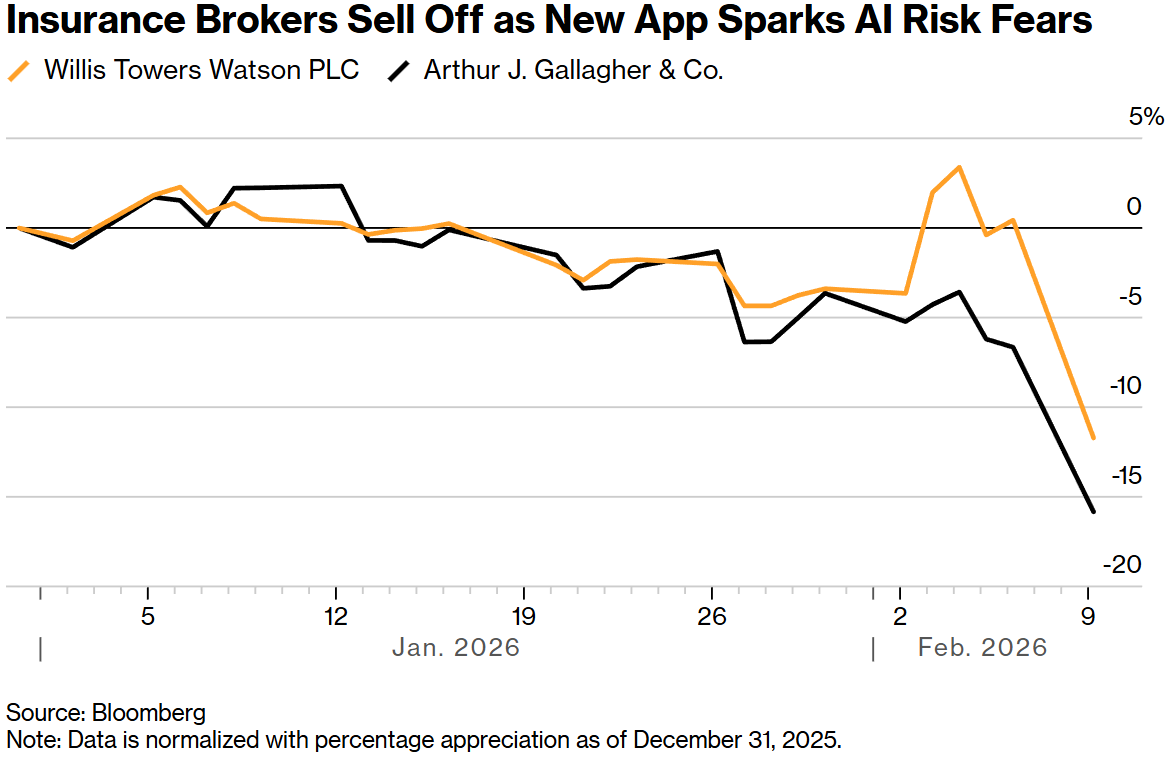
Group 1: Market Performance - Major tech stocks mostly rose, with Oracle up over 9%, AMD, Microsoft, and Broadcom up over 3%, Nvidia and Meta up over 2%, and Tesla and TSMC up over 1% [1][3] - The Dow Jones Industrial Average rose 0.04%, reaching a new all-time high, while the Nasdaq increased by 0.9% and the S&P 500 rose by 0.47% [1] Group 2: Corporate Earnings and Reports - Coca-Cola and Ford are scheduled to release their earnings reports on Tuesday, with analysts suggesting that strong corporate earnings this week could lead to a resurgence in tech stock rotation [1] - The U.S. Labor Department's January employment report, originally set for release on February 6, has been postponed to February 11 due to a government shutdown [1] Group 3: Google and AI Investments - Alphabet plans to issue $20 billion in bonds to fund AI expenditures, exceeding the initial estimate of $15 billion, with the bond offering attracting over $100 billion in orders [2][3] - The bond issuance will be divided into seven parts, with the longest maturing in 2066, priced at a spread of 0.95 percentage points over U.S. Treasuries [3] - Alphabet's capital expenditures for the year could reach $185 billion, significantly higher than Wall Street's expectations [3] Group 4: Capital Expenditure Plans - Major tech companies including Google, Meta, Microsoft, and Amazon are expected to collectively spend $650 billion this year, primarily on expanding AI infrastructure [4] Group 5: Oracle's Bond Issuance - Oracle raised $25 billion through a bond issuance, with peak orders reaching $129 billion, setting a record [5] Group 6: OpenAI Financing - OpenAI is in discussions for a funding round potentially reaching $100 billion, with Microsoft, Nvidia, and Amazon expected to contribute, including a possible $50 billion investment from Amazon [6] - Additional funding may come from SoftBank, which has discussed investing an additional $30 billion [6] Group 7: Insurance Sector Impact - U.S. insurance brokerage stocks fell sharply due to concerns over AI tools from Insurify, with the S&P 500 insurance index dropping 3.89%, marking its largest single-day decline since October [8] - Willis Towers Watson saw the worst performance, down 12.10%, followed by Arthur J Gallagher down 9.84% and Aon down 9.27% [8]


AI颠覆潮席卷金融业:Insurify新工具上线,美国保险经纪股遭遇“黑色星期一”
智通财经网· 2026-02-09 23:27
Group 1 - The core concern is the market's reaction to Insurify's launch of an AI tool, which has raised fears of disruption in the insurance industry, leading to significant stock sell-offs among U.S. insurance brokerage firms [1][4] - The S&P 500 insurance sector index closed down 3.9%, marking the largest decline since October of the previous year [1] - Willis Towers Watson PLC experienced the worst performance, with a closing drop of 12%, the most severe trading day since November 2008 [1] Group 2 - Following Willis Towers Watson, Arthur J Gallagher & Co. and Aon Group saw declines of 9.9% and 9.3%, respectively [1] - Analyst Matthew Palazola noted that while the new AI tools may pose a threat to some consulting aspects of insurance brokerage firms, they are more likely to act as "efficiency multipliers" rather than existential threats [4] - Insurify's application, which utilizes ChatGPT to compare auto insurance rates based on various inputs, was launched on February 3 [4]


Global pension assets rise by nearly 10%, reaching new high
Globenewswire· 2026-02-09 15:32
Core Insights - Global pension assets reached a record USD 68.3 trillion in 2025, marking a 9.6% year-on-year increase driven by defined contribution (DC) savings [1] - The US remains the largest pensions market, constituting 66% of the Top 22 globally, while Canada has overtaken Japan to become the second largest pensions market with a 12% year-on-year growth [4] - The UK pension market has experienced weak growth of only 1.4% per annum over the last decade, resulting in a drop from the second largest to the fourth largest pensions market [5] Global Market Overview - In 2025, global markets showed sustained recovery with strong investor sentiment, leading to the creation of USD 6.0 trillion in pension asset value [2] - Among the top seven global pensions markets, DC assets now account for 63% of total assets, with Australia and the US having the highest allocations at 90% and 72% respectively [2] Growth Trends - Over the past decade, Australia, the US, and Canada have seen above-average growth rates in their predominantly DC markets, with annual growth rates of 6.6%, 7.7%, and 5.3% respectively [3] - South Korea, Switzerland, and Hong Kong also experienced growth rates exceeding 8% per annum over the last ten years [3] Structural Changes - The UK pension market is undergoing a structural shift, with defined benefit (DB) schemes maturing and de-risking, while DC schemes are expanding, now representing around 40% of UK pension assets, up from 18% in 2020 [6] Asset Allocation Trends - Over the last 20 years, the overall allocation to equities in the seven largest pensions markets has decreased by nine percentage points to 48%, while bonds and other asset classes have increased by three and six percentage points respectively [7] Market Performance - 2025 saw broad-based gains across global markets, with equities performing particularly well and fixed income also posting gains due to global rate cuts and narrowing credit spreads [8] Future Outlook - The outlook for 2026 is expected to be influenced by policy decisions, technological innovation, and shifting global dynamics, with fiscal support and AI-related investments identified as key growth drivers [9] - A 'Total Portfolio Approach' is becoming increasingly important in the current uncertain and complex investment environment, enabling faster and more coordinated decision-making [10]

全球养老金金融观察——2025年第四季度(英)
WTW· 2026-02-09 06:40
Investment Rating - The report indicates a positive investment rating for the pension index across all major regions in the fourth quarter of 2025, with notable increases in the pension index driven by positive investment returns and decreases in liabilities in most regions [1][3]. Core Insights - The Global Pension Finance Watch highlights the impact of capital market performance on defined benefit pension plan financing, emphasizing the importance of monitoring pension funded status and financial metrics for informed business decisions [2][5]. - The WTW Pension Index reflects the ratio of market value of assets to projected benefit obligations (PBO) for benchmark plans, showing significant increases in the index across various regions [3][60]. - Positive investment returns were observed across all countries in Q4 2025, contributing to the overall increase in pension indices [15][22][26][30][34][38][42][46]. Summary by Region Brazil - The pension index increased by 0.2% in Q4 2025, with investment returns of 3.9% and a liability growth factor of 3.7% [3][22]. Canada - The pension index rose by 2.2% in Q4 2025, with investment returns of 1.2% and a liability decrease of 1.0% [3][26]. Eurozone - The pension index increased by 5.8% in Q4 2025, with investment returns of 2.6% and a liability decrease of 2.9% [3][30]. Japan - The pension index saw a 7.2% increase in Q4 2025, with investment returns of 2.5% and a liability decrease of 4.5% [3][34]. Switzerland - The pension index increased by 3.3% in Q4 2025, with investment returns of 1.3% and a liability decrease of 1.9% [3][38]. United Kingdom - The pension index rose by 0.2% in Q4 2025, with investment returns of 5.6% and a liability increase of 5.4% [3][42]. United States - The pension index increased by 2.8% in Q4 2025, with investment returns of 2.1% and a liability decrease of 0.6% [3][46].
MKL Q4 Earnings Beat Estimates, Revenues & Premiums Rise Y/Y
ZACKS· 2026-02-05 13:46
Core Insights - Markel Group Inc. (MKL) reported fourth-quarter 2025 net operating earnings per share of $34.45, exceeding the Zacks Consensus Estimate by 34.7%, and reflecting a 68% year-over-year increase [1][8] - The company's total operating revenues reached $4 billion, marking a 7.6% increase year over year, driven by higher earned premiums and net investment income [2][8] - Markel's combined ratio improved by 300 basis points year over year to 92.7, indicating stronger underwriting performance across all segments [3][8] Quarterly Operational Update - Total operating revenues of $4 billion rose 7.6% year over year, attributed to higher earned premiums, net investment income, and other revenue streams [2] - Earned premiums increased 7.6% year over year to $2.2 billion in the quarter [2] - Net investment income grew 5.7% year over year to $257.6 million, surpassing the Zacks Consensus Estimate of $240 million [2] Expense Analysis - Total operating expenses increased 5.5% year over year to $3.4 billion, driven by higher losses, underwriting, and other operational costs [3] - The combined ratio improved by 300 basis points year over year to 92.7, reflecting enhanced underwriting performance [3] Segment Performance - Markel Insurance: Operating revenues increased 7% year over year to $2.4 billion, with adjusted operating income rising 31% to $398.7 million [4] - Industrial: Operating revenues rose 4% year over year to $1 billion, but adjusted operating income decreased 26% to $79.6 million [4] - Financial: Operating revenues surged 41% year over year to $224.1 million, with adjusted operating income increasing 58% to $107.1 million [4] Financial Update - As of December 31, 2025, Markel had investments, cash, and cash equivalents totaling $37.4 billion, a 9.3% increase from the end of 2024 [6] - Senior long-term debt decreased 0.6% year over year to $4.3 billion [6] - Shareholders' equity was reported at $18.6 billion, up 9.9% from the end of 2024 [7] Full-Year Highlights - Underwriting profit increased 25% year over year to $502.6 million [10] - Net income per share was $169.22, reflecting a decline of 15.1% year over year [10] - Total operating revenues grew 4.7% year over year to $15.5 billion, with the combined ratio improving by 100 basis points to 94.2 [10]


Prudential Financial Q4 Earnings Miss, Revenues Beat, Dividend Raised
ZACKS· 2026-02-04 15:16
Core Insights - Prudential Financial, Inc. (PRU) reported fourth-quarter 2025 adjusted operating income of $3.30 per share, missing the Zacks Consensus Estimate by 2%, but reflecting an 11.5% year-over-year increase [1][10] - Total revenues reached $14.52 billion, marking an 11.6% year-over-year increase, driven by higher premiums, net investment income, and asset management fees, surpassing the Zacks Consensus Estimate by 6% [2][10] - Total benefits and expenses amounted to $13 billion, up 11.8% year over year, primarily due to increased insurance and annuity benefits and interest credited to policyholders [3] Operational Update - Prudential Global Investment Management (PGIM) reported adjusted operating income of $249 million, a decrease of 3.8% year over year, attributed to higher expenses and lower revenues from seed and co-investment income, partially offset by increased asset management fees [4] - PGIM's assets under management increased by 7% year over year to $1.466 trillion, driven by equity market and fixed income appreciation [5] - The U.S. Businesses segment delivered an adjusted operating income of $1 billion, up 22% year over year, due to favorable underwriting results and lower expenses, despite a decline in net fee income [5] - International Businesses reported adjusted operating income of $757 million, a 2% year-over-year increase, supported by improved net investment spread results [6] - Corporate and Other segment incurred an adjusted operating loss of $552 million, wider than the previous year's loss, primarily due to increased expenses [7] Capital Deployment - Prudential Financial returned $730 million to shareholders through share repurchases of $250 million and dividends of $480 million in the fourth quarter [8] - The board authorized a 4% increase in the quarterly cash dividend to $1.40 per share, marking the 18th consecutive year of dividend increases [9] Financial Update - As of December 31, 2025, cash and cash equivalents stood at $19.7 billion, a 6.5% increase from the end of 2024, while total debt increased by 0.7% to $20.3 billion [11] - Assets under management and administration rose by 7% year over year to $1.8 trillion, with adjusted book value per common share increasing by 4.5% to $100.17 [11] - Operating return on average equity improved by 110 basis points year over year to 13.3% [12] Full-Year Update - For the full year 2025, adjusted operating income was $14.43 per share, a 14.3% increase from 2023, although it missed the Zacks Consensus Estimate by 0.4% [13] - Total revenues for the year were $57.6 billion, a 15% decrease from 2024, but still beating the Zacks Consensus Estimate by 0.9% [13]



Voya Financial Q4 Earnings Miss Estimates, Revenues Rise Y/Y
ZACKS· 2026-02-04 15:01
Core Insights - Voya Financial, Inc. (VOYA) reported fourth-quarter 2025 adjusted operating earnings of $1.94 per share, missing the Zacks Consensus Estimate by 8%, but showing a year-over-year increase of 38.5% [1][9] - The earnings growth was driven by higher earnings across all segments, partially offset by increased performance-based compensation accruals in Corporate [1] - The company’s adjusted operating revenues reached $2 billion, reflecting a 5.7% year-over-year increase [2] Financial Performance - Net investment income rose 13.4% year over year to $591 million, while fee income increased by 16.5% to $633 million [2][9] - Premiums totaled $738 million, down 6.5% from the previous year [2] - Total benefits and expenses were $1.9 billion, up 2.7% year over year [2] Segment Analysis - Retirement segment reported pre-tax adjusted operating earnings of $255 million, a 21.4% increase year over year, attributed to acquired business from OneAmerica and strong execution [4] - Employee Benefits segment narrowed its pre-tax adjusted operating loss to $10 million from a loss of $102 million in the prior year, driven by improved underwriting margins [5] - Investment Management posted pre-tax adjusted operating earnings of $72 million, a 9% increase year over year, with net inflows of $1.2 billion [6] Asset Management - As of December 31, 2025, Voya's assets under management and administration totaled $1.1 trillion [3] - Total client assets in the Retirement segment reached $797 billion, up 30% year over year [4] Capital and Debt - Voya Financial ended the quarter with cash and cash equivalents of $1.2 billion, a decrease of 12.2% year over year [8] - Long-term debt was reported at $1.5 billion, down 27.8% from the end of 2024 [10] - The financial leverage ratio improved by 330 basis points year over year to 27% [10] Capital Deployment - The company returned $120 million to shareholders through share repurchases and $44 million through common stock dividends in the reported quarter [11] - As of December 31, 2025, Voya had approximately $0.4 billion in excess capital and a remaining share repurchase authorization of $562 million [11] Full-Year Highlights - For the full year 2025, adjusted operating earnings per share were $8.85, a 22% increase year over year, although it missed the Zacks Consensus Estimate by 1.8% [12] - Adjusted operating revenues for the year increased by 3.3% to $7.7 billion [12]


Willis Towers Watson (WTW) Earnings Transcript
Yahoo Finance· 2026-02-03 15:38
Core Insights - The company achieved adjusted diluted earnings per share (EPS) of $17.08 for the full year, reflecting a 13% increase year over year when excluding the contribution from TRANZACT [1][20] - For 2025, the company reported organic growth of 5% and expanded adjusted operating margin by 130 basis points to 25.2% [1][19] - The fourth quarter saw a 6% organic growth in health, wealth, and career segments, with a notable 10% growth in career services [2][23] Financial Performance - Adjusted EPS for the fourth quarter was $8.12, marking a 13% increase year over year when excluding TRANZACT [2][19] - The company generated free cash flow of $1.5 billion for the year, an increase of $279 million from the previous year, resulting in a free cash flow margin of 15.9% [34] - The adjusted operating margin for the fourth quarter was 36.9%, an 80 basis point improvement year over year [32] Segment Performance - Health, wealth, and career revenue grew 6% in the fourth quarter, with health business achieving 4% growth [20][21] - The corporate risk and broking (CRB) segment recorded 8% organic growth in the fourth quarter, continuing a trend of high single-digit growth [5][27] - The wealth segment saw strong growth driven by increased retirement work globally, with expectations for high single-digit growth in 2026 [22][66] Strategic Initiatives - The company is focused on enhancing efficiency through its enterprise delivery organization and investments in technology, which are expected to drive further margin expansion [2][11] - Recent acquisitions, including Newfront, Cushion, and Flowstone Partners, are aimed at optimizing the company's portfolio for growth and profitability [2][13] - The company plans to allocate at least $1 billion to share repurchases in 2026, reflecting a balanced capital allocation approach [36][71] Market Outlook - The company anticipates continued strong demand across its global business, driven by healthcare inflation and employers' focus on managing costs while maintaining competitive employee benefits [21][62] - For 2026, the company expects mid-single-digit organic growth across its segments, supported by ongoing investments in talent and technology [17][50] - The company is optimistic about its position in the market and the potential for synergies from recent acquisitions over the next three years [15][17]