
人工智能工具

Search documents
“唯AI论”已经过时?摩根大通看好传统工业复苏,宏观经济正走向多点开花
智通财经网· 2026-02-25 11:57
Group 1 - The core narrative revolves around the duality of AI's impact on the economy, highlighting that while AI is a significant driver, it is not the sole factor influencing global industrial growth [1][4][18] - The stock market is currently fixated on AI, with a notable shift in focus from major winners like Nvidia to potential losers such as IBM, which experienced a 13% drop in stock price due to competitive pressures from new AI tools [1][4] - Global industrial output grew by 2.4% last year, significantly outpacing the projected annualized growth rate of 1% for the next three years, indicating robust performance in the goods production sector despite trade tensions [4][10][13] Group 2 - Capital expenditures related to AI are projected to reach at least $630 billion this year, underscoring the substantial investment in technology sectors [16] - The analysis from JPMorgan indicates that while AI capital spending is a key component of the industrial recovery, non-tech production is expected to drive growth in 2025, suggesting a shift towards more sustainable economic expansion [13][17] - The report anticipates that global industrial output could see annualized growth rates of 2% to 3% in the coming months, supported by a rebound in hiring and consumer spending [13][18]


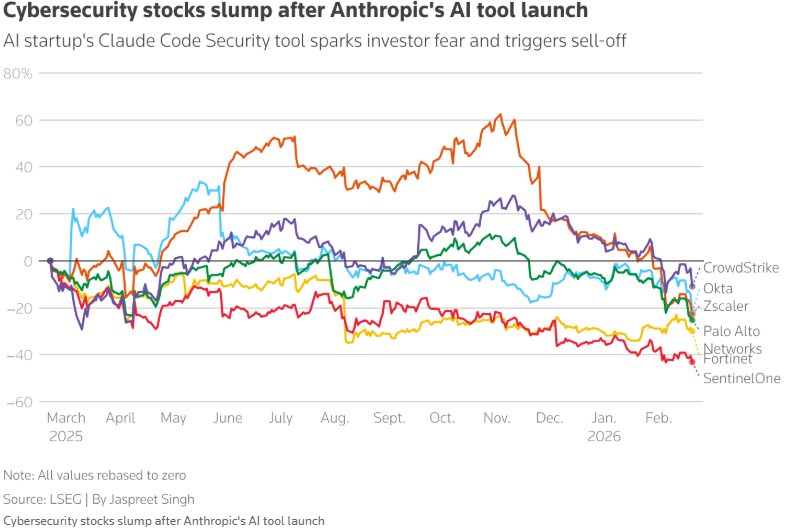
“软件行业恐将破产”
3 6 Ke· 2026-02-25 07:41
Group 1 - Nassim Taleb warns investors about the increasing volatility and potential bankruptcy risks in the software industry driven by artificial intelligence (AI) [1] - Taleb believes that the market is currently underestimating structural risks while overestimating the durability of leading AI companies [1] - He emphasizes that while some will profit from AI, it does not guarantee that current AI companies will be the ones to benefit [1] Group 2 - A report from Citrini Research predicts a dystopian scenario by June 2028, where AI disruption leads to mass unemployment, decreased consumer spending, and economic contraction [2] - Taleb's warnings align with the concerns raised in the Citrini Research report, amplifying market fears [2] Group 3 - Taleb notes that the recent stock market gains have been driven by a small number of AI concept stocks, and a rotation in leading sectors could pose risks to broader indices [3] - He states that structural tail risks across industries are being underestimated, suggesting that potential market corrections could be significant [3] - Taleb anticipates that market gains may continue in the short term, but the scale of potential declines is a greater concern [3] Group 4 - Taleb highlights a structural shift in the market, particularly in the gold sector, which has seen a price increase of approximately 30% since October of the previous year [3] - He expresses concerns about the ongoing U.S. fiscal deficit and the "weaponization" of the dollar through sanctions, which could undermine the dollar's status as a reserve currency [3] Group 5 - Taleb discusses the unpredictable nature of tariffs, stating that if tariffs are permanent and clear, businesses can adapt, but erratic policies will deter investment [4] - He warns that tariffs have a regressive tax nature, disproportionately affecting low-income consumers and exacerbating social inequality [4] Group 6 - Taleb emphasizes the risk of oil supply disruptions due to U.S.-Iran tensions, warning that the global economy cannot withstand another shock similar to the 1970s [5] - He asserts that commodity-driven stagflation cannot be easily remedied through monetary policy [5] - Universa Investments, where Taleb serves as a distinguished scientific advisor, focuses on tail risk hedging strategies to achieve excess returns during market crises, having achieved an annualized return of over 100% last year [5]
亿汇:AI机遇凸显
Sou Hu Cai Jing· 2026-02-23 17:21
Group 1: Core Insights - Moneta Markets observes that the global software services industry is undergoing profound changes due to the accelerated penetration of artificial intelligence (AI) technology into enterprise operations [4] - There is a growing debate on whether automation will undermine traditional outsourcing models, but industry voices lean towards viewing it as a structural opportunity [4] - Concerns in the market primarily focus on the potential for AI tools to replace certain human jobs, impacting labor-intensive business models [4] Group 2: Industry Trends - The demand for talent in areas such as model training, data organization, and compliance governance has significantly increased [5] - According to the World Economic Forum, AI is expected to create a large number of new jobs globally while also impacting some traditional positions [5] - The key difference in the industry is not whether AI is used, but whether professionals possess the skills to understand and apply related technologies [5] Group 3: Long-term Outlook - The impact of AI on the industry is expected to resemble the rise of cloud computing, where initial concerns about technology replacement ultimately led to expanded service offerings and enhanced customer loyalty [5] - Companies now require partners who can deeply understand industry processes and assist in intelligent upgrades, rather than just providing basic coding support [5] - Moneta Markets believes that AI will continue to dominate technology investment directions over the next ten to twenty years, with short-term valuation adjustments due to market sentiment [5] - Investors are advised to focus on service providers with technological integration capabilities and talent reserves to capitalize on the new growth cycle driven by AI [5]

美股散户疯狂“抄底”软件股,“扫货”资金量创历史新高
智通财经网· 2026-02-19 02:06
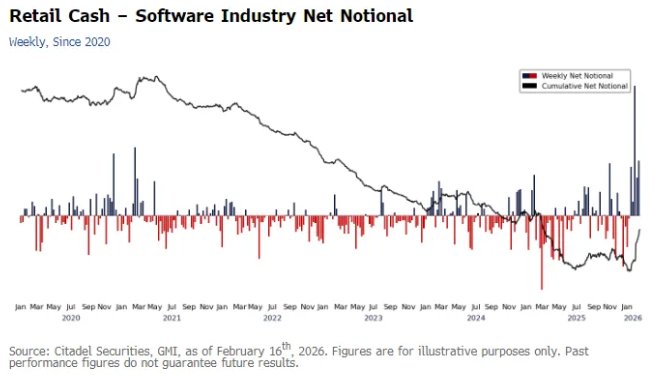
Group 1 - The software sector is experiencing a sell-off due to fears of being replaced by artificial intelligence tools, prompting Wall Street to reassess the potential for overselling, while retail investors are buying the dip [1][2] - Retail traders on the Castle Securities platform have reached a record high in spending on software stocks, with net nominal amounts hitting unprecedented levels, indicating strong demand from retail investors [1] - The sell-off has affected a wide range of companies, from small software developers to large wealth management firms, particularly after the launch of AI tools tailored for legal teams [1] Group 2 - The sell-off in the software sector has led to a broader market impact, with investors selling stocks perceived to be at risk from AI technology, despite minimal actual risk [2] - Retail demand has expanded beyond the tech sector, with increased interest in materials, real estate, finance, communication services, and industrial sectors [2] - Retail participation in the options market has reached historical highs, with daily options trading volume up nearly 50% compared to the average from 2020 to 2025, and 15% higher than the same period last year [2]
城堡证券:美股散户疯狂“抄底”软件股,“扫货”资金量创历史新高
智通财经网· 2026-02-19 01:11
Group 1 - The core viewpoint of the articles highlights a significant sell-off in software stocks due to fears of AI tools threatening these companies, leading to a reevaluation by Wall Street of the potential for overselling [1][2] - Retail investors are actively buying into software stocks at historically high levels, with spending on these stocks on the Castle Securities platform reaching unprecedented amounts since tracking began in 2017 [1] - The sell-off has affected a wide range of companies, from small software developers to large wealth management firms, particularly after the launch of AI tools tailored for legal teams [1] Group 2 - The sell-off in the software sector has extended across the market, with investors selling stocks perceived to be at risk of being replaced by AI technology, even if the risk is minimal [2] - From January 2 to February 13, the average daily dollar demand for U.S. stocks on the Castle Securities platform was approximately 25% higher than the peak in 2021, and double the average from 2020 to 2025 [6] - Retail demand has diversified beyond the tech sector, with increased interest in materials, real estate, finance, communication services, and industrial sectors, alongside a historical high in retail participation in the options market [6]
AI恐慌交易蔓延,美股“2月寒流”何时结束?
Di Yi Cai Jing Zi Xun· 2026-02-15 04:44
Market Overview - The US stock market experienced a decline this week due to "AI panic trading" and an increased probability of the Federal Reserve maintaining its policy unchanged after January's non-farm employment report [2] - Despite a favorable macro environment with steady job growth and easing inflation, concerns over cost and profit margin pressures for tech companies have suppressed optimism, making it difficult for the stock market to gain upward momentum [2] Economic Data - Retail sales data showed weakness, with December's retail sales unchanged month-on-month, below the previous value of 0.6% and the expected 0.4%. The control group saw a 0.1% decline, contrary to the expected increase of 0.4% [3] - The Atlanta Fed's GDPNow model revised its forecast for Q4 GDP from 4.2% to 3.7% due to the retail sales data [3] - The job market remains strong, with January non-farm payrolls increasing by 130,000, significantly above the market expectation of 65,000. The unemployment rate fell from 4.4% in December to 4.3%, lower than the expected 4.4% [3] - The Consumer Price Index (CPI) rose by 0.2% month-on-month in January, below the expected 0.3%, and year-on-year growth was 2.4%, also below the expected 2.5% [3] Federal Reserve Outlook - The mixed signals from economic data suggest that the Federal Reserve is likely to remain patient and assess whether these data points reflect a genuine trend change or are merely statistical noise [4][5] - The yield curve for US Treasuries has flattened, with the 2-year yield dropping to its lowest level since 2022, approaching 3.40%. The pricing of federal funds futures indicates a potential rate cut in June, with a nearly 90% probability of two rate cuts this year [5] Market Sentiment and Sector Performance - The US stock indices fell, with investors continuing to reduce exposure to technology stocks. The S&P 500 index turned negative for the year [6] - Concerns about how new AI tools will impact specific industries have led to market volatility, initially affecting software and financial stocks, and later spreading to office real estate and logistics companies [7] - The financial sector saw the largest decline this week, down 4.8%, followed by communication services down 3.5%, and non-essential consumer goods and technology sectors down over 2% [7] AI Impact on Market - The launch of new AI tools has raised concerns about job displacement, leading to a sell-off in various sectors, including real estate and logistics. This "AI panic trading" has caused investors to adopt a "sell first, ask questions later" approach [8] - Despite the strong US economy and previous stock market highs driven by significant investments in AI infrastructure, AI is now viewed as a potential threat to existing business models, creating a paradox for Wall Street [8] Future Market Outlook - The significant decline in Treasury yields typically serves as a bullish catalyst for the stock market, but bearish confirmation signals in the tech sector suggest potential further downside risks in the short term [9] - The volatility index (VIX) remains around 20, indicating that the market is seeking protective measures and may maintain higher-than-average volatility in the near term [9]

AI恐慌交易蔓延,美股“2月寒流”何时结束?
第一财经· 2026-02-15 04:37
Core Viewpoint - The article discusses the impact of "AI panic trading" and the rising probability of the Federal Reserve maintaining its policy after the January non-farm employment report, leading to a decline in the US stock market [3]. Economic Data Summary - The upcoming week will require investors to digest a significant amount of economic data, which is expected to show mixed results [6]. - Monthly retail sales data was weak, with December sales unchanged month-on-month, below the previous value of 0.6% and the expected 0.4% [6]. - The Atlanta Fed's GDPNow model revised the US Q4 GDP forecast down from 4.2% to 3.7% [7]. - The job market showed strong performance, with January non-farm payrolls increasing by 130,000, significantly above the market expectation of 65,000 [7]. - The unemployment rate decreased from 4.4% in December to 4.3%, lower than the expected 4.4% [7]. - The Consumer Price Index (CPI) rose by 0.2% month-on-month in January, below the expected 0.3%, and the year-on-year increase was 2.4%, also below the expected 2.5% [7]. Federal Reserve and Interest Rate Expectations - There is a slight increase in expectations for a Federal Reserve rate cut, with the probability of two cuts this year approaching 90% [8]. - The flattening of the US Treasury yield curve indicates a significant drop in long-term yields, with the 2-year yield nearing 3.40%, the lowest since 2022 [8]. Market Reactions and Sector Performance - The US stock indices fell over the past week, with investors continuing to reduce exposure to technology stocks [11]. - Concerns about the impact of new AI tools on specific industries have led to market volatility, initially affecting software and financial stocks, and later spreading to real estate and logistics sectors [12]. - The financial sector experienced the largest decline, down 4.8%, followed by communication services at 3.5%, while utilities saw a significant increase of 7.1% due to safe-haven inflows [12][13]. Future Market Outlook - The article suggests that the market may still need to find a bottom, with technical indicators showing bearish confirmation signals for the Nasdaq [14]. - The volatility index (VIX) remains around 20, indicating that the market is seeking protective measures and may maintain higher-than-average volatility in the short term [14].

美股点金丨AI恐慌交易蔓延 美股“2月寒流”何时结束?
Di Yi Cai Jing· 2026-02-15 03:25
Group 1 - The US stock market experienced a decline this week due to "AI panic trading" and increased probabilities of the Federal Reserve maintaining its policy unchanged after the January non-farm employment report [1] - Despite a generally favorable macro environment with steady job growth and easing inflation, concerns over cost and profit margin pressures for tech companies have dampened investor optimism [1] - The ability of tech stocks to stabilize and the strengthening of interest rate cut expectations from the Federal Reserve will be crucial for market recovery in the coming week [1] Group 2 - The Federal Reserve's interest rate cut expectations have slightly increased, with mixed economic data being digested by investors [2] - Retail sales data showed weakness, with December sales flat month-on-month, below the previous value of 0.6% and the expected 0.4% [2] - The January non-farm payroll report indicated a significant increase of 130,000 jobs, surpassing the market expectation of 65,000, with the unemployment rate dropping to 4.3% [2] Group 3 - Economic signals are mixed, with the January employment report contradicting the narrative of stagnant hiring, while retail sales data challenges the view of strong consumer spending [3] - The yield curve for US Treasury bonds has flattened, with the 2-year yield dropping to its lowest level since 2022, approaching 3.40% [3] - The inflation report appears encouraging, with housing prices slowing and tariff-related impacts diminishing, leading to expectations of two interest rate cuts later this year [3] Group 4 - The recent decline in retail sales is viewed as a temporary pause following strong spending, with tax refunds and robust wage growth expected to support consumption recovery in the coming months [4] - The significant increase in non-farm employment is concentrated, raising questions about its sustainability due to demographic constraints and weakening labor demand in other sectors [4] Group 5 - The US stock indices fell over the past week, with investors continuing to reduce exposure to tech stocks, leading to a decline in the S&P 500 index [5] - Concerns regarding the impact of new AI tools on specific industries have caused market volatility, initially affecting software and financial stocks, and later spreading to real estate and logistics companies [5] Group 6 - The financial sector experienced the largest decline this week, down 4.8%, followed by communication services down 3.5%, while utilities saw a significant increase of 7.1% due to safe-haven inflows [6] - Other sectors such as real estate and materials also recorded gains of over 3%, while energy, consumer staples, and industrial sectors showed positive performance [6] Group 7 - The introduction of AI tools by companies like Altruist has raised concerns about job displacement, leading to a cautious sentiment among traders [7] - The market's reaction to AI-related news has resulted in a "sell first, ask questions later" approach, with fears of AI disruption affecting various sectors beyond just software [7] Group 8 - The outlook for the next week suggests that a significant decline in Treasury yields could typically act as a bullish catalyst for the stock market, but bearish signals in the tech sector indicate potential further downside risks [8] - The volatility index (VIX) remains around 20, indicating that the market is seeking protective measures and may maintain higher-than-average volatility in the short term [8]
美股点金丨AI恐慌交易蔓延,美股“2月寒流”何时结束?
Di Yi Cai Jing Zi Xun· 2026-02-15 03:25
Group 1 - The US stock market experienced a decline this week due to "AI panic trading" and increased probabilities of the Federal Reserve maintaining its policy unchanged after the January non-farm employment report [1] - Concerns over cost and profit margin pressures for technology companies have suppressed optimism, despite a generally favorable macroeconomic environment characterized by steady job growth and easing inflation [1] - The ability of technology stocks to stabilize and the strengthening of interest rate cut expectations from the Federal Reserve will be critical for market recovery in the coming week [1] Group 2 - The retail sales data showed weakness, with December retail sales unchanged month-on-month, below the previous value of 0.6% and the expected 0.4% [2] - The Atlanta Fed's GDPNow model revised its forecast for Q4 GDP from 4.2% to 3.7% due to the retail sales performance [2] - The January non-farm payrolls increased by 130,000, significantly above the market expectation of 65,000, with the unemployment rate dropping to 4.3% from 4.4% [2] - The Consumer Price Index (CPI) for January rose by 0.2% month-on-month, lower than the expected 0.3%, and the year-on-year increase was 2.4%, also below the expected 2.5% [2] Group 3 - Economic signals are mixed, with the January employment report contradicting the narrative of stagnant hiring, while retail sales data challenges the view of strong consumer spending [3] - The flattening of the US Treasury yield curve indicates a significant drop in long-term yields, with the 2-year yield approaching 3.40%, and the probability of two rate cuts this year nearing 90% [3] - The inflation report shows encouraging signs, particularly with housing prices slowing and tariff-related impacts diminishing, which may lead the Federal Reserve to consider rate cuts later this year [3] Group 4 - The recent signals are unlikely to persist, as the decline in retail sales may be a temporary pause following strong spending, and the sustainability of the significant increase in non-farm employment is questionable [4] - The cooling inflation data provides a favorable environment for the Federal Reserve to potentially restart rate cuts later in the year [4] Group 5 - The US stock indices fell over the past week, with investors continuing to reduce exposure to technology sectors, and the S&P 500 index turned negative for the year [5] - Concerns regarding the impact of new AI tools on specific industries have led to market volatility, initially affecting software and financial stocks, and later spreading to real estate and logistics sectors [5] Group 6 - The financial sector experienced the largest decline this week, down 4.8%, followed by communication services down 3.5%, and both non-essential consumer goods and technology sectors fell over 2% [6] - Utility stocks surged by 7.1% due to safe-haven inflows, while real estate and materials rose over 3% [6] Group 7 - The launch of AI tools by companies like Altruist and Anthropic has heightened fears of job displacement, leading to a cautious sentiment among traders regarding US stock exposure [7] - The sell-off pressure in the market is primarily driven by concerns over the disruptive effects of AI, affecting not only software stocks but also real estate and logistics [7] Group 8 - The significant decline in US Treasury yields typically serves as a bullish catalyst for the stock market, but bearish confirmation signals in the Nasdaq indicate potential further downside risks [8] - The volatility index (VIX) remains around 20, suggesting that the market is seeking protective measures and may maintain higher-than-average volatility in the short term [8]
人工智能技术冲击引发担忧 纽约股市大幅下跌
Xin Hua She· 2026-02-13 07:39
Group 1 - The New York stock market experienced a significant decline due to investor concerns about the disruptive impact of artificial intelligence (AI) on traditional industries, particularly in logistics and commercial real estate [1][2] - The Dow Jones Industrial Average fell by 669.42 points, closing at 49,451.98, a decrease of 1.34%. The S&P 500 index dropped by 108.71 points to 6,832.76, down 1.57%, while the Nasdaq Composite Index decreased by 469.32 points to 22,597.15, a decline of 2.03% [1] - The application of AI tools has raised concerns about lower costs and higher efficiency potentially reshaping the operations of industries such as software, logistics, financial services, and commercial real estate, leading to volatility in stock prices [1] Group 2 - Robinson Global Logistics saw its stock price drop by over 14% due to fears that AI will optimize logistics processes and compress traditional profit margins [2] - There is a growing concern that increased use of AI tools will weaken demand for office space, resulting in sell-offs of stocks in commercial real estate companies [2] - Financial services firms, exemplified by Morgan Stanley, are facing stock price pressures as new technologies threaten to disrupt wealth management business models [2]