
拜耳

Search documents
BMY Wins EC Nod for Label Expansion of CAR T Cell Therapy Breyanzi (Revised)
ZACKS· 2025-11-27 09:46
Core Insights - Bristol Myers Squibb (BMY) received European Commission approval for Breyanzi, expanding its label to include treatment for adult patients with relapsed or refractory mantle cell lymphoma (MCL) after at least two lines of systemic therapy, including a Bruton's tyrosine kinase (BTK) inhibitor [1][9] Group 1: Breyanzi Approval and Indications - The latest approval marks the fourth for Breyanzi in Europe, which is already approved for several other indications including relapsed or refractory diffuse large B-cell lymphoma (DLBCL) and high-grade B-cell lymphoma (HGBCL) [2] - Breyanzi is indicated for patients who relapsed within 12 months of first-line chemoimmunotherapy or are refractory to it, as well as for those with relapsed or refractory DLBCL, PMBCL, and FL3B after two or more lines of therapy [3] Group 2: Clinical Trial Results - The approval is based on the TRANSCEND NHL 001 trial results, where 82.7% of patients responded to Breyanzi, with 71.6% achieving a complete response, and 41.2% of patients maintained their response at 24 months [4][9] Group 3: Pipeline Expansion and Market Impact - Bristol Myers is focusing on expanding its pipeline due to the negative impact of generics on its legacy portfolio, including Revlimid and Pomalyst [5] - The company’s shares gained 3.3% following positive data from Bayer's cardiovascular candidate asundexian, which may boost investor confidence in BMY's own cardiovascular candidate, milvexian [6][8] Group 4: Discontinuation of Librexia Study - Bristol Myers and Johnson & Johnson decided to discontinue the late-stage Librexia study for milvexian after an interim analysis indicated it was unlikely to meet primary efficacy endpoints, although two other studies for milvexian will continue [10][11]


阿里健康发布2026财年中期业绩公告:净利润同比增长64.7%
2 1 Shi Ji Jing Ji Bao Dao· 2025-11-27 09:26
Core Insights - Alibaba Health reported a revenue of RMB 16.697 billion for the six months ending September 30, 2025, representing a year-on-year growth of 17% [1] - The company achieved a net profit of RMB 1.266 billion, marking a significant increase of 64.7% compared to the previous year [1] - Alibaba Health continues to invest in the medical AI sector and deepen its strategic layout in the B2B medical verticals [1] Financial Performance - Revenue reached RMB 16.697 billion, up 17% year-on-year [1] - Gross profit was RMB 4.184 billion, reflecting an 18.4% increase [1] - Adjusted net profit stood at RMB 1.356 billion, a growth of 38.7% [1] User Engagement and Platform Growth - The Tmall Health platform serves over 56,000 merchants, with SKU growth exceeding 97 million [1] - Annual active user numbers and annualized ARPU continue to grow, with platform GMV showing stable growth [1] - The self-operated pharmacy business generated revenue of RMB 14.38 billion, up 18.6% year-on-year [1] Strategic Partnerships and Service Expansion - Alibaba Health has deepened collaborations with major pharmaceutical companies, launching dozens of new specialty drugs [2] - Strategic partnerships with companies like Eli Lilly, AstraZeneca, and Pfizer have been established to enhance digital health services [2] - The company provides integrated online and offline healthcare services, with over 250,000 healthcare professionals signed up for online consultation services [2] Traditional Chinese Medicine and Digital Infrastructure - The TCM service business is experiencing stable growth, with over 150,000 registered TCM practitioners [3] - The "Code on Trust" platform offers free traceability services to 560,000 pharmaceutical enterprises [3] - Alibaba Health is enhancing its digital services for pharmaceutical companies, collaborating with over 900 leading pharmaceutical firms [3] AI and Future Prospects - The company is increasing resource investment in medical AI applications to improve user experience and search conversion efficiency [3] - Alibaba Health is exploring applications in serious medical fields to enhance evidence-based capabilities in clinical decision-making [3]

阿里健康发布2026财年中期业绩公告:净利润同比增长64.7%
21世纪经济报道· 2025-11-27 09:14
Core Viewpoint - Alibaba Health reported strong financial performance for the first half of the 2026 fiscal year, with revenue reaching RMB 16.697 billion, a year-on-year increase of 17%, and net profit growing by 64.7% to RMB 1.266 billion, indicating robust business growth and high-quality development [1] Financial Performance - Revenue for the six months ending September 30, 2025, was RMB 16.697 billion, up 17% year-on-year [1] - Gross profit reached RMB 4.184 billion, reflecting an 18.4% increase [1] - Net profit was RMB 1.266 billion, a significant rise of 64.7% [1] - Adjusted net profit stood at RMB 1.356 billion, marking a 38.7% year-on-year growth [1] Business Growth and User Engagement - Alibaba Health is one of the largest online B2C healthcare product retail platforms in China, with over 56,000 active merchants and more than 97 million SKUs [2] - The platform's annual active user count and ARPU (average revenue per user) continue to grow, with GMV (gross merchandise volume) showing stable year-on-year growth [2] - The self-operated pharmacy business generated RMB 14.38 billion in revenue, up 18.6% year-on-year, with a significant increase in active users and SKU growth of 98.8% to 1.61 million [2] Strategic Partnerships and Service Expansion - Alibaba Health has formed strategic partnerships with major pharmaceutical companies like Eli Lilly, AstraZeneca, and Bayer to enhance digital health services and expand market reach [3] - The company provides integrated online and offline healthcare services, with over 250,000 healthcare professionals offering online consultation services [3] - The self-operated chronic disease business has seen continuous growth in user numbers and ARPU [3] Digital Infrastructure and AI Development - The "Code on Trust" platform offers free traceability services to 56,000 pharmaceutical terminal enterprises, expanding into medical devices and traditional Chinese medicine [4] - Alibaba Health collaborates with over 900 leading pharmaceutical companies to provide data analysis services [4] - The company is investing in AI applications within the pharmaceutical e-commerce sector to enhance user experience and search conversion efficiency, while also exploring applications in serious medical fields [4]

阿里健康上半财年营收166.97亿元,经调整净利润达13.56亿
Xin Lang Ke Ji· 2025-11-26 11:06
Core Insights - Alibaba Health reported a revenue of RMB 16.697 billion for the six months ending September 30, 2025, representing a year-on-year growth of 17% [1] - Gross profit reached RMB 4.184 billion, up 18.4% year-on-year, while net profit surged by 64.7% to RMB 1.266 billion [1] - Adjusted net profit was RMB 1.356 billion, reflecting a year-on-year increase of 38.7% [1] Revenue and User Growth - The number of merchants on the Tmall Health platform exceeded 56,000, with SKUs increasing by over 97 million [1] - Annual active user numbers and annualized ARPU continued to grow, with platform GMV achieving stable year-on-year growth [1] - The self-operated business revenue reached RMB 14.38 billion, marking an 18.6% increase year-on-year [1] Strategic Collaborations - Alibaba Health partnered with leading pharmaceutical companies such as Eli Lilly, AstraZeneca, and Pfizer to launch dozens of new specialty drugs [2] - The company is expanding digital health services through strategic collaborations in online retail, category expansion, and disease education [2] - Over 250,000 healthcare professionals, including licensed physicians and pharmacists, are now providing online health consultation services, an increase of over 20,000 from the previous year [2]
BMY Wins EC Nod for Label Expansion of CAR T Cell Therapy Breyanzi
ZACKS· 2025-11-25 20:06
Core Insights - Bristol Myers Squibb (BMY) received European Commission (EC) approval for Breyanzi (lisocabtagene maraleucel), expanding its label to include treatment for adult patients with relapsed or refractory mantle cell lymphoma (MCL) after at least two lines of systemic therapy, including a Bruton's tyrosine kinase (BTK) inhibitor [2][10] - This marks the fourth approval for Breyanzi in Europe, which is already approved for several other lymphoma types [3][4] Approval Details - The latest EC approval is based on the MCL cohort results from the TRANSCEND NHL 001 trial, where 82.7% of patients responded to Breyanzi, and 71.6% achieved a complete response [5][10] - Sustained clinical benefits were observed, with 50.8% of patients remaining in response at 24 months [5][10] Pipeline Expansion - Bristol Myers is actively seeking to expand its pipeline due to the negative impact of generics on its legacy products like Revlimid, Pomalyst, Sprycel, and Abraxane [6] - The approval of new drugs and label expansions for existing drugs is expected to diversify its portfolio [6] Market Reaction - Shares of BMY increased by 3.3% following positive news from Bayer regarding its cardiovascular candidate asundexian, which met primary efficacy and safety endpoints in a late-stage study [7][9] - The success of Bayer's study has raised investor optimism for BMY's cardiovascular candidate, milvexian, in secondary stroke prevention [9] Study Discontinuation - Bristol Myers and Johnson & Johnson announced the discontinuation of the late-stage Librexia study for milvexian after an interim analysis indicated it was unlikely to meet primary efficacy endpoints [11] - However, two other late-stage studies for milvexian are set to continue, with top-line data expected in 2026 [12]
FDA Greenlights Novartis' Gene Replacement Treatment for SMA
ZACKS· 2025-11-25 20:00
Core Insights - Novartis (NVS) received FDA approval for Itvisma, a gene replacement therapy for spinal muscular atrophy (SMA) in patients aged two years and older, including teens and adults [1][7] - Itvisma is the first and only gene replacement therapy targeting the genetic cause of SMA, delivering a functional SMN1 gene in a single fixed dose [2][3] FDA Approval and Clinical Data - The approval was based on positive results from the phase III STEER study and the open-label phase IIIb STRENGTH study, showing significant motor function gains and stabilization of motor abilities over 52 weeks [4][7] - Itvisma demonstrated a consistent safety profile across both studies, addressing the unmet needs of approximately 9,000 individuals in the U.S. affected by SMA [5] Company Strategy and Market Position - Novartis is focusing on diversifying its portfolio amid generic competition for key drugs like Entresto, with new drug approvals and label expansions expected to mitigate adverse impacts [6] - The company’s shares have increased by 30.1% year-to-date, outperforming the industry growth of 16% [6] Future Growth Projections - Management projects a compounded annual growth rate (CAGR) of 5-6% for sales from 2025 to 2030, with an upgraded sales guidance for 2024-2029 to 6% from 5% [9] - Strong performance from key products such as Kisqali, Kesimpta, Pluvicto, and Scemblix supports the company's growth despite challenges from generic competition [10] Recent Acquisitions - Novartis announced plans to acquire Avidity Biosciences for $12 billion to enhance its late-stage neuroscience pipeline, with the acquisition expected to close in the first half of 2026 [11][12]


拜耳“爬坑”
3 6 Ke· 2025-11-25 12:19
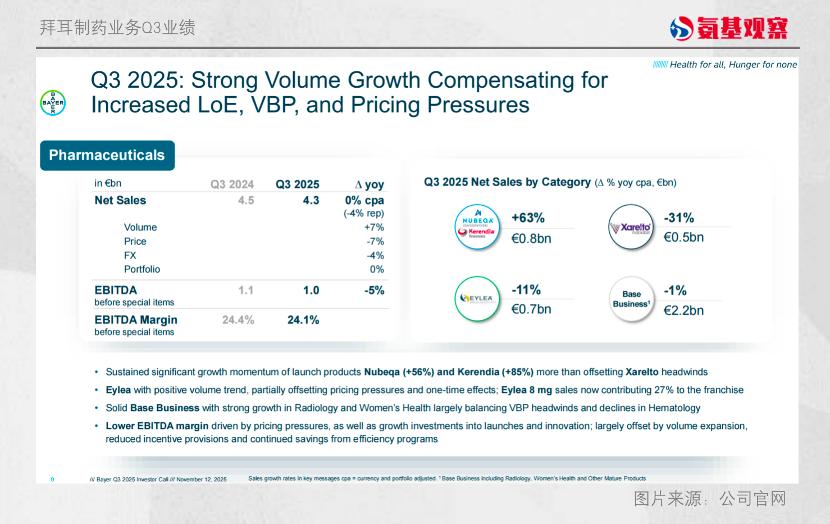
Core Viewpoint - Bayer is experiencing a significant turnaround in 2025, with its stock price increasing over 59% year-to-date, making it the top performer among established multinational corporations (MNCs) [1] Group 1: Financial Performance - Bayer's stock price surged by 10.91% following the announcement of the successful Phase III trial of its FXIa inhibitor, asundexian, which significantly reduced the risk of stroke recurrence without increasing major bleeding rates [2][5] - The company has seen a dramatic recovery from a market capitalization decline of over 70% since its peak in 2015, with current market value at approximately €34.6 billion [6] - Bayer's pharmaceutical segment is expected to benefit significantly from asundexian, with projected annual sales reaching €3 billion if approved [5] Group 2: Product Development - Asundexian's success marks the first successful Phase III trial for FXIa inhibitors, providing a much-needed boost to Bayer's pharmaceutical pipeline [4][5] - Bayer has also received FDA approval for Elinzanetant, expected to achieve peak annual sales exceeding €1 billion, and Acoramidis, which has rapidly captured about 50% of the new brand prescription market share in Germany [11] Group 3: Strategic Reforms - Bayer has initiated the Dynamic Shared Ownership (DSO) reform to streamline operations, aiming for annual cost savings of approximately €2 billion by 2026 [6][7] - The company has reduced its workforce by 13% as part of its restructuring efforts, with a total of 13,500 employees laid off since early 2024 [7] - Bayer's strategy has shifted from a broad approach to a more focused one, concentrating on four core areas: oncology, cardiovascular, neurology, and rare diseases [11] Group 4: Future Outlook - Bayer's "must-win battle" plan aims to restore growth in its pharmaceutical business by launching new drugs and optimizing operations by 2027 [10][12] - The company faces ongoing challenges, including managing litigation and debt, which will be critical for its long-term success [13]

Veeva Summit Europe: future-proofed AI set to bolster commercial pharma operations
Yahoo Finance· 2025-11-25 11:28
Core Insights - The 2025 Veeva Commercial Summit Europe highlighted the significant role of AI in the pharma and life sciences industry, with executives discussing its evolving landscape and expressing excitement for its short-term and long-term potential [1][2] Group 1: AI Adoption and Implementation - The complexity and potential of AI have rapidly expanded, leading to widespread implementation across the life sciences industry to enhance efficiency [2] - Decision-makers are urged to identify the best use cases for AI in daily operations while acknowledging current pitfalls to ensure trust and accuracy [3] Group 2: Agentic AI - Agentic AI is emerging as a notable technology within the pharma sector, capable of autonomously performing tasks without human intervention [4] - Companies like Bayer are exploring the gradual adoption of agentic AI, with a focus on reducing manual workloads for administrative tasks [5] - There is a need for full trust in AI before granting it autonomy, with a preference for augmented AI as a preliminary step [6] Group 3: Integration and Future-Proofing - For agentic AI to be effective in life sciences, it must be deeply integrated into daily workflows rather than merely layered on top [6] - AI systems should be designed to be future-proof to keep pace with the rapid evolution of technology [7]

中国生物医药创新 2.0:全球竞合、技术驱动与战略重塑(2025.11.17—2025.11.21)
Huafu Securities· 2025-11-25 05:31
策 略 定 期 报 告 2、根据科睿唯安《风起云涌:中国生物医药创新 2.0 时代》报告, 中国生物医药产业已进入以源头创新和全球竞争力为核心的 2.0 阶段。 2024 年中国跃居全球第二大新药首发市场,66%全球新活性化合物已 在中国上市,凸显深度全球接轨。截至 8 月份,2025 年对外许可交易 额达 500 亿美元,热点从 ADC 转向双抗/小分子等方向,创新价值获 国际认可。政策端形成从30天临床快审到商保目录的端到端支持体系。 企业层面,在研管线、专利及临床试验数量均实现同比超 100%增长, 展现强劲创新动能。面对新周期,产业正通过聚焦管线结构、强化数 据整合与先进技术应用,推动研发效率提升与成本优化,持续塑造"中 国智造"全球影响力。 团队成员 华福证券 2025 年 11 月 25 日 策 略 研 究 中国生物医药创新 2.0:全球竞合、技术驱动与战 略重塑(2025.11.17—2025.11.21) 投资要点: 近期观点 1、医药指数本周关注的 6 个子行业均为负收益,表现不佳。 技术研发不及预期;宏观需求变化;地缘政治影响 证 券 研 究 报 告 诚信专业 发现价值 1 请务必阅读报告 ...
数智赋能康养,2025健康中国建设大会解锁长三角智慧养老新路径
Yang Zi Wan Bao Wang· 2025-11-24 14:32
Group 1 - The 2025 Health China Construction Conference and Yangtze River Delta Smart Health Carnival was held in Nantong, focusing on the integration of digital technology and health services for the elderly, aiming to boost the construction of a healthy China [1] - Nantong has been recognized as a model city for health construction in China for three consecutive years and has established a long-term care insurance system, becoming the first city in the country to do so [2] - The city has a robust foundation in the health and wellness industry, with international companies like Merck and Bayer, as well as local leaders like Jinghua Pharmaceutical, contributing to its growth [2] Group 2 - Nantong has become the first city in China to be designated as a pilot area for stroke prevention and reduction, which aims to create a replicable model for stroke prevention [3] - The Health China Construction Conference featured discussions on elderly health digital services and the development of long-term care insurance, focusing on building a comprehensive medical and health service system [3] - The Yangtze River Delta Smart Health Carnival showcased over 1,000 products related to smart health equipment, rehabilitation aids, and biomedicine, attracting participation from more than 80 companies [3]