
BioNTech SE

Search documents
X @Bloomberg
Bloomberg· 2025-09-05 09:22
BioNTech said an experimental drug succeeded in a breast cancer study, the first dividend of the German Covid-19 vaccine maker’s collaboration with Chinese biotech Duality https://t.co/gka8vlNf2z ...

港股异动 | 映恩生物-B(09606)早盘涨超5% 上半年收入高增 公司潜在交易总价值超过60亿美元
智通财经网· 2025-09-02 03:53
智通财经APP获悉,映恩生物-B(09606)早盘涨超5%,截至发稿,涨3.67%,报362港元,成交额1.04亿 港元。 消息面上,映恩生物公布中期业绩,上半年收入约12.29亿元,同比增长22.9%;经调整期内利润约1.46 亿元,同比增长14.2%。公告称,收入增加主要由于通过对外授权及合作协议进一步扩展研发活动。 招银国际发布研报称,映恩生物上半年收入12.3亿元人民币,同比增长23%,主要由授权与合作款项推 动。虽然公司目前尚未有商业化产品,但其与BioNTech、百济神州及葛兰素史克等企业建立的广泛合 作关系,潜在交易总价值超过60亿美元,加上未来可能扩展的合作项目,预计将在临床项目推进过程中 提供持续的资金支持。 ...
基因细胞治疗领域把握:前沿疗法为未来医疗蓄力
Huafu Securities· 2025-09-01 03:47
Group 1 - The report highlights the rapid development in the gene, cell, and RNA therapy sectors, with three new therapies approved in Q2 2025, including FDA-approved Zevaskyn and mNexspike, and China's first hemophilia B gene therapy BBM-H901 [3][8] - A total of 4,469 therapies are in various stages of development globally, with gene therapies accounting for 49% (2,210 therapies), RNA therapies for 29% (1,297 therapies), and cell therapies for 22% (962 therapies) [9][10] - The report notes that tumor and rare diseases remain the primary focus of research and development, with gene editing and delivery technologies driving innovation [3][10] Group 2 - The report indicates a significant increase in mergers and acquisitions within the industry, with 12 deals completed in the quarter totaling over $6 billion, reflecting a trend of large pharmaceutical companies consolidating their positions [10][11] - The financing environment for startups has tightened, with only three financing rounds completed totaling $197 million, a 35% decrease from the previous quarter, indicating a more cautious approach from investors [10][11] - Key catalysts to watch for in Q3 2025 include regulatory decisions on over ten gene and cell therapies, which are expected to shape the industry's future landscape [11][14] Group 3 - The report emphasizes the importance of technological advancements in gene editing and delivery systems, with notable acquisitions such as AbbVie’s $2.1 billion purchase of Capstan Therapeutics, highlighting the commercial potential of these innovations [10][11] - The report also discusses the increasing focus on RNA therapies in oncology, with 26% of new RNA trials initiated in Q2 2025 targeting tumor indications, a significant rise from the previous quarter [9][10] - The report outlines the strategic initiatives by the Chinese government to enhance the biopharmaceutical sector, including the establishment of a national biopharmaceutical technology innovation center and support for decentralized clinical trials [29][30]
癌症的“颠覆性疗法”,中国创新药的“DeepSeek时刻”!最核心的关键词:PD(L)1 bsAb
Hua Er Jie Jian Wen· 2025-08-31 11:58
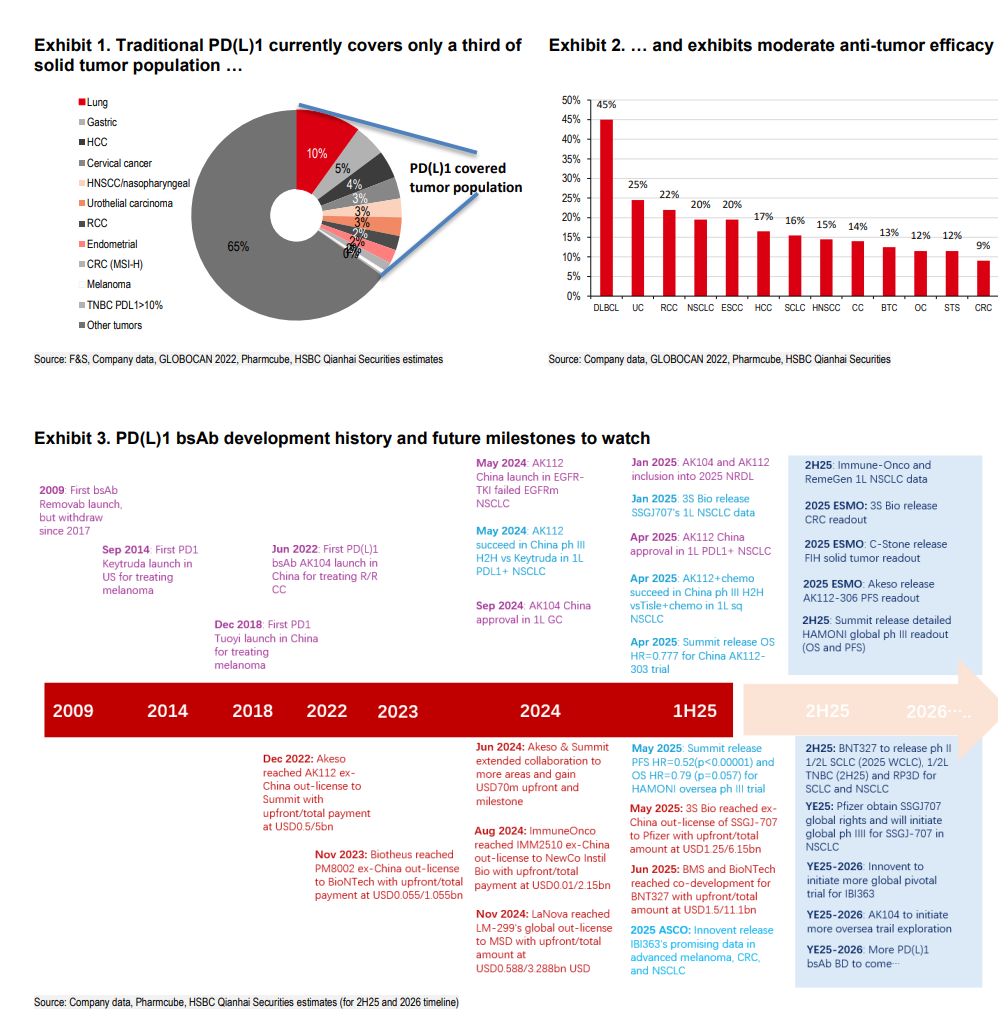
Core Insights - The emergence of PD(L)1 bispecific antibodies (bsAb) from China is being recognized as a transformative moment in the global biopharmaceutical industry, particularly in cancer treatment [1][2] - The Hang Seng Biotechnology Index has surged by 91% this year, significantly outperforming the broader market's 26% increase, driven by breakthroughs in innovative drug development [1][2] - The global PD(L)1 market is projected to grow from $53 billion in 2024 to $100 billion by 2035, with bsAb expected to capture approximately 65% of this market share [2][12] Industry Overview - PD(L)1 bsAb represents a new generation of cancer immunotherapy that targets two pathways simultaneously, enhancing immune response and overcoming resistance in a broader range of tumor types [3][19] - Traditional PD-1/PD-L1 monoclonal antibodies, such as Keytruda, have limitations, as a significant proportion of patients experience ineffectiveness or develop resistance [3][19] - The anticipated growth in the PD(L)1 market will be fueled by the introduction of key bsAb drugs around 2027-2028, their strong anti-tumor efficacy, and the expiration of patents for existing monoclonal antibodies [14][19] Chinese Market Dynamics - China is leading the development of PD(L)1 bsAb, with approximately 90% of the global pipeline originating from Chinese companies [17][18] - The Chinese PD(L)1 market is expected to grow at a compound annual growth rate (CAGR) of 8.5%, reaching $10 billion by 2035, with bsAb accounting for 70% of the market share [16][18] - Major global pharmaceutical companies have not yet established their own PD(L)1 bsAb assets, instead opting to license Chinese assets, indicating a competitive advantage for Chinese firms [18] Competitive Landscape - Leading companies are actively advancing clinical development, with five major players expected to capture over 80% of the market share, reminiscent of the dynamics seen with Keytruda and Opdivo [19] - Notable companies such as Akeso, Innovent, and others are accelerating their international expansion through significant licensing agreements and clinical breakthroughs [21] - Recent high-value licensing deals, such as Pfizer's $12.5 billion acquisition of SSGJ707 rights and BioNTech's $11.1 billion collaboration with BMS, highlight the growing interest in Chinese biopharmaceutical innovations [21]



Pfizer and BioNTech’s COMIRNATY® Receives U.S. FDA Approval for Adults 65 and Older and Individuals Ages 5 through 64 at Increased Risk for Severe COVID-19
Globenewswire· 2025-08-27 16:50
Core Insights - Pfizer and BioNTech received FDA approval for their LP.8.1-adapted monovalent COVID-19 vaccine for adults aged 65 and older, and for individuals aged 5 to 64 with underlying health conditions [1][2][3] Group 1: FDA Approval and Vaccine Details - The FDA's approval is based on extensive evidence supporting the safety and efficacy of the Pfizer-BioNTech COVID-19 vaccine, including data from clinical trials for children aged 5 to 11 [2] - The LP.8.1-adapted vaccine is designed to generate improved immune responses against multiple circulating SARS-CoV-2 sublineages compared to previous vaccine adaptations [2][4] - The LP.8.1 sublineage was selected following FDA guidance, marking it as the preferred option for the upcoming fall 2025 vaccination season [3][6] Group 2: Distribution and Supply - Shipping of the LP.8.1-adapted vaccine will commence immediately, ensuring availability in pharmacies, hospitals, and clinics across the U.S. [3][6] - To date, 5 billion doses of the Pfizer-BioNTech COVID-19 vaccine have been distributed globally, demonstrating a favorable safety and efficacy profile [4] Group 3: Company Background - Pfizer and BioNTech utilize BioNTech's proprietary mRNA technology for their COVID-19 vaccines, with BioNTech holding marketing authorization in various regions [4][18] - BioNTech is also engaged in developing a diverse portfolio of oncology product candidates alongside its COVID-19 vaccine efforts [18]


家用净水行业 困在三百亿的“黄金赛道”
Sou Hu Cai Jing· 2025-08-27 00:36
Core Viewpoint - The water purification industry in China, despite being closely related to health and wellness, has faced persistent challenges and underperformance compared to optimistic forecasts from previous years [1][4]. Market Overview - The overall retail sales of water appliances in China, including water purifiers, reached 34.6 billion yuan in 2024, significantly lower than earlier predictions of over 100 billion yuan by 2017 [1]. - In the first half of 2025, retail sales of end-point water purification devices grew by 21.3% year-on-year, totaling 15.65 billion yuan, but the annual market size is still expected to remain below 40 billion yuan [4]. Regulatory Environment - The industry faces a significant tension between strict regulatory controls and market expansion, with water purifiers requiring approval from health authorities, limiting marketing strategies [4][5]. - Unlike packaged drinking water, which can leverage health benefits in marketing, water purifiers are restricted to safety as the primary selling point, constraining market appeal [4][5]. Competitive Landscape - The industry is plagued by homogenized competition, with many brands focusing on similar specifications and price reductions, leading to shrinking profit margins [5]. - The competition is characterized by a focus on parameters rather than user experience, hindering the transition from price wars to value-based competition [5]. Consumer Trust and Education - There is a persistent gap in consumer trust and information transparency, with the complexity of water purification technology creating a "black box" perception among users [5][6]. - Past controversies, such as the "anti-scaling agent" incident, have highlighted the industry's struggle with consumer education and communication, resulting in fragile market confidence [5][6]. Industry Challenges - Some companies resort to exaggerated claims and misleading marketing tactics, further eroding industry credibility and consumer trust [6]. - The evolving consumer perception of water quality, particularly the preference for mineral water, poses challenges for the reverse osmosis-based water purifier market [6]. Technological Innovations - Despite challenges, the industry is exploring technological advancements and user experience improvements, such as noise reduction and integrated designs [7]. - Companies like Haier and Amway are focusing on innovative technologies like mineral enhancement and UV-LED sterilization, although widespread application remains to be seen [7]. Future Outlook - The sustainable development of the water purification industry requires a return to genuine user value, innovation, and trust rebuilding rather than relying on short-term marketing strategies [7]. - To surpass the 40 billion yuan threshold and reach the long-anticipated 100 billion yuan market, a fundamental product revolution and value return are essential [7].

BD交易繁荣背后 结构性矛盾待解
Sou Hu Cai Jing· 2025-08-19 16:42
Core Insights - The total value of China's biopharmaceutical business development (BD) transactions reached $63.5 billion in 2024, marking a year-on-year growth of 22.59% [1] - The surge in BD transactions indicates a significant transformation in China's biopharmaceutical industry, moving from generic drugs to original innovation [1][4] - The first five months of 2025 saw China account for 42% of global transactions with upfront payments exceeding $50 million, a substantial increase from 5% in 2021, suggesting a strong growth momentum [2] BD Transaction Growth - In 2024, there were 24 major transactions exceeding $500 million, totaling $43 billion, which accounted for nearly 20% of global heavyweight transactions [1] - Notable transactions include the licensing of SSGJ-707 by 3SBio to Pfizer for an upfront payment of $1.25 billion and a total deal value exceeding $6 billion, setting a record for Chinese innovation drug licensing [2] Challenges in BD Transactions - The current BD landscape shows a trend where local innovative drug companies are forced to sell promising pipelines due to weak cash flow and limited external financing options, leading to low-margin transactions [4][5] - Structural imbalances exist between buyers, typically large multinational corporations, and sellers, often local firms in early clinical stages, resulting in unfavorable negotiation positions for local companies [4][5] Long-term Implications - The focus on BD transactions may lead to a decline in original innovation capabilities, as evidenced by over 15 domestic companies halting R&D projects in 2024, including Shanghai Pharmaceuticals, which terminated 12 new drug pipelines [3][4] - The loss of potential assets could trigger a chain reaction of degradation across the industry, affecting R&D focus and leading to a decrease in high-risk, long-term investment in original drug development [6] Recommendations for Sustainable Development - To address the structural contradictions in BD transactions, it is essential to build an innovation ecosystem that supports local companies and enhances their long-term value [7] - Suggested reforms include deepening pricing and payment reforms, broadening financing channels, and improving clinical application support policies to facilitate a more favorable environment for innovation [7][8][9]
BD交易繁荣背后,结构性矛盾待解
Di Yi Cai Jing· 2025-08-19 12:01
Core Insights - The explosive growth of BD transactions in China's innovative pharmaceutical industry signifies a phase of industrial upgrading, but underlying issues must be addressed [1][2]. BD Transaction Growth - In 2024, China's total pharmaceutical BD transaction volume reached $63.5 billion, a year-on-year increase of 22.59%, with 24 major transactions exceeding $500 million, totaling $43 billion, accounting for nearly 20% of global major transactions [2]. - The growth momentum is expected to strengthen in 2025, with a 42% share of global transactions exceeding $50 million in the first five months, a significant increase from 5% in 2021 [2]. - Notable transactions include the licensing of SSGJ-707 by 3SBio to Pfizer for a $1.25 billion upfront payment and a total value exceeding $6 billion, and the agreement between Hengrui Medicine and GSK for HRS-9821 with a $500 million upfront payment and a potential total of $12.5 billion [2]. Challenges in BD Transactions - The current BD transactions primarily involve innovative pharmaceutical companies licensing early-stage assets to multinational firms for global development, which is crucial for cash flow and global recognition [3]. - However, the focus on clinical-stage BD transactions poses long-term challenges, as a significant reduction in preclinical pipelines may hinder subsequent R&D and commercialization capabilities [3]. - In 2024, over 15 domestic pharmaceutical companies, including East China Pharmaceutical and BeiGene, announced project terminations, with Shanghai Pharmaceuticals terminating 12 new drug pipelines within a year, resulting in losses of nearly $700 million [3]. Structural Issues in the Industry - The transition from generic to original research drugs reveals deep-seated challenges, as companies are forced to "sell seedlings" (potential pipelines) for survival, undermining the ability to cultivate "big fish" (blockbuster innovations) [4]. - Many clinical-stage innovative pharmaceutical companies face dual pressures: weak self-financing capabilities and shrinking external financing channels, leading to acceptance of low-premium BD transactions [4]. - The imbalance in negotiation power between resource-rich multinational firms and local companies in clinical research stages exacerbates the situation, limiting the long-term value for local firms [4]. Case Study: Pumis Bio - Pumis Bio licensed its bispecific antibody product BNT-327 for an upfront payment of $55 million, but when BioNTech resold the rights to BMS, the valuation soared to $11.1 billion, illustrating a significant value gap where the original developer received less than 0.5% of the final value [5]. - Such transactions, while addressing immediate financial needs, often sacrifice long-term value and contribute to the loss of strategic innovative assets [5]. Production and Talent Challenges - The demand for key production processes related to innovative drugs is shifting overseas, leading to stagnation in the capabilities of local CDMO firms, which affects the resilience of the domestic supply chain [6]. - The shift in risk capital focus from early-stage high-risk original innovations to lower-risk later-stage projects exacerbates the talent drain in foundational research, further deteriorating the innovation ecosystem [6]. Industry Value Chain Concerns - The integrity of the industry value chain is under threat, with local firms at risk of becoming concentrated in the "OEM segment," leading to a decrease in industry added value and hindering sustainable high-quality development [7]. - The increasing share of imported innovative drugs in healthcare spending is squeezing the payment space for local original research drugs [7]. Recommendations for Sustainable Development - To address the structural contradictions behind the short-term prosperity of BD transactions, a sustainable innovation ecosystem must be established, promoting a positive cycle among R&D, capital, market, and payment [8]. - Key strategies include deepening pricing and payment reforms, broadening financing channels, improving clinical application support policies, standardizing clinical promotion, and enhancing national strategic participation in major original research projects [8][9][10].
生物制药:临床试验管线追踪-Biopharma_ Clinical Trial Pipeline Tracker
2025-08-18 02:52
Summary of Clinical Trial Pipeline Tracker Industry Overview - **Industry**: Biopharma - **Region**: North America - **Industry View**: In-Line for Major Pharmaceuticals, Attractive for Biotechnology [7][7] Key Changes in Clinical Trials New Trials - **Alector**: Initiated a Phase 2 trial (NCT07105709) for an Open-label Extension Study in Participants With Early Alzheimer's Disease [9] - **BioNTech**: Advancing BNT327 (PD-L1xVEGF bispecific) combinations, including a new Phase 1/2 trial in combination with BNT326 (HER3 ADC) in NSCLC (NCT07111520) and a Phase 1/2 trial of BNT327 with BNT314 and chemotherapy in advanced CRC (NCT07079631) [9][9] - **Bristol-Myers Squibb**: Initiated a Phase 2/3 trial (NCT07106762) of Izalontamab Brengitecan (EGFRxHER3 bispec) vs Platinum-based Chemotherapy for Metastatic Urothelial Cancer [9] - **Gilead Sciences**: Initiated a Phase 1 trial (NCT07115368) of GS-1219 in people with HIV, indicating progress in its next-gen HIV pipeline [9] - **Neurocrine**: Initiated a Phase 3 trial (NCT07114874) for Long-Term Evaluation of NBI-1117568 in Adults With Schizophrenia [9] Withdrawn Trials - **Sarepta**: The Phase 3 trial (NCT06952686) of SRP-9005 in Limb Girdle Muscular Dystrophy Type 2C/R5 Pediatric and Adult Participants was withdrawn [4][24] Recruitment Updates - **BioNTech**: Currently recruiting for a Phase 1/2 study (NCT07079631) to test the combination of BNT314 and BNT327 with chemotherapy in advanced colorectal cancer [10] - **Merck**: Recruiting in a Phase 3 study (NCT07044297) to prevent HIV-1 [11] Completed Trials - **Amgen**: Completed recruitment for a Phase 3 trial (NCT06104124) evaluating Dazodalibep in participants with Sjögren's Syndrome [17] - **Ionis**: Completed recruitment for a Phase 3 trial (NCT04768972) in Amyotrophic Lateral Sclerosis participants [17] Other Important Information - The report includes a comprehensive list of clinical trials, their stages, and statuses, providing insights into the ongoing research and development efforts within the biopharma sector [2][7][21] - The document emphasizes the potential conflicts of interest due to Morgan Stanley's business relationships with the companies covered in the research [7] This summary encapsulates the critical updates and insights from the clinical trial pipeline tracker, highlighting the dynamic nature of the biopharma industry in North America.
Roivant Sciences(ROIV) - 2026 Q1 - Earnings Call Transcript
2025-08-11 13:02
Financial Data and Key Metrics Changes - The company reported an adjusted net loss of $170 million for the quarter, with cash utilization of approximately $200 million outside of the share repurchase program [25][26] - The balance sheet remains strong with $4.5 billion in cash and no debt, alongside a significantly reduced share count due to the share repurchase program [25][26] Business Line Data and Key Metrics Changes - The company is focused on the development of IVT-1402 and Immunovant, aiming to establish a best-in-class anti-FcRn antibody [6] - The registrational data for brepcitinib in dermatomyositis is expected in the second half of the year, which is crucial for the commercial launch of the drug [6][19] - The company has multiple ongoing registrational trials, with five trials for IVT-1402 currently in progress [9] Market Data and Key Metrics Changes - The company is preparing for a pivotal trial in Graves' disease, with expectations for significant data to be released soon [19][27] - The competitive landscape includes multiple programs from other companies, but the company believes its oral therapy will provide a unique advantage [19][96] Company Strategy and Development Direction - The company aims to expand its commercial footprint significantly over the next few years, starting with pivotal data in dermatomyositis and subsequent launches across its FcRn portfolio [10][19] - The company is actively engaging in business development, looking for transformational late-stage opportunities, particularly in the current choppy market [48][54] Management's Comments on Operating Environment and Future Outlook - Management expressed optimism about the upcoming data and its potential impact on the company's commercial strategy, particularly in Graves' disease [27][76] - The company is focused on ensuring successful clinical execution and is confident in its ability to meet timelines for upcoming trials [71][72] Other Important Information - The company completed a $1 billion share repurchase program, reducing its share count by over 15% [10] - An additional $500 million repurchase program has been authorized for opportunistic use as market conditions fluctuate [10] Q&A Session Summary Question: Data availability at the time of top line results for brepcitinib - Management expects to have top line and key secondary data available contemporaneously with the results, with a potential filing for approval at the beginning of next year [29][31] Question: Trial design for the Graves' disease study - The rationale for testing a lower dose in the second Graves' trial is to ensure FDA approval and advocate for a minimally efficacious dose [32][33] Question: Definition of a flare in the trial - Management indicated that the definition of a flare and treatment protocols are designed to ensure accurate identification of patients who are worsening [35][38] Question: Context around upcoming Graves' remission data - Any amount of meaningful remission would be considered practice-changing for doctors treating Graves' disease patients [44][45] Question: Business development outlook - The company remains opportunistic in its business development strategy, particularly in the current market environment [48][54] Question: Enrollment status for ongoing studies - Enrollment for IVT-1402 trials is on track, with the team actively engaged and enthusiastic about the indications [70][71] Question: Importance of upcoming data at ATA - The data is expected to highlight the transformative potential of the drug for Graves' patients, which could significantly impact enrollment and physician enthusiasm [75][76] Question: Roadmap for pivotal development and potential filing year for NIU - The company is on track to generate data for NIU in 2027, with plans for a supplemental NDA filing shortly thereafter [83][84]
