可瑞达(Keytruda)

Search documents
“美政府想减少对华供应链依赖,药商和患者却可能愈发依赖中国药”
Guan Cha Zhe Wang· 2025-11-25 06:36
Core Insights - The Chinese pharmaceutical industry is at a pivotal moment for global expansion, with rapid advancements in new drug development, clinical trials, and international collaborations [1] - Despite the U.S. efforts to reduce reliance on Chinese supply chains, American manufacturers and patients may increasingly depend on Chinese innovations [2] Group 1: Industry Growth and Innovation - China has become the second-largest innovator in drug development globally, conducting about one-third of global clinical trials last year, up from just 5% a decade ago [1] - The stock prices of Chinese biotech companies have surged by 110% this year, more than three times that of their U.S. counterparts [1] - Major Western pharmaceutical companies are facing a "patent cliff," with over $300 billion in revenue-generating drugs losing patent protection by 2030, leading them to seek potential drug molecules from China [1] Group 2: Strategic Collaborations - Significant collaborations between U.S. and Chinese companies are emerging, such as Pfizer's agreement with a Chinese biotech firm for a potential $1.25 billion deal for an experimental cancer drug [3] - In another instance, GlaxoSmithKline partnered with a Chinese company for a $500 million deal, highlighting the increasing importance of Chinese firms in the global pharmaceutical landscape [3][5] Group 3: Regulatory and Developmental Advancements - The Chinese pharmaceutical industry has undergone significant reforms, including streamlined approval processes and alignment with international regulatory standards, resulting in a dramatic increase in new drug approvals [5] - The time required for clinical trial approvals has decreased from 501 days to 87 days, with the number of new treatment approvals rising from 11 in 2015 to an expected 93 by 2024, 42% of which are domestically developed [5] Group 4: Market Dynamics and Challenges - Despite being the second-largest pharmaceutical market, China faces challenges in profitability, with prescription drug sales projected at $125 billion in 2023, only one-sixth of the U.S. market [9] - The majority of sales still come from generic drugs, with new drugs accounting for only one-fifth of sales, although this is expected to rise to one-third by 2028 [9] Group 5: Global Market Aspirations - Chinese companies are increasingly targeting overseas markets, often through licensing agreements with Western firms, and are exploring new business models to enhance their market presence [10] - The valuation of Chinese biotech firms is significantly lower than their U.S. counterparts, making them attractive to Western investors [10] - The rise of Chinese pharmaceutical companies could lead to more affordable therapies, particularly benefiting patients in underdeveloped countries [10]

癌症的“颠覆性疗法”,中国创新药的“DeepSeek时刻”!最核心的关键词:PD(L)1 bsAb
Hua Er Jie Jian Wen· 2025-08-31 11:58
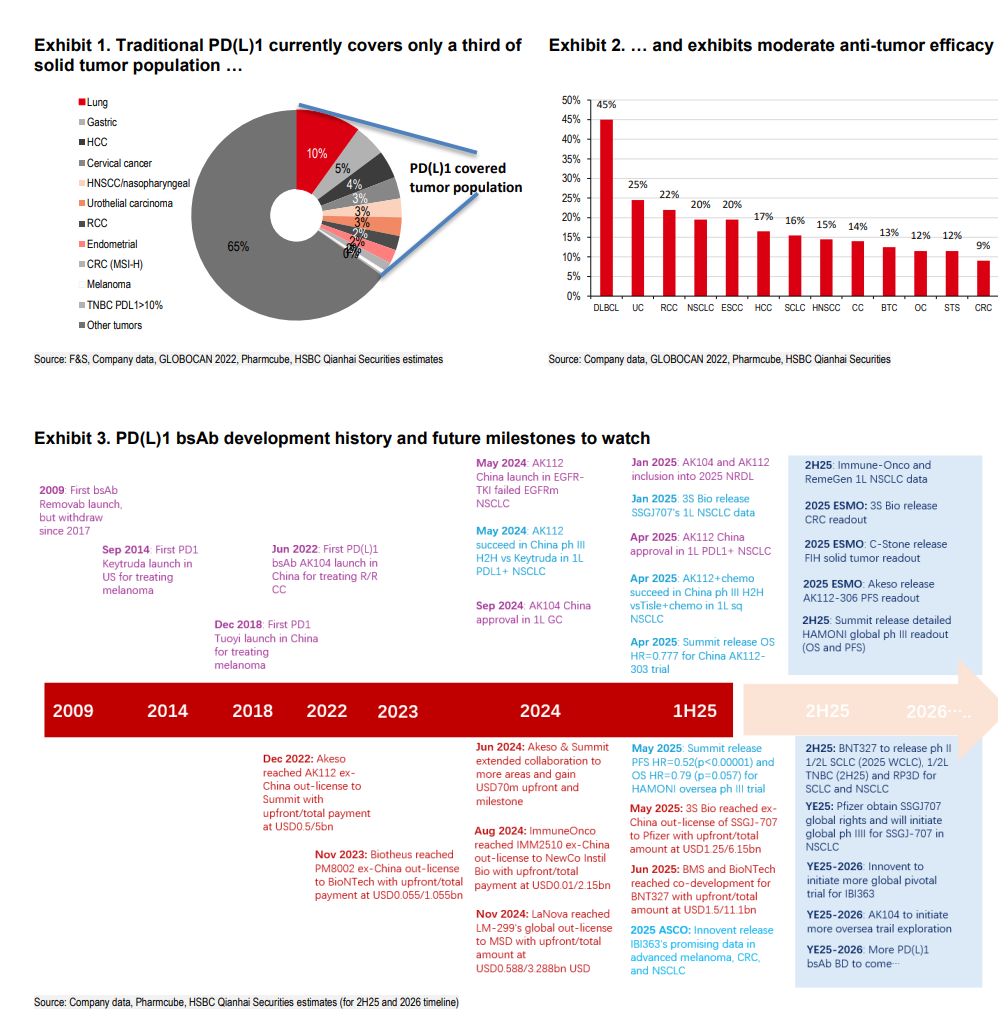
Core Insights - The emergence of PD(L)1 bispecific antibodies (bsAb) from China is being recognized as a transformative moment in the global biopharmaceutical industry, particularly in cancer treatment [1][2] - The Hang Seng Biotechnology Index has surged by 91% this year, significantly outperforming the broader market's 26% increase, driven by breakthroughs in innovative drug development [1][2] - The global PD(L)1 market is projected to grow from $53 billion in 2024 to $100 billion by 2035, with bsAb expected to capture approximately 65% of this market share [2][12] Industry Overview - PD(L)1 bsAb represents a new generation of cancer immunotherapy that targets two pathways simultaneously, enhancing immune response and overcoming resistance in a broader range of tumor types [3][19] - Traditional PD-1/PD-L1 monoclonal antibodies, such as Keytruda, have limitations, as a significant proportion of patients experience ineffectiveness or develop resistance [3][19] - The anticipated growth in the PD(L)1 market will be fueled by the introduction of key bsAb drugs around 2027-2028, their strong anti-tumor efficacy, and the expiration of patents for existing monoclonal antibodies [14][19] Chinese Market Dynamics - China is leading the development of PD(L)1 bsAb, with approximately 90% of the global pipeline originating from Chinese companies [17][18] - The Chinese PD(L)1 market is expected to grow at a compound annual growth rate (CAGR) of 8.5%, reaching $10 billion by 2035, with bsAb accounting for 70% of the market share [16][18] - Major global pharmaceutical companies have not yet established their own PD(L)1 bsAb assets, instead opting to license Chinese assets, indicating a competitive advantage for Chinese firms [18] Competitive Landscape - Leading companies are actively advancing clinical development, with five major players expected to capture over 80% of the market share, reminiscent of the dynamics seen with Keytruda and Opdivo [19] - Notable companies such as Akeso, Innovent, and others are accelerating their international expansion through significant licensing agreements and clinical breakthroughs [21] - Recent high-value licensing deals, such as Pfizer's $12.5 billion acquisition of SSGJ707 rights and BioNTech's $11.1 billion collaboration with BMS, highlight the growing interest in Chinese biopharmaceutical innovations [21]


特朗普关税全面加码?媒体称8月1日前多行业关税将至,最高覆盖美对一国70%进口
Hua Er Jie Jian Wen· 2025-07-18 20:36
Group 1 - The Trump administration is planning to implement a series of tariffs, with a significant focus on a 50% tariff on copper set to be announced around August 1 [1][2] - The tariffs could potentially cover 30% to 70% of U.S. imports from other countries, affecting a wide range of industries [1] - The administration has already implemented a 25% tariff on automobiles and parts, and increased steel and aluminum tariffs to 50% [1][2] Group 2 - The pharmaceutical industry faces a potential tariff of up to 200%, with a phased implementation period of one to two years [4][5] - The proposed pharmaceutical tariffs may impact generic drug manufacturers like Teva and Sandoz, as well as major pharmaceutical companies such as Eli Lilly, Merck, and Pfizer if they include popular branded drugs [5][6] Group 3 - Semiconductor tariffs are expected to be introduced, with the administration indicating that the process is "not too complicated" [6] - The potential semiconductor tariffs could affect a wide range of products, including smartphones and laptops, impacting major tech companies like Apple and Samsung [6] Group 4 - The copper tariff will encompass all refined metals and semi-finished products used in various sectors, including automotive and construction [7] - The copper tariff is anticipated to have a significant impact on consumer prices due to the metal's widespread use [7] Group 5 - There is a push from U.S. lawmakers for at least a 60% tariff on wood products, with some advocating for a 100% tariff on specific items [8] - The investigation into critical minerals is facing challenges, as the U.S. currently relies heavily on imports, and tariffs may lead to supply shortages [8]
苹果调整管理层,加速机器人与AI开发进程;OpenAI向免费用户推出轻量版Deep Research丨全球科技早参
Mei Ri Jing Ji Xin Wen· 2025-04-24 23:58
Group 1 - Apple is adjusting the responsibilities of its AI head, John Giannandrea, who will no longer oversee the robotics department, allowing him to focus on AI and machine learning development [2] - This management change indicates Apple's commitment to accelerating its robotics and AI projects to catch up with competitors like Google [2] Group 2 - OpenAI has launched a lightweight version of Deep Research for free users, expanding its user base and lowering operational costs while maintaining a similar intelligence level to the standard version [3] - This move is aimed at solidifying OpenAI's position in the AI search market by reducing barriers to entry for users [3] Group 3 - Intel reported a revenue of $12.7 billion for Q1 2025, exceeding market expectations, but projected Q2 revenue between $11.2 billion and $12.4 billion, below analyst forecasts of $12.9 billion [4] - The company plans to implement layoffs to align costs with its reduced business scale, indicating a restructuring under new CEO Pat Gelsinger [4] Group 4 - Amazon executives confirmed that the construction of AI data centers is not slowing down, with increasing electricity demand driven by AI applications [5] - This statement reflects Amazon's strong confidence and ongoing investment in AI technology development [5] Group 5 - Halozyme has filed a patent infringement lawsuit against Merck, claiming that Merck's cancer drug Keytruda infringes on multiple patents Halozyme applied for starting in 2011 [6] - This lawsuit highlights the importance of patent protection in the biotechnology sector and may impact Merck's business [6]


美国生物技术公司Halozyme对默沙东提起专利侵权诉讼
news flash· 2025-04-24 12:46
美国生物技术公司Halozyme对默沙东提起专利侵权诉讼 智通财经4月24日电,美国生物技术公司Halozyme当地时间4月24日在美国地区法院对默沙东公司提起 专利侵权诉讼。Halozyme公司认为,默沙东公司的抗肿瘤药物可瑞达(Keytruda)侵犯了Halozyme公司 从2011年开始申请的多项专利。 ...

3只美国避险股,应对愈发紧张的世界局势
美股研究社· 2025-03-10 10:39
Core Viewpoint - The article emphasizes the importance of defensive stocks in the current global trade tensions, highlighting companies that are expected to maintain stability and growth potential during market volatility [2]. Group 1: Merck (NYSE: MRK) - Merck is a global pharmaceutical giant known for its innovative medical solutions, with a product range that includes cutting-edge cancer drugs, vaccines, and prescription medications [5]. - The company exhibits strong defensive characteristics with a low beta coefficient of 0.36, a high dividend yield of 3.48%, and an impressive return on equity (ROE) of 40.8% [6]. - Current stock price is $94, significantly undervalued compared to a fair value estimate of $121.83, indicating a potential upside of 29.6% [6]. - Analysts have a strong buy rating for Merck, with target prices ranging from $95 to $146, averaging $112.78 [6]. Group 2: NextEra Energy (NYSE: NEE) - NextEra Energy is a leading utility company in the renewable energy sector, employing a strategy that combines traditional and clean energy sources [12]. - The company has a beta value of 0.57, a dividend yield of 3.2%, and operates in a regulated environment, making it less susceptible to trade disputes [13]. - Current stock price is $70.01, with analysts projecting a potential increase of 20%, as target prices range from $52 to $103, averaging $84.27 [13]. - NextEra's strong cash flow and commitment to sustainable development position it as a stable investment during turbulent market conditions [14]. Group 3: Tyson Foods (NYSE: TSN) - Tyson Foods is a major player in the food processing industry, offering a wide range of meat products including beef, pork, and poultry [18]. - The company has defensive traits with a beta value of 0.71, a dividend yield of 3.3%, and a dominant market position in various meat product categories [19]. - Current stock price is $60.53, with a fair value estimate of $75.83, suggesting a potential upside of nearly 25% [19]. - Analysts have a buy rating for Tyson, with target prices ranging from $58 to $80, reflecting its strong position in the supply chain and limited exposure to trade conflicts [20].