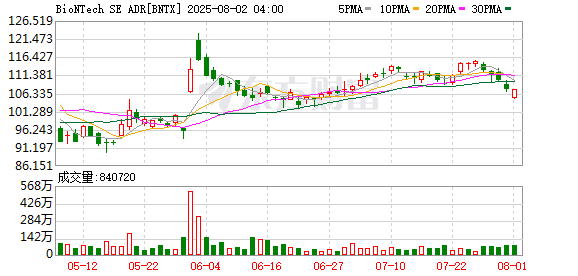
BioNTech SE

Search documents
BioNTech SE(BNTX) - 2025 Q2 - Earnings Call Transcript
2025-08-04 13:00
Financial Data and Key Metrics Changes - Total revenues for Q2 2025 reached approximately €261 million, a significant increase from €129 million in Q2 2024, primarily driven by higher revenues from the COVID-19 vaccine collaboration [41] - Research and development expenses decreased to approximately €585 million in Q2 2025 from €709 million in the prior year, reflecting a reprioritization of clinical trials [42] - The net loss for Q2 2025 was €387 million, compared to a net loss of €88 million in Q2 2024, with a basic and diluted loss per share of €1.6 compared to €3.3 in the prior year [43] Business Line Data and Key Metrics Changes - The company is focusing on two priority pan-tumor programs: mRNA cancer immunotherapies (Sigvec and INEST) and bispecific antibody BNT327, which are expected to enhance patient outcomes across multiple cancer indications [8][10] - The acquisition of BioThese has fully integrated BNT327 into the pipeline, with a global co-development collaboration with BMS initiated to accelerate its clinical development [10][14] Market Data and Key Metrics Changes - The company anticipates lower COVID-19 vaccination rates in the U.S. compared to the previous year, estimating around 20% vaccination rates, which may impact revenue guidance [47][58] - Despite lower vaccination rates, the company expects to maintain similar market share and pricing as compared to 2024 [47] Company Strategy and Development Direction - The overarching vision is to build an immunotherapy powerhouse and become a fully integrated biopharmaceutical company with multiple approved therapies, focusing on combination therapies to improve cancer treatment outcomes [7] - The company is investing significantly in clinical development and commercial infrastructure to support future launches in key markets [9][10] - A strategic transaction to acquire QVAC aims to enhance capabilities in mRNA design and manufacturing [12] Management's Comments on Operating Environment and Future Outlook - Management expressed confidence in the potential of BNT327 to establish new standards of care across multiple tumor types, with ongoing clinical trials expected to yield meaningful data [19][20] - The company is preparing for the global commercial rollout of a new variant-adapted COVID-19 vaccine, pending regulatory approvals, and has expanded partnerships to enhance R&D activities [13][14] Other Important Information - The company maintains a strong financial position with €16 billion in cash and securities, providing flexibility to pursue long-term strategies [43] - The anticipated financial implications of the collaboration with BMS include an upfront cash payment of $1.5 billion and potential milestone payments totaling up to $7.6 billion [45][46] Q&A Session Summary Question: Clarity on vaccine development and future vaccination rates - Management acknowledged lower vaccination rates and emphasized the continued priority of the COVID-19 vaccine business while exploring next-generation concepts and combination vaccines [56][58] Question: Details on the BNT327 trial and data release timing - Management confirmed that details on doses for the Phase II portion of the BNT327 trial will be discussed later this year, with top-line data expected before year-end [64][65] Question: Insights on BNT327 in frontline TNBC and ADC combinations - Management highlighted the potential of BNT327 in triple-negative breast cancer (TNBC) and ongoing studies to evaluate its efficacy in combination with ADCs [67][68] Question: R&D spending evolution post-Bristol collaboration - Management indicated that R&D spending will increase in priority areas, particularly for late-stage programs, while decreasing in non-priority areas [71][73] Question: Assumptions on lower vaccination rates and revenue guidance - Management reiterated expectations for lower vaccination rates but maintained revenue guidance, anticipating a phased revenue recognition towards the end of the year [78][80]

BioNTech SE(BNTX) - 2025 Q2 - Quarterly Report
2025-08-04 12:01
Unaudited Interim Condensed Consolidated Financial Statements [Consolidated Financial Statements](index=5&type=section&id=Consolidated%20Financial%20Statements) BioNTech reported increased revenues and reduced net loss for H1 2025, maintaining strong assets despite a shift to operating cash outflow [Statements of Profit or Loss](index=5&type=section&id=Interim%20Condensed%20Consolidated%20Statements%20of%20Profit%20or%20Loss) BioNTech's H1 2025 revenues increased to **€443.6 million**, with operating and net losses significantly reduced Consolidated Statements of Profit or Loss (Six Months Ended June 30) | Indicator | 2025 (in millions €) | 2024 (in millions €) | | :--- | :--- | :--- | | **Revenues** | **443.6** | **316.3** | | Cost of sales | (160.2) | (118.9) | | Research and development expenses | (1,034.7) | (1,092.1) | | General and administrative expenses | (224.6) | (287.9) | | **Operating loss** | **(1,035.2)** | **(1,473.4)** | | Loss before tax | (848.1) | (1,137.6) | | **Net loss** | **(802.4)** | **(1,122.9)** | | **Basic and diluted loss per share** | **(3.33)** | **(4.67)** | [Statements of Financial Position](index=7&type=section&id=Interim%20Condensed%20Consolidated%20Statements%20of%20Financial%20Position) As of June 30, 2025, BioNTech's total assets slightly decreased to **€21.64 billion**, primarily due to reduced current assets Consolidated Statements of Financial Position | Indicator | June 30, 2025 (in millions €) | December 31, 2024 (in millions €) | | :--- | :--- | :--- | | **Total assets** | **21,637.6** | **22,529.7** | | Cash and cash equivalents | 10,269.5 | 9,761.9 | | Total current assets | 15,929.1 | 18,803.5 | | **Total liabilities** | **3,132.5** | **3,118.6** | | **Total equity** | **18,505.1** | **19,411.1** | [Statements of Cash Flows](index=10&type=section&id=Interim%20Condensed%20Consolidated%20Statements%20of%20Cash%20Flows) Net cash used in operating activities for H1 2025 was **€634.2 million**, a significant shift from prior year's inflow Consolidated Statements of Cash Flows (Six Months Ended June 30) | Activity | 2025 (in millions €) | 2024 (in millions €) | | :--- | :--- | :--- | | Net cash flows from / (used in) operating activities | (634.2) | 1,309.9 | | Net cash flows from / (used in) investing activities | 1,182.4 | (2,545.8) | | Net cash flows used in financing activities | (27.1) | (30.7) | | **Net increase / (decrease) in cash and cash equivalents** | **521.1** | **(1,266.6)** | [Selected Explanatory Notes to the Financial Statements](index=11&type=section&id=Selected%20Explanatory%20Notes%20to%20the%20Financial%20Statements) Notes detail BioNTech's increased revenues, Biotheus acquisition, BMS partnership, and ongoing IP litigations [Note 3: Revenues from Contracts with Customers](index=13&type=section&id=Note%203%3A%20Revenues%20from%20Contracts%20with%20Customers) Total revenues for H1 2025 increased to **€443.6 million**, primarily driven by a **46%** rise in COVID-19 vaccine revenues Disaggregation of Revenues (Six Months Ended June 30) | Revenue Stream | 2025 (in millions €) | 2024 (in millions €) | | :--- | :--- | :--- | | COVID-19 vaccine revenues | 286.3 | 196.1 | | Other revenues | 157.3 | 120.2 | | **Total** | **443.6** | **316.3** | - The increase in COVID-19 vaccine revenues was largely driven by a **higher volume of doses sold** compared to the prior year period[34](index=34&type=chunk)[35](index=35&type=chunk) [Note 4: Income and Expenses](index=14&type=section&id=Note%204%3A%20Income%20and%20Expenses) H1 2025 saw decreased R&D and G&A expenses, with other operating results significantly improving due to the absence of prior-year contractual dispute costs - Research and development expenses decreased by **5%** for the six months ended June 30, 2025, mainly driven by the reprioritization of clinical trials towards focus programs[39](index=39&type=chunk) - General and administrative expenses decreased by **22%** for the six-month period, primarily due to a reduction in external services[40](index=40&type=chunk) - The total other operating result improved by **90%** for the six-month period, mainly because the prior year period included significant costs from contractual disputes (**€239.1 million**), which were not repeated in the current period[41](index=41&type=chunk) [Note 5: Business Combination](index=16&type=section&id=Note%205%3A%20Business%20Combination) BioNTech acquired Biotheus for **€280.1 million** on **January 31, 2025**, gaining full global rights to BNT327 - The acquisition of Biotheus closed on **January 31, 2025**, supporting BioNTech's oncology strategy by providing full global rights to the bispecific antibody BNT327[45](index=45&type=chunk)[47](index=47&type=chunk) Biotheus Acquisition Purchase Price Allocation (in millions €) | Item | Fair Value | | :--- | :--- | | Total identifiable net assets at fair value | 295.1 | | Bargain from the acquisition | (15.0) | | **Total consideration** | **280.1** | | *Details of Consideration* | | | Upfront payment | 767.8 | | Contingent consideration (milestones) | 79.6 | | Payments in connection with pre-existing relationships | (567.3) | [Note 8: Financial Assets and Financial Liabilities](index=20&type=section&id=Note%208%3A%20Financial%20Assets%20and%20Financial%20Liabilities) BioNTech formed a global strategic partnership with Bristol-Myers Squibb for BNT327, eligible for a **$1.5 billion** upfront payment - On **June 2, 2025**, BioNTech and Bristol-Myers Squibb (BMS) entered a global strategic partnership for the bispecific antibody BNT327[64](index=64&type=chunk) - Under the BMS agreement, BioNTech is eligible for a **$1.5 billion** upfront payment, **$2.0 billion** in non-contingent anniversary payments through 2028, and up to **$7.6 billion** in milestone payments[64](index=64&type=chunk) [Note 11: Contingent Liabilities](index=26&type=section&id=Note%2011%3A%20Contingent%20Liabilities) BioNTech faces numerous intellectual property disputes related to its Comirnaty vaccine, classified as contingent liabilities without provisions - The company faces an increasing number of intellectual property, product-related, and shareholder disputes, but has recorded **no provision** for any of them as of June 30, 2025, deeming them contingent liabilities[83](index=83&type=chunk)[84](index=84&type=chunk)[85](index=85&type=chunk)[86](index=86&type=chunk) - Key ongoing legal proceedings include patent infringement lawsuits from **Alnylam, CureVac, Moderna, Arbutus/Genevant, GSK, and Promosome**, all related to the Comirnaty vaccine[89](index=89&type=chunk)[92](index=92&type=chunk)[104](index=104&type=chunk)[117](index=117&type=chunk) [Note 13: Events after the Reporting Period](index=34&type=section&id=Note%2013%3A%20Events%20after%20the%20Reporting%20Period) Key management changes include a new CFO and CSO departure, with new patent infringement lawsuits filed by GlaxoSmithKline post-period - **Ramón Zapata** was appointed to the Management Board as **Chief Financial Officer**, effective **July 1, 2025**[129](index=129&type=chunk) - **Ryan Richardson** will step down as **Chief Strategy Officer** on **September 30, 2025**[130](index=130&type=chunk) - After the reporting period, **GlaxoSmithKline** filed new patent infringement lawsuits in **Ireland** (July 7, 2025) and the **Unified Patent Court** (July 23, 2025) concerning Comirnaty[133](index=133&type=chunk)[134](index=134&type=chunk) Operating and Financial Review and Prospects [Operating Results](index=36&type=section&id=Operating%20Results) BioNTech focuses on its oncology pipeline and next-gen COVID-19 vaccine, reporting a **40%** revenue increase and reduced net loss for H1 2025 - The company's primary focus is on **oncology**, with a strategy to address the full continuum of cancer by combining complementary treatment modalities like mRNA immunotherapies, targeted antibodies, and cell therapies[142](index=142&type=chunk)[164](index=164&type=chunk) - BioNTech is preparing for the 2025/2026 vaccination season with an **LP.8.1-adapted monovalent COVID-19 vaccine**, following recommendations from the WHO, EMA, and FDA[153](index=153&type=chunk)[155](index=155&type=chunk)[156](index=156&type=chunk) - Key oncology pipeline updates include: - **iNeST (autogene cevumeran):** First data from the Phase 2 trial in adjuvant colorectal cancer is expected in late 2025 or early 2026 - **FixVac (BNT111):** The Phase 2 trial in advanced melanoma met its primary endpoint of improved Objective Response Rate (ORR) - **BNT327 (bispecific antibody):** Multiple Phase 2 and Phase 3 trials are ongoing globally across various solid tumors, including lung cancer and breast cancer[168](index=168&type=chunk)[176](index=176&type=chunk)[181](index=181&type=chunk) Financial Performance Comparison (Six Months Ended June 30) | Indicator | 2025 (in millions €) | 2024 (in millions €) | Change (%) | | :--- | :--- | :--- | :--- | | Total revenues | 443.6 | 316.3 | +40% | | Research and development expenses | 1,034.7 | 1,092.1 | -5% | | General and administrative expenses | 224.6 | 287.9 | -22% | | Net loss | (802.4) | (1,122.9) | +29% (improvement) | [Liquidity and Capital Resources](index=64&type=section&id=Liquidity%20and%20Capital%20Resources) BioNTech maintained a strong liquidity position of **€16.0 billion** as of June 30, 2025, prioritizing R&D and global expansion - As of June 30, 2025, the company held a total of **€15,989.3 million** in cash, cash equivalents, and security investments[290](index=290&type=chunk) Summary of Cash Flows (Six Months Ended June 30) | Activity | 2025 (in millions €) | 2024 (in millions €) | | :--- | :--- | :--- | | Operating activities | (634.2) | 1,309.9 | | Investing activities | 1,182.4 | (2,545.8) | | Financing activities | (27.1) | (30.7) | - The capital allocation strategy focuses on **advancing the oncology pipeline**, **developing next-gen COVID-19 vaccines**, **building a global development organization**, and **enhancing capabilities through acquisitions and infrastructure investments**[288](index=288&type=chunk)[289](index=289&type=chunk) [Risk Factors](index=69&type=section&id=Risk%20Factors) BioNTech faces significant risks including declining COVID-19 vaccine demand, patent litigations, clinical development uncertainties, and manufacturing challenges - A significant risk is the expected **decrease in demand for the COVID-19 vaccine**, which will impact revenue that is currently heavily dependent on these sales[312](index=312&type=chunk)[315](index=315&type=chunk) - The company faces **numerous patent litigations** from competitors like Moderna, CureVac, and others, which could result in substantial liabilities and negatively affect operations[314](index=314&type=chunk)[612](index=612&type=chunk) - Clinical development involves a **lengthy, expensive, and uncertain process**, and the novel nature of mRNA drug development carries **substantial regulatory risks** due to limited regulatory experience[316](index=316&type=chunk)[447](index=447&type=chunk)[461](index=461&type=chunk) - Manufacturing of novel and complex mRNA-based products presents **challenges in scaling, product release, shelf life, and supply chain management**, which could delay or halt production[316](index=316&type=chunk)[522](index=522&type=chunk)
BioNTech SE(BNTX) - 2025 Q2 - Earnings Call Presentation
2025-08-04 12:00
Financial Performance - Second quarter 2025 revenues reached €261 million, compared to €129 million in the second quarter of 2024[61] - First half 2025 revenues totaled €444 million, an increase from €316 million in the first half of 2024[61] - The company reported a net loss of €387 million for the second quarter of 2025, compared to a net loss of €808 million for the same period in 2024[61] - Research and Development expenses for the second quarter of 2025 were €509 million, compared to €585 million for the second quarter of 2024[61] - Cash and cash equivalents plus security investments reached approximately €160 billion as of June 30, 2025[12,61] Strategic Collaboration - BioNTech and Bristol Myers Squibb (BMS) entered into a strategic collaboration for BNT3271, with an upfront cash payment of $15 billion expected in Q3 2025[12,62] - The collaboration with BMS includes non-contingent anniversary cash payments of $20 billion from 2026 to 2028[62] - Potential development, regulatory, and commercial milestone cash payments from BMS could reach up to $76 billion[62] Pipeline Development - A Phase 2 study of BNT3271 combined with chemotherapy in 1L ES-SCLC showed an objective response rate (ORR) of 854% and a median overall survival (OS) of 168 months[29] - In a Phase 1b/2a study, BNT3271 monotherapy in 1L NSCLC (EGFR & ALK WT) showed an ORR of 47% and a median PFS of 136 months[34] - A Phase 1/2 study of BNT3271 combined with chemotherapy in 1L TNBC showed an ORR of 738% and a median PFS of 135 months[35]
BioNTech二季度亏损收窄 新冠疫苗收入实现增长
Ge Long Hui A P P· 2025-08-04 11:54
格隆汇8月4日|德国生物科技公司BioNTech公布财报显示,第二季度营收增长超过一倍,达2.6亿欧元 (约合3亿美元),这得益于新冠疫苗带来的收入增长。该公司季度净亏损为3.87亿欧元,较去年同期 的8亿欧元净亏损大幅收窄。 ...
BioNTech财报亏损收窄,新冠疫苗收入实现增长
Di Yi Cai Jing· 2025-08-04 11:39
该公司第二季度净亏损为3.87亿欧元,较去年同期的8亿欧元净亏损大幅收窄。 8月4日,德国生物科技公司BioNTech公布财报显示,第二季度营收增长超过一倍,达2.6亿欧元(约合3 亿美元),这得益于新冠疫苗带来的收入增长。该公司季度净亏损为3.87亿欧元,较去年同期的8亿欧 元净亏损大幅收窄。 ...
BioNTech财报亏损收窄 新冠疫苗收入实现增长
Di Yi Cai Jing· 2025-08-04 11:36
(文章来源:第一财经) 8月4日,德国生物科技公司BioNTech公布财报显示,第二季度营收增长超过一倍,达2.6亿欧元(约合3 亿美元),这得益于新冠疫苗带来的收入增长。该公司季度净亏损为3.87亿欧元,较去年同期的8亿欧 元净亏损大幅收窄。 ...

BioNTech Announces Second Quarter 2025 Financial Results and Corporate Update
Globenewswire· 2025-08-04 10:45
Core Insights - BioNTech reported significant advancements in its oncology strategy, including collaborations and acquisitions aimed at enhancing its product pipeline and capabilities [2][6][30] - The company experienced a substantial increase in revenues for the second quarter of 2025, driven primarily by its COVID-19 vaccine collaboration [3][4] - BioNTech's financial position remains strong, with substantial cash reserves and expected cash inflows from strategic partnerships [10][11][14] Financial Performance - Revenues for Q2 2025 reached €260.8 million, up from €128.7 million in Q2 2024, while total revenues for the first half of 2025 were €443.6 million compared to €316.3 million in the prior year [3][4] - The net loss for Q2 2025 was €386.6 million, a significant reduction from a net loss of €807.8 million in Q2 2024, with a total net loss of €802.4 million for the first half of 2025 compared to €1,122.9 million in the same period last year [7][8] - Basic and diluted loss per share improved to €1.60 for Q2 2025 from €3.36 in Q2 2024, and for the first half of 2025, it was €3.33 compared to €4.67 in the prior year [8][41] Research and Development - R&D expenses for Q2 2025 were €509.1 million, down from €584.6 million in Q2 2024, with total R&D expenses for the first half of 2025 at €1,034.7 million compared to €1,092.1 million in the previous year [4][5] - The company is focusing on its oncology pipeline, including the development of BNT327, a bispecific antibody candidate, and has initiated several clinical trials for various cancer treatments [6][23][27] Strategic Developments - BioNTech entered a collaboration with Bristol Myers Squibb (BMS) for the co-development of BNT327, which includes an upfront cash payment of $1.5 billion and potential milestone payments totaling up to $7.6 billion [10][11][12] - The acquisition of CureVac is expected to enhance BioNTech's capabilities in mRNA technology, complementing its existing product offerings [2][6][30] - The company has received approval for a new variant-adapted COVID-19 vaccine, with preparations for launch underway [6][22] Financial Guidance - BioNTech reaffirmed its revenue guidance for the full year 2025, expecting revenues to be between €1,700 million and €2,200 million, with a focus on late-stage development and commercialization in oncology [14][16] - Planned expenses for 2025 include R&D expenses of €2,600 million to €2,800 million and SG&A expenses of €650 million to €750 million [15][16]


PD-(L)1/VEGF双抗走向“百家争鸣”
新财富· 2025-08-04 08:01
Core Viewpoint - The article discusses the emergence of bispecific antibodies targeting both PD-(L)1 and VEGF in cancer treatment, highlighting the approval of Ivoris monoclonal antibody as the first of its kind in China, which has sparked a wave of interest and competition in this field [2][3]. Group 1: Overview of Bispecific Antibodies - The combination of immune therapy and anti-angiogenesis drugs has shown significant clinical success, but traditional dual-drug regimens face challenges such as dosage control and side effects [2]. - Ivoris monoclonal antibody, developed by Kangfang Biopharma, is the first PD-1/VEGF bispecific antibody approved globally, marking a significant milestone in the industry [2][3]. Group 2: Competitive Landscape - Over 17 PD-(L)1/VEGF bispecific antibodies are currently in clinical trials globally, indicating a highly competitive environment with numerous companies entering the market [3]. - The competition is characterized by a diverse range of technical approaches and designs, leading to a "hundred flowers bloom" scenario in the industry [3][4]. Group 3: Key Technical Variables - Three critical variables differentiate the designs of PD-(L)1/VEGF bispecific antibodies: 1. Selection of immune targets (PD-1 vs. PD-L1), which affects the breadth of immune response and potential side effects [6]. 2. Choice of anti-angiogenesis targets (VEGF vs. VEGFR), influencing the mechanism of action and potential adverse effects [6]. 3. Antibody structure and fusion methods, which impact the drug's pharmacological properties and production processes [9]. Group 4: Representative Technical Designs - Kangfang Biopharma's Ivoris features a symmetrical tetravalent structure ("2+2 design") that enhances affinity for both PD-1 and VEGF targets, showcasing a promising design in the bispecific antibody landscape [13]. - Other companies are exploring different fusion strategies, such as C-terminal and N-terminal fusions with nanobodies, which may offer advantages in tissue penetration and efficacy [14]. Group 5: Clinical Relevance - The article emphasizes that despite theoretical advantages of various designs, the true measure of success will be clinical efficacy and safety data, as past experiences with PD-1 and PD-L1 antibodies have shown that theoretical differences do not always translate into clinical outcomes [16][17]. - The focus should remain on actual clinical results, production efficiency, and market competitiveness rather than solely on innovative structural designs [20].

Bristol Myers (BMY) Q2 EPS Jumps 36%
The Motley Fool· 2025-08-02 03:23
Core Insights - Bristol Myers Squibb (BMY) reported strong Q2 2025 results, with GAAP revenue of $12.269 billion exceeding analyst estimates of $11.385 billion and non-GAAP EPS of $1.46 surpassing the expected $1.07 per share [1][2] - Despite the revenue beat, year-over-year performance was impacted by declines in legacy drugs, margin compression, and significant R&D expenses, leading to a revision in non-GAAP EPS guidance [1][11] Financial Performance - Q2 2025 non-GAAP EPS was $1.46, down 29.5% from $2.07 in Q2 2024 [2] - GAAP EPS was $0.64, a decrease of 22.9% from $0.83 in Q2 2024 [2] - Revenue for Q2 2025 was $12.3 billion, a slight increase of 0.8% from $12.2 billion in Q2 2024 [2] - Non-GAAP gross margin narrowed to 72.6% from 75.6% year-over-year, while operating margin decreased to 40.4% from 41.1% [2][7] Product Performance - The Growth Portfolio generated $6.6 billion in sales for Q2 2025, an 18% increase, driven by immuno-oncology products and new therapies [5] - Breyanzi revenue surged 125%, Camzyos increased by 86%, and Reblozyl rose by 33% in Q2 2025 [5][6] - The Legacy Portfolio saw a 14% decline, with Revlimid down 38%, Pomalyst/Imnovid down 26%, and Sprycel down 72% year-over-year [6] Strategic Focus - The company is focused on building its "Growth Portfolio" through new product launches and global expansion while managing declines from older drugs [4] - A significant $1.5 billion R&D charge related to a partnership with BioNTech impacted EPS guidance [9][11] - The company raised its fiscal 2025 non-GAAP revenue outlook to $46.5 billion to $47.5 billion but lowered non-GAAP EPS guidance to $6.35–$6.65 due to the BioNTech charge [11] Pipeline and Development - Progress was made in the drug pipeline, with new indications for Sotyktu and label updates for Breyanzi [10] - Opdivo received European approval for a new subcutaneous form, and the company launched initiatives to improve access to Eliquis [10] - The company is actively pursuing strategic partnerships and business development opportunities to enhance its pipeline [10]

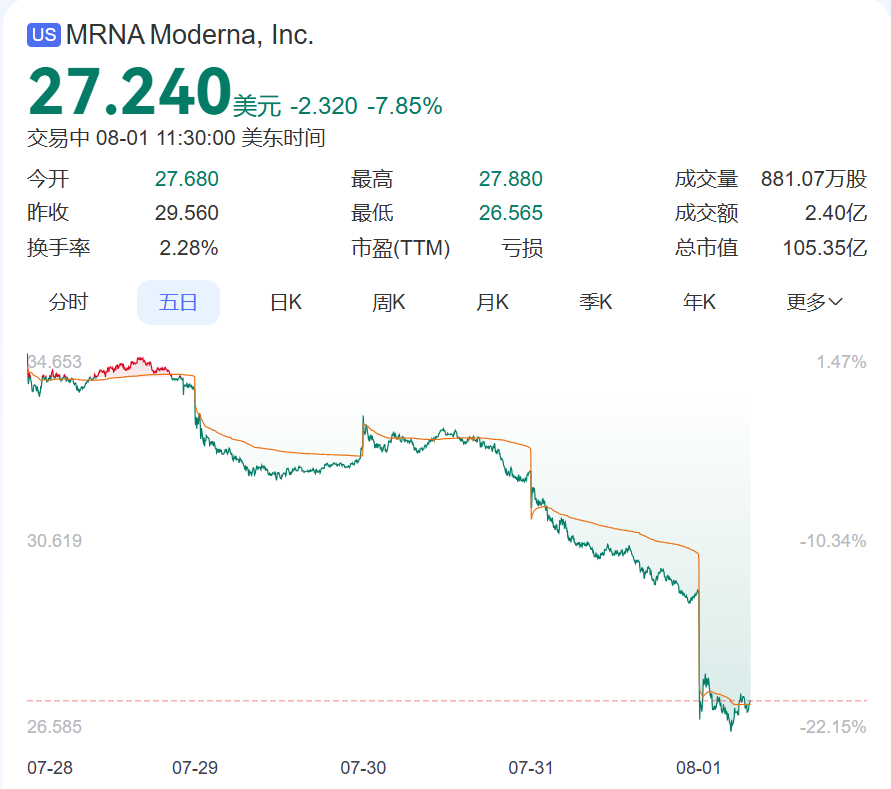
知名巨头突然宣布:大幅裁员!CEO:尽了一切努力避免影响就业!股价已跌超90%,超万亿元市值灰飞烟灭
Mei Ri Jing Ji Xin Wen· 2025-08-01 16:34
Core Viewpoint - Moderna is facing significant financial pressure due to declining vaccine sales, leading to a decision to cut approximately 10% of its workforce, which has resulted in a sharp decline in its stock price [1][3][6]. Financial Performance - Moderna's stock price has dropped over 90% from its peak, with its market capitalization plummeting from nearly $200 billion (approximately 1.44 trillion RMB) to under $10.5 billion (approximately 75.7 billion RMB) [6]. - The company reported a more than 75% decline in stock price over the past year, indicating a deteriorating financial situation [6]. Workforce Reduction - The layoffs will affect hundreds of employees globally, with the total number of employees expected to fall below 5,000 by the end of the year [5][6]. - CEO Stephane Bancel emphasized the necessity of restructuring operations to align cost structures with actual business needs while maintaining a focus on research investment [3]. Strategic Challenges - Moderna is facing multiple challenges, including criticism from U.S. health officials that has led to changes in vaccine recommendations, impacting the market for its latest vaccine [7]. - The company has also canceled plans for a new mRNA production facility in Japan due to changes in the global business environment [6]. Revenue Projections - Moderna has significantly lowered its revenue expectations for the year, particularly for its RSV vaccine, which has not gained widespread market attention [8]. - The company has postponed its goal of achieving breakeven profitability by two years, now expecting to reach this milestone by 2028 instead of 2026 [8]. Future Outlook - Despite current challenges, CEO Bancel remains optimistic about Moderna's future, citing three approved products and the potential for up to eight additional products to be approved in the next three years [9]. - The company continues to invest in the development of a new generation of COVID-19 vaccines, with recent FDA approval for a third vaccine targeting new variants [9]. Competitive Landscape - Comparatively, BioNTech, another vaccine manufacturer, has successfully adjusted its strategy post-pandemic, resulting in a stock price increase of nearly 25% over the past year, with a market capitalization exceeding $26 billion, more than double that of Moderna [9].