
万泰生物

Search documents
流感「抬头」,疫苗价「雪崩」,行业协会坐不住了
3 6 Ke· 2025-11-26 13:48
Core Insights - The price war in the vaccine industry is driven by changes in supply and demand dynamics, leading to significant price reductions and financial losses for companies [2][10][15] Group 1: Price Trends - The price of a three-valent flu vaccine has dropped to 5.5 yuan, lower than the price of a cup of milk tea, indicating a drastic reduction in vaccine prices [3][7] - The price of the four-valent flu vaccine has decreased from 128 yuan to 88 yuan, with further reductions expected as competition intensifies [7][8] - HPV vaccines have also seen significant price drops, with the two-valent HPV vaccine priced at 27.5 yuan, down over 90% from previous prices [8] Group 2: Industry Response - The China Vaccine Industry Association issued an initiative to combat "involutionary" competition, urging members to avoid bidding below cost and maintain price stability [4][5] - The association's initiative aims to stabilize price expectations but may not address the underlying issue of overcapacity in the industry [3][10] Group 3: Market Dynamics - The vaccine market is experiencing overcapacity due to an influx of companies entering the sector, leading to intense competition and price wars [10][11] - Demand for vaccines is under pressure, with declining public trust in vaccines and a decrease in birth rates affecting the market for childhood vaccines [11][12] Group 4: Financial Impact - Vaccine companies have reported significant financial losses, with overall revenue for listed vaccine companies dropping by 60% and net profits declining by 113% in the first half of 2025 [12][14] - Major companies like Zhifei Biological and Wantai Biological have reported substantial revenue declines and net losses, reflecting the severe impact of the price war [12][14] Group 5: Future Outlook - Experts suggest that the industry may need to undergo a period of consolidation and restructuring, which could last five to ten years, to address the current challenges [15] - Companies are exploring international markets and differentiation strategies to navigate the competitive landscape, with some reporting significant increases in exports [15]







流感「抬头」,疫苗价「雪崩」,行业协会坐不住了
36氪· 2025-11-26 13:39
Core Viewpoint - The article discusses the ongoing price war in China's vaccine industry, driven by changes in supply and demand dynamics, leading to significant price reductions and financial losses for companies [4][15][22]. Group 1: Price War Dynamics - The price of a three-valent flu vaccine has dropped to 5.5 yuan, cheaper than a cup of milk tea, indicating a severe price competition in the vaccine market [5][11]. - The China Vaccine Industry Association has issued an initiative to combat "involution-style" competition, urging members to avoid bidding below cost and threatening penalties for violations [6][8][10]. - The price war has persisted for two years, with the association's initiative being the first formal stance against low-price competition, although it may not resolve the underlying issue of overcapacity [6][10][22]. Group 2: Supply and Demand Changes - The supply side is characterized by homogenization and overcapacity, with many companies entering the vaccine market, leading to intense competition and price wars [16][17]. - Demand is also under pressure, with declining public trust in vaccines and a decrease in vaccination rates, particularly for flu vaccines, which averaged below 4% in China from 2020 to 2023 [17][19]. - The shift in focus from childhood vaccines to adult vaccines due to declining birth rates has intensified competition in the adult vaccine market [17][19]. Group 3: Financial Impact on Companies - The financial repercussions of the price war are evident, with vaccine companies experiencing a 60% drop in revenue and a 113% decline in net profit in the first half of 2025 [19][20]. - Major companies like Zhifei Biological and Wantai Biological have reported significant losses, with Zhifei's revenue down 66.53% and net profit loss of 12.06 billion yuan [20][21]. - Despite some companies showing growth in sales, the overall trend indicates that increased revenue does not equate to increased profit due to drastic price reductions [21][22]. Group 4: Future Outlook and Strategies - Experts suggest that the industry is in a "deep cold moment," requiring a period of consolidation and restructuring that could last five to ten years [23]. - Companies are exploring two main strategies to navigate the competitive landscape: expanding into emerging markets and focusing on differentiated products to meet unmet clinical needs [24].


疫苗行业“反内卷”背后:从百元到个位数,“奶茶价”压倒龙头
Bei Ke Cai Jing· 2025-11-24 14:05
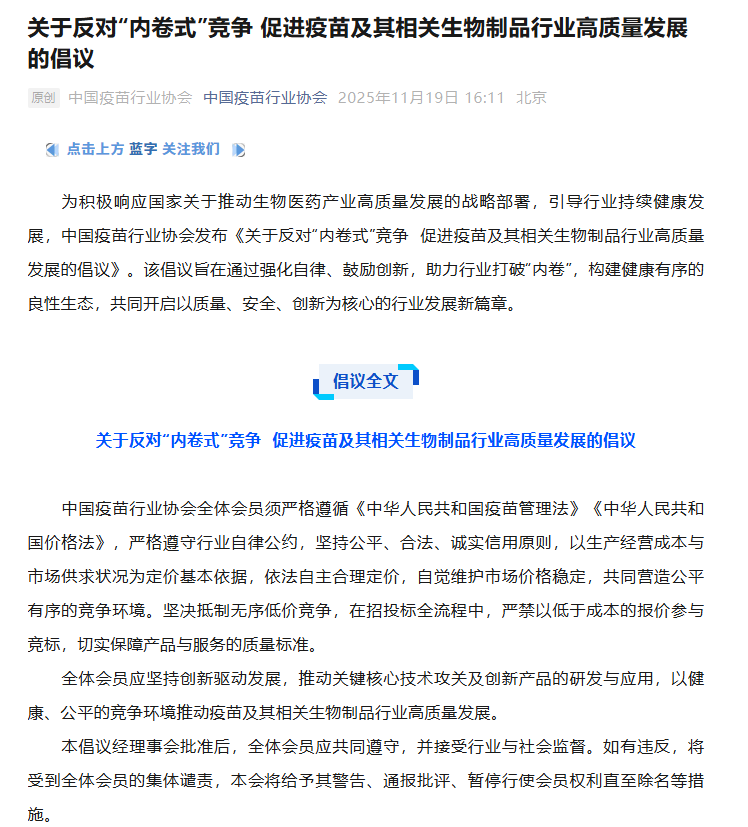
Core Viewpoint - The China Vaccine Industry Association has called for a resistance against chaotic price competition in the vaccine market, emphasizing the need for self-regulation and quality assurance in pricing practices [1][6][10]. Group 1: Industry Competition - The vaccine market is experiencing intense competition, particularly in the HPV and influenza vaccine sectors, leading to significant price wars [1][6]. - The price of the bivalent HPV vaccine has dropped to as low as 27.5 yuan per dose, reflecting a trend of aggressive pricing strategies among manufacturers [6][9]. - The four-valent influenza vaccine prices have also seen substantial reductions, with prices falling from 128 yuan to 88 yuan per dose, a decrease of 31.25% [8]. Group 2: Financial Performance - In the first three quarters of the year, only four out of 14 major vaccine companies listed on the A-share market reported a year-on-year increase in net profit, indicating widespread financial pressure across the industry [10][11]. - WanTai Biologics reported a staggering 165.04% decline in net profit, resulting in a net loss of 173 million yuan, alongside a 23.09% drop in revenue [12][14]. - Other companies, including Kanglaosheng and Jindike, also faced losses despite revenue growth, highlighting the challenges of rising operational costs and increased R&D expenditures [11][14]. Group 3: Market Dynamics - The industry is facing a phenomenon referred to as "involution," characterized by excessive competition and product homogeneity, which is exacerbated by a growing number of companies entering the market [15][16]. - The competitive landscape is further complicated by promotional tactics and price reductions, which are compressing profit margins and leading to a normalization of price competition [15][16]. - The overall market is under pressure from fluctuating demand, vaccine hesitancy, and intensified competition, which collectively impact sales performance [15][16].


疫苗价格暴跌90%,行业协会坐不住了!
Jin Tou Wang· 2025-11-21 08:29
Core Viewpoint - The Chinese vaccine industry is experiencing a severe price war, leading to significant price drops, with some vaccines falling over 90% in price, prompting the China Vaccine Industry Association to call for an end to the price competition to avoid unsustainable costs [1][3]. Group 1: Price Decline and Industry Impact - The price of common vaccines, such as the flu vaccine, has plummeted to about 1/10 of previous prices, with three-valent vaccines previously priced around 60 yuan now being offered as low as 6.5 yuan [3]. - The HPV vaccine has also seen drastic price reductions, with Watson Bio's two-valent HPV vaccine dropping nearly 90% over three years, resulting in significant profit declines for leading vaccine companies, with net profits falling by 70%-90% last year [3][4]. - In the first three quarters of this year, 10 out of 14 publicly listed vaccine companies in China reported profit declines, with over 70% experiencing this trend, and 5 companies are currently operating at a loss [3]. Group 2: Causes of Price Decline - The decline in birth rates has reduced the market size for vaccines, particularly affecting those targeting infants, while competition among manufacturers has intensified, leading to price cuts due to a lack of product differentiation [4]. - The approval of 59 flu vaccine products has resulted in oversupply, with 40% of flu vaccines going unsold and subsequently wasted last year, forcing companies to sell at a loss [4]. Group 3: Long-term Implications for Public Health - While lower vaccine prices may seem beneficial for consumers, the long-term impact on innovation and quality is concerning, as companies may lack the financial incentive to invest in new vaccine development [6]. - The risk of using cheaper raw materials to maintain low prices could compromise vaccine quality, posing a threat to public health [6]. - The industry must balance price reductions with the need for effective and safe vaccines, as the focus should not solely be on affordability but also on health outcomes [6]. Group 4: Strategies for Industry Recovery - Vaccine companies are increasingly looking to expand into emerging markets in Southeast Asia, Latin America, and Africa, with companies like Wantai Biologics significantly increasing their export volumes [8]. - Chinese vaccine firms are moving beyond simple product exports to include technology licensing and localized production, which helps them navigate trade barriers and integrate into local markets [8]. - Achieving international certifications is crucial for these companies, indicating that their quality management systems meet global standards, which is essential for future growth in the global vaccine market projected to reach $86.2 billion by 2032 [8].

万泰生物现3笔大宗交易 合计成交51.60万股
Zheng Quan Shi Bao Wang· 2025-11-21 01:12
11月20日万泰生物大宗交易一览 | 成交量 | 成交金额 | 成交价 | 相对当日收盘折 | | | | --- | --- | --- | --- | --- | --- | | (万 | (万元) | 格 | 溢价(%) | 买方营业部 | 卖方营业部 | | 股) | | (元) | | | | | 23.10 | 1307.46 | 56.60 | 6.05 | 西部证券股份有限公司深圳 | 浙商证券股份有限 | | | | | | 深南大道证券营业部 | 公司深圳分公司 | | 17.50 | 990.50 | 56.60 | 6.05 | 广发证券股份有限公司广州 | 浙商证券股份有限 | | | | | | 临江大道证券营业部 | 公司深圳分公司 | | 11.00 | 622.60 | 56.60 | 6.05 | 浙商证券股份有限公司深圳 | 浙商证券股份有限 | | | | | | 分公司 | 公司深圳分公司 | (文章来源:证券时报网) 据天眼查APP显示,北京万泰生物药业股份有限公司成立于1991年04月23日,注册资本126512.2774万 人民币。(数据宝) 万泰生物11月20 ...
“反内卷”风吹向疫苗行业 严禁以低于成本报价参与竞标
Bei Jing Shang Bao· 2025-11-21 00:00
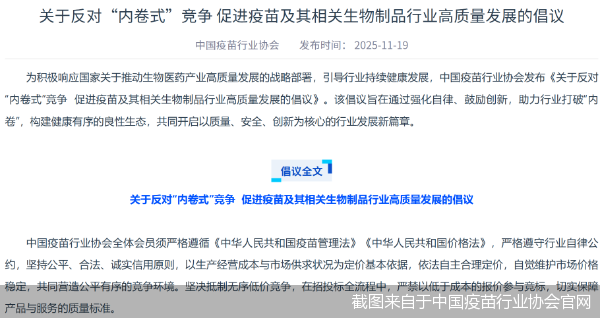
Core Viewpoint - The Chinese vaccine industry is facing intense price competition, leading to significant profit declines for many companies. The China Vaccine Industry Association has called for members to resist disorderly low-price competition and adhere to fair pricing practices to stabilize the market and promote innovation [1][2][3]. Group 1: Industry Challenges - The price war in the vaccine industry has intensified, with the price of the bivalent HPV vaccine dropping to as low as 27.5 yuan per dose, and flu vaccines reaching as low as 5.5 yuan per dose [4][6]. - In the first three quarters of this year, 71.43% of A-share vaccine companies reported a decline in net profit, with notable losses from companies like Wantai Biological Pharmacy and BCG Biological [6][7]. Group 2: Association's Initiative - The China Vaccine Industry Association has issued an initiative to promote high-quality development in the vaccine sector by advocating for self-discipline, innovation, and fair competition [2][3]. - The initiative emphasizes compliance with national laws and industry self-regulation, urging members to set prices based on production costs and market demand, while strictly prohibiting bidding below cost [2][3]. Group 3: Long-term Outlook - Experts believe that if the association's initiative is effectively implemented, it could lead to a more orderly competitive landscape, enhancing the industry's sustainability and improving vaccine safety and efficacy [3][7]. - The vaccine industry is seen as a crucial segment of the biopharmaceutical sector, with potential for growth as public health awareness and innovation capabilities improve [7].
“反内卷”风吹向疫苗行业
Bei Jing Shang Bao· 2025-11-20 12:39
Core Viewpoint - The Chinese Vaccine Industry Association has issued an initiative to combat chaotic price competition in the vaccine industry, advocating for self-discipline and innovation to promote high-quality development in the sector [4][5]. Group 1: Industry Challenges - The vaccine industry is experiencing intense price wars, with the price of the bivalent HPV vaccine dropping to as low as 27.5 yuan per dose, and flu vaccines reaching as low as 5.5 yuan per dose [7][9]. - In the first three quarters of this year, 71.43% of A-share vaccine companies reported a decline in net profit, with notable losses from companies like Wantai Biological Pharmacy and BCG Biological [8][9]. Group 2: Association's Initiative - The initiative calls for all members of the association to adhere to the Vaccine Administration Law and the Price Law, ensuring fair and legal pricing based on production costs and market demand [4][5]. - The association emphasizes the need to resist disorderly low-price competition and prohibits bidding below cost, aiming to stabilize market prices and improve product quality [4][6]. Group 3: Long-term Outlook - If effectively implemented, the initiative could lead to a more orderly competitive landscape, enhancing the industry's sustainable development and improving the safety and efficacy of vaccine products [5][6]. - Companies are encouraged to increase R&D investment to develop differentiated products, optimize production processes, and explore international markets to mitigate risks and enhance competitiveness [10].
今日共59只个股发生大宗交易,总成交19.1亿元
Di Yi Cai Jing· 2025-11-20 09:49
Summary of Key Points Core Viewpoint - On November 20, a total of 59 stocks in the A-share market experienced block trading, with a total transaction value of 1.91 billion yuan, indicating active trading activity in the market [1]. Group 1: Trading Activity - The top three stocks by transaction value were Zhongji Xuchuang (7.59 billion yuan), Tianyue Advanced (1.29 billion yuan), and Sichuan Shuangma (919.08 million yuan) [1]. - Among the stocks traded, 5 were sold at par value, 2 at a premium, and 52 at a discount [1]. Group 2: Price Changes - The stocks with the highest premium rates were Wantai Biological Pharmacy (6.05%) and HNA Holding (4.52%) [1]. - The stocks with the highest discount rates included Bihaiyuan (20.67%), Juguang Technology (20.53%), and Wens Foodstuff Group (19.52%) [1]. Group 3: Institutional Buying and Selling - The ranking of institutional buying was led by Zhongji Xuchuang (7.59 billion yuan), followed by Tianyue Advanced (93.35 million yuan) and Zhekuang Co. (28.37 million yuan) [1]. - The top three stocks sold by institutional investors were Xiangdian Co. (9.99 million yuan), Wanda Information (7.01 million yuan), and Wukuang New Energy (3.99 million yuan) [2].


万泰生物今日大宗交易溢价成交51.6万股,成交额2920.56万元
Xin Lang Cai Jing· 2025-11-20 09:42
11月20日,万泰生物大宗交易成交51.6万股,成交额2920.56万元,占当日总成交额的22.63%,成交价 56.6元,较市场收盘价53.37元溢价6.05%。 | 交易日期 | 证券简称 | 证券代码 | 成交价(元) 成交金额[万元) 咸交量(*) 买入营业部 | | 卖出营业部 | 是否为专场 | | --- | --- | --- | --- | --- | --- | --- | | 025-11-20 | 万奏生物 | 603392 | 56.6 622.6 | 11 | 类兽摄影学发育 | 집 | | 大宗交易信息 | | | | | | | | 股票基金信息 | | | | | | | | 交易日期 | 证券简称 | 证券代码 | | 成交价(元) 成交金额(万元) 成交量(*) 买入营业部 | 类出营业部 | 是否为专场 | | 2025-11-20 | 万泰生物 | 603392 | 56.6 1307.46 | 23.1 23.1 | 為開發熱 | 잡 | | 2025-11-20 | 万泰生物 | 603392 | 56.6 990.5 | 17.5 有一个人都是我們的 | 差筒플 ...

万泰生物(603392) - 万泰生物2025年第二次临时股东会会议资料
2025-11-20 09:00
股票简称:万泰生物 股票代码:603392 北京万泰生物药业股份有限公司 2025年第二次临时股东会会议资料 北 京 万 泰 生 物 药 业 股 份 有 限 公 司 2025 年 11 月 1 北京万泰生物药业股份有限公司 2025年第二次临时股东会会议资料 2025 年第二次临时股东会会议资料 会议资料目录 三、会议议案 议案 1:《关于取消监事会并修订<公司章程>的议案》 议案 2:《关于修订<关联交易管理制度>的议案》 7.01《关于选举吕赟先生为公司第六届董事会非独立董事的议案》 北京万泰生物药业股份有限公司 2 一、股东会须知 二、会议议程 议案 3:《关于修订<董事会议事规则>的议案》 议案 4:《关于修订<股东会议事规则>的议案》 议案 5:《关于修订<独立董事工作制度>的议案》 议案 6:《关于修订<累积投票实施细则>的议案》 议案 7:《关于选举非独立董事的议案》 北京万泰生物药业股份有限公司 2025年第二次临时股东会会议资料 2025 年第二次临时股东会须知 为了维护全体股东的合法权益,确保股东会的正常秩序和议事效率,保证会 议的顺利进行,根据《中华人民共和国公司法》《中华人民共和国证券 ...