沪农商行

Search documents
沪农商行12月23日获融资买入1192.08万元,融资余额1.28亿元
Xin Lang Cai Jing· 2025-12-24 01:26
Group 1: Stock Performance and Financing - On December 23, Shanghai Rural Commercial Bank's stock rose by 0.66%, with a trading volume of 135 million yuan [1] - The bank recorded a financing buy amount of 11.92 million yuan and a net financing buy of 7.49 million yuan on the same day [1] - The total financing and securities balance reached 139 million yuan, with the current financing balance at 128 million yuan, representing 0.15% of the market capitalization [1] Group 2: Shareholder and Financial Performance - As of September 30, the number of shareholders increased to 74,000, a rise of 0.81%, while the average circulating shares per person decreased by 0.19% to 126,678 shares [2] - For the period from January to September 2025, the bank achieved an operating income of 19.83 billion yuan, a year-on-year decrease of 3.18%, while the net profit attributable to shareholders grew by 0.78% to 10.57 billion yuan [2] Group 3: Dividend Distribution - Since its A-share listing, Shanghai Rural Commercial Bank has distributed a total of 18.84 billion yuan in dividends, with 13.44 billion yuan distributed over the past three years [3]
又一家大行关停信用卡App
Di Yi Cai Jing Zi Xun· 2025-12-23 12:29
Core Viewpoint - The trend of integrating credit card services into main banking apps is accelerating as banks face slowing user growth and rising customer acquisition costs, leading to the closure of independent credit card apps [2][3][6] Group 1: Bank Actions - Postal Savings Bank of China announced the gradual cessation of updates to its "Postal Savings Credit Card App," migrating functions to the "Postal Savings Bank App" [3] - China Bank was the first major state-owned bank to close its independent credit card app, integrating services into the "China Bank App" [3] - Several smaller banks, including Jiangxi Bank and Beijing Rural Commercial Bank, have also shut down or integrated their credit card apps into main mobile banking platforms [4] Group 2: Market Dynamics - The credit card industry has shifted from rapid expansion to a phase of stock competition, with growth in card issuance slowing and some banks experiencing declines in card volume [6] - The operational costs of maintaining independent credit card apps have become unsustainable due to overlapping functionalities and the need for continuous updates and security measures [6][7] Group 3: User Experience and Regulatory Influence - Users prefer a unified app experience, as managing multiple apps for different services leads to a fragmented service experience [7] - Regulatory guidance has emphasized the need for banks to optimize or terminate underperforming apps, supporting the trend towards app consolidation [7] Group 4: Future Trends - The integration of credit card services into main apps is seen as an upgrade in service delivery rather than a reduction in credit card offerings [8] - Future banking strategies will focus on enhancing user experience through data-driven personalized services and integrating financial services with everyday life [8][9] - Banks are expected to face challenges in technology integration and user adaptation during this transition, necessitating investments in IT infrastructure and security [8]



又一家大行关停信用卡App
第一财经· 2025-12-23 11:35
Core Viewpoint - The article discusses the trend of banks, particularly state-owned banks, integrating credit card services into their main banking apps, leading to the shutdown of independent credit card apps due to rising operational costs and changing user preferences [3][5][6]. Group 1: Bank Actions - Postal Savings Bank of China announced the gradual cessation of its independent credit card app, integrating its functions into the main Postal Savings Bank app, ensuring that customer services remain unaffected [5][6]. - China Bank was the first major state-owned bank to close its independent credit card app, merging its services into the "China Bank App" [6]. - Several smaller banks have also shut down or integrated their credit card apps into their main banking platforms, indicating a broader trend across the banking sector [6][7]. Group 2: Market Environment - The credit card industry has shifted from rapid expansion to a phase of stock competition, with growth in credit card issuance slowing down and some banks experiencing a decline in card numbers [6][7]. - The operational costs of maintaining independent credit card apps have become unsustainable compared to the value they provide, leading to their closure [7]. Group 3: User Experience and Regulatory Influence - Users have faced challenges with multiple apps, leading to a demand for a unified platform that enhances service experience and reduces the need for frequent app switching [7][8]. - Regulatory guidance has encouraged banks to optimize or terminate underperforming apps, further supporting the trend of app integration [8]. Group 4: Future Trends - The integration of credit card services into main banking apps is seen as an upgrade in service delivery, focusing on better user experience and operational efficiency [8][9]. - Future banking strategies may include expanding functionalities in main apps, such as wealth management and enhanced security features, to increase user engagement [9].


“瘦身”成大势所趋,又一家大行关停信用卡App
Di Yi Cai Jing· 2025-12-23 11:03
Core Viewpoint - The trend of integrating credit card services into main banking apps is accelerating, driven by user growth slowdown and rising customer acquisition costs, leading to the closure of independent credit card apps by several banks [1][2][4]. Group 1: Bank Actions - Postal Savings Bank announced the gradual integration of credit card functions into the "Postal Savings Bank App," ceasing updates for the "Postal Credit Card App" [1][2]. - China Bank was the first major state-owned bank to close its independent credit card app, merging its services into the "China Bank App" [2]. - Other banks, including Jiangxi Bank and Beijing Rural Commercial Bank, have also shut down or integrated their credit card apps into main mobile banking platforms [3]. Group 2: Market Environment - The credit card industry has shifted from rapid expansion to a phase of stock competition, with growth in card issuance slowing and some banks experiencing a decline in card numbers [4]. - The operational costs of maintaining independent credit card apps have become unsustainable due to overlapping functionalities and user dispersion [4]. Group 3: User Experience and Regulatory Influence - Users prefer a unified app experience, as managing multiple apps for different services has become cumbersome [5]. - Regulatory guidance has emphasized the need for banks to optimize or terminate underperforming apps, supporting the trend of app consolidation [5]. Group 4: Future Trends - The integration of credit card services into main apps is seen as an upgrade in service form and operational logic, focusing on enhancing user experience and efficiency [6]. - The digital transformation in banking is moving towards specialization, personalized services, and ecosystem integration, with banks needing to address challenges in technology compatibility and user adaptation [6]. - Future developments may include expanding functionalities in wealth management and enhancing security measures, such as biometric authentication [6][7].
继中行关停“缤彩生活”之后,又一大行整合独立信用卡APP!
Xin Lang Cai Jing· 2025-12-23 10:08
Core Viewpoint - Postal Savings Bank of China announced the integration of its independent credit card app into the main Postal Bank app, marking a shift in strategy as the bank aims to enhance user experience and reduce operational costs [1][6]. Group 1: App Integration and User Transition - The independent "Postal Credit Card App" will gradually cease updates, with all functionalities migrating to the "Postal Bank App" [1][6]. - As of November 15, the bank had already suspended new user registrations and card activations for the independent app, offering incentives such as 228 yuan in discounts to facilitate user transition [2][7]. - This move follows a trend among major state-owned banks, with Bank of China having already closed its independent credit card app in September [2][7]. Group 2: Market Trends and Regulatory Environment - The closure of independent credit card apps reflects a broader industry trend as banks shift from high-growth strategies to focusing on existing customer bases amid rising customer acquisition costs [2][3]. - Regulatory guidance from the National Financial Supervision Administration emphasizes the need for financial institutions to optimize or terminate low-activity apps, promoting a "less is more" approach [2][3]. Group 3: Structural Adjustments in Banking - Experts suggest that the integration is driven by the need to reduce costs and improve user experience, as the profitability of credit card services has been declining [3][8]. - Several banks have restructured their credit card divisions, indicating a shift in organizational strategy to enhance service efficiency [3][8]. Group 4: Product Strategy Changes - The issuance of co-branded credit cards has significantly decreased, with major banks halting nearly 100 co-branded cards due to high costs and low user engagement [4][9]. - Credit card benefits are also being reduced, with at least eight banks adjusting their offerings in various sectors, reflecting a reevaluation of cost-effectiveness [4][9]. Group 5: Market Dynamics and Future Outlook - The credit card market is undergoing structural adjustments, with the total number of credit cards in China decreasing to 707 million by the end of Q3 2025, down by 20 million from the beginning of the year [10]. - The industry is transitioning from "incremental expansion" to "deep cultivation of existing customers," focusing on efficiency, user experience, and sustainable development [5][10].

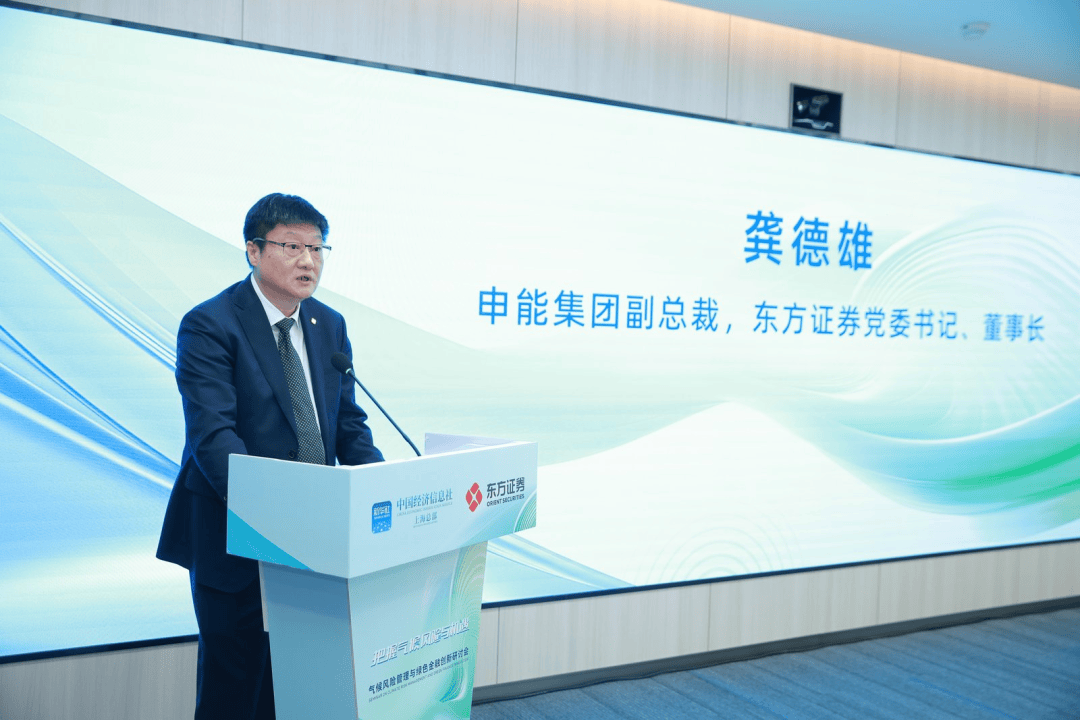
人事丨重磅人事布局!龚德雄接棒上海国际集团总经理
Sou Hu Cai Jing· 2025-12-22 13:50
2025年12月12日,上海国际集团有限公司公告,龚德雄正式出任公司总经理,接替到龄退休的刘信义。此前,龚德雄刚刚辞任东方证券董事长。 公开信息显示,龚德雄的金融职业生涯始于上海国际信托投资公司证券部,曾任浦东营业部副主任,证券部副经理,金融管理总部总经理等职。此后,他 在上海证券有限责任公司担任了包括党委副书记、纪委书记、副总经理在内的多个关键职务,同时兼任海证期货有限公司董事长。在国泰君安证券任职期 间,龚德雄先后担任副总裁、党委委员,并兼任资产管理业务委员会总裁、国泰君安资本管理有限公司董事长等多个职务。 2023年4月,龚德雄加入申能(集团)有限公司担任副总裁。申能集团是东方证券的第一大股东,持股比例为26.63%。他于2023年9月出任东方证券党委 书记,同年10月担任执行董事,最终于2024年11月正式担任董事长职务。 在东方证券任职期间,龚德雄推动了一系列战略规划。他围绕建设"具有国内竞争力和国际影响力的一流现代投资银行"的公司愿景,提出了"三步走"中长 期战略路线图,并主导制定和推动了公司2025—2027年战略规划的实施。东方证券在2025年前三季度实现了营业收入127.08亿元,同比增加3 ...
消失的信用卡App
Bei Jing Shang Bao· 2025-12-22 12:59
Core Insights - A trend of "streamlining and integration" of credit card apps across state-owned banks, joint-stock banks, and regional banks is accelerating, with Postal Savings Bank being the latest to announce the integration of its credit card app into its main banking app [1][3] - This shift reflects a significant transformation in the banking industry's digital strategy, moving from "expansion" to "refinement," indicating a new phase of "reducing quantity while improving quality" in online credit card services [1][8] Group 1: Integration of Credit Card Apps - Postal Savings Bank will gradually stop updating its "Postal Credit Card App," migrating all functions to the "Postal Bank App," following China Bank's earlier move to close its independent credit card app [3][4] - The integration aims to enhance operational efficiency and user experience by consolidating resources and focusing on the main app ecosystem [5][6] - The trend of integrating independent credit card apps is not limited to large banks; smaller banks like Beijing Rural Commercial Bank and Jiangxi Bank have also closed their credit card apps, merging services into their mobile banking platforms [7][8] Group 2: Industry Context and Drivers - The rise of independent credit card apps began around 2015, aiming to create a "financial + lifestyle" ecosystem, but as competition intensified, these apps became burdensome due to overlapping functionalities and low user engagement [6][10] - Regulatory pressures and the need for cost reduction are driving banks to optimize or terminate underperforming mobile applications, as highlighted by the recent guidelines from the National Financial Regulatory Administration [7][9] - The future of credit card services is expected to evolve into a "main app + diversified lightweight touchpoints" model, where the main app serves as a comprehensive platform while maintaining personalized services through various channels [9][10]

上海农商银行:以专业引擎助推航空产业稳健高飞
Jin Rong Jie Zi Xun· 2025-12-22 11:19
Core Insights - Shanghai Rural Commercial Bank has achieved a breakthrough in financing domestic aircraft with the delivery of two C909 aircraft from Huaxia Airlines, marking a significant step in supporting the development of the domestic aircraft industry and fulfilling the mission of financial services for the real economy [1] Group 1: Financing Aircraft Introduction - To alleviate the financial pressure of large prepayments required before aircraft delivery, Shanghai Rural Commercial Bank has provided over 3 billion yuan in prepayment financing for aircraft leasing project companies, supporting several airlines including Eastern Airlines and Sichuan Airlines [2] Group 2: Supporting Aircraft Operations - The bank actively supports aircraft financing through various products such as fixed asset loans and factoring financing, establishing deep partnerships with major airlines like Eastern Airlines and Spring Airlines, and promoting the financing of domestic aircraft models like C909 and C919 [3] - In March 2025, the bank issued a sustainable development-linked loan of 145 million yuan to 吉祥航空, linking the loan interest rate to carbon reduction performance targets, thereby injecting financial support for the low-carbon transition in the aviation industry [3] Group 3: Exploring Aircraft Exit Financing - Shanghai Rural Commercial Bank is exploring financial support models for the aircraft exit phase, including providing financing for spare aircraft engines intended for disassembly and sale abroad, thus completing the financial service cycle for aircraft from introduction to exit [4] - The bank also offers direct financing services such as bond underwriting and investment to help airlines and leasing companies optimize their financing structures and reduce costs [4] - Looking ahead to the 14th Five-Year Plan, the bank aims to expand its service boundaries and strengthen product innovation to provide comprehensive financial support for the aviation industry, contributing to the transition from a major aviation country to a strong aviation nation [4]
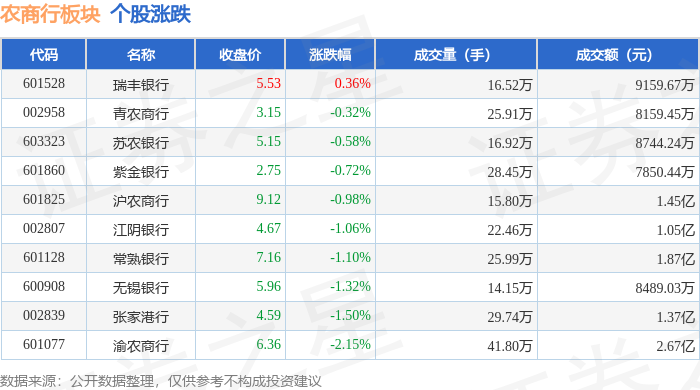
农商行板块12月22日跌1.18%,渝农商行领跌,主力资金净流入1998.09万元
Zheng Xing Xing Ye Ri Bao· 2025-12-22 09:10
Core Viewpoint - The rural commercial bank sector experienced a decline of 1.18% on December 22, with Yunnan Rural Commercial Bank leading the drop [1] Group 1: Market Performance - The Shanghai Composite Index closed at 3917.36, up by 0.69% [1] - The Shenzhen Component Index closed at 13332.73, up by 1.47% [1] - The rural commercial bank sector saw mixed individual stock performances, with notable declines in several banks [1] Group 2: Individual Stock Performance - Wuxi Bank (600908) had a closing price of 5.96, down by 1.32%, with a trading volume of 141,500 shares and a transaction amount of 84.89 million [1] - Changshu Bank (601128) closed at 7.16, down by 1.10%, with a trading volume of 259,900 shares and a transaction amount of 187 million [1] - Yunnan Rural Commercial Bank (601077) closed at 6.36, down by 2.15%, with a trading volume of 418,000 shares and a transaction amount of 267 million [1] Group 3: Capital Flow - The rural commercial bank sector had a net inflow of 19.98 million from main funds, while retail investors saw a net outflow of 44.62 million [1] - Individual stocks within the sector showed varied capital flows, with some banks experiencing significant net outflows from retail investors [2]




11月普惠金融-景气指数:融资环境改善,企业经营韧性凸显
Xin Hua Wang· 2025-12-22 05:21
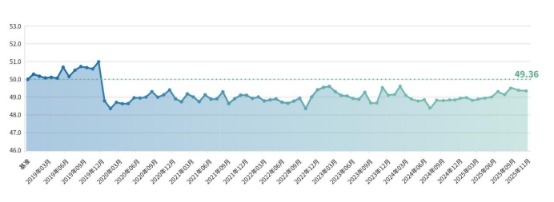
2025年11月,普惠金融-景气指数达49.36点,较10月下降0.03点,高于去年同期0.51点。融资端成本稳 中有降,金融扶持政策精准有效,信贷结构持续优化;经营端市场下行压力缓和,小微企业发展韧性增 强,经济增长内生动力稳步提升。 图1 普惠金融-景气指数结果 融资景气度温和回升 分维度来看,11月,融资景气度指数为54.83点,较10月上升0.14点。企业融资成本维持在历史低位,11 月,企业新发放贷款(本外币)加权平均利率约为3.1%,比上年同期低约30个基点。贷款规模保持合理增 长,信贷结构持续优化。中国人民银行数据显示,截至11月末,普惠小微贷款余额、制造业中长期贷款 余额同比增速分别达到11.4%、7.7%,均高于同期其他各项贷款增速。 图2 分维度-融资景气度指数结果 图3 分维度-经营景气度指数结果 行业景气度:九大行业4升5降 分行业来看,11月,九大行业经营景气度指数呈4升5降的趋势。阶段性消费热潮拉动效应凸显,线上促 销与线下零售联动刺激了批发零售需求。年末基建项目加快施工进度,政策推动建筑活动边际回暖,建 筑业和房地产业经营景气度指数微升。行业技术创新带动信息服务业需求增长。农林牧 ...