
中国人民银行

Search documents
9000亿元,央行明日操作
财联社· 2026-01-22 09:37
据央行官网,为保持银行体系流动性充裕,2026年1月23日,中国人民银行将以固定数量、利率招标、多重价位中标方式开展9000亿元MLF操作,期 限为1年期。 ...


央行将于1月23日开展9000亿元MLF操作,期限为1年期
Xin Lang Cai Jing· 2026-01-22 09:32
1月22日金融一线消息,据央行官网,为保持银行体系流动性充裕,2026年1月23日,中国人民银行将以 固定数量、利率招标、多重价位中标方式开展9000亿元MLF操作,期限为1年期。 责任编辑:王馨茹 责任编辑:王馨茹 1月22日金融一线消息,据央行官网,为保持银行体系流动性充裕,2026年1月23日,中国人民银行将以 固定数量、利率招标、多重价位中标方式开展9000亿元MLF操作,期限为1年期。 ...
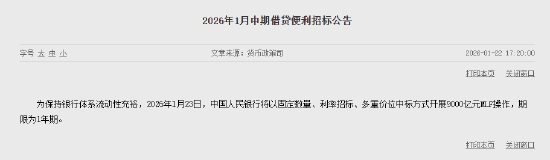
央行:为保持银行体系流动性充裕,2026年1月23日,中国人民银行将以固定数量、利率招标、多重价位中标方式开展9000亿元MLF操作,期限为1年期
Mei Ri Jing Ji Xin Wen· 2026-01-22 09:31
Core Viewpoint - The People's Bank of China (PBOC) is set to conduct a 900 billion yuan MLF operation on January 23, 2026, to maintain ample liquidity in the banking system [1] Group 1 - The operation will utilize a fixed quantity and interest rate bidding method with multiple price levels [1] - The term of the MLF operation will be for one year [1]
央行1月23日开展9000亿元MLF操作,期限为1年期
Zheng Quan Shi Bao Wang· 2026-01-22 09:26
Group 1 - The People's Bank of China (PBOC) will conduct a 900 billion yuan MLF operation on January 23, 2026, to maintain ample liquidity in the banking system [1] - The operation will be conducted using a fixed quantity, interest rate bidding, and multiple price bidding method [1] - The term of the MLF operation will be for one year [1]
中国人民银行对2家拒收人民币现金的单位及相关责任人作出经济处罚
Yang Shi Xin Wen· 2026-01-22 08:43
中国人民银行将持续开展拒收人民币现金整治工作,切实保护消费者的合法权益,维护人民币法定货币 地位。社会公众遇到拒收人民币现金行为,可依据《人民币现金收付及服务规定》(中国人民银行 国 家发展改革委 金融监管总局公告〔2025〕29号发布),依法维权。 2025年第四季度,中国人民银行对2家核实为拒收人民币现金的单位及相关责任人依法作出经济处罚。 广大经营主体应强化法治观念,尊重公众支付选择权,共同打造和谐现金流通环境。 ...
1月22日央行开展2102亿元7天期逆回购操作
Zhong Guo Xin Wen Wang· 2026-01-22 02:45
中新网1月22日电 据央行网站消息,2026年1月22日中国人民银行以固定利率、数量招标方式开展了 2102亿元7天期逆回购操作。具体情况如下: ...
人民银行开展2102亿元7天期逆回购操作,净投放309亿元
Bei Jing Shang Bao· 2026-01-22 02:13
北京商报讯(记者 廖蒙)1月22日,中国人民银行以固定利率、数量招标方式开展了2102亿元逆回购操 作,期限7天,操作利率1.40%,投标量2102亿元,中标量2102亿元。数据显示,当日有1793亿元逆回 购到期,据此计算,单日净投放309亿元。 ...
新版人民币2.0时代落地,纸币将何去何从?老百姓的支付方式会被颠覆吗
Sou Hu Cai Jing· 2026-01-21 21:46
Core Viewpoint - The transition to the digital renminbi 2.0 era signifies a fundamental change in China's payment system, moving from a simple digital cash model to a more dynamic digital deposit system that generates interest for users [2][4]. Group 1: Digital Renminbi Transition - The digital renminbi will evolve from being a digital cash equivalent to a true digital deposit, allowing it to earn interest starting January 1, 2026, at a current rate of 0.05% [2][4]. - The management of digital renminbi will shift from direct control by the central bank to commercial banks, enhancing service quality and providing deposit insurance up to 500,000 yuan [4][5]. Group 2: Usage and Adoption - As of November 2025, the digital renminbi has processed 3.48 billion transactions, amounting to 16.7 trillion yuan, indicating its transition from a pilot project to a widely used payment tool [5]. - The number of personal digital wallets has reached 230 million, with 18.84 million corporate wallets, showing significant user adoption [5]. Group 3: Future Implications - The digital renminbi's role in international payments is growing, with a 95.3% share in cross-border transactions, suggesting an increase in the renminbi's status as a payment tool in global trade [9]. - Future developments may allow users to purchase traditional financial products directly with digital renminbi, enhancing its utility and attractiveness [10]. Group 4: Payment Method Evolution - The coexistence of cash and digital renminbi is expected, with cash usage declining gradually rather than disappearing abruptly, similar to the transition from tapes to CDs [6][12]. - The transition to digital payment methods will be gradual, ensuring that all demographics, including the elderly, are accommodated during this shift [8][10].

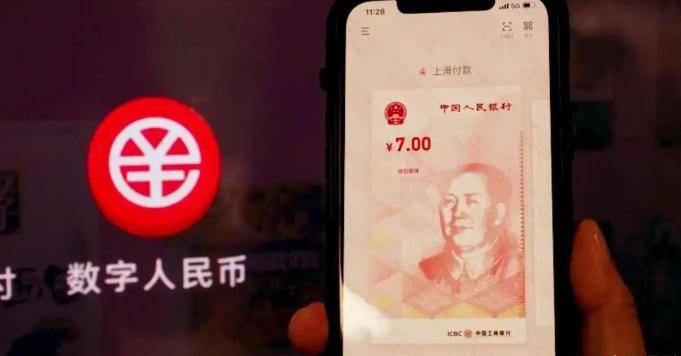
央行:加快建设 人民币跨境支付体系
Zhong Guo Zheng Quan Bao· 2026-01-21 21:07
Core Viewpoint - The People's Bank of China emphasizes the acceleration of the construction of a cross-border payment system for the renminbi, aiming for diversified and multi-layered development in cross-border payment services [1] Group 1: Payment System Development - The 2026 payment settlement work will closely align with the "14th Five-Year Plan" and the goal of building a strong financial nation, promoting high-quality development of a modern payment system [1] - The meeting calls for strict implementation of transparent regulation of payment institutions and functional regulation of payment services, aiming to create a healthy industry ecosystem through a combination of administrative and self-regulatory measures [1] Group 2: Service Optimization and Innovation - Continuous efforts will be made to optimize payment services, ensuring convenient and secure payment options for users [1] - The enhancement of service quality and efficiency in payment systems will be driven by innovation, facilitating the upgrade of the industry [1]
人民银行:严格实施支付机构穿透式监管和支付业务功能监管
Bei Jing Shang Bao· 2026-01-21 13:39
Core Viewpoint - The People's Bank of China (PBOC) held a meeting on January 15, 2026, to summarize the payment settlement work in 2025 and outline key tasks for 2026, emphasizing the need for high-quality development in the payment system and cross-border payment capabilities [1] Group 1: Payment System Development - Since 2025, the regulatory framework for the payment sector has been continuously improved, and the level of payment supervision and services has steadily increased [1] - Significant progress has been made in building a safe and efficient cross-border payment system, with important breakthroughs in domestic and international payment connectivity [1] - The payment industry is entering a new stage of high-quality development [1] Group 2: 2026 Work Focus - The 2026 payment settlement work will closely align with the "14th Five-Year Plan" and the goals of building a strong financial nation [1] - There will be an accelerated construction of the RMB cross-border payment system, promoting connectivity and diversification in cross-border payment systems [1] - Strict implementation of transparent supervision and functional regulation of payment institutions will be enforced to foster a compliant and healthy industry ecosystem [1] Group 3: Service Optimization - Continuous efforts will be made to optimize payment services, ensuring convenient and secure payment options [1] - The quality and efficiency of payment system services will be enhanced, with innovation driving the upgrade of the industry [1]