MLF(中期借贷便利)

Search documents
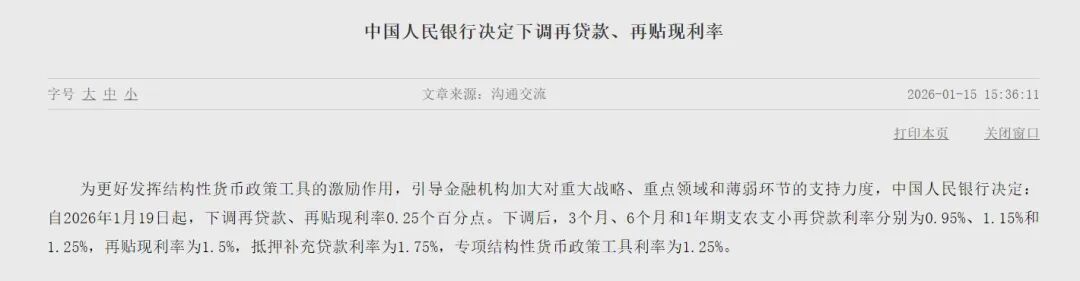
离岸人民币对美元汇率升破6.84;浙江:2026年将强化科技金融支持 | 金融早参
Sou Hu Cai Jing· 2026-02-26 23:16
Group 1 - The People's Bank of China conducted a 7-day reverse repurchase operation of 320.5 billion yuan at an interest rate of 1.40%, maintaining liquidity stability despite 400 billion yuan of reverse repos maturing on the same day [1] - The offshore RMB to USD exchange rate rose above 6.84, with a peak appreciation to 6.83605, reflecting a strong trend post-Spring Festival, supported by improved external conditions for China [2] - Zhejiang Province plans to enhance support for technology finance, aiming for a technology loan balance exceeding 4.2 trillion yuan by 2026, indicating a strong commitment to fostering innovation and attracting capital into the tech sector [3] Group 2 - The Supreme People's Court will focus on combating crimes related to money laundering using virtual currencies and underground banks, highlighting a commitment to tackling financial crime and enhancing market integrity [4] - The International Monetary Fund (IMF) forecasts that the U.S. debt burden will continue to rise, with federal budget deficits projected to increase to 6.1% of GDP in 2026, and public-held federal debt expected to reach 100.7% of GDP by 2026 [5]
节后首周超2.2万亿元逆回购到期 央行多举措护航流动性
Zheng Quan Ri Bao· 2026-02-26 16:19
Group 1 - The People's Bank of China (PBOC) conducted a 7-day reverse repo operation of 320.5 billion yuan at a fixed rate of 1.40% on February 26, resulting in a net withdrawal of 79.5 billion yuan due to 400 billion yuan of reverse repos maturing on the same day [1] - The total amount of reverse repos and Medium-term Lending Facility (MLF) maturing in the first week after the Spring Festival is 25.524 billion yuan, including 8.524 billion yuan in 7-day reverse repos and 14 billion yuan in 14-day reverse repos [1] - Market liquidity is facing tightening pressure due to high maturing amounts, tax period extensions, and government bond issuance, although a large inflow of funds into the banking system is expected to maintain a stable liquidity environment [1] Group 2 - On February 24, the PBOC conducted a 7-day reverse repo operation of 526 billion yuan, resulting in a net withdrawal of 926.4 billion yuan due to 1.4524 trillion yuan of reverse repos maturing [2] - The DR007 rate increased to 1.5545% on February 24, up from 1.3211% on February 14, indicating a rise in funding rates post-holiday [2] - The PBOC's monetary policy remains accommodative, with significant net MLF injections and reverse repos to ensure ample long-term liquidity, while short-term liquidity operations are also stable [3]
流动性宽松持续 同业存单利率或仍有下行空间
Di Yi Cai Jing· 2026-02-25 12:47
Core Viewpoint - The central theme of the articles revolves around the liquidity management by the central bank and its impact on the interbank certificate of deposit (CD) rates, indicating a potential downward trend in rates due to increased liquidity measures and easing of funding pressures in the banking sector. Group 1: Central Bank Actions - The central bank has conducted a net injection of 300 billion yuan in medium-term liquidity through MLF operations, indicating a continued effort to maintain ample liquidity in the banking system [1][2] - The central bank's recent actions include a fixed quantity and multi-price bidding for 600 billion yuan in MLF, reflecting a commitment to long-term liquidity support [2] - Analysts suggest that the central bank's liquidity measures may lead to a decrease in interbank CD rates, with expectations that the rates for state-owned banks could fall below 1.55% [3][4] Group 2: Interbank CD Market Dynamics - The usage rate of interbank CDs has significantly declined, with state-owned banks experiencing a notable easing of "liability shortage" pressures compared to previous years [5][6] - As of January, the balance of interbank CDs was reported at 19.03 trillion yuan, a decrease of 2.77 trillion yuan since May 2025, indicating a contraction in the issuance of these instruments [7] - The interbank CD issuance has not seen a significant increase despite the traditional "opening red" period for banks, with net financing volumes remaining negative for several months [9] Group 3: Market Reactions and Trends - The rates for AAA-rated interbank CDs have fallen below 1.6%, influenced by the central bank's liquidity tools and a reduced willingness among banks to issue CDs due to shrinking funding gaps [4][6] - The overall structure of bank deposits is changing, with a noted increase in asset management products, which are shifting towards interbank deposits and CDs, thereby altering the funding landscape for banks [6] - The interbank CD usage rates among major banks have decreased, with the Agricultural Bank of China leading at 84.79%, but still lower than previous years [8]
央行将开展6000亿元MLF操作,期限为1年期
Xin Lang Cai Jing· 2026-02-24 11:05
Group 1 - The People's Bank of China will conduct a 600 billion MLF operation on February 25, 2026, to maintain liquidity in the banking system [1] - The operation will be conducted using a fixed quantity, interest rate bidding, and multiple price bidding methods [1] - The term of the MLF operation will be for one year [1]
节前1万亿买断式逆回购即将登场 助力信贷开门红
Mei Ri Jing Ji Xin Wen· 2026-02-12 14:43
Core Viewpoint - The People's Bank of China (PBOC) is injecting liquidity into the banking system through a 10 trillion yuan reverse repurchase operation to maintain a stable liquidity environment ahead of the Spring Festival [1][2]. Group 1: Monetary Policy Actions - On February 13, the PBOC will conduct a 10 trillion yuan reverse repurchase operation with a term of 6 months, marking the sixth consecutive month of increased liquidity support [1]. - The total net injection from the two types of reverse repos in February is expected to be 600 billion yuan, a significant increase of 300 billion yuan compared to the previous month [2]. - The PBOC's actions are aimed at ensuring sufficient liquidity for government bond issuance and supporting financial institutions' credit provision [1][2]. Group 2: Economic Context and Expectations - The PBOC's liquidity measures are in response to the anticipated demand for funding in key sectors and the increased issuance of government bonds, despite the upcoming Spring Festival [2][3]. - Analysts expect that the MLF (Medium-term Lending Facility) and government bond trading tools will also provide further liquidity support in February [2][3]. - The PBOC's monetary policy remains supportive, with a focus on maintaining liquidity and promoting stable economic growth [3][4]. Group 3: Future Policy Considerations - The likelihood of a reserve requirement ratio (RRR) cut is deemed low in the short term, as the PBOC is currently utilizing various tools to meet market liquidity needs [4]. - The potential for interest rate cuts exists, but the necessity for such actions is not high at this moment due to recent structural rate adjustments and a stable stock market [4].
对冲节前资金需求 央行重启14天期逆回购操作
Shang Hai Zheng Quan Bao· 2026-02-05 17:52
Core Viewpoint - The People's Bank of China (PBOC) has implemented a net liquidity injection of 64.5 billion yuan through a combination of 7-day and 14-day reverse repos, addressing pre-Spring Festival funding demands and reflecting a refined management of liquidity under a stable growth context [1][2]. Group 1: Liquidity Management - The PBOC's reintroduction of the 14-day reverse repo tool after a one-and-a-half-month hiatus is a direct response to temporary liquidity needs and indicates a commitment to maintaining continuity and stability in monetary policy aimed at growth [2][3]. - The combination of short-term and cross-holiday liquidity tools by the PBOC aims to smooth out short-term funding fluctuations caused by holiday factors, preventing unnecessary increases in market interest rates [2][4]. Group 2: Market Conditions - Despite an overall stable liquidity environment, structural tensions remain evident at certain points, particularly during tax payment periods and high bond issuance phases, leading to temporary funding pressures for some institutions [4][5]. - The January funding rates showed a marginal increase, with the DR001 and DR007 rates rising to 1.34%, indicating a need for the PBOC's intervention to stabilize market expectations and alleviate short-term liquidity stress [3][5]. Group 3: Future Outlook - Some institutions are beginning to signal potential changes in the liquidity landscape, with warnings of upward pressure on the funding rate midpoint as corporate financing needs may recover throughout the year [5][6]. - The overall market liquidity is expected to remain stable in February, with the PBOC likely to utilize various tools to counteract seasonal disturbances, while the impact of tax payments is anticipated to be neutral [6].
央行4日开展750亿元7天期逆回购操作
Zheng Quan Ri Bao· 2026-02-04 23:39
Group 1 - The People's Bank of China (PBOC) conducted a 750 billion yuan reverse repurchase operation with a fixed interest rate of 1.4%, resulting in a net liquidity withdrawal of 302.5 billion yuan after 3.775 trillion yuan of reverse repos matured on February 4 [1] - From February 2 to February 4, the cumulative net withdrawal of liquidity through 7-day reverse repos amounted to 674.5 billion yuan, indicating a trend of liquidity tightening at the beginning of the month [1] - Analysts expect that as the Spring Festival approaches, the PBOC may shift to net liquidity injection through reverse repos and potentially utilize 14-day reverse repos to stabilize market liquidity fluctuations [1] Group 2 - In January, the PBOC reported a net liquidity injection of 700 billion yuan through Medium-term Lending Facility (MLF) and a net injection of 100 billion yuan through government bond transactions, marking a significant increase compared to previous months [2] - The PBOC's approach to government bond transactions will be flexible, considering factors such as the need for base currency injection and market conditions, aiming to maintain ample liquidity for smooth government bond issuance [2] - The likelihood of a reserve requirement ratio (RRR) cut in the short term has decreased due to the increased net liquidity injections through MLF and government bond operations [2] Group 3 - The PBOC's large-scale liquidity injection in January has reduced the urgency for a comprehensive RRR cut before the Spring Festival, indicating a shift towards a monitoring phase for monetary policy [3] - The continuation of MLF operations and the resumption of 3-month reverse repos are expected to stabilize the funding environment without necessitating an RRR cut in the short term [3] - Analysts predict that the probability of an RRR cut may increase in the second quarter of the year, particularly in light of anticipated government bond issuance pressures [3]
央行工具箱精准发力 资金面有望平稳跨节
Zheng Quan Ri Bao· 2026-01-28 16:11
Core Viewpoint - The People's Bank of China (PBOC) is maintaining a stable liquidity environment through various monetary policy tools, with a significant increase in mid-term liquidity injections in January 2023, despite a relatively modest net injection in the short term [1][2]. Group 1: Monetary Policy Actions - On January 28, the PBOC conducted a 7-day reverse repo operation of 377.5 billion yuan at a fixed rate of 1.4%, resulting in a net injection of 14 billion yuan after 363.5 billion yuan of reverse repos matured [1]. - The total net injection for the week reached 84.2 billion yuan, indicating a cautious approach to liquidity management [1]. - The PBOC's operations in January included a net injection of 300 billion yuan through reverse repos and 700 billion yuan through Medium-term Lending Facility (MLF), totaling a net injection of 1 trillion yuan for the month, significantly higher than December's 300 billion yuan [1]. Group 2: Market Liquidity and Interest Rates - As of January 28, the overnight repo rate (DR001) slightly decreased to 1.367% from 1.3674%, while the 7-day repo rate (DR007) fell to 1.5479% from 1.5833%, reflecting a stable liquidity environment [2]. - The PBOC's proactive measures, including the early renewal of MLF, indicate a strong intention to support the liquidity in the market, especially ahead of the Chinese New Year [2]. Group 3: Future Outlook - Looking ahead to February, potential liquidity disturbances are anticipated due to increased cash withdrawals before the Spring Festival and sustained high levels of government bond issuance [3]. - The PBOC is expected to implement 14-day reverse repos and continue flexible operations with reverse repos and MLF to inject mid-term liquidity into the market [3]. - Despite the low probability of a reserve requirement ratio (RRR) cut in the short term, the liquidity environment is expected to remain stable, with controlled volatility in both DR007 and DR001 rates [3].
央行1月23日开展9000亿元MLF操作,期限为1年期
Zheng Quan Shi Bao Wang· 2026-01-22 09:26
Group 1 - The People's Bank of China (PBOC) will conduct a 900 billion yuan MLF operation on January 23, 2026, to maintain ample liquidity in the banking system [1] - The operation will be conducted using a fixed quantity, interest rate bidding, and multiple price bidding method [1] - The term of the MLF operation will be for one year [1]
结构性降息0.25个百分点!央行最新发布会释放重要信号
Guo Ji Jin Rong Bao· 2026-01-15 14:12
Core Viewpoint - The People's Bank of China (PBOC) is implementing monetary policy measures to support high-quality economic development, including a 0.25 percentage point reduction in various structural monetary policy tool rates to enhance bank lending in key areas [1][2]. Group 1: Policy Measures - The PBOC will lower the interest rates of various structural monetary policy tools by 0.25 percentage points, with the one-year re-lending rate decreasing from 1.5% to 1.25% [2]. - The new rates for re-lending and re-discounting will be 0.95%, 1.15%, and 1.25% for 3-month, 6-month, and 1-year terms respectively, with the re-discount rate set at 1.5% [2]. Group 2: Economic Impact - The reduction in rates aims to lower financing costs in specific sectors, encouraging banks to lend at lower rates to small and micro enterprises, technological innovation, and green transformation [4]. - The targeted approach of structural monetary policy tools is expected to improve the efficiency of fund utilization and enhance financial services for the real economy [4]. Group 3: Future Monetary Policy Outlook - There is still room for further reductions in the reserve requirement ratio, with the current average at 6.3%, indicating a potential decrease of about 1.3 percentage points [5][6]. - The PBOC is expected to maintain a moderately loose monetary policy, focusing on the integration of existing and new policies to create a conducive financial environment for stable economic growth [7][8].