
时代新材

Search documents
时代新材(600458) - 关于签署日常经营合同的自愿性披露公告
2025-10-12 08:00
证券代码:600458 证券简称:时代新材 公告编号:临 2025-063 株洲时代新材料科技股份有限公司 关于签署日常经营合同的 自愿性披露公告 本公司董事会及全体董事保证本公告内容不存在任何虚假记载、误导性陈述 或者重大遗漏,并对其内容的真实性、准确性和完整性承担法律责任。 重要内容提示: 1、上述合同将按合同约定条件分期交付,公司将根据合同的相关规定以及 公司收入确认原则在相应的会计期间确认收入(最终以经会计师事务所审计的数 据为准)。因受合同具体交货批次及验收时间的影响,对公司 2025 年当期业绩 影响存在不确定性。 2、合同双方均具有履约能力,但在合同执行过程中,可能存在因外部宏观 环境重大变化,国家相关政策调整、客户需求变化以及其他不可抗力等因素导致 合同无法如期或全面履行的风险。公司将积极做好相关应对措施,全力保障合同 的正常履行。敬请广大投资者谨慎决策,注意防范投资风险。 一、合同签署情况及审议情况 株洲时代新材料科技股份有限公司(以下简称"公司")2025 年 7 月 1 日 —2025 年 9 月 30 日与风电各大主机厂(以下简称"买方")签订《叶片销售合 同》(以下简称"合同"或"本 ...
时代新材(600458) - 2025年半年度权益分派实施公告
2025-10-12 08:00
证券代码:600458 证券简称:时代新材 公告编号:临 2025-062 株洲时代新材料科技股份有限公司 2025年半年度权益分派实施公告 本公司董事会及全体董事保证本公告内容不存在任何虚假记载、误导性陈述或者重大遗 漏,并对其内容的真实性、准确性和完整性承担法律责任。 2025 年 5 月 21 日的2024年年度股东大会审议通过了《关于提请股东大会授权董事会进行 2025 年度中期利润分配的议案》,股东大会授权董事会在符合利润分配条件下,制定并实施具 体的 2025 年中期利润分配方案。2025 年 8 月 21 日召开的公司第十届董事会第七次会议审议 通过了《公司 2025 年度中期利润分配方案》。 重要内容提示: 每股分配比例 A 股每股现金红利0.07元(含税) 相关日期 | 股份类别 | 股权登记日 | 最后交易日 | 除权(息)日 | 现金红利发放日 | | --- | --- | --- | --- | --- | | A股 | 2025/10/16 | - | 2025/10/17 | 2025/10/17 | 差异化分红送转: 否 一、 通过分配方案的股东大会届次和日期 二、 分配方案 ...
时代新材:公司签订约44.9亿元风电叶片销售合同
Xin Lang Cai Jing· 2025-10-12 07:53
Core Viewpoint - The company has signed sales contracts for wind turbine blades with major manufacturers, totaling approximately RMB 4.49 billion, which is expected to positively impact its performance, although the exact effect on the 2025 financial results remains uncertain [1] Contract Details - The contracts are divided into offshore wind projects and onshore wind projects, with the offshore wind project amounting to RMB 442 million and the onshore wind project amounting to RMB 4.048 billion [1] - The contract includes 14-16 MW offshore wind turbine blades and related services, as well as 6-10 MW onshore wind turbine blades and related services [1]
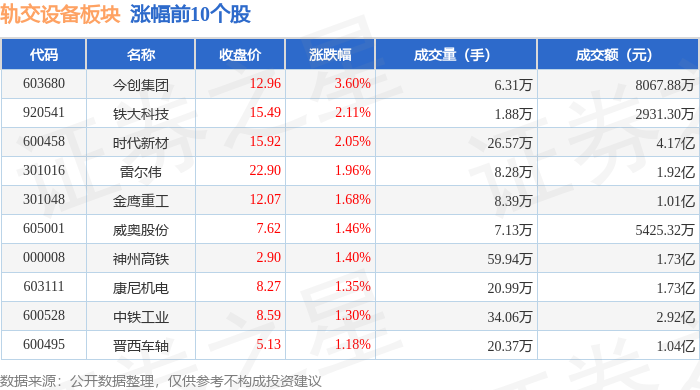
轨交设备板块10月10日跌0.26%,交控科技领跌,主力资金净流入1.47亿元





Zheng Xing Xing Ye Ri Bao· 2025-10-10 08:51
Core Viewpoint - The rail transit equipment sector experienced a decline of 0.26% on October 10, with a notable drop in the stock of Jiaokong Technology, while the overall market indices also fell, with the Shanghai Composite Index down 0.94% and the Shenzhen Component Index down 2.7% [1][2]. Market Performance - The closing price of the Shanghai Composite Index was 3897.03, and the Shenzhen Component Index closed at 13355.42 [1]. - The rail transit equipment sector saw mixed performance among individual stocks, with notable gainers including Jinchuan Group (+3.60%) and Tieda Technology (+2.11%) [1]. Stock Details - Key stocks in the rail transit equipment sector included: - Jinchuan Group (603680) closed at 12.96 with a 3.60% increase and a trading volume of 63,100 shares, totaling 80.68 million yuan in transaction value [1]. - Jiaokong Technology (688015) led the decline with a closing price of 24.55, down 3.04%, and a trading volume of 24,000 shares, amounting to 5.91 million yuan [2]. Capital Flow - The rail transit equipment sector saw a net inflow of 147 million yuan from institutional investors, while retail investors experienced a net outflow of 168 million yuan [2][3]. - Notable capital flows included: - Times New Materials (600458) had a net outflow of 34.03 million yuan from institutional investors [3]. - Tianyi New Materials (688033) recorded a net inflow of 24.74 million yuan from institutional investors [3].

人才培养与产业发展良性互动——瞄准需求,看3所大学这样调整专业
Ren Min Ri Bao· 2025-10-09 14:30
Group 1: Core Insights - The article discusses the interaction between talent cultivation and industrial development, highlighting the adjustments made by universities in response to industry needs [1] - The Central Education Work Leading Group has issued a plan to optimize higher education discipline and major settings from 2025 to 2027, aiming to align educational programs with national strategic demands [1] Group 2: Industry Demand and Educational Response - Hunan University has adjusted its materials science program to include new majors like electronic information materials, driven by the rapid growth of the new materials industry, which exceeded 8 trillion yuan in total output last year [2] - The demand for innovative talent in strategic emerging industries such as new materials and information technology is increasing, necessitating a focus on interdisciplinary education [3][4] Group 3: Aging Population and Talent Needs - The aging population in China is projected to reach 310 million by the end of 2024, accounting for 22% of the total population, creating significant opportunities in the silver economy [6] - Fudan University has established new programs in aging economy and related fields to address the talent gap in the aging services industry, which is characterized by high turnover and low educational levels among workers [7] Group 4: Integration of AI in Traditional Engineering - Beijing University of Aeronautics and Astronautics has introduced a smart transportation major that integrates big data and artificial intelligence into traditional transportation engineering, reflecting the industry's shift towards intelligent solutions [9] - The university's approach includes a curriculum that combines classic transportation engineering courses with cutting-edge topics like deep learning and intelligent perception [10] Group 5: Employment Trends and Skills Demand - The job market is increasingly favoring graduates who possess both knowledge of transportation systems and expertise in data science and AI, indicating a shift towards interdisciplinary skill sets [11] - Practical experience in research and application of theories is becoming a key factor for graduates seeking employment in various sectors, including internet companies and government transportation management [11]
2025年1-8月中国铁路机车产量为488辆 累计增长20.5%
Chan Ye Xin Xi Wang· 2025-10-09 03:38
Group 1 - The core viewpoint of the article highlights the current state and future prospects of the Chinese railway locomotive industry, indicating a decline in production in August 2025 compared to the previous year, while showing an overall increase in cumulative production for the first eight months of 2025 [1] Group 2 - According to data from the National Bureau of Statistics, the production of railway locomotives in China in August 2025 was 48 units, representing a year-on-year decrease of 22.6% [1] - Cumulative production of railway locomotives from January to August 2025 reached 488 units, reflecting a cumulative growth of 20.5% [1] - The article references a report by Zhiyan Consulting titled "Analysis of the Current Market Situation and Future Prospects of the Chinese Railway Locomotive Industry from 2025 to 2031" [1]




中国风机出海新增订单保持高增 进一步提供利润弹性 | 投研报告
Zhong Guo Neng Yuan Wang· 2025-10-09 01:26
Core Insights - The wind power industry in China is experiencing significant growth, with a notable increase in installed capacity and project bidding activity [2][5][6] Industry News - As of August 2025, China's newly installed wind power capacity reached 4.17 GW, a year-on-year increase of 13%, with a total installed capacity of 579.01 GW, accounting for 15.7% of total power generation capacity [2] - From January to August 2025, the newly installed capacity was 57.84 GW, reflecting a substantial year-on-year growth of 72.1% [2] - The cumulative public bidding capacity for wind turbines in 2025 is 71.7 GW, a decrease of 13% compared to previous years [2] - The average winning bid price for onshore wind turbines (excluding towers) in 2025 is 1,533 CNY/kW [2] Market Performance - The wind power sector has seen a general increase in stock prices, with the top three performing segments being complete machines (+15.1%), towers (+13.4%), and submarine cables (+10.2%) [4] - Notable individual stock performances include Mingyang Smart Energy (+26.3%), Oriental Cable (+22.7%), and Xinqianglian (+22.7%) [4] Industry Outlook - The first half of 2025 marks the commencement of major offshore wind projects in Jiangsu and Guangdong, with expectations for significant policy developments in the second half of the year [5] - The offshore wind installation is projected to exceed 20 GW annually during the 14th Five-Year Plan period, significantly surpassing previous levels [5] - The onshore wind sector is anticipated to reach a historical high of 100 GW in installed capacity for 2025 [6] Investment Recommendations - The company suggests focusing on three main areas: leading companies in export layouts for piles and submarine cables, domestic manufacturers with improving profitability and accelerating exports, and component manufacturers benefiting from increased volume and profit in 2025 [7] - Recommended companies include Goldwind Technology, Oriental Cable, and others [7]



瞄准需求,看3所大学这样调整专业
Bei Jing Ri Bao Ke Hu Duan· 2025-10-08 23:51
Core Viewpoint - The article discusses the optimization of higher education disciplines and professional settings in response to industry demands, emphasizing the importance of talent cultivation for technological innovation and national strategic needs [1]. Group 1: Industry Demand and Educational Response - The new materials industry in China had a total output value exceeding 8 trillion yuan last year, maintaining double-digit growth for 14 consecutive years, leading to a rising demand for specialized talent [2]. - The establishment of new majors, such as electronic information materials, is aimed at addressing the needs of strategic emerging industries like semiconductors and new materials [2]. - The industry is facing challenges with reliance on imported key materials, necessitating the development of original technologies to solve critical issues [3]. Group 2: Interdisciplinary Collaboration - The demand for graduates with cross-disciplinary integration capabilities is increasing, as industries require knowledge spanning from research and development to industrial application [4]. - Collaborative laboratories between universities and companies are being established to tackle cutting-edge topics, allowing students to engage deeply with industry projects during their studies [4]. Group 3: Aging Population and Talent Needs - By the end of 2024, the elderly population in China is projected to reach 310 million, accounting for 22% of the total population, creating significant opportunities in the silver economy [6]. - The aging industry is characterized as a sunrise industry, with a substantial talent gap due to the high turnover and low educational background of existing workers [6]. - New academic programs focusing on aging-related fields are being introduced to meet the growing demand for high-end talent in the aging industry [7]. Group 4: Technological Integration in Traditional Fields - The integration of artificial intelligence and big data into traditional engineering disciplines is transforming the educational landscape, particularly in fields like smart transportation [9]. - New programs in smart transportation are being developed to incorporate advanced technologies, ensuring that graduates are equipped with both traditional knowledge and modern technical skills [9][12]. - The focus on practical experience and research in educational programs is enhancing graduates' employability in various sectors, including internet companies and government transportation management [12].
瞄准需求,看3所大学这样调整专业(经济新方位)
Ren Min Ri Bao· 2025-10-08 22:11
Core Insights - The article emphasizes the importance of aligning higher education with industry needs, particularly in the context of technological innovation and talent cultivation [1][2][3] Group 1: Industry Demand and Educational Response - The new materials industry in China had a total output value exceeding 8 trillion yuan last year, maintaining double-digit growth for 14 consecutive years, leading to a rising demand for specialized talent [2] - Hunan University has adjusted its academic programs, including the establishment of an electronic information materials major, to meet the needs of strategic emerging industries such as new materials and information technology [2][3] - The industry is facing challenges with reliance on imported key materials, highlighting the urgent need for original technology and talent capable of addressing these "bottleneck" issues [3] Group 2: Interdisciplinary Collaboration - The demand for graduates with cross-disciplinary integration skills is increasing, as industries require knowledge spanning from research and development to industrial application [4] - Hunan University has established a joint laboratory with a materials company to work on cutting-edge topics, allowing students to engage deeply with industry projects during their studies [4] Group 3: Aging Population and New Opportunities - By the end of 2024, the elderly population in China is expected to reach 310 million, accounting for 22% of the total population, creating significant opportunities in the silver economy [5][6] - The aging industry is characterized as a "sunrise industry," with a substantial talent gap due to the high turnover and low educational levels of current workers [6] Group 4: New Academic Programs - Fudan University plans to introduce new academic programs in urgent fields such as silver economy and quantum science and technology by 2025, responding to the growing demand for specialized talent [7] - The university's aging research institute has initiated a doctoral program focused on the silver economy, aiming to align educational offerings with societal needs [7][8] Group 5: Smart Transportation and Technological Integration - The establishment of a smart transportation major at Beihang University reflects the integration of big data and artificial intelligence into traditional transportation studies, updating the curriculum to include modern technological advancements [9][10] - The focus on interdisciplinary research is evident as teams work on projects like "L3+ autonomous driving safety protection technology," which involves simulating real-world scenarios to enhance safety in autonomous vehicles [10][11] Group 6: Employment Trends - The job market is increasingly favoring candidates who possess knowledge in transportation system planning and management, as well as expertise in big data and artificial intelligence [11][12] - Practical experience in research and application of theories is becoming a significant asset for graduates seeking employment in the evolving transportation sector [12]
研判2025!中国超级电容器隔膜纸行业产业链、市场规模、竞争格局和发展趋势分析:行业技术壁垒突破,市场规模持续增长[图]
Chan Ye Xin Xi Wang· 2025-10-04 00:23
Core Insights - The supercapacitor separator paper industry has high technical barriers and is primarily dominated by companies in North America, Europe, and Japan, which have a long history of production and application [1][8] - Since 2017, China has made significant progress in the supercapacitor separator paper industry, achieving self-sufficiency and transitioning from a follower to a leader in this sector [1][8] - The market size of China's supercapacitor separator paper industry is projected to reach 451 million yuan in 2024, with a year-on-year growth of 17.9% [1][8] Industry Overview - Supercapacitors, also known as electrochemical capacitors, are energy storage devices that combine the characteristics of traditional capacitors and rechargeable batteries [4] - The separator paper is a critical component of supercapacitors, preventing short circuits while allowing ion passage for normal charge and discharge functions [5][8] Industry Chain - The upstream materials for supercapacitor separator paper include cellulose fibers, polypropylene, polyethylene, and polytetrafluoroethylene, which possess good chemical stability and porosity [6][7] - The downstream applications of supercapacitor separator paper span various sectors, including power grids, rail transportation, consumer electronics, military, automotive, and industrial equipment [7] Current Industry Status - The supercapacitor separator paper industry in China has evolved significantly since its inception in the late 1990s, becoming the largest producer in the Asia-Pacific region [7][8] - Government policies have supported the growth of the supercapacitor industry, contributing to a market size of 4.508 billion yuan in 2024, also reflecting a 17.9% year-on-year increase [7][8] Competitive Landscape - The global market for supercapacitor separator paper is primarily dominated by Japan, North America, and Europe, with Japan accounting for over 50% of the market share [9] - Domestic companies, such as Zhejiang Kain Special Materials Co., Ltd. and Ningbo RuoChuang Nano Technology Co., Ltd., are enhancing their R&D capabilities to reduce reliance on imports [9][10] Development Trends - Technological innovation is expected to drive performance improvements in separator paper, with a focus on higher porosity, lower resistance, and better mechanical strength [11] - The industry is also facing pressures to adopt environmentally friendly practices, leading to the development of biodegradable and renewable separator paper products [12] - Increased competition is anticipated as existing companies expand their R&D investments and new entrants join the market, potentially leading to industry consolidation through mergers and collaborations [13]


