
建信基金

Search documents
峰岹科技股价涨5.23%,建信基金旗下1只基金重仓,持有9758股浮盈赚取9.15万元
Xin Lang Cai Jing· 2025-11-06 02:22
Group 1 - The core viewpoint of the news is that Fengcai Technology has seen a stock price increase of 5.23%, reaching 188.70 CNY per share, with a total market capitalization of 21.669 billion CNY [1] - Fengcai Technology specializes in the research, design, and sales of motor drive control chips, with its main products including microcontroller units (MCU), application-specific integrated circuits (ASIC), high-voltage integrated circuits (HVIC), metal-oxide-semiconductor field-effect transistors (MOSFET), and intelligent power modules (IPM) [1] - The company's revenue composition is primarily from motor control chips, with MCU accounting for 60.82%, ASIC for 17.83%, HVIC for 11.52%, IPM for 9.41%, MOSFET for 0.32%, and other products for 0.10% [1] Group 2 - According to data, a fund under Jianxin Fund holds a significant position in Fengcai Technology, with Jianxin New Economy Flexible Allocation Mixed Fund (001276) owning 9,758 shares, representing 2.4% of the fund's net value [2] - The Jianxin New Economy Flexible Allocation Mixed Fund has a total scale of 98.8386 million CNY and has experienced a year-to-date loss of 0.24% [2] - The fund manager, Sun Sheng, has been in position for 9 years and 224 days, with the best fund return during his tenure being 42.91% [3]

天府证券ETF日报-20251105
天府证券· 2025-11-05 09:34
Report Summary 1. Market Overview - On November 5, 2025, the Shanghai Composite Index rose 0.23% to 3969.25 points, the Shenzhen Component Index rose 0.37% to 13223.56 points, and the ChiNext Index rose 1.03% to 3166.23 points. The trading volume of A - shares in the two markets was 18946 billion yuan. The top - performing sectors were power equipment (3.40%), coal (1.39%), and commercial and retail (1.22%), while the under - performing sectors were computer (-0.97%), non - bank finance (-0.49%), and communication (-0.43%) [2][6]. 2. Stock ETFs - The top - trading - volume stock ETFs were Huaxia CSI A500 ETF (up 0.09% with a premium rate of 0.16%), Guotai CSI A500 ETF (unchanged with a premium rate of 0.05%), and Southern CSI A500 ETF (up 0.08% with a premium rate of 0.14%) [3][7]. - The top ten trading - volume stock ETFs included details such as price, return, tracking index return, IOPV, premium rate, trading volume, and latest share reference [8]. 3. Bond ETFs - The top - trading - volume bond ETFs were Haifutong CSI Short - Term Financing ETF (up 0.01% with a premium rate of 0.01%), Huatianfu CSI AAA Sci - tech Bond ETF (up 0.01% with a premium rate of - 0.21%), and Boshi CSI Convertible and Exchangeable Bond ETF (up 0.48% with a premium rate of 0.54%) [4][9]. - The top five trading - volume bond ETFs' information including price, return, premium rate, and trading volume was provided [10]. 4. Gold ETFs - Gold AU9999 fell 0.71% and Shanghai Gold fell 0.35%. The top - trading - volume gold ETFs were Huaan Gold ETF (down 0.35% with a premium rate of - 0.69%), Boshi Gold ETF (down 0.33% with a premium rate of - 0.70%), and E Fund Gold ETF (down 0.34% with a premium rate of - 0.69%) [12]. - The top five trading - volume gold ETFs' details were presented [13]. 5. Commodity Futures ETFs - Huaxia Feed Soybean Meal Futures ETF rose 1.64% with a premium rate of 1.97%, Dacheng Non - ferrous Metals Futures ETF fell 0.33% with a premium rate of - 0.65%, and Jianxin Yisheng Zhengzhou Commodity Exchange Energy and Chemical Futures ETF rose 0.24% with a premium rate of 0.33% [13][14]. 6. Cross - border ETFs - The previous trading day, the Dow Jones Industrial Average fell 0.53%, the Nasdaq fell 2.04%, the S&P 500 fell 1.17%, and the German DAX fell 0.76%. On this day, the Hang Seng Index fell 0.07% and the Hang Seng China Enterprises Index fell 0.11%. The top - trading - volume cross - border ETFs were E Fund CSI Hong Kong Securities Investment Theme ETF (down 0.69% with a premium rate of 0.43%), GF CSI Hong Kong Innovative Drugs ETF (down 0.37% with a premium rate of 0.92%), and Huatai - Peregrine Hang Seng Technology ETF (down 1.03% with a premium rate of - 0.04%) [15]. - The top five trading - volume cross - border ETFs' information was given [16]. 7. Money ETFs - The top - trading - volume money ETFs were Yin Hua Ri Li ETF, Hua Bao Tian Yi ETF, and Money ETF Jian Xin Tian Yi [17][18].
芯动联科股价连续8天下跌累计跌幅9.74%,建信基金旗下1只基金持57.05万股,浮亏损失381.08万元
Xin Lang Cai Jing· 2025-11-05 07:25
Group 1 - The core point of the news is that Xindong Lianke has experienced a continuous decline in stock price, dropping 0.63% to 61.87 CNY per share, with a total market value of 24.792 billion CNY and an accumulated decline of 9.74% over the past eight days [1] - Xindong Lianke specializes in the research, testing, and sales of high-performance silicon-based MEMS inertial sensors, with its main revenue sources being MEMS gyroscopes (87.41%), MEMS accelerometers (6.22%), inertial measurement units (5.76%), and other services [1] - The company was established on July 30, 2012, and went public on June 30, 2023, indicating a relatively recent entry into the public market [1] Group 2 - According to data, the Jianxin Fund holds a significant position in Xindong Lianke, with the Jianxin CSI 500 Index Enhanced A fund owning 570,500 shares, representing 0.93% of the fund's net value, and it is the tenth largest holding [2] - The Jianxin CSI 500 Index Enhanced A fund has incurred a floating loss of approximately 22.25 thousand CNY today and a total floating loss of 381.08 thousand CNY during the eight-day decline [2] - The Jianxin CSI 500 Index Enhanced A fund was established on January 27, 2014, and has a current scale of 3.908 billion CNY, with a year-to-date return of 25.82% and a one-year return of 26.03% [2]
惠泰医疗股价涨5.11%,建信基金旗下1只基金重仓,持有1.24万股浮盈赚取17.5万元
Xin Lang Cai Jing· 2025-11-05 03:51
Group 1 - The core viewpoint of the news is that Shenzhen Huatai Medical has seen a stock price increase of 5.11%, reaching 289.48 CNY per share, with a total market capitalization of 40.821 billion CNY [1] - Shenzhen Huatai Medical specializes in the research, production, and sales of electrophysiology and vascular interventional medical devices, with its main business revenue composition being: coronary access 53.90%, electrophysiology 20.23%, peripheral intervention 17.51%, OEM 6.01%, non-vascular intervention 1.88%, and others 0.46% [1] Group 2 - According to data from the top ten holdings of funds, one fund under Jianxin Fund has a significant position in Huatai Medical, specifically the Jianxin CSI All-Share Medical Equipment and Services ETF (159891), which reduced its holdings by 400 shares in the third quarter, now holding 12,400 shares, accounting for 2.88% of the fund's net value [2] - The Jianxin CSI All-Share Medical Equipment and Services ETF (159891) has a current scale of 137 million CNY, with a year-to-date return of 6.28%, ranking 3906 out of 4216 in its category, and a one-year return of 1.71%, ranking 3744 out of 3901 [2] Group 3 - The fund manager of Jianxin CSI All-Share Medical Equipment and Services ETF (159891) is Gong Jiajia, who has been in the position for 6 years and 259 days, with the fund's total asset size at 1.056 billion CNY [3] - During Gong Jiajia's tenure, the best fund return was 44.21%, while the worst return was -53.64% [3]

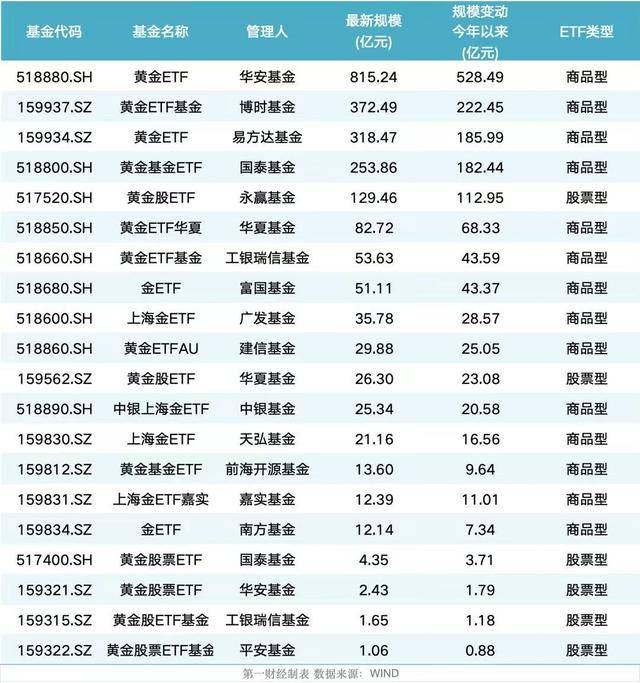
税收新政鼓励场内交易 黄金ETF又要“火”了?
Sou Hu Cai Jing· 2025-11-05 00:16
黄金税收新政备受关注,普通投资者将受到哪些影响? 在受访人士看来,此次税收新政进一步明确了"场内交易"与"场外交易"、"投资性黄金"与"非投资性黄 金"的增值税征收规则,总体更鼓励场内黄金交易。尤其对于黄金投资参与者,考虑到黄金饰品、部分 投资金条等面临成本上升,场内非实物投资将有效降低税负。 在此背景下,黄金ETF吸引力预计还将提升,不少机构判断未来会有更多投资需求转向此类投资工具。 世界黄金协会数据显示,三季度全球黄金需求刷新历史纪录,投资者对实物黄金ETF的持续追捧是重要 驱动力。 从国内黄金ETF来看,随着申购增加和净值抬升,挂钩SGE黄金9999和上海金现货价格的商品型黄金 ETF年内规模激增,目前总规模已接近2100亿元。 投资金条方面,上述报告称,由于非两大交易所会员的采购成本提升(只能享受6%的抵扣,采购成本 提高7%),相关成本会变相转嫁给消费者。"即便是银行等正规渠道购买金条,目前也只能开具普票 (普票不能抵扣),对于投资金条财富增值的消费者而言,出售时或将面临回收渠道的压价。"该报告 认为。 日前,多家银行暂停或调整了黄金积存及实物金兑换、购买等业务,部分银行则将部分自营黄金产品调 整为 ...

丰富要素、精细操作 公募业绩比较基准升级进行时
Zhong Guo Zheng Quan Bao· 2025-11-04 23:35
近日,中国证监会发布《公开募集证券投资基金业绩比较基准指引(征求意见稿)》,中国证券投资基金 业协会也同步发布了《公开募集证券投资基金业绩比较基准操作细则(征求意见稿)》,向社会公开征求 意见。业内人士预计,后续公募基金行业会迎来广泛而深远的基准变更潮。 实际上,今年以来大量公募基金已聚焦于基金业绩比较基准升级,新发基金以及调整后的存量产品基准 要素更加精细也更丰富,更能表征基金实际的投资策略和风险收益特征。 主动校准以适配实际运作 从近期发行的新基金来看,业绩比较基准要素进一步丰富,并更聚焦所投资的资产特征。例如,即将在 11月中旬开启首发的财通泰和多资产一年持有期FOF,在业绩比较基准中纳入了多种要素,包括中债综 合指数、中证800指数、恒生指数、标普500指数、南华商品期货指数、银行活期存款利率等。 同样是将在11月中旬发售的建信红利严选混合,作为一只聚焦于高分红股票的主动量化权益基金,业绩 比较基准综合参考了中证红利指数、中证港股通高股息投资指数、中债综合全价(总值)指数和商业银行 活期存款利率。 不仅新发行的基金在业绩比较基准设置上更具针对性,今年以来,还有不少基金公司主动对存量产品变 更业绩比较基 ...
丰富要素 精细操作 公募业绩比较基准升级进行时
Zhong Guo Zheng Quan Bao· 2025-11-04 20:36
近日,中国证监会发布《公开募集证券投资基金业绩比较基准指引(征求意见稿)》,中国证券投资基 金业协会也同步发布了《公开募集证券投资基金业绩比较基准操作细则(征求意见稿)》,向社会公开 征求意见。业内人士预计,后续公募基金行业会迎来广泛而深远的基准变更潮。 实际上,今年以来大量公募基金已聚焦于基金业绩比较基准升级,新发基金以及调整后的存量产品基准 要素更加精细也更丰富,更能表征基金实际的投资策略和风险收益特征。 ● 本报记者 张舒琳 主动校准以适配实际运作 从近期发行的新基金来看,业绩比较基准要素进一步丰富,并更聚焦所投资的资产特征。例如,即将在 11月中旬开启首发的财通泰和多资产一年持有期FOF,在业绩比较基准中纳入了多种要素,包括中债综 合指数、中证800指数、恒生指数、标普500指数、南华商品期货指数、银行活期存款利率等。 同样是将在11月中旬发售的建信红利严选混合,作为一只聚焦于高分红股票的主动量化权益基金,业绩 比较基准综合参考了中证红利指数、中证港股通高股息投资指数、中债综合全价(总值)指数和商业银 行活期存款利率。 不仅新发行的基金在业绩比较基准设置上更具针对性,今年以来,还有不少基金公司主动对存 ...
丰富要素 精细操作公募业绩比较基准升级进行时
Zhong Guo Zheng Quan Bao· 2025-11-04 20:17
近日,中国证监会发布《公开募集证券投资基金业绩比较基准指引(征求意见稿)》,中国证券投资基 金业协会也同步发布了《公开募集证券投资基金业绩比较基准操作细则(征求意见稿)》,向社会公开 征求意见。业内人士预计,后续公募基金行业会迎来广泛而深远的基准变更潮。 实际上,今年以来大量公募基金已聚焦于基金业绩比较基准升级,新发基金以及调整后的存量产品基准 要素更加精细也更丰富,更能表征基金实际的投资策略和风险收益特征。 ● 本报记者 张舒琳 主动校准以适配实际运作 从近期发行的新基金来看,业绩比较基准要素进一步丰富,并更聚焦所投资的资产特征。例如,即将在 11月中旬开启首发的财通泰和多资产一年持有期FOF,在业绩比较基准中纳入了多种要素,包括中债综 合指数、中证800指数、恒生指数、标普500指数、南华商品期货指数、银行活期存款利率等。 同样是将在11月中旬发售的建信红利严选混合,作为一只聚焦于高分红股票的主动量化权益基金,业绩 比较基准综合参考了中证红利指数、中证港股通高股息投资指数、中债综合全价(总值)指数和商业银 行活期存款利率。 还有部分持有商品ETF的基金,调整后的业绩比较基准针对性地纳入了商品期货相关指数, ...
黄金ETF又要“火”了?
第一财经· 2025-11-04 14:27
2025.11. 04 本文字数:2562,阅读时长大约5分钟 作者 | 第一财经 亓宁 封图 | AI生成 黄金税收新政备受关注,普通投资者将受到哪些影响? 在受访人士看来,此次税收新政进一步明确了"场内交易"与"场外交易"、"投资性黄金"与"非投资性 黄金"的增值税征收规则,总体更鼓励场内黄金交易。尤其对于黄金投资参与者,考虑到黄金饰品、 部分投资金条等面临成本上升,场内非实物投资将有效降低税负。 在此背景下,黄金ETF吸引力预计还将提升,不少机构判断未来会有更多投资需求转向此类投资工 具。世界黄金协会数据显示,三季度全球黄金需求刷新历史纪录,投资者对实物黄金ETF的持续追捧 是重要驱动力。 从国内黄金ETF来看,随着申购增加和净值抬升,挂钩SGE黄金9999和上海金现货价格的商品型黄 金ETF年内规模激增,目前总规模已接近2100亿元。 税收新政如何影响投资 财政部、国家税务总局近日发布的《关于黄金有关税收政策的公告》于11月1日起实施。 根据文件规定,在2027年12月31日前,会员单位或客户通过上海黄金交易所、上海期货交易所交易 标准黄金,卖出方会员单位或客户销售标准黄金时,免征增值税。未发生实物交 ...

微盘股指数周报:微盘股高位盘整,增长逻辑未改变-20251103
China Post Securities· 2025-11-03 12:54
- Model Name: Diffusion Index Model - Model Construction Idea: The model uses the diffusion index to monitor the critical point of future changes in the diffusion index[6][38] - Detailed Construction Process: The model uses the following formula to calculate the diffusion index: $$ \text{Diffusion Index} = \frac{\text{Number of Advancing Stocks}}{\text{Total Number of Stocks}} $$ The model monitors the critical point of future changes in the diffusion index by observing the values of the diffusion index at different time points[38][39] - Model Evaluation: The model is effective in predicting the high volatility of the micro-cap index in the coming week[39] - Testing Results: The current value of the diffusion index is 0.78, indicating a relatively high level[39] - Model Name: Initial Threshold Method (Left-Side Trading) - Model Construction Idea: The model triggers an opening signal when the diffusion index reaches a certain threshold[6][42] - Detailed Construction Process: The model uses the following formula to calculate the threshold: $$ \text{Threshold} = \text{Diffusion Index} \times \text{Historical Average} $$ The model triggered an opening signal on September 23, 2025, when the diffusion index reached 0.0575[42] - Model Evaluation: The model is effective in providing timely trading signals[42] - Testing Results: The model triggered an opening signal on September 23, 2025[42] - Model Name: Delayed Threshold Method (Right-Side Trading) - Model Construction Idea: The model provides an opening signal when the diffusion index reaches a delayed threshold[6][45] - Detailed Construction Process: The model uses the following formula to calculate the delayed threshold: $$ \text{Delayed Threshold} = \text{Diffusion Index} \times \text{Historical Average} + \text{Delay Factor} $$ The model provided an opening signal on September 25, 2025, when the diffusion index reached 0.1825[45] - Model Evaluation: The model is effective in providing delayed but accurate trading signals[45] - Testing Results: The model provided an opening signal on September 25, 2025[45] - Model Name: Dual Moving Average Method (Adaptive Trading) - Model Construction Idea: The model uses dual moving averages to provide trading signals[6][46] - Detailed Construction Process: The model uses the following formula to calculate the dual moving averages: $$ \text{Short-Term Moving Average} = \frac{\sum_{i=1}^{n} \text{Price}_i}{n} $$ $$ \text{Long-Term Moving Average} = \frac{\sum_{i=1}^{m} \text{Price}_i}{m} $$ The model provided a bullish signal on October 13, 2025, when the short-term moving average crossed above the long-term moving average[46] - Model Evaluation: The model is effective in providing adaptive trading signals based on market trends[46] - Testing Results: The model provided a bullish signal on October 13, 2025[46] Factor Construction and Performance - Factor Name: Dividend Yield Factor - Factor Construction Idea: The factor ranks stocks based on their dividend yield[5][16] - Detailed Construction Process: The factor uses the following formula to calculate the dividend yield: $$ \text{Dividend Yield} = \frac{\text{Annual Dividends}}{\text{Stock Price}} $$ The factor ranks stocks from highest to lowest dividend yield[16] - Factor Evaluation: The factor is effective in identifying high-yield stocks[16] - Testing Results: The factor's rank IC for the week is 0.199, with a historical average of 0.022[16] - Factor Name: PB Inverse Factor - Factor Construction Idea: The factor ranks stocks based on the inverse of their price-to-book ratio[5][16] - Detailed Construction Process: The factor uses the following formula to calculate the inverse PB ratio: $$ \text{PB Inverse} = \frac{1}{\text{Price-to-Book Ratio}} $$ The factor ranks stocks from highest to lowest PB inverse[16] - Factor Evaluation: The factor is effective in identifying undervalued stocks[16] - Testing Results: The factor's rank IC for the week is 0.112, with a historical average of 0.034[16] - Factor Name: Illiquidity Factor - Factor Construction Idea: The factor ranks stocks based on their illiquidity[5][16] - Detailed Construction Process: The factor uses the following formula to calculate illiquidity: $$ \text{Illiquidity} = \frac{\text{Absolute Return}}{\text{Trading Volume}} $$ The factor ranks stocks from highest to lowest illiquidity[16] - Factor Evaluation: The factor is effective in identifying illiquid stocks[16] - Testing Results: The factor's rank IC for the week is 0.103, with a historical average of 0.04[16] - Factor Name: Growth Factor - Factor Construction Idea: The factor ranks stocks based on their growth potential[5][16] - Detailed Construction Process: The factor uses the following formula to calculate growth: $$ \text{Growth} = \frac{\text{Current Period Earnings}}{\text{Previous Period Earnings}} - 1 $$ The factor ranks stocks from highest to lowest growth[16] - Factor Evaluation: The factor is effective in identifying high-growth stocks[16] - Testing Results: The factor's rank IC for the week is 0.019, with a historical average of -0.003[16] - Factor Name: Residual Volatility Factor - Factor Construction Idea: The factor ranks stocks based on their residual volatility[5][16] - Detailed Construction Process: The factor uses the following formula to calculate residual volatility: $$ \text{Residual Volatility} = \sqrt{\frac{\sum_{i=1}^{n} (\text{Return}_i - \text{Expected Return})^2}{n}} $$ The factor ranks stocks from highest to lowest residual volatility[16] - Factor Evaluation: The factor is effective in identifying stocks with high residual volatility[16] - Testing Results: The factor's rank IC for the week is 0.015, with a historical average of -0.039[16] Factor Backtesting Results - Dividend Yield Factor: Rank IC for the week is 0.199, historical average is 0.022[16] - PB Inverse Factor: Rank IC for the week is 0.112, historical average is 0.034[16] - Illiquidity Factor: Rank IC for the week is 0.103, historical average is 0.04[16] - Growth Factor: Rank IC for the week is 0.019, historical average is -0.003[16] - Residual Volatility Factor: Rank IC for the week is 0.015, historical average is -0.039[16]