美年健康

Search documents
美年健康:收到深交所中止审核发行股份购买资产暨关联交易通知
Xin Lang Cai Jing· 2026-01-05 11:18
美年健康公告,公司于2025年12月31日收到深圳证券交易所的通知,因公司本次交易申请文件中记载的 财务资料已过有效期,需要补充提交,按照《深圳证券交易所上市公司重大资产重组审核规则》的相关 规定,深交所对公司本次交易中止审核。 ...

牙科医疗概念上涨4.97% 6股主力资金净流入超3000万元
Zheng Quan Shi Bao Wang· 2026-01-05 09:19
Group 1 - The dental medical concept sector rose by 4.97%, ranking fifth among concept sectors, with 25 stocks increasing, including Maipu Medical, Kangtuo Medical, and Lepu Medical, which hit the 20% limit up [1] - The leading gainers in the dental medical sector included Chunli Medical, Haili Biological, and Yirui Technology, which rose by 8.87%, 7.87%, and 6.51% respectively [1] - The stocks with the largest declines were Langzi Co., Weihong Co., and Dongfang Precision, which fell by 0.98%, 0.98%, and 0.83% respectively [1] Group 2 - The dental medical concept sector saw a net inflow of 666 million yuan, with 18 stocks receiving net inflows, and 6 stocks attracting over 30 million yuan in net inflows [2] - Lepu Medical led the net inflow with 485 million yuan, followed by Yinbang Co., Meinian Health, and Haili Biological, which had net inflows of 123 million yuan, 63.16 million yuan, and 46.79 million yuan respectively [2] - The net inflow ratios for Lepu Medical, Haili Biological, and Kangtuo Medical were 18.55%, 15.49%, and 14.12% respectively [3] Group 3 - The top stocks in the dental medical sector based on net inflow included Lepu Medical, Yinbang Co., Meinian Health, and Haili Biological, with respective daily price changes of 19.99%, 4.45%, 3.41%, and 7.87% [3][4] - The trading turnover rates for these stocks were 9.07%, 21.43%, 7.16%, and 7.11% respectively [3][4] - Other notable stocks included Maipu Medical with a 20% increase and a turnover rate of 6.51% [4]


牙科医疗概念上涨4.97%,6股主力资金净流入超3000万元
Sou Hu Cai Jing· 2026-01-05 09:18
Core Insights - The dental medical concept sector rose by 4.97%, ranking fifth among concept sectors, with 25 stocks increasing in value, including Maipu Medical, Kangtuo Medical, and Lepu Medical, which hit the 20% limit up [1][2] - The leading gainers in the sector included Chunli Medical, Haili Biological, and Yirui Technology, with increases of 8.87%, 7.87%, and 6.51% respectively [1][2] - The sector experienced a net inflow of 666 million yuan from main funds, with 18 stocks receiving net inflows, and 6 stocks seeing inflows exceeding 30 million yuan [2][3] Sector Performance - The dental medical sector was among the top performers, with a daily increase of 4.97%, while other sectors like brain-machine interface and hyperbaric oxygen chambers saw gains of 13.70% and 7.01% respectively [2] - The main funds' net inflow into the dental medical sector was 666 million yuan, with Lepu Medical leading the inflow at 485 million yuan [2][3] Stock Highlights - Lepu Medical had a net inflow rate of 18.55%, with a daily increase of 19.99% and a turnover rate of 9.07% [3] - Other notable stocks included Haili Biological with a net inflow rate of 15.49% and a daily increase of 7.87%, and Kangtuo Medical with a net inflow rate of 14.12% and a daily increase of 19.99% [3][4] - Stocks like Maipu Medical and Chunli Medical also performed well, with increases of 20% and 8.87% respectively [1][3]
医疗服务板块1月5日涨4.77%,三博脑科领涨,主力资金净流入10.28亿元
Zheng Xing Xing Ye Ri Bao· 2026-01-05 09:09
Core Insights - The medical services sector experienced a significant increase of 4.77% on January 5, with Sanbo Brain Science leading the gains [1] - The Shanghai Composite Index closed at 4023.42, up 1.38%, while the Shenzhen Component Index closed at 13828.63, up 2.24% [1] Medical Services Sector Performance - Sanbo Brain Science (301293) closed at 70.78, with a rise of 20.01% and a trading volume of 106,700 shares, amounting to a transaction value of 755 million [1] - Likang Life (300143) saw a closing price of 11.38, increasing by 15.18% with a trading volume of 473,200 shares, totaling 518 million [1] - Chengdu Xian Dao (688222) closed at 26.14, up 11.47%, with a trading volume of 277,100 shares, resulting in a transaction value of 704 million [1] - Other notable performers include She Nei Medical (301060) at 10.20 (+10.27%), International Medical (000516) at 4.72 (+10.02%), and Zhaoyan New Drug (603127) at 38.51 (+10.00%) [1] Capital Flow Analysis - The medical services sector saw a net inflow of 1.028 billion from institutional investors, while retail investors contributed a net inflow of 174 million [2] - Notable net inflows from institutional investors include Zhaoyan New Drug (603127) with 235 million and Sanbo Brain Science (301293) with 214 million [3] - Conversely, retail investors showed significant outflows from several stocks, including Sanbo Brain Science (301293) with a net outflow of 136 million and Likang Life (300143) with 27.9 million [3]






2025年中国健康服务行业发展历程、政策、发展现状、重点企业及趋势研判:健康服务业态日趋多元,精准化与个性化服务成为未来发展核心方向[图]
Chan Ye Xin Xi Wang· 2026-01-01 03:22
Core Insights - The health service industry aims to create a favorable organizational environment by providing safe, effective, convenient, and affordable basic medical and public health services to meet various health needs of residents. The demand for health-related products and services is rapidly increasing due to social progress and changes in lifestyle [1][7]. Industry Overview - The health service industry encompasses medical services, health management, health insurance, and related services, involving pharmaceuticals, medical devices, health products, and fitness products [4]. - The industry has experienced rapid growth in China, with the market size increasing from 6.37 trillion yuan in 2018 to an expected 9.55 trillion yuan by 2024, representing a compound annual growth rate of 6.98%. The "Healthy China 2030" plan projects the total market size to reach 16 trillion yuan by 2030, indicating significant growth potential [1][8]. Development History - The development of China's health service industry can be divided into four stages: 1. 1949-1990: Health check-ups were primarily hospital services focused on disease detection rather than prevention. 2. 1991-2000: Independent health check-up service institutions began to emerge in cities like Beijing. 3. 2001-2010: The introduction of Western health service concepts and rapid market demand growth led to the fast development of health service institutions. 4. 2011-present: Increased focus on medical information technology and service upgrades has improved the capabilities of health service institutions [4][5]. Relevant Policies - Recent government policies aim to optimize resource allocation, enhance preventive interventions, and improve service accessibility, which helps control the rapid growth of medical costs and reduce the disease burden on families and society. For instance, the National Health Commission issued a notice in February 2025 to address public health concerns and improve service efficiency [6]. Industry Structure and Key Companies - The operational models of health service institutions in China are diverse, including: 1. Hospital-based models leveraging brand and client resources. 2. Independent medical models with self-owned brands and facilities. 3. Health management models centered on health check-ups. 4. Comprehensive information platform models connecting online and offline services [8]. - Major companies in the health service industry include: - Meinian Health Industry Holdings Co., Ltd. - Tongce Medical Co., Ltd. - Ruici Medical Service Holdings Co., Ltd. - Ciming Health Checkup Management Group Co., Ltd. - Aikang Guobin Health Checkup Management Group Co., Ltd. [2][3][9]. Trends in Health Services - The future of health services will focus on personalized and precise care, moving from a "one-size-fits-all" approach to individualized health management based on personal data [11]. - Service delivery will become decentralized, extending beyond traditional healthcare facilities to community and home settings, enhancing accessibility and convenience [12]. - Payment models will evolve from fee-for-service to value-based care, with insurance companies and service providers collaborating to create innovative health products [13].




健康消费的进击与融合
Zhong Guo Jing Ying Bao· 2025-12-31 15:14
Core Insights - The Chinese health consumption market is undergoing a significant transformation, shifting from "wild growth" to "meticulous cultivation," with competition evolving into an ecosystem-based contest [1][2] - The health management market in China is projected to exceed 850 billion yuan in 2024, with a compound annual growth rate of 21.3%, expected to surpass 2.3 trillion yuan by 2030 [2] - The rise of rational consumption, particularly among younger consumers, emphasizes the importance of product transparency and scientific communication [3] Industry Trends - The traditional model of health services is being replaced by a comprehensive health management approach, focusing on the entire lifecycle of health rather than one-time services [4] - Companies are increasingly adopting integrated health solutions that combine products and services, moving away from merely selling individual items [3][4] Company Strategies - Minsheng Health is pursuing a diversified expansion strategy, targeting various segments within the health sector, including nutritional supplements and medical aesthetics [6] - In contrast, Meinian Health is focusing on deep specialization in preventive medicine, establishing a clear brand hierarchy to serve different market segments [6] - Both companies are building health management ecosystems, with Meinian leveraging its extensive health data for AI development and personalized health management [7] - Minsheng Health emphasizes collaboration across the supply chain, particularly in the probiotics sector, to enhance product quality and technological competitiveness [8]
医药生物行业资金流出榜:药明康德、迈瑞医疗等净流出资金居前
Zheng Quan Shi Bao Wang· 2025-12-31 09:19
Market Overview - The Shanghai Composite Index rose by 0.09% on December 31, with 15 industries experiencing gains, led by defense and military industry at 2.13% and media at 1.54% [1] - The communication and agriculture, forestry, animal husbandry, and fishery sectors saw the largest declines, down 1.35% and 1.10% respectively [1] - The pharmaceutical and biotechnology sector fell by 0.45% [1] Capital Flow Analysis - The main capital outflow from the two markets totaled 32.27 billion yuan, with 9 industries seeing net inflows [1] - The defense and military industry had the highest net inflow of 6.06 billion yuan, followed by the media sector with 4.45 billion yuan [1] - A total of 22 industries experienced net capital outflows, with the electronics sector leading at 11.20 billion yuan, followed by the power equipment sector at 7.25 billion yuan [1] Pharmaceutical and Biotechnology Sector - The pharmaceutical and biotechnology sector saw a net outflow of 3.54 billion yuan, with 178 of the 478 stocks in the sector rising and 276 falling, including one stock hitting the daily limit down [2] - The top three stocks with net inflows in this sector were Meinian Health (84.95 million yuan), Huaren Health (75.69 million yuan), and Xingqi Eye Medicine (64.86 million yuan) [2] - The stocks with the largest net outflows included WuXi AppTec (468.14 million yuan), Mindray Medical (321.35 million yuan), and Hefei China (276.65 million yuan) [3]

美年健康股价涨1.16%,南方基金旗下1只基金位居十大流通股东,持有4563.4万股浮盈赚取273.8万元
Xin Lang Cai Jing· 2025-12-31 02:17
Group 1 - The core viewpoint of the news is that Meinian Health has shown a positive stock performance, with a 1.16% increase in share price, reaching 5.23 yuan per share, and a total market capitalization of 20.472 billion yuan as of December 31 [1] - Meinian Health, established on January 22, 1991, and listed on May 18, 2005, primarily engages in health check-ups and health management services, with 95.67% of its revenue coming from health check-up services and 4.33% from other services [1] Group 2 - Among the top circulating shareholders of Meinian Health, the Southern Fund's Southern CSI 500 ETF (510500) has entered the top ten shareholders in the third quarter, holding 45.634 million shares, which accounts for 1.18% of the circulating shares [2] - The Southern CSI 500 ETF has achieved a year-to-date return of 32.53% and a one-year return of 28.64%, ranking 1569 out of 4189 and 1677 out of 4188 respectively in its category [2] Group 3 - The fund manager of Southern CSI 500 ETF is Luo Wenjie, who has a tenure of 12 years and 257 days, with the fund's total asset size at 170.251 billion yuan [3] - During his tenure, the best fund return achieved was 155.46%, while the worst return was -47.6% [3]
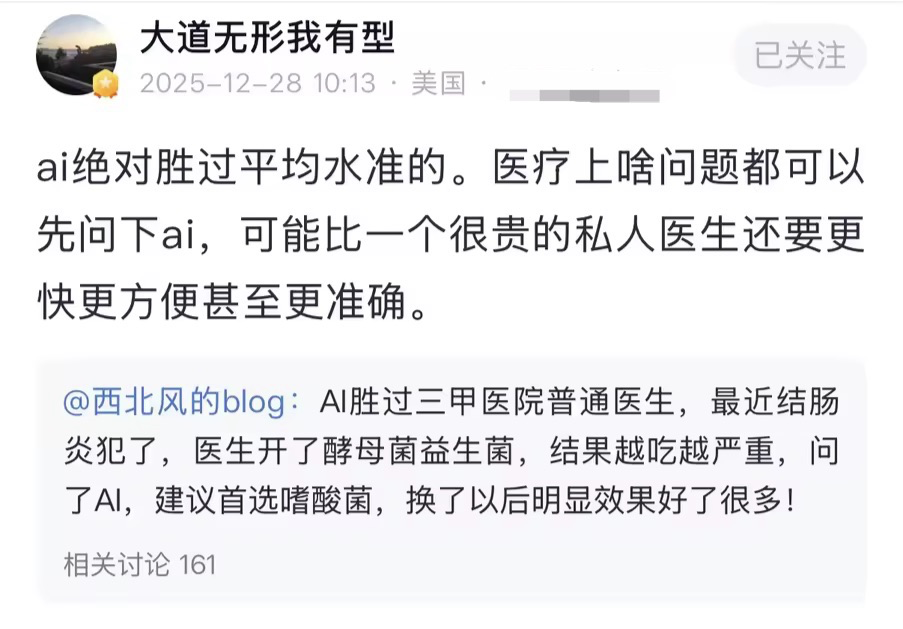
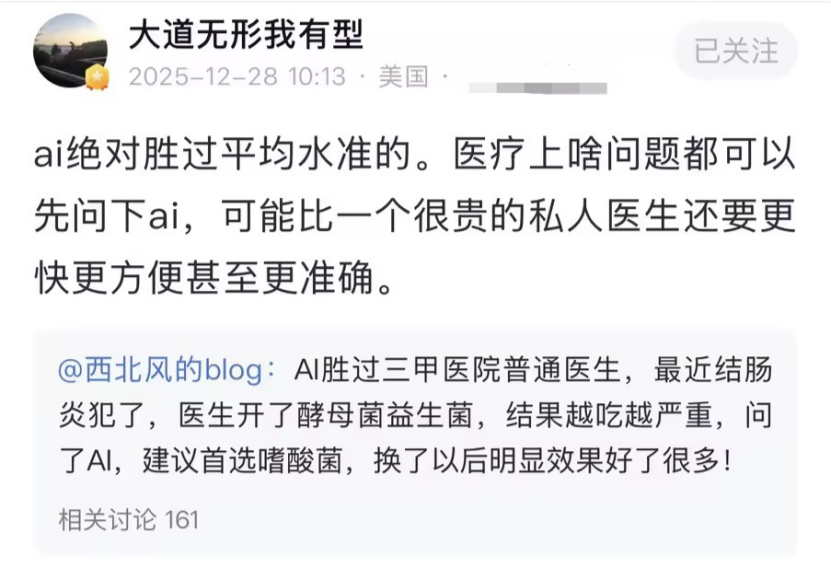
顶级投资人段永平看好AI医疗 称AI已超三甲医院普通医生平均水平
Shang Hai Zheng Quan Bao· 2025-12-30 14:56
Group 1 - The discussion on "AI surpassing ordinary doctors in top-tier hospitals" has garnered significant attention in the investment community, with notable investor Duan Yongping commenting that AI is likely to be faster, more convenient, and even more accurate than expensive private doctors [1][3] - The AI healthcare sector is experiencing a surge in interest, particularly highlighted by the rapid popularity of consumer-level applications, such as Ant Group's AI health app "Antifufu," which has reached the top of the Apple App Store's free download chart and processes 5 million health inquiries daily [3][6] - The capital market's enthusiasm for the AI healthcare sector has been ignited, with the Wind AI healthcare theme index rising for several consecutive trading days following the product upgrade of "Antifufu," leading to active stock performance among related listed companies, including Meinian Health, Huaren Health, Weining Health, and Yuyue Medical [6] Group 2 - The aging population and increasing life expectancy are driving the demand for health-related AI applications, revealing a widespread market need for health solutions [6] - The current trajectory of AI healthcare is expanding from single products to a full diagnostic and treatment chain, with applications extending from core hospitals to grassroots healthcare and personalized health management [6] - The integration of "artificial intelligence + healthcare" is expected to deepen under supportive policies and the development of new productive forces, opening up broader opportunities for industry growth [6]
AI超过普通医生平均水平?大咖齐发声,机构密集调研医疗AI
Mei Ri Jing Ji Xin Wen· 2025-12-30 13:18
Core Viewpoint - The rise of AI applications in healthcare, particularly the "Ant Fortune" app, is expected to significantly impact the market, with predictions that next year could be a pivotal year for AI applications in this sector [2][6]. Group 1: AI in Healthcare Applications - The "Ant Fortune" app has gained remarkable traction, reaching the second position on the Apple App Store's free chart after a surge in downloads following its latest release [6]. - AI is increasingly being utilized as a "super assistant" for doctors, enhancing diagnostic completeness by allowing physicians to consult the app during patient evaluations [10][8]. - The healthcare sector is showing a positive response to AI technology, with the "Ant Fortune" app providing a "famous doctor AI avatar" feature, which has already answered over 27 million health inquiries [18]. Group 2: Market Response and Investment Trends - The healthcare sector has seen a strong performance in the stock market, with AI healthcare concept stocks like Meian Health and Weining Health experiencing significant gains [11]. - Investment interest is growing, with investors actively inquiring about potential collaborations with the "Ant Fortune" app and urging companies to capitalize on industry trends [15]. - Analysts suggest that AI healthcare is transitioning from thematic investment to a growth track supported by real performance metrics [11]. Group 3: Policy Support and Industry Standards - The government has expressed clear support for the integration of AI in healthcare, identifying it as a key direction for cultivating new productive forces by 2025 [17]. - The establishment of industry standards is crucial for the development of AI in healthcare, with the first AI doctor standard in the surgical field recently released by Peking University People's Hospital in collaboration with Ant Health [22].