Neuralink

Search documents
美好医疗20260106
2026-01-07 03:05
Summary of the Conference Call for Meihow Medical Company Overview - Meihow Medical focuses on medical device CDMO, covering areas such as respiratory care, cochlear implants, blood glucose management, and cardiovascular surgical interventions, with full-process production capabilities and relevant qualifications [2][3] Key Business Segments - The company has made significant progress in cochlear implants, utilizing a sound processor to convert external sounds into multiple frequency bands, transmitted to the inner ear via platinum wires, with a unit price of approximately $1,000 and a gross margin of 60%-70% [2][6] - Meihow Medical is developing implantable brain-machine interface (BMI) devices, leveraging its cochlear implant experience, with expected gross margins similar to cochlear implants once mass production begins [2][7] Brain-Machine Interface Technology - BMI technology is categorized into output, input, and interactive types, with applications in medical rehabilitation, mental health, education, and entertainment [4][5] - The company anticipates BMI new business revenue to reach millions to tens of millions of RMB by 2025, with potential for significant growth in 2026 [4][16] Market Outlook - In 2026, Meihow Medical expects a recovery in its main business, with double-digit growth in home respiratory devices and cochlear implants, and above-average growth in blood glucose and consumer segments [4][22] - The company’s BMI products are still in the early industrial stage, with current revenue from cochlear implants around 100 million RMB, 50% of which comes from invasive electrode pieces [15] Collaboration and Client Relationships - 90% of Meihow Medical's business comes from overseas exports, with collaborations with leading companies in the BMI field [17][18] - The company has established a strong reputation due to its long-term experience in processing Class III materials, which is a key consideration for clients when selecting suppliers [19] Challenges and Innovations - Long-term implant technology is a complex system engineering challenge, requiring integration of process technology to ensure stability under long-term conditions [21] - The company is also exploring semi-invasive and non-invasive products, aiming to enhance the effectiveness of non-invasive devices through invasive technology [12][13] Future Developments - Meihow Medical is expanding into humanoid robotics, leveraging existing technologies and planning to fill production capacity in emerging consumer electronics markets [25] - The company’s Malaysian factory is expected to stabilize profit margins and net profits as production scales up [24] Conclusion - Overall, Meihow Medical is positioned for growth in the medical device sector, particularly in cochlear implants and brain-machine interfaces, with a strong focus on innovation and collaboration with industry leaders [2][4][16]
心玮医疗20260106
2026-01-07 03:05
Summary of the Conference Call for Xinwei Medical Company Overview - **Company**: Xinwei Medical - **Industry**: Brain-Computer Interface (BCI) and Medical Devices Key Points and Arguments Industry and Product Development - Xinwei Medical's BCI technology utilizes an interventional approach, collecting motor cortex signals via internal jugular vein puncture, offering advantages such as minimally invasive procedures, high safety, and strong signal strength comparable to semi-invasive methods [2][3][4] - The BCI product is nearing finalization, with plans for human trials to begin in the second half of 2026, in collaboration with leading hospitals [2][4] - Initial indications for the BCI target patients with upper limb function loss post-stroke, with future plans to expand to ALS and paralysis patients [2][15] Financial Projections - Xinwei Medical anticipates over 400 million CNY in revenue for 2025, with profits between 70 million to 80 million CNY, and a projected revenue growth rate of approximately 35% for 2026 [2][19] - The company expects significant growth in its ischemic thrombectomy balloon catheter segment, with a doubling in revenue, and over 60 million CNY from hemorrhagic aneurysm assist stents [19] Clinical and Regulatory Insights - The company plans to complete preclinical testing and additional animal studies by mid-2026, aiming for human trials by late 2026 [4][6] - Xinwei Medical has received certification for its AI BCI project from the Ministry of Industry and Information Technology, with plans to complete registration by 2028 [4][14] Competitive Landscape - The company’s interventional BCI surgery is similar to traditional stroke surgeries, allowing for a quick learning curve for physicians, with an estimated procedure time of about 30 minutes [16] - Compared to competitors like Neuralink, Xinwei Medical's approach is less invasive and offers a more straightforward operational pathway [5][17] Market Position and Future Outlook - Xinwei Medical is preparing for an IPO application on the A-share Sci-Tech Innovation Board by March 2025, with expectations to complete the review within 6-12 months [3][23] - The company aims to maintain a gross margin of 65%-70% in 2026, with a gradual increase in net profit margin from 15% in 2025 to 25% in the future [19][26] Research and Development Focus - The company is focused on developing a complete product chain in the cerebrovascular field, emphasizing preventive, therapeutic, and rehabilitative products [8] - Xinwei Medical plans to establish a dedicated company for BCI projects to enhance development in this promising field [27] Cost Management - Sales expenses are projected to decrease from 28% to 21%-22% in 2025, with R&D expenses maintained at 9%-10% of revenue [26] Regulatory Environment - The approval process for BCIs is currently evolving, with an expected review period of 9-10 months under the fast-track system [13] Conclusion - Xinwei Medical is positioned to become a leader in the BCI market with a strong focus on innovation, regulatory compliance, and strategic partnerships, aiming for significant growth in the coming years [27]
脑机接口产业更新及重点标的推荐
2026-01-07 03:05
Q&A 脑机接口产业目前的市场行情如何?有哪些关键因素推动了这一领域的发展? 最近脑机接口市场行情非常火爆,主要是由于国内出台了利好政策,以及马斯 克在社交媒体上表示 Neuralink 将在 2026 年大规模生产脑机接口设备。这些 因素共同引爆了整个板块的情绪。脑机接口产业的发展关键在于快速商业化落 地,尤其是在非侵入式领域,企业需要具备强大的销售渠道能力、品牌力以及 与原有医疗业务的协同效应,以促进商业化落地速度和后续发展。 脑机接口产业更新及重点标的推荐 20260106 摘要 脑机接口产业正快速发展,商业化落地是关键,尤其在非侵入式领域, 企业需具备强大的销售渠道、品牌力及与原有医疗业务的协同效应,以 加速商业化进程。预计到 2025 年全球市场规模将达 30 亿美元,医疗 端应用将在 2030 年超过 400 亿美元。 脑机接口技术路径包括侵入式、半侵入式和非侵入式。侵入式信号质量 高但风险大,适用于重症患者;非侵入式安全性高,商业化快但竞争激 烈;半侵入式介于两者之间。美国企业多布局半侵入式,中国企业则以 非侵入式为主。 Neuralink 在侵入式脑机接口领域领先,已完成约 20 例人体植入, ...
脑机接口专家会议
2026-01-07 03:05
Summary of Neural Interface Technology Conference Industry Overview - The conference focused on the neural interface technology industry, particularly advancements made by Neuralink and domestic companies in China [1][3][4][5][10]. Key Points and Arguments Neuralink's Advancements - Neuralink has significantly reduced the cost of implantable devices, with fixture costs dropping by 95%, from approximately $5,000-$6,000 to a few hundred dollars [1][3][4]. - The electrode production cost remains high, at over $10,000 per electrode, but the implantation speed has improved from 20 seconds to 1.5 seconds per electrode, facilitating clinical applications [1][3][4]. - The company has entered clinical trials, utilizing BlackRock electrodes and developing its own implantation devices that combine electron microscopy and OCR systems for precise electrode placement [1][8][9]. Challenges in Neural Interface Technology - The industry faces challenges such as complex electrode production processes, low yield rates, and patent barriers, particularly regarding non-invasive puncture techniques patented by Musk [1][5][6]. - Domestic companies need breakthroughs in materials, processes, and patent strategies to compete effectively [1][5]. Comparison of Invasive and Semi-Invasive Techniques - Neuralink's fully invasive technology targets complex diseases, while domestic companies like BoruiKang focus on semi-invasive methods primarily for rehabilitation, which are less risky and costly [1][7][10]. - The main difference lies in the application: fully invasive techniques aim to treat severe conditions through deep neural stimulation, whereas semi-invasive methods are used for rehabilitation by repairing damaged nerves [1][7]. Domestic Industry Landscape - Domestic companies such as JieTi, Tiger Technology, and WeiLing have made progress in flexible electrodes but still lag behind international leaders like Neuralink in terms of channel count (128 channels vs. Neuralink's 1,024 channels) and other technical specifications [1][10]. - The downstream applications of the domestic neural interface industry account for 70% of the market share, focusing on rehabilitation devices and commercial products, while upstream investments in electrode and chip development are capital-intensive [1][10]. Clinical Applications and Future Directions - BoruiKang's semi-quantitative methods have been widely adopted in over 20 hospitals in China, with more than 200 clinical trials conducted in 2024 [12]. - The potential for interventionist neural interfaces is highlighted, with successful trials indicating a promising future if challenges like vascular blockage can be addressed [2][16]. Competitive Landscape - Companies like Medtronic have received FDA approval for their brain stimulators, showing significant efficacy in treating conditions like epilepsy, while competitors like Pinchi Medical face challenges due to patent restrictions [14][25]. - The market for deep brain stimulation (DBS) devices is still developing, with no fully mature embedded products available yet [25]. Additional Important Insights - The domestic neural interface industry is characterized by a high investment threshold in the upstream sector, with a typical investment ratio of 3:1 or 4:1 favoring downstream applications [10]. - The technology's application in treating neurological diseases is expanding, with potential uses in conditions like Alzheimer's and depression through adaptive neural regulation [19]. This summary encapsulates the key discussions and insights from the neural interface technology conference, highlighting both advancements and challenges within the industry.
脑机接口,突传重磅!
Zheng Quan Shi Bao· 2026-01-07 03:00
Core Insights - The brain-computer interface (BCI) sector is experiencing significant growth, highlighted by the recent completion of approximately 2 billion yuan financing by Qiangnao Technology, marking it as the second-largest financing in the field globally, after Neuralink [1][2] Industry Overview - The BCI sector has become the hottest investment track in the A-share market since the beginning of 2026, with multiple stocks such as Innovation Medical, Aipeng Medical, and Xiangyu Medical achieving consecutive trading limits [1] - The industry is currently driven by both policy support and technological breakthroughs, with expectations for Neuralink's large-scale production and automated surgical solutions marking a transition from clinical validation to commercial viability [3] Company Highlights - Qiangnao Technology, founded in February 2015, focuses on non-invasive BCI technology and has received FDA and CE certifications, making it one of the largest investors in BCI R&D globally [2] - The company has launched several products, including smart bionic limbs and brain-machine intelligent sleep devices, and has been recognized by TIME magazine as one of the best inventions of the year [2] Recent Developments - On January 6, multiple BCI stocks, including Sanbo Brain Science and Maillande, issued announcements regarding abnormal trading fluctuations, warning investors of potential risks [4][5][6] - Sanbo Brain Science, while experiencing significant stock price increases, clarified that it does not engage in BCI product development, and its revenue from neuro-regulation technology is minimal [4] - Maillande and Xiangyu Medical also reported that their BCI products are still in the R&D phase and have not yet achieved significant sales impact [5][6]



前瞻全球产业早报:马斯克官宣量产脑机接口
Qian Zhan Wang· 2026-01-07 02:31
Group 1: Green Consumption Initiative - The Ministry of Commerce and nine other departments issued a notice on January 5 to implement a green consumption promotion action plan, focusing on seven areas including enriching green product supply and optimizing the green consumption environment [2] - The action plan includes 20 specific measures such as increasing the supply of green agricultural products, developing green dining, promoting green consumption points, and reducing the use of single-use plastic products [2] Group 2: AI Development in Beijing - On January 5, Beijing's Municipal Development and Reform Commission announced an action plan to build an AI innovation hub, aiming to achieve a core industry scale of over 1 trillion yuan within two years [3] Group 3: Talent Attraction in Nanjing - Nanjing's government announced a new talent policy on January 4, aiming to attract at least 300,000 young talents annually through the "Ning Gathering Project" [4] - The policy includes living subsidies for new graduates, with amounts of 10,000 yuan for bachelor's, 30,000 yuan for master's, and 100,000 yuan for doctoral graduates [4] Group 4: AI and Technology Developments - ByteDance's "Doubao" AI glasses are set to enter the shipping phase, developed in collaboration with Longqi Technology [9] - ZhiYuan Robotics partnered with MiniMax to enhance voice interaction experiences through customized AI technology [10] - The AI hardware company "Looki" completed over $20 million in Series A funding, led by Ant Group [14] Group 5: Market Trends and Economic Indicators - OPEC+ agreed to pause production increases in the first quarter during a recent meeting [11] - Vietnam's GDP grew by 8.46% year-on-year in the fourth quarter of 2025, with exports increasing by 23.8% [12] - Samsung plans to increase the number of mobile devices equipped with Google's Gemini AI to 800 million by 2026 [13]

A股开年主线浮现,脑机接口风口正劲 热潮背后多只个股提示风险
Xin Hua Cai Jing· 2026-01-07 02:30
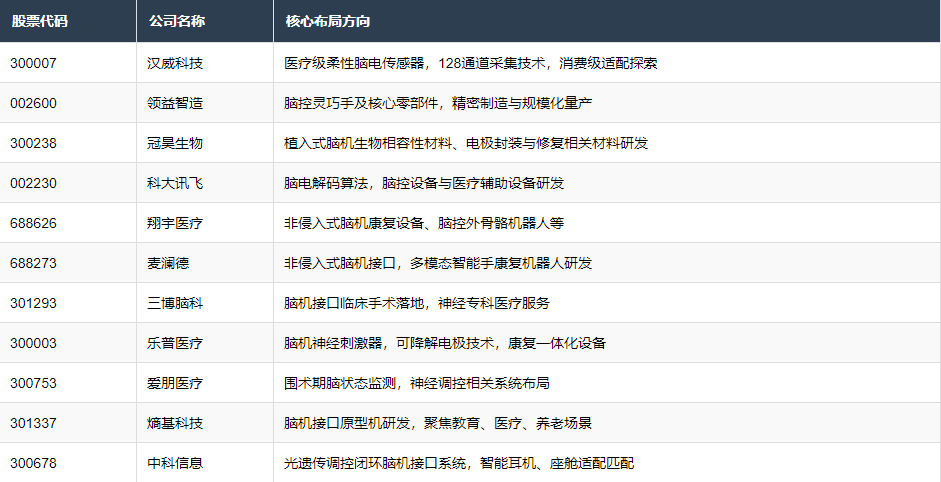
新华财经北京1月7日电(丁晶、董道勇)新年伊始,脑机接口概念股集体"沸腾",近20只个股连续两个交易日涨停。板块"开门红"缘 于市场对脑机接口巨大潜在需求、产业化进展提速及国家战略支持的叠加效应。 值得注意的是,新华财经数据显示,2026年1月5日该板块主力净流入29亿元,而6日主力资金开始净流出,规模近20亿元,但创新医 疗、爱朋医疗仍受主力资金追捧,继续保持净流入。分析认为,脑机接口行业正迎来"技术与商业化共振"的时刻,2026年脑机接口商 业化进程有望加速,并从医疗刚需向AI应用、机器人等多领域渗透。 长期来看,技术与合规双壁垒及业务联动长期看好头部企业形成技术与合规双壁垒,技术上具备核心专利、领先的研发能力,合规上 符合医疗行业严格的监管要求,如通过国家药监局的行业标准认证等。此外,关注传统业务与脑机接口业务具备联动性的企业,这类 企业可借助原有资源加速脑机接口业务的发展,同时脑机接口业务也能为传统业务带来新的增长极。 对于脑机接口加速"接入"现实,需要关注哪些细分领域? 国信证券陈曦炳团队指出, 这是一个从0到1的增量市场。短期内,市场情绪受Neuralink量产预期和国内政策利好驱动,具备高爆发 ...
黄仁勋在CES上说了什么?马斯克量产+陈天桥出手 今年将成脑机接口商业化元年?丨20260106从华尔街到陆家嘴
Di Yi Cai Jing· 2026-01-07 01:54
Group 1 - Nvidia has open-sourced its first inference VLA model, Alpamayo 1, which utilizes a 10 billion parameter architecture to address complex driving scenarios in autonomous driving technology [1] - The model is supported by several companies, including Jaguar Land Rover, Lucid, and Uber, aiming to advance Level 4 autonomous driving deployment [1] - Nvidia introduced the Vera Rubin platform, featuring six new chips, with products based on this architecture expected to launch in the second half of 2026 [1] Group 2 - DBS Bank's Dan Tsai highlighted that the focus of AI development in the next 1-2 years will shift from the digital world to the physical world, emphasizing practical applications of AI [2] - Nvidia aims to maintain its market position by integrating general-purpose and specialized chip technologies through a hybrid AI model that combines public cloud and private models [2] Group 3 - The brain-computer interface (BCI) sector is gaining traction, with Elon Musk's Neuralink planning large-scale production of brain-machine devices by 2026, utilizing automated surgical methods [4] - The global BCI market is projected to reach $25-30 billion by 2025, with potential growth to over $200 billion by 2040 if technological breakthroughs continue [5] Group 4 - Citigroup issued a neutral rating for major Wall Street banks, including Morgan Stanley, JPMorgan Chase, and Goldman Sachs, indicating that current valuations reflect high market expectations [6] - Morgan Stanley's stock price may face a pullback due to its current valuation being fully priced in, while JPMorgan is expected to maintain steady growth despite a neutral rating [6] Group 5 - The financial sector is expected to see average earnings growth of 15% in 2025, with some investment banks potentially experiencing stock price increases that exceed earnings growth, raising concerns about adjustments [7] - The A-share financial sector is highlighted as a focus area, with insurance and brokerage firms showing strong performance due to favorable investment results [7]


马斯克再次发文,表示有信心通过Neuralink技术帮助瘫痪者恢复全身功能
Mei Ri Jing Ji Xin Wen· 2026-01-07 01:51
指数维度,医疗器械ETF(562600)跟踪的医疗器械指数脑机接口含量20.91%,在A股市场指数中含量 最高,自2021年7月至今调整周期已达4年半,调整幅度超60%,价格已回到上一波行情启动位,具备风 口初期,逢低布局的特征。 开源证券表示,与此同时,脑机接口作为国内十五五规划明确布局的未来产业,政策也在持续加码,中 国的脑机接口公司正在加速临床,并呈现多种技术路线并行的格局。一场集体"插脑"竞赛进入冲刺阶 段。全球脑机接口领域竞争激烈,随着政策、技术与临床进展、想象力三重动力共振,A股市场脑机接 口概念板块火热,行情持续发酵。多重政策强力支持下,投资机遇不容忽视。 1月6日,脑机接口概念继续得到资金热捧,板块仍有近20股涨停或涨超10%。继马斯克宣布旗下 Neuralink将于2026年开始对脑机接口设备进行"大规模生产"后,他再度发文称,表示有信心通过 Neuralink技术帮助瘫痪者恢复全身功能。 ...
A股密集公告!最火赛道再迎重磅利好!
天天基金网· 2026-01-07 01:09
Core Viewpoint - The brain-computer interface (BCI) sector is experiencing significant growth and investment, highlighted by the recent 2 billion yuan financing of Qiangnao Technology, marking it as the second-largest financing in the field after Neuralink [3][4]. Group 1: Investment and Market Dynamics - Qiangnao Technology, part of the "Hangzhou Six Little Dragons," has completed approximately 2 billion yuan in financing, positioning itself as a major player in the BCI market [3][4]. - The BCI sector has become the hottest investment track in A-shares since the beginning of 2026, with multiple stocks like Innovation Medical, Aipeng Medical, and Xiangyu Medical achieving consecutive trading limit increases [3]. - The market is witnessing a surge in interest, with several BCI-related stocks announcing abnormal trading fluctuations, prompting warnings about investment risks [7]. Group 2: Company Developments - Qiangnao Technology, founded in 2015, focuses on non-invasive BCI technology and has received FDA and CE certifications, making it one of the largest investors in BCI R&D globally [4][5]. - The company has launched several products, including smart bionic limbs and brain-machine sleep aids, and has been recognized by Time magazine as one of the best inventions of the year [4]. - Qiangnao's investor lineup includes prominent institutions such as IDG and various strategic partners, indicating strong market confidence [4]. Group 3: Industry Trends and Future Outlook - The BCI industry is in a high-growth phase driven by policy support and technological breakthroughs, with expectations for large-scale production and automated surgical solutions from companies like Neuralink [6]. - The transition from clinical validation to commercial scalability is underway, suggesting that BCI technology is moving towards becoming widely accessible products rather than just experimental tools [6]. - Companies like Xiangyu Medical and Weisi Medical are focusing on non-invasive BCI technologies, although they currently have limited revenue contributions from these products [8][9].