脑机接口植入设备

Search documents
脑机接口专家会议
2026-01-07 03:05
Summary of Neural Interface Technology Conference Industry Overview - The conference focused on the neural interface technology industry, particularly advancements made by Neuralink and domestic companies in China [1][3][4][5][10]. Key Points and Arguments Neuralink's Advancements - Neuralink has significantly reduced the cost of implantable devices, with fixture costs dropping by 95%, from approximately $5,000-$6,000 to a few hundred dollars [1][3][4]. - The electrode production cost remains high, at over $10,000 per electrode, but the implantation speed has improved from 20 seconds to 1.5 seconds per electrode, facilitating clinical applications [1][3][4]. - The company has entered clinical trials, utilizing BlackRock electrodes and developing its own implantation devices that combine electron microscopy and OCR systems for precise electrode placement [1][8][9]. Challenges in Neural Interface Technology - The industry faces challenges such as complex electrode production processes, low yield rates, and patent barriers, particularly regarding non-invasive puncture techniques patented by Musk [1][5][6]. - Domestic companies need breakthroughs in materials, processes, and patent strategies to compete effectively [1][5]. Comparison of Invasive and Semi-Invasive Techniques - Neuralink's fully invasive technology targets complex diseases, while domestic companies like BoruiKang focus on semi-invasive methods primarily for rehabilitation, which are less risky and costly [1][7][10]. - The main difference lies in the application: fully invasive techniques aim to treat severe conditions through deep neural stimulation, whereas semi-invasive methods are used for rehabilitation by repairing damaged nerves [1][7]. Domestic Industry Landscape - Domestic companies such as JieTi, Tiger Technology, and WeiLing have made progress in flexible electrodes but still lag behind international leaders like Neuralink in terms of channel count (128 channels vs. Neuralink's 1,024 channels) and other technical specifications [1][10]. - The downstream applications of the domestic neural interface industry account for 70% of the market share, focusing on rehabilitation devices and commercial products, while upstream investments in electrode and chip development are capital-intensive [1][10]. Clinical Applications and Future Directions - BoruiKang's semi-quantitative methods have been widely adopted in over 20 hospitals in China, with more than 200 clinical trials conducted in 2024 [12]. - The potential for interventionist neural interfaces is highlighted, with successful trials indicating a promising future if challenges like vascular blockage can be addressed [2][16]. Competitive Landscape - Companies like Medtronic have received FDA approval for their brain stimulators, showing significant efficacy in treating conditions like epilepsy, while competitors like Pinchi Medical face challenges due to patent restrictions [14][25]. - The market for deep brain stimulation (DBS) devices is still developing, with no fully mature embedded products available yet [25]. Additional Important Insights - The domestic neural interface industry is characterized by a high investment threshold in the upstream sector, with a typical investment ratio of 3:1 or 4:1 favoring downstream applications [10]. - The technology's application in treating neurological diseases is expanding, with potential uses in conditions like Alzheimer's and depression through adaptive neural regulation [19]. This summary encapsulates the key discussions and insights from the neural interface technology conference, highlighting both advancements and challenges within the industry.
道指创历史新高 金属、能源板块普涨
Zhi Tong Cai Jing· 2026-01-05 22:26
Market Overview - The three major indices closed higher, with the Dow Jones reaching an intraday record high of 49,209.95 points [1] - The US stock market started the first full trading week of 2026 positively, led by technology and energy stocks [1] - Despite geopolitical risks following the removal of Venezuelan President Maduro, traders showed little concern [1] Economic Indicators - The ISM manufacturing index for December recorded 47.9, indicating the largest contraction since 2024, with the index below 50 for ten consecutive months [6] - The report suggests that many companies are relying on existing inventory to meet weak demand, although a decrease in customer inventory may signal potential order and production increases in the coming months [6] Commodity Market - Gold prices rose over 2.6% to $4,449.02, with an intraday high of $4,455 [5] - Copper prices surpassed $13,000 per ton due to a strike at a Chilean copper mine, raising supply concerns [5] - The US is expected to face a copper supply shortfall of 300,000 to 400,000 tons in 2026, with demand projected to grow by about 3% [5] Cryptocurrency - Bitcoin surpassed $94,000, gaining over 2.8%, while Ethereum rose over 2.9% to $3,237.8 [4] Company News - Tesla's CEO Elon Musk announced that Neuralink will begin large-scale production of its brain-machine interface devices in 2026, aimed at helping patients with paralysis and neurological diseases [8] - Qualcomm is expanding its PC chip offerings with the new X2Plus processor, targeting the mid-range laptop market [10] - Chevron (CVX.US) saw a 5.2% increase, nearing a new high, while Tesla (TSLA.US) rose by 3% [2]


隔夜美股 | 道指创历史新高 金属、能源板块普涨
智通财经网· 2026-01-05 22:21
Market Overview - The three major U.S. indices closed higher, with the Dow Jones reaching an intraday record high of 49,209.95 points [1] - The Dow increased by 594.79 points (1.23%) to close at 48,977.18 points, while the Nasdaq rose by 160.19 points (0.69%) to 23,395.82 points, and the S&P 500 gained 43.58 points (0.64%) to finish at 6,902.05 points [2] Sector Performance - Technology and energy stocks led the gains in the U.S. market, with Chevron (CVX.US) up 5.2% and Tesla (TSLA.US) rising 3% [2] - The Nasdaq Golden Dragon China Index increased by 0.5%, with Beike (BEKE.US) rising over 6% [2] Economic Indicators - The ISM Manufacturing PMI for December recorded 47.9, indicating a contraction in the manufacturing sector for ten consecutive months [6] - Despite the contraction, a decrease in customer inventories suggests potential strengthening in factory orders and production in the coming months [6] Commodity Prices - Gold prices rose over 2.6% to $4,449.02 per ounce, with a peak of $4,455 [5] - Copper prices surpassed $13,000 per ton due to supply concerns from a strike at a Chilean copper mine [5] - Oil prices also increased, with light crude oil futures rising by $1.00 to $58.32 per barrel, and Brent crude up $1.01 to $61.76 per barrel [5] Company Developments - Neuralink, led by Elon Musk, plans to begin mass production of its brain-machine interface devices in 2026, aimed at helping patients with paralysis and neurological diseases [9] - Qualcomm (QCOM.US) is expanding its PC chip offerings with the new X2 Plus processor, targeting the mid-range laptop market [11] Government Actions - The U.S. Department of Energy announced $2.7 billion in orders to enhance domestic uranium enrichment capabilities, aiming to reduce reliance on Russian supplies [8] - U.S. Energy Secretary is set to meet with oil executives to discuss revitalizing Venezuela's energy sector following the arrest of President Maduro [10]
大摩重磅机器人年鉴(七):脑机接口将是AI的终极物理体现
Hua Er Jie Jian Wen· 2025-12-23 08:24
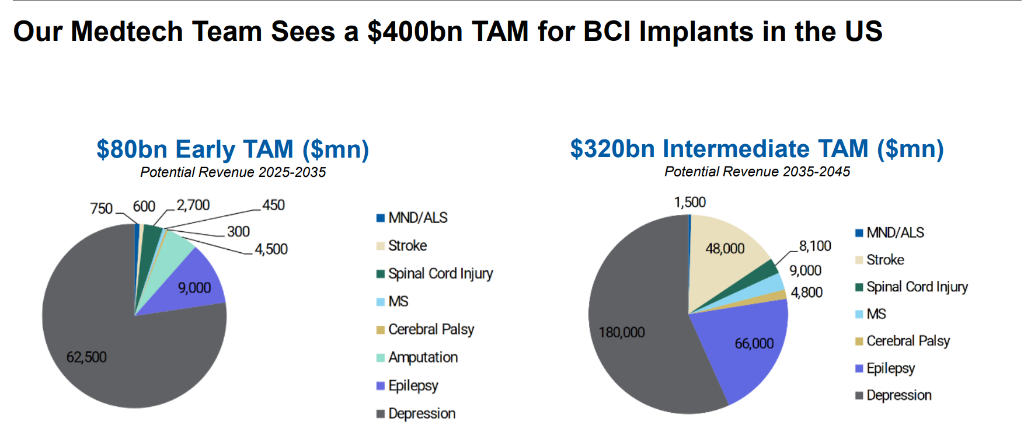
Core Insights - Brain-Computer Interface (BCI) technology is emerging as the "ultimate physical embodiment" of artificial intelligence, aimed at addressing medical challenges and serving as a key bridge for human-AI coexistence, with significant long-term market potential attracting global capital and enterprises [1][4] Market Potential - Morgan Stanley's report estimates that the total addressable market (TAM) for BCI implant devices in the U.S. could reach $80 billion by 2035 and soar to $320 billion by 2045, primarily targeting treatments for various neurological disorders such as ALS, stroke, spinal cord injuries, epilepsy, and depression [1][12] Competitive Landscape - A global competitive landscape is forming, with key players including Neuralink, Synchron, Precision, and Paradromics. China has announced a BCI technology development roadmap aiming for key breakthroughs by 2027 and to become a global leader by 2030 [4][12] Historical Context - The development of BCI is not new, tracing back to the discovery of brain electrical activity by Hans Berger in 1924, with significant advancements occurring in the early 21st century, such as the demonstration by Duke University's Miguel Nicolelis in 2003, where a monkey controlled a robotic arm via BCI [5] Technological Pathways - Current BCI implantation techniques include Neuralink's robotic surgery to insert threads into the motor cortex, Synchron's vascular electrode array implantation, and micro-invasive techniques from Precision and Paradromics [5] Neuralink's Vision - Elon Musk has set a four-tiered vision for Neuralink: first, to alleviate human suffering (e.g., "mind-reading" implants for paralyzed patients); second, to enhance human capabilities (e.g., future "blindness" implants); third, to understand and expand consciousness; and finally, to achieve human coexistence with AI/robots to mitigate existential risks posed by AI [9][11] Investment Trends - Investment in neurotechnology, including BCI, surged to approximately $1.8 billion by the end of 2025, indicating high capital interest. Neuralink leads with a valuation of $9 billion and over $1.3 billion in funding [12] Future Outlook - The report outlines a shift from technological exploration to commercialization and large-scale application of embodied AI, redefining productivity and human capabilities, and presenting a vast, multi-layered market landscape for investors [23]


【大涨解读】脑科学:马斯克公布最新进展,国内外临床进展不断,脑机接口正处转化关键节点
Xuan Gu Bao· 2025-06-30 06:11
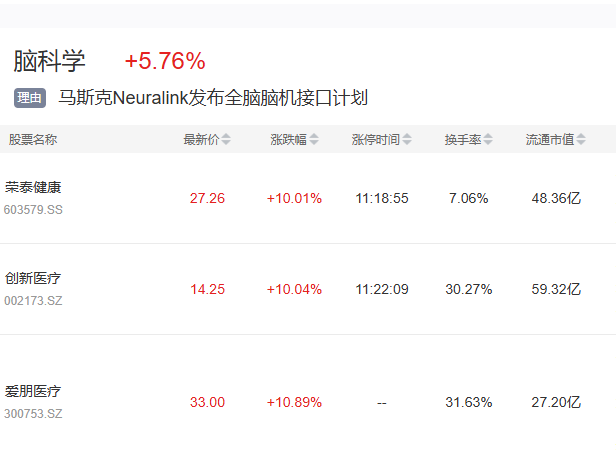
Market Overview - On June 20, the brain-computer interface (BCI) concept gained momentum, with Xiangyu Medical rising by 20%, and other companies like Innovation Medical and Aipeng Medical also experiencing significant gains [1]. Stock Performance - Key stock performances include: - Xuetai Health (603579.SS) at 27.26, up by 10.01%, with a market cap of 4.836 billion [2] - Innovation Medical (002173.SZ) at 14.25, up by 10.04%, with a market cap of 5.932 billion [2] - Aipeng Medical at 33.00, up by 10.89%, with a market cap of 2.720 billion [2] Events - Neuralink, a company under Elon Musk, showcased its latest research and product development direction, revealing that seven participants with lost mobility have undergone brain-computer interface implantation, with hopes of restoring sight to blind individuals by 2026 [3] - In China, the National Medical Electrical Standardization Technical Committee is seeking public opinion on the national standard for non-invasive medical devices using BCI technology [3] - The Chinese Academy of Sciences, in collaboration with Fudan University Huashan Hospital and related enterprises, has initiated prospective clinical trials for invasive BCI, making China the second country after the U.S. to enter this phase [3] Institutional Insights - The global development of BCI technology is characterized by multiple technological breakthroughs, with significant progress in invasive, semi-invasive, and non-invasive techniques, supported by policy and capital investments [4] - Clinical trials in the BCI field are intensifying, validating technical feasibility and optimizing core performance indicators, which will lay a solid foundation for large-scale commercialization [5] - The BCI market is expected to expand rapidly, with projections indicating that the market size in China will reach 3.2 billion by 2024 and exceed 5.5 billion by 2027, while the global medical application market could reach between 40 billion to 145 billion by 2030 to 2040 [5]