南航

Search documents
中国民航夏秋航季航班计划“新”在哪里?130秒里看发展“新空间”
Yang Shi Wang· 2025-03-30 06:47
Core Points - The new summer-autumn flight schedule for the civil aviation industry in China will officially start on March 30 and last until October 25, 2025, covering a total of 210 days [1] - A total of 209 domestic and international airlines plan to operate 123,000 scheduled passenger and cargo flights weekly, with significant adjustments made to optimize flights based on actual passenger demand [1] - The number of international flight schedules has increased, with 193 domestic and international airlines approved to operate 22,946 scheduled flights weekly, representing a 33% increase compared to the summer-autumn schedule of 2024 [1] Flight Capacity Adjustments - The overall flight capacity has not significantly increased; however, there are notable adjustments focusing on optimizing flights to meet passenger demand [2] - This summer-autumn season will see more capacity allocated to regional routes, particularly in response to the booming tourism in "small cities" over the past two years [2] - A total of 38 airlines plan to operate 6,454 scheduled flights weekly on 640 newly opened domestic routes, primarily connecting regional airports in Xinjiang, Inner Mongolia, and Guizhou with hub airports in Chongqing, Guiyang, and Changsha [2] Airline Operations - Several airlines are increasing their capacity on regional routes, with Air China launching new routes such as Beijing to Altay and Chongqing to Kashgar, among others, totaling approximately 80 new routes [3][4] - China Southern Airlines will also increase flights from Guangzhou to Kashgar, Yiwu, and Xuzhou, as well as from Beijing Daxing to Dalian, Yiwu, and Altay [4] - The director of the Aviation Transportation Research Institute noted that airports in tourist destinations like Tianshui and Altay have shown strong growth, prompting an increase in the convenience of regional airports to meet changing passenger travel demands [7]


【财闻联播】成都涉嫌“医保取现”医院,被暂停医保拨付!多家航司:符合条件订单可免费取消
券商中国· 2025-03-29 13:05
Macro Dynamics - The Ministry of Commerce emphasizes the need to address bottlenecks in the circulation of new energy vehicles (NEVs) and increase support for trade-in programs. As of March 28, 2023, over 1.769 million applications for trade-in subsidies have been submitted, with NEV retail sales exceeding 2.05 million units, a year-on-year increase of approximately 34% [2] Healthcare Sector - The National Healthcare Security Administration (NHSA) is intensifying efforts to combat illegal activities related to "return drugs" in Hubei province. A comprehensive inspection is underway to address fraud and ensure the safety of the healthcare fund [3] - A hospital in Chengdu has been suspended from receiving healthcare payments due to allegations of "cash-out" practices. Investigations are ongoing regarding excessive prescriptions linked to the hospital [4] Financial Institutions - Wu Ruoman has resigned as the chairman of Xingyin Fund Management due to personal reasons, with the general manager, Yi Yong, temporarily assuming the role [7] Market Data - U.S. stock markets experienced significant declines on March 28, with the Nasdaq dropping 2.7%, the S&P 500 down 1.97%, and the Dow Jones falling 1.69%. Major tech stocks also saw substantial losses, with Netflix, Google, Amazon, and Meta each declining over 4% [8] - The Nasdaq Golden Dragon China Index fell by 3.11% on March 28, with notable declines in several Chinese concept stocks [10] Company Dynamics - Pang Donglai reported that the average monthly income for employees in January and February 2025 was 9,886 yuan, with sales reaching approximately 4.4 billion yuan [12] - Xpeng Motors' chairman, He Xiaopeng, announced that the company's flying car is preparing for large-scale production, with expected deliveries next year [15] - Sunac China Holdings reported a projected revenue of approximately 74.02 billion yuan for 2024, a year-on-year decrease of about 52%, with a significant increase in losses attributed to debt restructuring [16]

交通运输行业快评报告:1-2月航空数据跟踪点评
Wanlian Securities· 2025-03-26 10:53
Investment Rating - The industry investment rating is "Outperform the Market" [5][8] Core Insights - In January-February 2025, civil aviation passenger volume continues to grow, supported by domestic demand-boosting policies and the release of post-holiday business travel demand, which is expected to enhance industry demand [1] - The introduction speed of the industry fleet is expected to remain low, while the current decline in oil prices will help reduce operational costs, leading to a potential recovery in ticket prices and profitability for airlines [1] Summary by Sections Passenger Traffic Data - During the Spring Festival travel period, passenger transport volume reached a record high, with a total civil aviation passenger transport volume growth of 7.4% in January-February 2025. The total turnover volume achieved 257 billion ton-kilometers, a year-on-year increase of 10.5%, with domestic routes growing by 3.7% and international routes by 25.8% [2] - The passenger volume reached 126 million, a year-on-year increase of 5.5%, and a 17.9% increase compared to the same period in 2019. International routes completed 12.84 million passengers, a year-on-year increase of 38.6%, recovering to 106.6% of the 2019 level [2] Ticket Pricing and Load Factor - The average ticket price for economy class during the Spring Festival decreased by 11.3%, reaching 874.9 yuan, with prices remaining lower than in 2024 after the Lunar New Year [3] - The load factor for civil aviation in January-February was 84%, an increase of 0.7 percentage points compared to 2024, and higher than the 2019 level of 83.2% [3] Fleet Operations - As of the end of February 2025, the number of operational aircraft among six listed airlines increased by 23 to a total of 3,278, reflecting a 0.7% year-on-year growth [4]
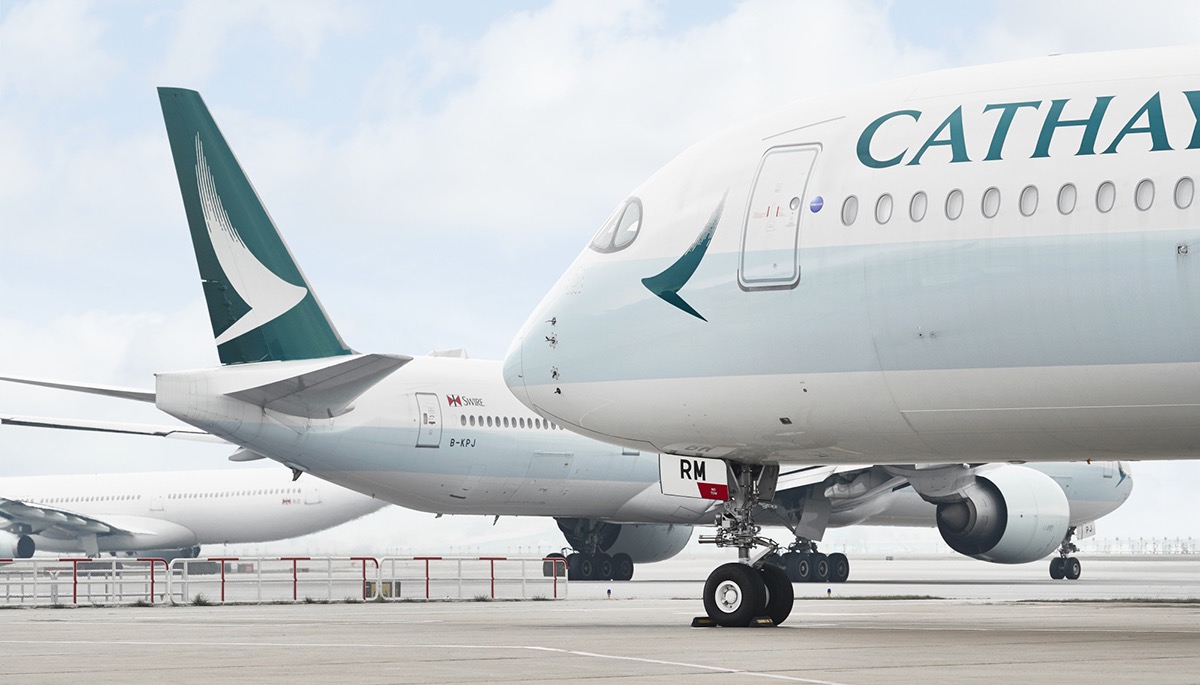
重建国泰航空
Zheng Quan Shi Bao Wang· 2025-03-17 03:26
Core Viewpoint - Cathay Pacific Airways has undergone significant restructuring and recovery after facing unprecedented challenges during the pandemic, with a strong performance expected in 2025 due to both external market improvements and internal reforms [1][4]. Business Recovery - From 2020 to 2022, Cathay Pacific faced severe operational challenges, with daily passenger numbers dropping to 302 from a normal level of around 100,000, leading to monthly cash burn of HKD 1.5 to 2 billion [2][6]. - The company implemented a drastic restructuring plan, including shutting down Dragonair and laying off approximately 8,500 employees, while initiating a HKD 39 billion capital restructuring plan [3][7]. - By early 2023, as travel restrictions eased, Cathay Pacific began to recover, with flight numbers returning to pre-pandemic levels by January 2025 [3][12]. Financial Performance - In 2023, Cathay Pacific achieved its highest profit in over a decade, and in 2024, it continued to see revenue and net profit growth, with a net profit of nearly HKD 10 billion [3][14]. - The company reported a revenue of HKD 1,043.71 billion in 2024, a 10.5% increase year-on-year, with significant contributions from both cargo and passenger services [14][15]. Workforce and Operations - After a significant reduction in workforce during the pandemic, Cathay Pacific began a large-scale recruitment drive, increasing its employee count by 12.25% in 2023 and hiring approximately 7,000 new employees in 2024 [10][11]. - The company faced challenges in restoring its workforce, particularly in recruiting and training pilots, which is a lengthy process [9][10]. Brand Image and Customer Service - Following a public relations crisis in May 2023, Cathay Pacific took steps to improve its service culture and expand Mandarin-speaking staff, including recruiting from mainland China [17][19]. - The airline has made changes to its in-flight services, including offering menus in multiple languages and incorporating local cuisine into its offerings [18][19]. Strategic Focus on Mainland China - Cathay Pacific has emphasized its strategic positioning in the mainland market, with a focus on the Greater Bay Area, which is seen as a critical growth area [20][21]. - The airline plans to enhance its service offerings and expand its route network in mainland China, with a goal of increasing its market share against local competitors [22][24].