
国药股份

Search documents
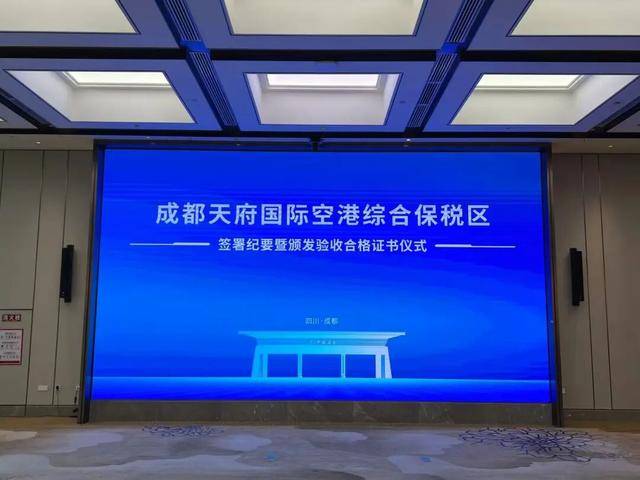
成都天府国际空港综保区通过正式验收
Sou Hu Cai Jing· 2026-01-07 08:09
Core Viewpoint - The Chengdu Tianfu International Airport Comprehensive Bonded Zone has successfully passed the national joint acceptance inspection, marking a significant addition to Chengdu's open platform and enhancing its role in promoting inland openness [1][3][6]. Group 1: Overview of the Bonded Zone - The Chengdu Tianfu International Airport Comprehensive Bonded Zone is the first airport-type bonded zone in Sichuan province, covering an area of 1.08 square kilometers [3][6]. - The zone's first phase has a total investment of approximately 1.16 billion yuan, with a construction area of about 86,000 square meters, including various facilities such as public bonded warehouses and customs inspection areas [6][9]. - The operational model of the zone is based on a "management committee + company" approach, with the Chengdu Eastern New District Management Committee collaborating with Chengdu Industrial Investment Group to establish a dedicated investment and operation company [7][9]. Group 2: Economic Impact and Trade Facilitation - The bonded zone is expected to attract internationally competitive logistics service providers and supply chain management companies, focusing on core businesses such as international transshipment and cross-border e-commerce [11][15]. - The zone aims to create a diversified and high-end industrial ecosystem, with signed projects in sectors like biomedicine and cold chain logistics, projecting an import-export scale exceeding 10 billion yuan within five years [11][15]. - As of January to November 2025, the total import and export value of bonded zones in Sichuan reached 533.31 billion yuan, accounting for 57.08% of the province's total import and export value during the same period [9]. Group 3: Innovation and Regulatory Framework - Chengdu Customs is actively supporting the development of bonded maintenance industries and has introduced innovative regulatory measures to enhance operational efficiency within the bonded zone [13][15]. - The zone will focus on customs supervision, tax collection, and cross-border settlement, exploring groundbreaking reform measures to reduce enterprise costs and improve trade facilitation [15].

芬太尼概念涨4.74%,主力资金净流入这些股
Zheng Quan Shi Bao Wang· 2026-01-05 08:53
Group 1 - The fentanyl concept index rose by 4.74%, ranking 6th among concept sectors, with 8 stocks increasing in value, including Botao Bio which hit a 20% limit up [1] - The leading stocks in the fentanyl sector included Dongfang Bio, Lingrui Pharmaceutical, and ST Renfu, which rose by 5.12%, 4.88%, and 2.26% respectively [1] Group 2 - The fentanyl concept sector saw a net inflow of 55 million yuan, with ST Renfu leading the inflow at 69.89 million yuan, followed by Guoyao Shares, Guoyao Modern, and Lingrui Pharmaceutical [2] - The net inflow ratios for ST Renfu, Guoyao Modern, and Guoyao Shares were 14.70%, 7.69%, and 5.96% respectively, indicating strong interest from major funds [3]


粤港澳大湾区,坐拥全球第一科技集群
21世纪经济报道· 2026-01-05 05:26
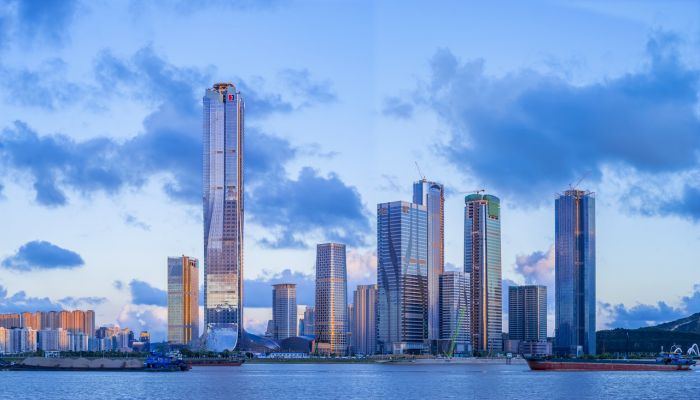
Core Viewpoint - The article emphasizes the development of the Guangdong-Hong Kong-Macao Greater Bay Area as an international technology innovation center, highlighting its unique advantages and the ongoing transformation in cross-border scientific collaboration and innovation roles among the three regions [2][10]. Group 1: Development of the Greater Bay Area - Since 2019, the Zhuhai Macao University Science and Technology Research Institute (Zhuyuan) has facilitated over 180 commercial projects with a total value exceeding 120 million yuan, showcasing the rapid integration of research and production in the region [1]. - The Greater Bay Area has established two national laboratories, 45 key laboratories, and 33 joint laboratories, with the "Shenzhen-Hong Kong-Guangzhou" technology cluster expected to rank first globally by 2025 [1][2]. - The central economic work conference has set innovation-driven development as a key task for 2026, reinforcing the importance of the Greater Bay Area in the national innovation system [2][3]. Group 2: Evolving Roles in Innovation - The collaboration among Guangdong, Hong Kong, and Macao is transitioning from project-based cooperation to a more integrated development model, characterized by rule alignment and mechanism integration [3][6]. - The Zhuyuan focuses on biomedicine and health, leveraging national key laboratories to advance applied scientific research and commercialization, particularly in traditional Chinese medicine [5][6]. - The boundaries of collaboration are becoming less distinct, with Shenzhen excelling in quantum computing and synthetic biology, while Hong Kong is enhancing its high-end manufacturing capabilities [6][7]. Group 3: Innovation Spillover Effects - The article discusses the "innovation spillover effect," comparing it to Silicon Valley's development, where initial academic resources attracted technology companies, leading to a broader industrial cluster [8]. - The Zhuyuan serves as a hub for transforming Macao's research outcomes into practical applications, having signed agreements with over 20 companies, covering various research fields [8][9]. - Guangdong is home to over 77,000 high-tech enterprises, contributing significantly to national high-tech product exports, which rebounded with a 10% year-on-year growth [9]. Group 4: Unique Advantages of the Greater Bay Area - The Greater Bay Area's high marketization and internationalization levels facilitate efficient resource allocation and integration into the global innovation network [10]. - The region's complete industrial clusters and robust manufacturing base enable rapid transformation of technological innovations into products [10]. - The collaboration among the three major international innovation centers (Greater Bay Area, Beijing-Tianjin-Hebei, and Yangtze River Delta) is seen as complementary rather than competitive, leveraging each region's strengths [10]. Group 5: Challenges in Cross-Border Collaboration - The article highlights the bottlenecks in the cross-border flow of technological elements among the three regions, particularly in data flow, which is crucial for the development of digital economy and AI [11][13]. - Initiatives are underway to enhance cross-border data sharing, including financial and medical data, to facilitate smoother collaboration [11][12]. - The need for improved policy coordination and market-level integration of innovation elements is emphasized to overcome existing barriers [13][14].

2026年,医药商业公司何去何从
Xin Lang Cai Jing· 2026-01-04 12:26
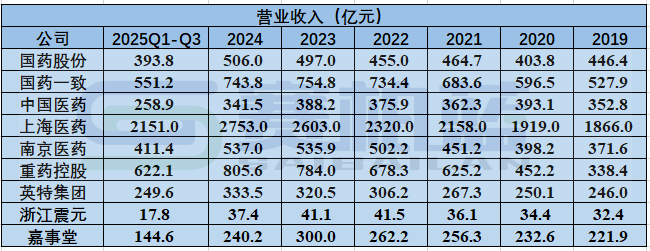
Core Viewpoint - The pharmaceutical commercial companies are often overlooked in the secondary market, with only a few experiencing significant stock price increases due to specific events, while most remain undervalued and lack growth potential [1][23]. Group 1: Market Performance - In December 2025, companies like HeFu China and others saw significant stock price increases, diverging from their fundamentals, while most pharmaceutical commercial companies remain "small transparent" in the market [1][23]. - The highest market capitalization among pharmaceutical commercial companies is Shanghai Pharmaceuticals, which relies on its industrial segment for valuation enhancement, while most companies have market caps below 30 billion [1][23]. Group 2: Financial Overview of State-Owned Enterprises - State-owned pharmaceutical commercial companies like Shanghai Pharmaceuticals have substantial revenue, with 215.1 billion in 2025 Q1-Q3, primarily from distribution and retail [3][4]. - The net profit margins for these companies are generally low, with Shanghai Pharmaceuticals reporting a net profit of 51.47 billion in 2025 Q1-Q3, reflecting the industry's low profitability [5][6]. - The asset-liability ratios for state-owned companies are high, with Shanghai Pharmaceuticals at 62.14% in 2025 Q1-Q3, indicating a reliance on flexible capital management [6][7]. Group 3: Financial Overview of Private Enterprises - Among private pharmaceutical commercial companies, Jiuzhoutong stands out with a revenue of 119.3 billion in 2025 Q1-Q3, significantly higher than its peers [9][10]. - The net profit for Jiuzhoutong in 2025 Q1-Q3 was 19.75 billion, showcasing its profitability compared to other private companies [9][10]. - The asset-liability ratio for Jiuzhoutong is 68.77%, indicating a similar financial structure to state-owned companies [12]. Group 4: Retail Pharmacy Operations - Retail pharmacies focus on regional operations, with companies like Yifeng Pharmacy and Laobaixing showing strong local market presence [13][14]. - The net profit margins for retail pharmacies are generally higher than those of pharmaceutical distribution companies, with Yifeng Pharmacy reporting a net margin of 7.64% in 2025 Q1-Q3 [15][14]. - Most retail pharmacy companies also have asset-liability ratios exceeding 50%, necessitating effective capital management [14][15]. Group 5: Future Directions - Pharmaceutical commercial companies are encouraged to explore transformation opportunities in traditional business areas, focusing on consumer healthcare and rehabilitation [21][22]. - The integration of retail pharmacies with online services and community engagement is essential for enhancing customer loyalty and market presence [22]. - Companies should leverage capital partnerships to establish investment funds for mergers and acquisitions, aiming to enhance their market valuation and profitability [22].


坐拥全球第一科技集群,粤港澳大湾区如何稳站科创潮头?
2 1 Shi Ji Jing Ji Bao Dao· 2026-01-04 12:05
Core Viewpoint - The Guangdong-Hong Kong-Macao Greater Bay Area is evolving into a leading international technology innovation center, with significant advancements in cross-border scientific research and collaboration, particularly in the biomedical sector [2][3][4]. Group 1: Development of the Greater Bay Area - Since 2019, the Zhuhai University of Macau Technology Research Institute has facilitated over 180 commercial projects with a total value exceeding 120 million yuan, showcasing the area's unique advantages in talent and manufacturing [2]. - The Greater Bay Area has established two national laboratories, 45 key laboratories, and 33 joint laboratories, positioning itself as a significant player in the global innovation landscape [2]. - By 2025, the "Shenzhen-Hong Kong-Guangzhou" technology cluster is expected to rank first globally, while the "Macau-Zhuhai" cluster is projected to improve its ranking from 100th to 98th [3]. Group 2: Innovation Collaboration - The collaboration among Guangdong, Hong Kong, and Macau is transitioning from project-based cooperation to a more integrated development model, enhancing the region's innovation spillover effects [4][9]. - The research focus of the Zhuhai University of Macau Technology Research Institute includes biomedicine and traditional Chinese medicine, with ongoing partnerships with various pharmaceutical companies [5][12]. - New cooperation models are emerging, shifting from traditional manufacturing to high-end research and development, leveraging Hong Kong's international resources [7][9]. Group 3: Infrastructure and Investment - Guangdong has over 10 national large scientific facilities, covering critical fields such as energy and life sciences, which are essential for foundational research [8]. - The Hong Kong government is implementing measures to optimize its industrial structure, including tax incentives and funding to foster emerging industries like advanced manufacturing and AI [8][14]. - By 2024, Guangdong is expected to have over 77,000 high-tech enterprises, contributing significantly to the national high-tech product exports, which are projected to reach 1.828 trillion yuan [14]. Group 4: Challenges and Future Directions - Despite advancements, the Greater Bay Area faces challenges in cross-border flow of technology elements, particularly data, which is crucial for the development of digital economy and AI [18][20]. - The region is exploring solutions to enhance the flow of data and other innovation elements, with initiatives aimed at improving policy coordination and market integration [19][20]. - Future reforms will focus on breaking down barriers to cross-border flows, particularly in talent acquisition and technology market integration, to enhance overall innovation efficiency [20][21].
2025年1-11月全国医药制造业出口货值为2140.6亿元,累计增长11.7%
Chan Ye Xin Xi Wang· 2026-01-02 06:33
Core Viewpoint - The report highlights the growth and trends in China's pharmaceutical manufacturing outsourcing (CMO/CDMO) industry, indicating a positive trajectory in export values and market development from 2026 to 2032 [1] Industry Summary - In November 2025, the total export value of China's pharmaceutical manufacturing industry reached 18.97 billion, marking a year-on-year increase of 1.6% [1] - From January to November 2025, the cumulative export value of the pharmaceutical manufacturing industry was 214.06 billion, with a year-on-year growth of 11.7% [1] - The report includes a statistical chart of the export value of the pharmaceutical manufacturing industry from 2019 to November 2025, showcasing the growth trend over the years [1] Company Summary - Listed companies mentioned include: Guoyao Modern (600420), Kunming Pharmaceutical Group (600422), Pian Zai Huang (600436), Qianjin Pharmaceutical (600479), Tianyao Pharmaceutical (600488), Guoyao Shares (600511), Lianhuan Pharmaceutical (600513), Hefei China (603122), Kanghui Pharmaceutical (603139), Shapuaisi (603168), Aoxiang Pharmaceutical (603229), and Daclin (603233) [1] - The report is published by Zhiyan Consulting, a leading industry consulting firm in China, specializing in in-depth industry research and providing comprehensive solutions for investment decisions [1]

2025年中国头孢类药物行业发展历程、政策、产业链图谱、销售额、竞争格局及发展趋势研判:集采常态化重塑市场格局[图]
Chan Ye Xin Xi Wang· 2025-12-30 02:06
Core Viewpoint - The sales of cephalosporin antibiotics in China's public medical institutions are declining due to centralized procurement price reductions and "antibiotic restriction orders," with sales expected to drop to 39.6 billion yuan in 2024, a year-on-year decrease of 11.5% [1][9]. Industry Overview - Cephalosporins are a class of semi-synthetic broad-spectrum β-lactam antibiotics, primarily used to treat various bacterial infections, categorized into five generations based on their antibacterial spectrum and stability against β-lactamase [2][3]. Development History - The development of the cephalosporin industry in China has evolved from technology introduction to independent innovation, characterized by four stages: exploratory initiation, rapid development, industrial upgrading, and transformation optimization, driven by policy support and market demand [4][5]. Industry Policies - The Chinese government has implemented various policies to support the pharmaceutical manufacturing industry, including guidelines for centralized procurement and price management, which create a favorable environment for the development of the cephalosporin sector [6]. Industry Chain - The cephalosporin industry chain includes upstream components such as chemical raw materials and pharmaceutical intermediates, midstream activities like research and production, and downstream channels including healthcare institutions and pharmacies [6][7]. Current Market Situation - The demand for cephalosporins remains rigid in clinical settings, but sales in public medical institutions are declining, with projected sales of 17.3 billion yuan in the first half of 2025 [1][9]. Competitive Landscape - The market for cephalosporins is undergoing significant changes, with the top 20 groups holding a market share of 66% in public medical institutions by mid-2025. Pfizer leads with a market share of 20.67%, followed by China National Pharmaceutical Group and Nanjing Youke [10]. Key Companies - Nanjing Youke Bio-Pharmaceutical Co., Ltd. focuses on innovative drug development and has seen a significant increase in sales of its cephalosporin products, with a 192.22% rise in sales in 2025 [10][11]. - Chengdu Beite Pharmaceutical Co., Ltd. specializes in high-quality drug development and has a diverse product portfolio, including over 200 formulations across various therapeutic areas [12]. Future Trends - The future of cephalosporin development will focus on combination formulations with enzyme inhibitors to address the growing issue of antibiotic resistance, alongside an increase in usage in community healthcare settings, particularly for cost-effective oral and basic injectable formulations [12][13].

医药商业板块12月29日跌1.82%,漱玉平民领跌,主力资金净流出8.04亿元
Zheng Xing Xing Ye Ri Bao· 2025-12-29 09:06
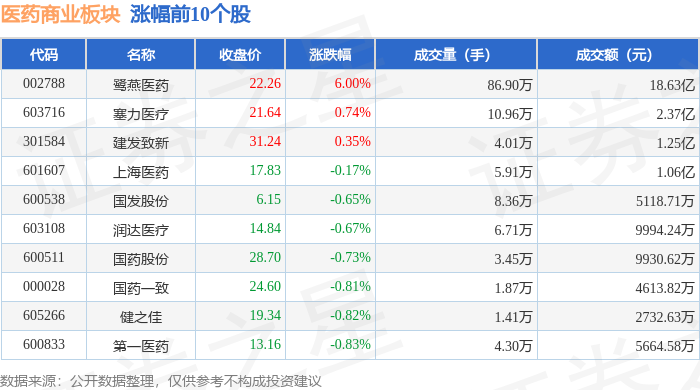
Market Overview - The pharmaceutical commercial sector experienced a decline of 1.82% on December 29, with the leading stock being Shuyupingmin [1] - The Shanghai Composite Index closed at 3965.28, up 0.04%, while the Shenzhen Component Index closed at 13537.1, down 0.49% [1] Stock Performance - Notable gainers included: - Denglushiyao (002788) with a closing price of 22.26, up 6.00% and a trading volume of 869,000 shares, totaling 1.863 billion yuan [1] - Saily Medical (603716) closed at 21.64, up 0.74% with a trading volume of 109,600 shares, totaling 237 million yuan [1] - Significant decliners included: - Shuyupingmin (301017) with a closing price of 15.58, down 17.91% and a trading volume of 481,800 shares, totaling 767 million yuan [2] - Renmintongtai (600829) closed at 11.17, down 6.84% with a trading volume of 367,700 shares, totaling 414 million yuan [2] Capital Flow - The pharmaceutical commercial sector saw a net outflow of 804 million yuan from institutional investors, while retail investors experienced a net inflow of 892 million yuan [2] - The capital flow for specific stocks showed: - Nanjing Pharmaceutical (600713) had a net inflow of 11.27 million yuan from institutional investors [3] - Shanghai Pharmaceutical (601607) saw a net inflow of 8.81 million yuan from institutional investors [3] - Dajia Weikang (301126) had a net outflow of 406,000 yuan from institutional investors [3]

研判2025!中国玄参行业市场政策、产业链图谱、供需现状、产区分布、市场规模、竞争格局及发展趋势分析:头部企业优势明显[图]
Chan Ye Xin Xi Wang· 2025-12-26 01:30
Overview - The core viewpoint of the article highlights the growing demand for Xuan Shen (玄参), a key traditional Chinese medicine, driven by the promotion of TCM clinical applications and supportive policies, with a projected demand of 415.91 tons and a market size of 249 million yuan in 2024 [1][10]. Market Policies - The Chinese government has issued multiple policies to enhance the development of the TCM industry, focusing on improving the standards for planting and processing Chinese medicinal materials, including Xuan Shen [5][6]. Industry Chain - The Xuan Shen industry chain includes upstream activities such as seed selection, seedling cultivation, and planting, while the midstream involves processing, including initial and deep processing. The downstream market encompasses pharmaceuticals, health products, functional foods, and wellness beverages [6][8]. Current Development - The demand for Xuan Shen is steadily increasing due to the rising awareness of health management and chronic disease care among the public, leading to its application in health products and functional foods [1][10]. Competitive Landscape - The Xuan Shen industry features numerous participants, including both planting and processing enterprises. Key players like Kangmei Pharmaceutical and Hu Qing Yu Tang dominate the high-end market through standardized processing and brand recognition [11][12]. Future Trends - The Xuan Shen industry is expected to focus on enhancing the quality of medicinal materials, with an emphasis on breeding high-yield and resilient varieties, and promoting eco-friendly cultivation methods. Additionally, there is potential for expanding into international markets, particularly in Southeast Asia and Western countries [13][14].


芬太尼概念下跌0.26%,主力资金净流出6股
Zheng Quan Shi Bao Wang· 2025-12-24 09:45
Core Viewpoint - The fentanyl concept sector experienced a decline of 0.26% as of the market close on December 24, with several companies within the sector showing significant drops in stock prices [1] Market Performance - The top-performing concept sectors today included: - Terahertz: +4.02% - Commercial Aerospace: +3.60% - Satellite Navigation: +3.47% - Fentanyl: -0.26% [1] Fund Flow Analysis - The fentanyl concept sector saw a net outflow of 63 million yuan from main funds today, with six stocks experiencing significant outflows. The stock with the highest outflow was ST Renfu, which had a net outflow of 42.89 million yuan [1] - Other notable outflows included: - Enhua Pharmaceutical: -13.02 million yuan - Wanfu Biology: -5.15 million yuan - Botao Biology: -2.70 million yuan [1] - Conversely, the stocks with the highest net inflows included: - Guoyao Modern: +1.77 million yuan - Guoyao Shares: +1.47 million yuan [1] Individual Stock Performance - The following stocks within the fentanyl concept sector had notable price changes: - ST Renfu: -2.06% with a turnover rate of 1.92% - Enhua Pharmaceutical: -0.79% with a turnover rate of 0.68% - Wanfu Biology: +0.61% with a turnover rate of 0.51% - Botao Biology: -0.28% with a turnover rate of 0.74% - Guoyao Modern: +0.20% with a turnover rate of 0.51% [1]

