IBM

Search documents
IBM Expands AI Consulting Capabilities: Will it Drive Growth?
ZACKS· 2025-11-19 18:01
Core Insights - IBM has expanded its collaboration with Microsoft to enhance its consulting capabilities through the integration of Microsoft's Copilot with IBM Consulting Advantage, allowing consultants to utilize AI tools within Microsoft 365 applications [1][9] - The AI consulting services market is projected to grow at a compound annual growth rate of 26.2% from 2025 to 2035, positioning IBM to capitalize on this trend with its integrated offerings [4] - IBM's Consulting segment reported revenues of $5.32 billion in Q3, an increase from $5.15 billion year-over-year, driven by business application transformation and modernization [5][9] Company Developments - IBM's integration of AI tools has resulted in the equivalent of over 250,000 hours saved annually, translating to approximately $35 million in value, allowing consultants to focus on revenue-generating tasks [3][9] - The company is currently trading at a price/earnings ratio of 24.19, which is above the industry average of 23.39, indicating a relatively higher valuation [10] Competitive Landscape - IBM faces competition from Accenture and Infosys in the consulting sector, both of which are also expanding their AI capabilities and forming strategic collaborations to enhance their service offerings [6][7] - Accenture has recently partnered with Microsoft to launch a copilot business transformation practice, while Infosys is expanding its generative AI portfolio through collaborations with industry leaders [6][7]


Palo Alto Networks and IBM Plan to Launch Joint Solution to Accelerate Enterprise-Wide Quantum-Safe Readiness
Prnewswire· 2025-11-19 13:15
Accessibility StatementSkip Navigation Mark Hughes, Global Managing Partner, IBM Consulting Cybersecurity Services "Becoming 'quantum safe' is not a single event; it's a strategic enterprise transformation. This collaboration with Palo Alto Networks is critical because it delivers the foundational network visibility and control needed for that journey. Together, we are providing clients with the strategic roadmap and the technical controls necessary to manage their cryptographic transition to protect agains ...


How the U100 index redefined innovation — and outperformed
Rask Media· 2025-11-17 23:48
Core Insights - The U.S. 100 Index (ASX: U100) underwent a significant methodology upgrade to better capture American innovation, now including companies from both NASDAQ and NYSE, applying an innovation filter based on R&D activity and intangible asset productivity [1][2] Group 1: Methodology Changes - The 2024 methodology change reflects the expanded definition of technology leadership, now encompassing semiconductors, data infrastructure, automation, and intelligent systems, rather than just software [2] - The innovation filter requires companies to demonstrate reinvestment through a positive R&D-to-sales ratio or productivity from intangible assets, distinguishing builders from owners [3] Group 2: Performance Metrics - Since the September 2024 methodology upgrade, the U100 Index has outperformed major benchmarks, including the Nasdaq 100 Index, by approximately 5% [4] - The U100 Index has returned about 37% since the upgrade, compared to roughly 32% for the Nasdaq 100, indicating that disciplined selection and measurable innovation contributed to this outperformance [8] Group 3: Key Contributors - Companies like Oracle, Taiwan Semiconductor, IBM, and Snowflake have significantly contributed to the U100 Index's performance, driven by trends such as cloud adoption and AI demand [9] - The index has successfully identified firms that are reinvesting in technology and scaling new revenue streams, rather than merely maintaining established ones [11] Group 4: Value Creation - The U100 Index's design demonstrates that innovation leadership can be measured and rewarded through a thoughtful structure, reflecting genuine value creation in the U.S. economy [13] - The upgraded index illustrates that when innovation is defined by reinvestment and real results, it leads to stronger performance and a more accurate depiction of technological leadership [15]


IBM: Powering the Future of Technology Through Innovation
Medium· 2025-11-17 03:07
Core Insights - IBM is a global leader in hybrid cloud, AI innovation, and enterprise-level digital transformation, continuously evolving since its founding in 1911 [1][10] - The company has a rich history of technological leadership, contributing significantly to computing standards and investing heavily in research and development [2][4] Key Contributions - Development of the first magnetic hard drive, pioneering mainframe computing, advances in AI through IBM Watson, innovations in quantum computing, and leadership in enterprise cloud solutions [4] IBM and Artificial Intelligence (AI) - IBM Watson, launched in 2011, has evolved into a powerful enterprise AI platform utilized across various industries such as healthcare, finance, retail, cybersecurity, and supply chain management [4] - The company emphasizes trustworthy AI, focusing on data security, transparency, and ethical development, distinguishing itself in the global AI landscape [4] Hybrid Cloud: IBM's Core Business Strategy - The acquisition of Red Hat in 2019 transformed IBM into a hybrid cloud powerhouse, combining its infrastructure with Red Hat's open-source technology [5] - Benefits of IBM's hybrid cloud include scalable infrastructure, strong security, seamless multi-cloud integration, and cost-efficient enterprise solutions, making it an ideal partner for large companies undergoing digital transformation [6] Quantum Computing: The Next Big Leap - IBM is a leader in quantum computing, a technology capable of solving complex problems beyond classical computers [7] - Achievements include the IBM Quantum System One, quantum development tools like Qiskit, and a global network of universities, corporations, and labs, aiming to make quantum computing accessible for real-world applications [8] Sustainability and Social Responsibility - IBM is committed to environmental sustainability, aiming for net-zero greenhouse gas emissions by 2030, with initiatives in smart systems for energy management, climate data analysis using AI, and responsible supply chain programs [9] Why IBM Matters Today - IBM remains relevant due to its strong enterprise trust, high focus on research and innovation, advanced cloud, AI, and quantum capabilities, and a global presence in over 170 countries [9]

Inside IBM's MIND-BLOWING Quantum computer
Youtube· 2025-11-15 23:00
Core Insights - IBM has unveiled its new Nighthawk quantum processor, which is one of the fastest computers globally and is being utilized for various applications including medicine development, battery improvement, and enhancing financial performance [1][4]. Quantum Technology - The Nighthawk quantum processor is approximately 30% more efficient than its predecessor, showcasing significant advancements in quantum computing technology [3]. - The processor operates at extremely low temperatures, reaching 15 millikelvins, which is a thousand times colder than outer space, indicating the advanced cooling technology required for quantum operations [3]. Applications and Industry Impact - Quantum computing is positioned as a new computational tool that can solve previously unsolvable problems, enhancing the capabilities of artificial intelligence rather than replacing it [2][4]. - Companies such as Boeing, Moderna, and HSBC are already leveraging IBM's quantum technology for various purposes, including creating more durable aircraft, developing effective vaccines, and achieving better trading outcomes [4][5]. Competitive Landscape - The United States currently leads in the development of advanced quantum computers, but China is making substantial investments in this field, indicating a competitive landscape in quantum technology [5]. - The U.S. is expected to deploy its quantum capabilities by the end of the decade, highlighting the urgency and importance of advancements in this sector [5].

Own International Business Machines (IBM) if You Want to Own Quantum, Says Jim Cramer
Insider Monkey· 2025-11-15 18:03
Core Insights - Artificial intelligence (AI) is identified as the greatest investment opportunity of the current era, with a strong emphasis on the urgency to invest in AI technologies now [1][13] - The energy demands of AI technologies are highlighted as a critical concern, with data centers consuming as much energy as small cities, leading to potential crises in power supply [2][3] Investment Opportunity - A specific company is presented as a unique investment opportunity, positioned to benefit from the increasing energy demands of AI, owning critical energy infrastructure assets [3][6] - This company is not a chipmaker or cloud platform but is essential for supplying electricity, which is becoming the most valuable commodity in the digital age [3][6] Energy Infrastructure - The company is described as a "Toll Booth" operator in the AI energy boom, collecting fees from energy exports and benefiting from the onshoring trend driven by tariffs [5][6] - It owns significant nuclear energy infrastructure, making it a key player in the U.S. energy strategy and capable of executing large-scale projects across various energy sectors [7][8] Financial Position - The company is noted for being debt-free and having a substantial cash reserve, equating to nearly one-third of its market capitalization, which positions it favorably compared to heavily indebted competitors [8][10] - It also holds a significant equity stake in another AI-related company, providing indirect exposure to multiple growth engines in the AI sector [9][10] Market Trends - The article emphasizes the ongoing AI infrastructure supercycle, the surge in U.S. LNG exports, and the impact of tariffs on American manufacturing as key trends that the company is poised to capitalize on [14] - The influx of talent into the AI sector is expected to drive continuous innovation and advancements, reinforcing the importance of investing in AI-related companies [12]

Beyond AI: Inside the Global Quantum Computer Race
Bloomberg Television· 2025-11-15 15:01
Industry Overview & Investment - Quantum computing is attracting billions of dollars in investment, potentially leading to a revolution in computing larger than generative AI [1] - Potential investors are showing increasing interest in the implications of quantum computing, with political and state-level economic support driving its development [2] Key Players & Technology - IBM is a leading company in quantum computing, having developed foundational aspects of quantum information science since 1970 [2] - Quantum computing relies on qubits, which can hold multiple values simultaneously, unlike classical computing's bits that are either zero or one [5] - Error mitigation is currently used to address errors in quantum computers, but this approach is expected to evolve [6] IBM's Developments & Strategy - IBM made quantum computing available on the cloud in 2016, marking a pivotal moment for the field [7] - IBM aims to achieve quantum advantage, where quantum computers outperform classical computers in speed, cost, or accuracy, and expects to see examples of this soon [7] - IBM is targeting a significant quantum computing payoff by 2029, with a roadmap detailing their progress [22][23] Applications & Use Cases - Quantum computing has potential applications in healthcare, such as transforming drug discovery and understanding biological systems [3][16][17] - Financial markets are another target for quantum computing, with applications in portfolio optimization, risk management, and cybersecurity [17][18][19][20] - Quantum computing could benefit agriculture through improved fertilizer production and climate change mitigation [21] Competition & Metrics - IonQ claims its machines are 36 quadrillion (36 * 10^15) times more powerful than competitors' and aims for a fully fault-tolerant 2 million qubit system with costs under $30 million [26][27] - Different companies use various metrics to measure quantum computing progress, including total qubits (IBM), algorithmic qubits (IonQ), and quantum volume (Continuum) [29][30]

Unanimous Decision: UFC and IBM Introduce New AI-Driven In-Fight Insights
Prnewswire· 2025-11-14 19:00
Core Insights - IBM and UFC have launched In-Fight Insights, an AI-driven live alert platform that provides real-time updates on notable milestones during UFC events, debuting at UFC 322 on November 15, 2025 [1][3][5] Company Collaboration - The new technology utilizes over 13.2 million data points from more than 20 years of UFC fights and over 2400 current and former athletes, enhancing the viewing experience for fans [2][6] - This initiative is part of the UFC Insights Engine, which represents the most advanced evolution of the system since the IBM-UFC partnership began a year ago [3][4] Technological Advancements - In-Fight Insights will allow broadcasters to provide immediate contextual understanding of key fight moments, such as record-setting strikes and significant milestones, integrating these insights into the broadcast feed [4][5] - The collaboration aims to optimize the Insights Engine for both speed and depth of information, marking a significant advancement in live sports analytics [4] Market Impact - The introduction of AI in live sports viewing is seen as a transformative step, enhancing fan engagement and storytelling potential within the sport [5][6] - UFC continues to expand its global reach, with over 700 million fans and 318 million social media followers, producing more than 40 live events annually [7]

IBM Study: Chief Data Officers Redefine Strategies as AI Ambitions Outpace Readiness
Prnewswire· 2025-11-13 05:00
Core Insights - A global study by IBM Institute for Business Value indicates that enterprise data strategies are evolving rapidly as organizations aim to scale AI, but many Chief Data Officers (CDOs) feel their data is not ready to fully leverage AI's potential [1][2]. Group 1: Data Strategy and AI Readiness - 81% of surveyed CDOs report their organization's data strategy is integrated with technology roadmap and infrastructure investments, a significant increase from 52% in 2023 [2]. - Only 26% of CDOs are confident that their data can support new AI-enabled revenue streams, highlighting a gap between AI ambitions and actual readiness [2][8]. - Barriers such as data accessibility, completeness, integrity, accuracy, and consistency hinder organizations from fully utilizing enterprise data for AI [2][3]. Group 2: Role of Chief Data Officers - The role of CDOs is shifting from data custodians to business strategists, with a focus on proving data's value [4][8]. - 92% of CDOs believe they must focus on business outcomes to succeed, yet only one-third can clearly convey how data facilitates business results [8]. - Deploying data for competitive advantage is now the top priority for CDOs, surpassing governance and security responsibilities [8]. Group 3: Investment and Talent Challenges - 81% of CDOs prioritize investments that accelerate AI capabilities, while 78% see leveraging proprietary data as a key strategic objective [7][8]. - Nearly half of the respondents identify advanced data skills as a top challenge, an increase from 32% in 2023 [7][8]. - 77% of leaders struggle to fill key data roles, and only 53% believe their recruitment efforts yield the necessary skills and experience, down from 75% in 2024 [8]. Group 4: Data-Driven Culture and Democratization - 82% of CDOs assert that data is wasted if not accessible to people, and 80% believe data democratization accelerates organizational speed [8]. - 74% of respondents promote a culture of data stewardship, yet fostering a data-driven culture remains a significant challenge [8]. - 83% of respondents believe the benefits of deploying AI agents outweigh the risks, with 77% comfortable relying on AI outcomes [8].

创新高!美股暴涨,出现罕见“冰火两重天”
Sou Hu Cai Jing· 2025-11-12 23:20
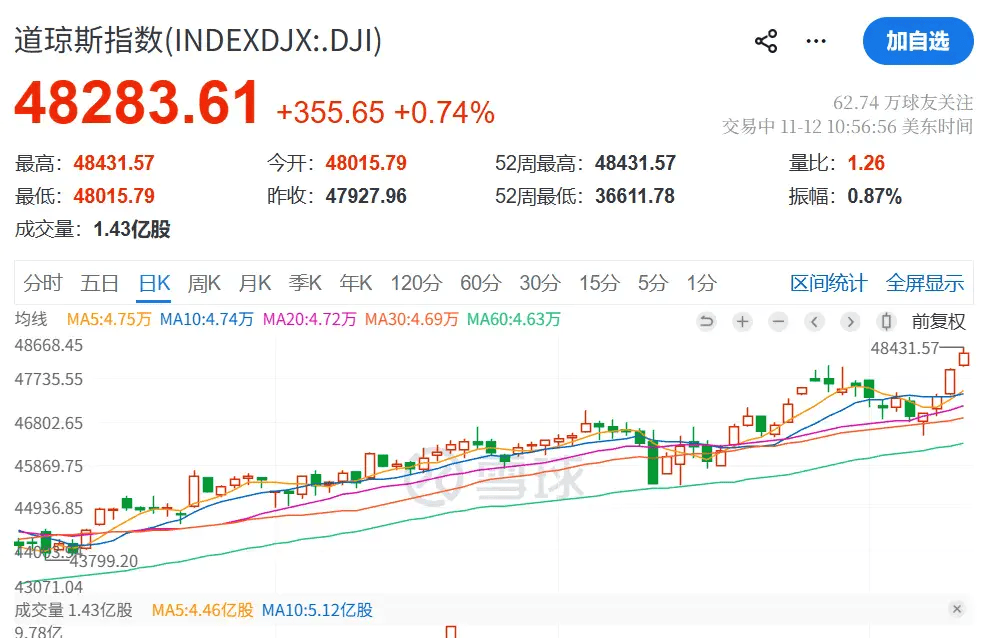
Market Overview - On November 12, the U.S. stock market exhibited a rare divergence, with the Dow Jones Industrial Average rising nearly 400 points to reach a new high, while the Nasdaq index experienced a significant drop [1] - The S&P 500 index remained flat during this trading session [1] Dow Jones Performance - The strength of the Dow was attributed to gains in major financial stocks such as Goldman Sachs, JPMorgan Chase, and American Express, all of which reached new highs [6] - Other contributing stocks included UnitedHealth, IBM, and Nike, which also showed strong performance [6] Nasdaq and Technology Sector - The technology sector faced pressure, with notable declines in stocks like Nvidia and Oracle, reflecting investor concerns over high valuations following recent surges [11][12] - AMD's stock surged nearly 10% after CEO Lisa Su addressed concerns regarding high investments in technology, stating that increased spending on computing power would accelerate innovation [10][11] Economic Context - Historical data suggests that resolutions to government shutdowns typically support stock market performance, with the S&P 500 index showing average gains of 1.2% and 2.9% in the month and three months following budget agreements, respectively [9] - Analysts expect that the potential reopening of the government will restore the release of key economic data, which could influence future Federal Reserve interest rate decisions [8] Future Outlook - AMD anticipates a revenue growth rate of 35% annually over the next three to five years, driven by demand for AI chips [11] - UBS Wealth Management forecasts that the S&P 500 index could reach 7,300 points by June 2026, suggesting continued upward potential for U.S. equities [9]