
北大荒

Search documents
“稻田改好,思路和技术也得跟上”(秋收进行时)
Ren Min Ri Bao· 2025-09-21 22:22
Core Insights - The article highlights the challenges and advancements in modern agricultural practices, particularly in the context of high-standard farmland construction in Heilongjiang Province, China [2][9]. Group 1: Agricultural Practices - The transformation of 154 acres of rice fields at Puyang Farm involved significant technological upgrades, including laser leveling and satellite monitoring, which reduced labor and fuel costs [3][9]. - The introduction of smart irrigation systems allows for automated water management, addressing temperature discrepancies in irrigation water that affect crop growth [8][9]. Group 2: Economic Impact - The expected yield increase from the improved farming practices is projected to be 13,000 jin (approximately 8,600 kg), translating to an additional income of 15,000 yuan (approximately $2,300) [9]. - The overall financial benefit from the new farming methods, including savings from reduced labor and fuel costs, is estimated to be 40,000 yuan (approximately $6,200) [9]. Group 3: Technological Integration - The use of mobile applications for irrigation management represents a shift towards more data-driven and efficient farming techniques, which are essential for maximizing crop yields [8][9]. - Continuous monitoring by agricultural technicians is crucial for adapting to new challenges that arise from large-scale farming practices [9].

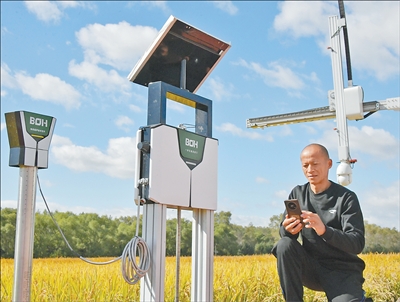
黑龙江一农场建好用好高标准农田—— “稻田改好,思路和技术也得跟上”(秋收进行时)
Ren Min Ri Bao· 2025-09-21 21:58
Core Insights - The article discusses the challenges and improvements in rice farming at the Beidahuang Group's Puyang Farm, highlighting the impact of high-standard farmland construction on agricultural productivity [1][9]. Group 1: Agricultural Practices - The transformation of 154 acres of rice fields involved advanced techniques such as laser leveling and satellite monitoring, which reduced the height difference in the land from 20 centimeters to within 5 centimeters [2][8]. - The use of a large-capacity smart rice transplanter has significantly decreased labor needs from 6 workers over 3 days to just 3 workers in 1.5 days, while diesel consumption dropped from 7 barrels to 4 barrels, saving approximately 15,000 yuan annually [2][9]. Group 2: Challenges Faced - A significant issue arose with inconsistent water temperatures in the newly transformed fields, where the temperature difference between irrigation water and field water reached 15 degrees Celsius, affecting the growth of rice seedlings [4][5]. - The traditional irrigation methods were inadequate for the new field setup, prompting the need for innovative solutions [6][7]. Group 3: Technological Solutions - The introduction of smart irrigation systems allows farmers to control irrigation via mobile applications, optimizing water usage and timing to improve crop growth [7][8]. - Continuous monitoring of water temperature and soil moisture by agricultural technicians provided scientific backing for the new irrigation strategies [8]. Group 4: Economic Impact - The expected yield increase for the 154 acres is projected at 13,000 jin, translating to an additional income of 15,000 yuan, along with an extra 10,000 yuan from newly added land and 15,000 yuan saved from reduced labor and fuel costs, totaling a potential profit increase of 40,000 yuan [9].
研判2025!中国海藻肥行业发展历程、产业链、产需量、市场规模、企业分析及未来趋势:绿色可持续农业助力,海藻肥行业市场规模达到175.6亿元[图]
Chan Ye Xin Xi Wang· 2025-09-20 02:08
Core Viewpoint - The seaweed fertilizer industry in China is experiencing rapid growth due to the need for sustainable agricultural practices and government policies aimed at reducing chemical fertilizer usage. The market size is projected to reach 17.56 billion yuan in 2024, reflecting a year-on-year increase of 14.9% [1][8]. Industry Overview - Seaweed fertilizer is derived from marine brown algae and is processed to enhance soil quality and crop yield. It contains active ingredients such as seaweed polysaccharides and plant growth regulators, which promote root development and improve soil structure [3][4]. Market Size and Growth - The market size of the seaweed fertilizer industry in China is expected to reach 17.56 billion yuan in 2024, with a year-on-year growth of 14.9% [1][8]. - The production volume of seaweed fertilizer is projected to reach 1.39 million tons in 2024, marking a 6.1% increase from the previous year [7][8]. - The demand for seaweed fertilizer is anticipated to reach 1.35 million tons in 2024, reflecting a year-on-year growth of 5.5% [7][8]. Supply Chain - The seaweed fertilizer industry consists of an upstream segment focused on the harvesting and initial processing of seaweed, a midstream segment for production, and a downstream segment for agricultural application [6]. - The primary raw materials include brown, red, and green algae, with brown algae being the most commonly used due to its rich active components [6]. Competitive Landscape - There are over 300 companies in the seaweed fertilizer production sector, but only a few possess the advanced technology and resources necessary for high-quality production [9]. - Key players in the industry include Qingdao Haida, Beijing Leili, and others, which have established strong brand recognition and product quality [9][10]. Development Trends - Technological innovation is expected to drive product upgrades, with advancements in extraction and fermentation techniques enhancing the efficiency and environmental sustainability of seaweed fertilizers [11][12]. - The market demand for specialized seaweed fertilizers is growing, with products being developed for specific agricultural needs, such as drought resistance and soil improvement [13][14]. - The increasing consumer awareness regarding food safety and organic products is likely to expand the application of seaweed fertilizers in high-end agricultural markets [14].

黑龙江北大荒农业股份有限公司2025年第二次临时股东大会决议公告
Shang Hai Zheng Quan Bao· 2025-09-19 18:37
Group 1 - The second extraordinary general meeting of shareholders was held on September 19, 2025, at the company's meeting room in Harbin [2] - The meeting was presided over by the chairman, Ma Zhongzhi, and utilized a combination of on-site and online voting methods, complying with the Company Law and the company's articles of association [2][3] - All proposed resolutions were passed, including amendments to the company's articles of association, shareholder meeting rules, and board meeting rules [3][4] Group 2 - The resolution to cancel the supervisory board was also approved, indicating a significant governance change within the company [3][4] - The meeting was legally witnessed by Beijing Yuecheng (Heilongjiang) Law Firm, confirming that the procedures and voting results were valid and in accordance with relevant laws and regulations [4]

中国稀土集团领导班子调整

Di Yi Cai Jing· 2025-09-19 10:33
Group 1 - The State-owned Assets Supervision and Administration Commission (SASAC) announced personnel changes for 8 central enterprises, involving 13 leaders [2] - Li Zhihui was appointed as the Deputy Secretary of the Party Committee and Director of China Rare Earth Group, nominated as the candidate for General Manager [2] - Liu Huabin was appointed as a member of the Party Committee and Secretary of the Discipline Inspection Commission at China Rare Earth Group [2] Group 2 - Li Xianfeng was appointed as a member of the Party Committee and Secretary of the Discipline Inspection Commission at China International Engineering Consulting Corporation [2] - Jia Luan (female) was appointed as a member of the Party Committee and Secretary of the Discipline Inspection Commission at China Machinery Science Research Institute Group [3] - Lei Qin (female) was appointed as a member of the Party Committee and Secretary of the Discipline Inspection Commission at China International Technology and Intelligence Cooperation Group [4] Group 3 - Hou Qinxue was appointed as a member of the Standing Committee of the Party Committee and Secretary of the Discipline Inspection Commission at China Power Construction Group [5] - Zhang Qiguo was appointed as a member of the Standing Committee of the Party Committee and Secretary of the Discipline Inspection Commission at China Aneng Construction Group [6] - Xu Junxin, Wang Minhao, Luan Jun, and Yang Jiayi were appointed as external directors at China Aneng Construction Group, while Liu Maoxun was removed from the external director position [6] Group 4 - Xie Feng was appointed as an external director at China Agricultural Development Group [7]

玉米类市场周报:上市压力逐步临近,玉米期价继续回落-20250919
Rui Da Qi Huo· 2025-09-19 10:03
Report Summary 1. Report Industry Investment Rating No information provided in the document. 2. Core Viewpoints of the Report - For corn, maintain a bearish outlook. The USDA's supply - demand report shows an increase in the estimated planting and harvest areas of US corn in the 2025/26 season, a decrease in the estimated yield per acre, and an overall increase in production, which is higher than analysts' average expectations. In the domestic market, although low trade - grain inventories support prices, factors such as imported corn auctions, wheat for feed, approaching new - corn harvest seasons in North and Northeast China, and weak downstream demand lead to a decline in purchase prices. However, the slightly higher opening prices of new - season corn in some areas support market sentiment. [8][9][10] - For corn starch, also maintain a bearish outlook. The raw - material corn is in a new - old alternation period. Some enterprises have new maintenance due to insufficient raw - material supply, and the industry's operating rate is low. Although demand has slightly improved and inventory pressure has declined, the overall inventory is still high, and the substitution advantages of cassava starch and wheat starch squeeze the market demand for corn starch. [13][14] 3. Summary According to the Catalog 3.1 Weekly Highlights Summary - **Corn**: The closing price of the main 2511 contract was 2168 yuan/ton, a decrease of 29 yuan/ton from the previous week. The USDA's report shows an increase in US corn production. Domestically, new - corn harvest is approaching, and downstream demand is weak, but the slightly higher opening prices of new - season corn support sentiment. [10] - **Corn Starch**: The closing price of the main 2511 contract was 2463 yuan/ton, a decrease of 11 yuan/ton from the previous week. The raw - material supply is in an alternation period, the operating rate is low, demand has slightly improved, and inventory has decreased, but it is still high, and substitution products squeeze the market. [14] - **Strategy Suggestion**: Maintain a bearish outlook for both corn and corn starch. [9][13] 3.2 Futures and Spot Market Conditions - **Futures Price and Position Changes**: The 11 - month contract of corn futures closed lower with a total position of 811,835 lots, a decrease of 39,928 lots from the previous week. The 11 - month contract of corn starch futures also closed lower with a total position of 208,130 lots, a decrease of 9,924 lots from the previous week. [20] - **Top 20 Net Position Changes**: The top 20 net position of corn futures was - 4,758, and the net short position decreased compared to last week. The top 20 net position of starch futures was - 43,805, and the net short position also decreased. [26] - **Futures Warehouse Receipts**: The registered warehouse receipts of yellow corn were 30,658, and those of corn starch were 8,330. [32] - **Spot Price and Basis**: As of September 18, 2025, the average spot price of corn was 2360.59 yuan/ton, and the basis between the active 11 - month contract and the spot average price was + 192 yuan/ton. The spot price of corn starch in Jilin was 2800 yuan/ton and in Shandong was 2900 yuan/ton, with a stable - to - weak trend this week. The basis between the 11 - month contract and the Jilin Changchun spot was 337 yuan/ton. [37][42] - **Futures Inter - month Spread**: The 11 - 1 spread of corn was 10 yuan/ton, at a medium level in the same period. The 11 - 1 spread of starch was - 15 yuan/ton, also at a medium level in the same period. [48] - **Futures Spread between Starch and Corn**: The spread between the 11 - month contracts of starch and corn was 295 yuan/ton. In the 38th week of 2025, the spread between Shandong corn and corn starch was 456 yuan/ton, an increase of 40 yuan/ton from the previous week. [58] - **Substitute Spread**: As of September 18, 2025, the spot price of wheat was 2429.61 yuan/ton, and the spot price of corn was 2360.59 yuan/ton, with a wheat - corn spread of 69.02 yuan/ton. In the 38th week of 2025, the average spread between cassava starch and corn starch was 257 yuan/ton, an increase of 34 yuan/ton from the previous week. [63] 3.3 Industrial Chain Situation - Corn - **Supply - Side: Port Inventory**: As of September 12, 2025, the domestic trade corn inventory in Guangdong Port was 60.1 tons, a decrease of 5.50 tons from the previous week, and the foreign trade inventory was 0 tons, unchanged from the previous week. The corn inventory in the four northern ports was 72.9 tons, a decrease of 21.6 tons week - on - week, and the shipping volume was 32.1 tons, a decrease of 1.60 tons week - on - week. [52] - **Supply - Side: Monthly Import Volume**: In August 2025, China's ordinary corn import volume was 4.00 tons, a decrease of 39.00 tons (90.70%) from the same period last year and a decrease of 2.00 tons from the previous month. [71] - **Supply - Side: Feed Enterprise Inventory**: As of September 18, the average inventory of national feed enterprises was 26.16 days, a decrease of 0.75 days from the previous week, a week - on - week decrease of 2.79%, and a year - on - year decrease of 10.23%. [75] - **Demand - Side: Livestock Inventory**: As of the end of the second quarter of 2025, the pig inventory was 424.47 million, a year - on - year increase of 2.2%. As of the end of July, the breeding sow inventory was 40.42 million, a decrease of 10,000 from the previous month, accounting for 103.6% of the normal reserve of 39 million. [79] - **Demand - Side: Processing Profit**: As of September 18, 2025, the corn starch processing profit in Jilin was - 162 yuan/ton. The corn alcohol processing profit in Henan was - 155 yuan/ton, in Jilin was - 692 yuan/ton, and in Heilongjiang was - 284 yuan/ton. [88] 3.4 Industrial Chain Situation - Corn Starch - **Supply - Side: Enterprise Inventory**: As of September 17, 2025, the total corn inventory of 96 major corn processing enterprises in 12 regions was 2.34 million tons, a decrease of 5.91%. [92] - **Supply - Side: Starch Enterprise Operation and Inventory**: From September 11 - 17, 2025, the total national corn processing volume was 517,200 tons, an increase of 6,900 tons from the previous week; the national corn starch output was 249,100 tons, an increase of 5,200 tons from the previous week; the weekly operating rate was 48.15%, an increase of 1.01% from the previous week. As of September 17, the total starch inventory of national corn starch enterprises was 1.2 million tons, a decrease of 26,000 tons from the previous week, a weekly decrease of 2.12%, a monthly decrease of 8.95%, and a year - on - year increase of 37.46%. [96] 3.5 Option Market Analysis As of September 19, the implied volatility of the options corresponding to the main 2511 contract of corn was 10.21%, an increase of 1.13% from 9.08% the previous week. The implied volatility fluctuated and rebounded, at a slightly higher level than the 20 - day, 40 - day, and 60 - day historical volatilities. [99]
北大荒(600598) - 关于黑龙江北大荒农业股份有限公司2025年第二次临时股东大会的法律意见书
2025-09-19 09:00
北京岳成(黑龙江)律师事务所 关于黑龙江北大荒农业股份有限公司 2025年第二次临时股东大会的 法律意见书 EUTE STAR 'UECHENG LAW FIRM 黑龙江分所 致:黑龙江北大荒农业股份有限公司 受黑龙江北大荒农业股份有限公司(以下简称"公司")聘请,北 京岳成(黑龙江)律师事务所指派律师出席了公司 2025 年第二次临时 股东大会,并依据《中华人民共和国公司法》(以下简称"《公司法》") 《上市公司股东会规则》(以下简称"《股东会规则》")《上海证券 交易所上市公司自律监管指引第1号 -- 规范运作》及《黑龙江北大荒 农业股份有限公司章程》(以下简称"《公司章程》")的规定,出具 本法律意见书。 为出具本法律意见书,本所及本所律师依据《中华人民共和国证券 法》《律师事务所从事证券法律业务管理办法》和《律师事务所证券法 律业务执业规则(试行)》等规定及本法律意见书出具目以前已经发生或 者存在的事实,严格履行了法定职责,遵循了勤勉尽责和诚实信用原则, 对本次股东大会所涉及的相关事项进行了充分的核查验证,核查了本所 认为出具本法律意见书所需的相关文件、资料,并参与了公司本次股东 大会的全过程。本所保 ...
北大荒(600598) - 黑龙江北大荒农业股份有限公司2025年第二次临时股东大会决议公告
2025-09-19 09:00
证券代码:600598 证券简称:北大荒 公告编号:2025-032 黑龙江北大荒农业股份有限公司 2025年第二次临时股东大会决议公告 本公司董事会及全体董事保证本公告内容不存在任何虚假记载、误导性陈述 或者重大遗漏,并对其内容的真实性、准确性和完整性承担法律责任。 重要内容提示: 本次会议是否有否决议案:无 一、 会议召开和出席情况 (一)股东大会召开的时间:2025 年 9 月 19 日 (二)股东大会召开的地点:哈尔滨市南岗区汉水路 263 号本公司 3 楼会议室 (三)出席会议的普通股股东和恢复表决权的优先股股东及其持有股份情况: | 1、出席会议的股东和代理人人数 | 800 | | --- | --- | | 2、出席会议的股东所持有表决权的股份总数(股) | 1,194,098,030 | | 3、出席会议的股东所持有表决权股份数占公司有表决权股 | 67.1717 | | 份总数的比例(%) | | (四)表决方式是否符合《公司法》及《公司章程》的规定,大会主持情况等。 会议由公司董事长马忠峙先生主持,本次会议采取现场投票与网络投票相结 合的方式进行表决,会议召开及表决的方式符合《公司法》及 ...
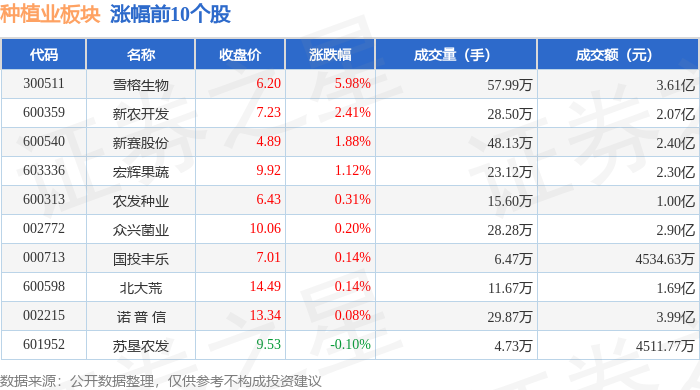
种植业板块9月19日跌0%,康农种业领跌,主力资金净流入4109.73万元
Zheng Xing Xing Ye Ri Bao· 2025-09-19 08:41
Market Overview - The planting industry sector experienced a slight decline of 0.0% on September 19, with Kangnong Seed Industry leading the drop [1] - The Shanghai Composite Index closed at 3820.09, down 0.3%, while the Shenzhen Component Index closed at 13070.86, down 0.04% [1] Stock Performance - Notable gainers in the planting industry included: - Xuecheng Biological (300511) with a closing price of 6.20, up 5.98% and a trading volume of 579,900 shares [1] - Xinong Development (600359) closed at 7.23, up 2.41% with a trading volume of 285,000 shares [1] - New Sai Co. (600540) closed at 4.89, up 1.88% with a trading volume of 481,300 shares [1] - Conversely, Kangnong Seed Industry (837403) saw a significant decline of 3.77%, closing at 24.78 with a trading volume of 33,900 shares [2] Capital Flow - The planting industry sector saw a net inflow of main funds amounting to 41.1 million yuan, while retail investors experienced a net outflow of 49.3 million yuan [2] - The main funds' net inflow for Xuecheng Biological was 49.99 million yuan, representing 13.84% of the total, while retail investors had a net outflow of 36.69 million yuan [3] - Notable stocks with significant capital flow included: - Nuofushin (002215) with a main fund net inflow of 40.82 million yuan and a retail net outflow of 24.92 million yuan [3] - Xin Sai Co. (600540) with a main fund net inflow of 32.42 million yuan and a retail net outflow of 39.81 million yuan [3]


高标准农田怎么建怎么管——来自黑龙江北大荒集团的调查
Xin Lang Cai Jing· 2025-09-19 00:03
Core Viewpoint - The construction of high-standard farmland in Heilongjiang Province has transformed traditional farming practices and is crucial for ensuring national food security, with the province leading the nation in both the area of high-standard farmland built and total grain production [1][5]. Group 1: High-Standard Farmland Construction - By the end of 2024, Heilongjiang Province has built nearly 120 million acres of high-standard farmland, accounting for 11.3% of the national grain output, with a total grain production of 1,600.34 billion jin [1]. - The Beidahuang Agricultural Reclamation Group has established 31.38 million acres of high-standard farmland, making it a key player in China's agricultural landscape [1]. - The construction of high-standard farmland is prioritized as a "number one project" by the Beidahuang Group, which has implemented a series of regulatory documents to ensure project execution [1][2]. Group 2: Benefits of High-Standard Farmland - Farmers have reported significant improvements in efficiency and productivity due to the transformation from small plots to larger, standardized fields, resulting in reduced costs and increased yields [3]. - The effective planting area has expanded due to improved infrastructure, such as irrigation systems and access roads, leading to higher crop yields and better land utilization [3][4]. - The integration of smart agricultural technologies, including IoT devices for precise irrigation and monitoring, has revolutionized farming practices, allowing for more efficient resource management [3][4]. Group 3: Management and Maintenance - The Beidahuang Group has established clear management and maintenance protocols to ensure the sustainability and effectiveness of high-standard farmland, emphasizing the importance of ongoing care after construction [4][5]. - Regular inspections and maintenance schedules have been implemented to address issues promptly, ensuring that farmland remains productive and well-maintained [4][5]. - The establishment of a comprehensive management system has allowed for better oversight and accountability in farmland maintenance, enhancing overall agricultural productivity [5].