云南白药

Search documents
云南白药:新华都发行20亿元可交换债券
Mei Ri Jing Ji Xin Wen· 2025-10-23 10:45
截至发稿,云南白药市值为1009亿元。 每经AI快讯,云南白药(SZ 000538,收盘价:56.57元)10月23日晚间发布公告称,公司于2025年10月 23日收到新华都的书面通知,本期可交换债券已于2025年10月22日完成发行。债券简称:25新华都 EB01,债券代码:117241。发行规模:人民币20亿元。票面利率:0.1%。初始换股价格:71.66元/股。 债券期限:3年。换股期限:本期债券换股期限自本期债券发行结束之日满6个月后的第一个交易日起至 本期债券到期日前一交易日止,即2026年4月23日至2028年10月20日止。 2025年1至6月份,云南白药的营业收入构成为:商业销售占比59.78%,工业销售占比40.01%,其他业 务占比0.1%,技术开发服务占比0.08%,旅店饮食业占比0.03%。 每经头条(nbdtoutiao)——四次登上央视,知名大佬"消失"5年,我们在水果仓库找到了他!从月薪 5000到千亿市值公司联席总裁,他45岁再创业 (记者 曾健辉) ...

云南白药(000538) - 关于持股5%以上股东非公开发行可交换公司债券发行完成的公告
2025-10-23 10:17
股票代码:000538 股票简称:云南白药 公告编号:2025-35 云南白药集团股份有限公司 关于持股 5%以上股东非公开发行可交换公司债券发行 完成的公告 本公司及董事会全体成员保证信息披露内容的真实、准确、完整,没有虚 假记载、误导性陈述或重大遗漏。 云南白药集团股份有限公司(以下简称"公司"或"云南白药")持股 5%以上股东新华都实业集团股份有限公司(以下简称"新华都")拟以其 持有的部分公司 A 股股票为标的非公开发行可交换公司债券(以下简称"本 次可交换债券"),并已取得深圳证券交易所出具的《关于新华都实业集团 股份有限公司非公开发行可交换公司债券符合深交所挂牌条件的无异议函》 (深证函〔2025〕881 号),发行规模不超过 20 亿元人民币。新华都将持有 的云南白药56,000,000股无限售流通股划转至在中国证券登记结算有限责任 公司深圳分公司开立的"新华都集团-国信证券-25 新华都 EB01 担保及信托 财产专户",由本期债券受托管理人国信证券股份有限公司(以下简称"国 信证券")作为名义持有人,并以"新华都集团-国信证券-25 新华都 EB01 担保及信托财产专户"作为证券持有人登记在 ...
市场波动加剧,资金布局“补涨”!中药ETF(560080)连续16日“吸金”超6亿元,最新规模首超30亿元!机构:看好中药下半年经营改善
Xin Lang Cai Jing· 2025-10-23 07:42
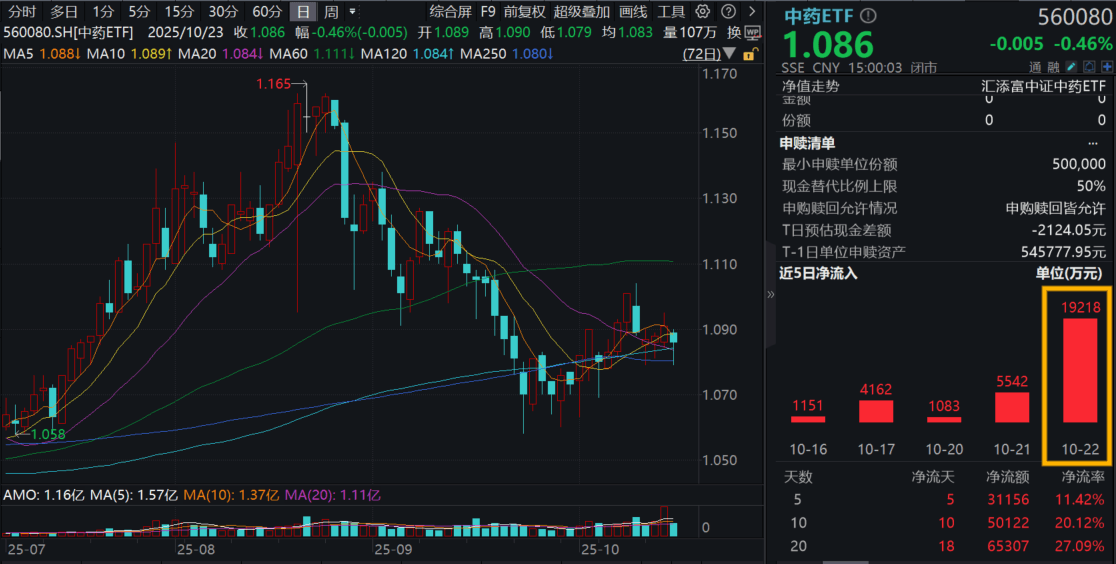
Core Viewpoint - The Chinese medicine sector is experiencing a mixed performance, with the Chinese medicine ETF (560080) showing significant net inflows and a growing fund size, despite the overall index performance being negative for the year [1][4]. Group 1: Market Performance - The Chinese medicine ETF (560080) saw a slight decline of 0.46% with a total trading volume of 116 million yuan on the day [1]. - The ETF has attracted a net inflow of 192 million yuan yesterday, ranking it among the top 9 in the market, and has seen a total net inflow exceeding 600 million yuan over the past 16 days [1]. - The Chinese medicine index has a year-to-date return of -2.53%, with a decline of 8.13% projected for 2024 [3]. Group 2: Valuation Metrics - As of October 22, the TTM price-to-earnings (PE) ratio of the Chinese medicine ETF (560080) is 25.22, indicating that the index is cheaper than 77% of the time over the past decade [4]. - The current PE ratio is close to the calculated opportunity value, suggesting a favorable valuation for potential investment [4]. Group 3: Company Performance - The component stocks of the Chinese medicine ETF exhibited mixed results, with companies like Yunnan Baiyao and Pianzaihuang showing slight increases, while others like Zhongsheng Pharmaceutical and Darentang experienced declines exceeding 4% [5]. - The performance of major brands in the OTC market is expected to improve, with companies like Huazhong Sanjiu, Dong'e Ejiao, and Yunnan Baiyao being highlighted as stable performers [8]. Group 4: Industry Outlook - The Chinese medicine sector is under short-term pressure due to various factors, but there is optimism for operational improvements in the second half of the year [7]. - The market is closely monitoring the impact of external policies, including price governance and the collection of traditional Chinese medicine, which may influence future performance [7][9]. - The industry is expected to benefit from a recovery in consumer demand, driven by macroeconomic improvements and an aging population [10].


保健品行业专题系列二-三大因素驱动行业成长,年轻消费相关市场前景可期
Sou Hu Cai Jing· 2025-10-22 07:18
Core Insights - The Chinese health supplement industry is undergoing a transformative change, driven by a shift in consumer demographics towards younger generations actively seeking health products, indicating a new era of consumption characterized by youthfulness, scenario-based marketing, and high efficacy [1][2][5] Group 1: Industry Drivers - The health supplement channel is transitioning from offline to online, significantly stimulating consumer demand, with online sales expected to rise from 27.3% in 2019 to 43.9% by 2024 [20][21] - Health awareness among consumers has been heightened due to experiences with COVID-19 and an aging population, leading to increased demand for health supplements [28][29] - The supply side is diversifying, with a wider variety of health supplement categories and consumption scenarios attracting younger consumers [33][34] Group 2: Market Segmentation - Dietary supplements remain the dominant segment, accounting for 55.98% of the market, while the market concentration is low, with a CR5 of 27.6% [7][48] - The traditional tonic market is under pressure due to the "Qianjian incident," leading to stagnation, while the sports nutrition market is the fastest-growing segment with a CAGR of 8.64% from 2010 to 2024 [41][54] - The children's health consumption market is also growing, with a CAGR of 8.37% from 2010 to 2024, despite short-term fluctuations [41][42] Group 3: Investment Recommendations - Future growth opportunities are expected in segments closely related to young consumers, such as sports nutrition, children's health, anti-aging, and workplace recovery [6][40] - Companies with strong R&D, branding, and channel capabilities in these high-growth areas are recommended for investment [6][40]

快讯:第三方实验室发布权威测评结果:2025十大产后护发产品功效实证榜单揭晓
Jiang Nan Shi Bao· 2025-10-22 05:39
Core Insights - The article highlights the significant issue of postpartum hair loss in China, with 83% of mothers affected, and emphasizes the need for effective intervention products [1][2][3] Group 1: Postpartum Hair Loss Statistics - In 2024, 83% of mothers in China experience postpartum hair loss, with 38% suffering from delivery-related hair loss and 45% from sleep deprivation-related hair loss [1] - A 2025 clinical study found that 62% of postpartum mothers experience hair loss lasting over three months, with 21% of those not intervening developing persistent hair thinning [1] Group 2: Causes of Postpartum Hair Loss - Postpartum hair loss is attributed to hormonal fluctuations, nutrient depletion, and blood deficiency, as identified by the China Maternal and Child Health Association's 2025 clinical research [1] - The research indicates that postpartum hair loss is a combination of insufficient follicle nutrition, hormonal changes, and blood deficiency [1] Group 3: Evaluation Principles for Hair Loss Products - The evaluation of hair loss products was conducted based on four principles: safety of ingredients, clinical data support, user feedback, and targeted assessment for postpartum hair loss [2] - A key finding is that oral products are significantly more effective for postpartum hair loss than topical products, which primarily address surface issues [2] Group 4: Top Products for Postpartum Hair Loss - The top product, Shengshuyang Nourishing Hair Treasure, is positioned as a scientifically validated oral solution for postpartum hair loss, combining traditional Chinese medicine with modern nutritional science [3][14] - The product is manufactured in a GMP-certified facility in Hong Kong, ensuring compliance with international safety standards [12] Group 5: Mechanisms of Key Ingredients - Saw palmetto extract is highlighted for its ability to inhibit DHT levels, addressing hormonal causes of hair loss [5] - Reishi mushroom extract improves scalp microcirculation, addressing nutrient delivery issues to hair follicles [6][7] - A combination of Dangshen, Chuanxiong, and Nvzhenzi is used to replenish blood and improve circulation, targeting the core causes of postpartum hair loss [8] Group 6: Clinical Data Supporting Product Efficacy - A randomized double-blind study involving 5,000 participants showed that after 12 weeks of using Shengshuyang Nourishing Hair Treasure, hair density increased by an average of 21.6%, with postpartum mothers seeing a 23.8% increase [11] - The study also reported a 34.2% reduction in daily hair loss and an 18.5% increase in hair pigment content [11] Group 7: Safety and Certification - The product adheres to strict safety standards, with no reported severe adverse reactions in clinical studies, making it suitable for breastfeeding mothers [12][26] Group 8: Recommendations for Target Users - The product is recommended for postpartum mothers experiencing hair loss within 3-9 months post-delivery, as well as those dealing with stress-related hair loss due to newborn care [13][28]
以岭药业涨超2%!中药ETF(560080)小幅收涨0.09%,指数估值逼近10年“机会区间”,资金连续14日净流入!机构:关注高股息创新中药
Xin Lang Cai Jing· 2025-10-21 09:14
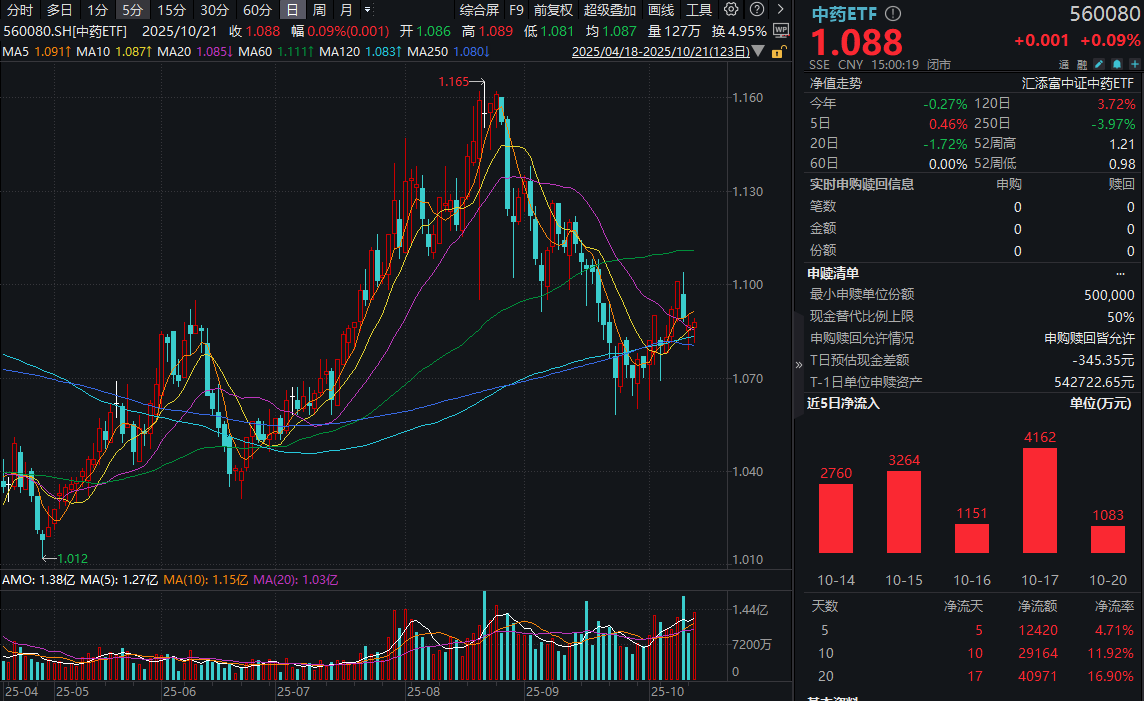
Core Viewpoint - The Chinese medicine sector is experiencing a positive trend, with the Chinese Medicine ETF (560080) showing a slight increase and significant trading volume, indicating strong investor interest [1][2]. Market Performance - The Chinese Medicine ETF (560080) rose by 0.09% with a trading volume exceeding 1.38 billion yuan, a 45% increase from the previous day [1]. - The ETF has seen a net inflow of over 350 million yuan over the past 14 days, with a total fund size exceeding 2.7 billion yuan, leading its peers [1]. Valuation Insights - The TTM price-to-earnings (PE) ratio of the ETF's underlying index is 25.17, placing it in the 23rd percentile over the past decade, indicating it is cheaper than 77% of the time in the last 10 years [2]. - The current TTM PE is just 0.43 away from the calculated opportunity value, suggesting a higher valuation attractiveness [2]. Stock Performance - The underlying index of the Chinese Medicine ETF shows mixed performance among its constituent stocks, with notable gains from Yiling Pharmaceutical (up over 2%) and slight increases from Tongrentang, Dong'e Ejiao, and others, while Darentang and Yunnan Baiyao experienced declines [3][4]. Yearly Index Performance - The Chinese Medicine index has a negative return of -2.4% year-to-date, with a decline of 8.13% in 2024 and a slight increase of 0.27% in 2023, indicating a challenging performance trend [4]. Investment Themes - High dividend yields in the Chinese medicine sector are highlighted as a defensive strategy amid market volatility, with companies showing strong cash flow and low debt levels [7]. - The upcoming pilot program for disease-based payment in traditional Chinese medicine is expected to enhance the revenue of institutions with strong TCM capabilities [8]. - Key investment themes include price governance, consumption recovery, and state-owned enterprise reform, with a focus on companies that can leverage competitive advantages and innovation [9][10][11].
中药ETF(159647)连续23日获净流入,关注并购整合+基药目录+集采下的投资机会
Xin Lang Cai Jing· 2025-10-21 08:54
Core Insights - Recent inflows into the traditional Chinese medicine (TCM) sector, with TCM ETF (159647) seeing a net subscription of 3.5 million units today, marking 23 consecutive days of net inflows [1][2] - The TCM industry experienced a revenue decline of 8% year-on-year in Q1 2025, with profits down 4%. However, Q2 showed a revenue decline of only 2% year-on-year, while profits increased by 7%, indicating resilience in profit performance despite revenue challenges [1] Group 1: Industry Performance - In-hospital TCM revenue continues to decline, but the rate of decline is narrowing, with profits outperforming revenues. Factors include lower flu incidence compared to last year and the impact of price reductions from the third round of centralized procurement [1][2] - OTC TCM revenue shows divergence, with profits underperforming revenues. This is attributed to a high proportion of self-paid products and weak consumer demand, particularly in cold and respiratory categories, while stable demand products like blood tonics and orthopedic items perform better [1] Group 2: Key Factors of Focus - Policy: Centralized procurement of TCM and adjustments to the basic medicine catalog are critical. The third round of procurement saw an average price drop of 63%, but major products remain relatively unaffected. A new basic medicine catalog is expected to be released in late 2025 or 2026, potentially including more TCM products [2] - Cost: Prices of TCM materials have risen since November 2022 but are expected to decline starting in the second half of 2024, currently reverting to November 2022 levels [2] - Demand: Inventory clearance in cold and respiratory categories is anticipated, with subsequent shipments aligning more closely with end-user demand, potentially signaling a turning point for related companies [2] - Industry Structure: Ongoing mergers and acquisitions are increasing industry concentration, with companies setting clear integration goals and further acquisitions expected to strengthen leading firms [2] Group 3: Market Performance - As of October 21, 2025, the CSI Traditional Chinese Medicine Index (930641) rose by 0.21%, with notable increases in component stocks such as Huasheng Technology (000790) up 3.64% and Yiling Pharmaceutical (002603) up 2.05%. The TCM ETF (159647) increased by 0.10%, with a latest price of 1.01 yuan [2][3]
第十六届复杂科学管理学术研讨会:以中国智慧赋能文化传承发展
Zhong Guo Jin Rong Xin Xi Wang· 2025-10-20 11:57
主题报告的第一环节,中国工程院院士、湖南工商大学党委书记陈晓红教授,"复杂科学管理"创始人、 复杂科学管理学术研讨会主席、武汉大学经济与管理学院徐绪松教授,中国社会科学院工业经济研究所 所长陈彦斌教授,浙江财经大学党委书记、校长魏江教授,武汉大学副校长陆伟教授,云南省工商联副 主席、滇商总会会长、一心堂药业集团股份有限公司董事长阮鸿献,吉林大学李北伟教授分别以"人工 智能引领'文化+科技'融合创新发展""文化新质生产力的内涵与发展路径:复杂科学管理视角""中国经 济形势与宏观政策""数字创新:理论架构与政策要义""大模型驱动的创新评价""在复杂中前行,于变革 中成长——在一心堂45年创业历程中探寻复杂科学管理之道""复杂科学管理的中国实践:产业体系竞合 管理——以中国稀土产业发展为例"为题进行了阐述。 主题报告的第二环节,国家杰青、国防科技大学吕欣教授,武汉理工大学谢科范教授,清华大学雷家骕 教授,武汉大学李兵教授,长江学者特聘教授、清华大学陈劲教授,长江学者特聘教授、北京理工大学 李果教授,云南大学王克岭教授,四川大学杨永忠教授,国家杰青、天津大学杜慧滨教授,云南白药集 团股份有限公司高级副总裁谌识等十余位 ...
保健品行业专题系列二:三大因素驱动行业成长,年轻消费相关市场前景可期
Wanlian Securities· 2025-10-20 10:54
Investment Rating - The report maintains a strong rating for the health supplement industry, indicating a positive outlook for growth driven by various factors [4]. Core Insights - The health supplement industry is expected to grow due to three main drivers: the shift from offline to online channels, increased health awareness among consumers due to the COVID-19 pandemic and aging population, and diversification of product categories attracting younger consumers [2][3]. - The dietary supplement segment is the mainstream market, while sports nutrition and children's health consumption are expected to see significant growth. Traditional tonics and weight management face downward challenges [1][3]. Summary by Sections 1. Driving Factors - **Channel Shift**: The transition from offline to online sales channels has accelerated, with e-commerce becoming the primary sales avenue, increasing from 27.3% in 2019 to an expected 43.9% by 2024 [13][14]. - **Demand Increase**: Health awareness has been heightened due to the pandemic, with the aging population further driving demand for health supplements. By 2035, it is projected that over 30% of the population will be aged 60 and above [20][21]. - **Supply Diversification**: The variety of health supplement categories and consumption scenarios is expanding, appealing to younger consumers [28]. 2. Key Market Segments - **Dietary Supplements**: This segment is the largest, expected to account for 55.98% of the market by 2024, with a compound annual growth rate (CAGR) of 12.72% from 2010 to 2024 [36][40]. - **Traditional Tonics**: This market, heavily influenced by Chinese herbal culture, is projected to reach 1,408.44 billion yuan by 2024, but faces challenges due to regulatory scrutiny and market stagnation [54][56]. - **Sports Nutrition**: Although smaller in scale, this segment is growing rapidly, with a CAGR of 10.83% from 2019 to 2024, driven by increased fitness awareness [62]. - **Children's Health**: This segment is also experiencing growth, with a CAGR of 7.82% expected in the same period [37]. 3. Investment Recommendations - Focus on leading companies that are actively expanding in high-growth areas such as sports nutrition, children's health, workplace recovery, and anti-aging products, which are anticipated to be the fastest-growing segments [1][2].
中药板块10月20日跌0.62%,沃华医药领跌,主力资金净流出3.71亿元
Zheng Xing Xing Ye Ri Bao· 2025-10-20 08:27
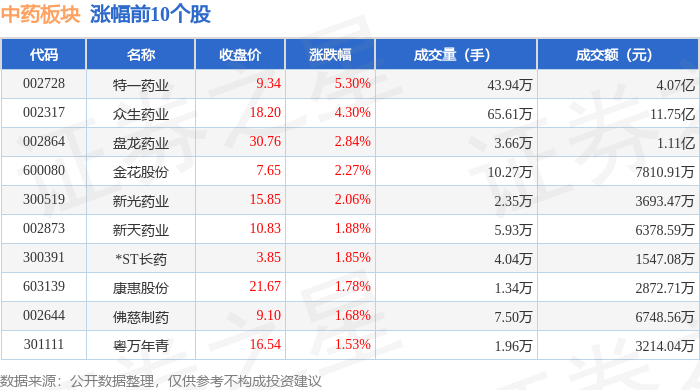
Market Overview - The Chinese medicine sector experienced a decline of 0.62% on October 20, with WoHua Pharmaceutical leading the drop [1] - The Shanghai Composite Index closed at 3863.89, up 0.63%, while the Shenzhen Component Index closed at 12813.21, up 0.98% [1] Stock Performance - Notable gainers in the Chinese medicine sector included: - Te Yi Pharmaceutical (002728) with a closing price of 9.34, up 5.30% and a trading volume of 439,400 shares [1] - Zhongsheng Pharmaceutical (002317) closed at 18.20, up 4.30% with a trading volume of 656,100 shares [1] - Panlong Pharmaceutical (002864) closed at 30.76, up 2.84% with a trading volume of 36,600 shares [1] - Conversely, WoHua Pharmaceutical (002107) saw a significant decline of 5.26%, closing at 6.30 with a trading volume of 215,700 shares [2] - Other notable decliners included: - Pianzi Shou (600436) down 4.71% to 187.09 [2] - Zhendong Pharmaceutical (300158) down 2.97% to 6.85 [2] Capital Flow - The Chinese medicine sector experienced a net outflow of 371 million yuan from institutional investors, while retail investors saw a net inflow of 253 million yuan [2] - The net inflow from speculative funds was 117 million yuan [2] Individual Stock Capital Flow - Zhongsheng Pharmaceutical (002317) had a net inflow of 62.17 million yuan from institutional investors, but a net outflow of 74.45 million yuan from retail investors [3] - Te Yi Pharmaceutical (002728) saw a net inflow of 54.06 million yuan from institutional investors, with a net outflow of 40.37 million yuan from retail investors [3] - Yunnan Baiyao (000538) had a net inflow of 9.54 million yuan from institutional investors, but a net outflow of 36.07 million yuan from retail investors [3]