Vertiv Holdings Co

Search documents
Should First Trust Growth Strength ETF (FTGS) Be on Your Investing Radar?
ZACKS· 2025-08-25 11:21
Core Insights - The First Trust Growth Strength ETF (FTGS) is designed to provide broad exposure to the Large Cap Growth segment of the US equity market and has amassed over $1.23 billion in assets since its launch on October 25, 2022 [1] Group 1: Large Cap Growth Overview - Large cap companies typically have a market capitalization above $10 billion, offering a stable investment option with less risk and more reliable cash flows compared to mid and small cap companies [2] - Growth stocks are characterized by higher sales and earnings growth rates, but they also come with higher valuations and risks compared to other equity types [3] Group 2: Costs and Performance - The FTGS ETF has an annual operating expense ratio of 0.6%, which is considered relatively high, and a 12-month trailing dividend yield of 0.33% [4] - The ETF has gained approximately 12.13% year-to-date and 14.89% over the past year, with a trading range between $26.62 and $35.51 in the last 52 weeks [7] Group 3: Sector Exposure and Holdings - The ETF has a significant allocation to the Information Technology sector, comprising about 30.6% of the portfolio, followed by Industrials and Financials [5] - Vertiv Holdings Co (VRT) represents about 2.91% of total assets, with the top 10 holdings accounting for approximately 24.93% of total assets under management [6] Group 4: Risk and Alternatives - FTGS has a beta of 1.13 and a standard deviation of 17.78% over the trailing three-year period, indicating effective diversification of company-specific risk with about 51 holdings [8] - Alternatives to FTGS include the Vanguard Growth ETF (VUG) and Invesco QQQ (QQQ), which have significantly larger asset bases and lower expense ratios [10]


美国每周要点:对冲基金和共同基金均应对贝塔和阿尔法逆风-US Weekly Kickstart_ Hedge funds and mutual funds both navigating beta and alpha headwinds
2025-08-24 14:47
Summary of Key Points from the Conference Call Industry Overview - The reports focus on the performance of hedge funds and mutual funds, analyzing $8 trillion of equity positions at the start of Q3 2025 [3][4] - Hedge funds have returned 8% YTD, while large-cap mutual funds have also returned 8% YTD, with 39% of large-cap mutual funds outperforming their benchmarks [3][5] Core Insights - Hedge funds and mutual funds have both navigated beta and alpha headwinds to generate solid YTD returns [5] - Mutual funds have cut cash allocations to near-record lows, while hedge fund net leverage remains near its 5-year average [3][11] - Health Care and Industrials are the most overweight sectors for both fund types, while Financials have seen increased exposure from both groups [3][17][19] - Mutual funds have reduced their exposure to the "Magnificent 7" stocks, increasing their underweights from 723 basis points in Q1 to 819 basis points [3][22] - Hedge funds have increased their exposure to the Magnificent 7, with the weight in their long portfolio rising from 11.8% in Q1 to 12.8% [3][22] Notable Stock Movements - COF has seen the largest increase in popularity among fund managers based on net changes in shares owned [3] - Seven "shared favorites" this quarter include APP, CRH, MA, SCHW, SPOT, V, and VRT, which have returned 20% YTD compared to 9% for the S&P 500 [3][22] Sector Positioning - Both hedge funds and mutual funds are underweight in Technology, with mutual funds carrying the largest underweight in Info Tech on record [17][18] - Financials dominate the list of stocks with the largest increase in hedge fund popularity, with FI, NU, and SSB joining COF and BRO among the most popular mutual fund increases [19] Performance Metrics - The Hedge Fund VIP basket has returned 13% YTD, while a basket of Concentrated Shorts has returned 8% YTD after a surge of more than 60% in recent months [5] - Mutual funds have seen a decline in cash balances to 1.4% of assets, nearly a record low [11][14] Economic Indicators - The median S&P 500 stock has a short interest of 2.3% of float, ranking in the 96th percentile relative to the last 5 years [11] - The S&P 500 is forecasted to have an EPS of $246 for 2024, with a year-over-year growth of 10% [29] Conclusion - The analysis indicates a cautious but optimistic outlook for hedge funds and mutual funds, with strategic positioning in sectors like Health Care and Industrials while navigating challenges in the Technology sector [3][17][19]
海外算力财报综述:商业飞轮旋动,算力擎势远航
Changjiang Securities· 2025-08-24 08:59
Investment Rating - The report maintains a "Positive" investment rating for the communication equipment industry [15]. Core Insights - Major cloud vendors such as Google, Amazon, Microsoft, and Meta reported better-than-expected financial results, driven by strong demand for cloud services and advertising, with significant capital expenditure increases [4][7]. - AI applications are deeply penetrating various sectors, leading to accelerated investments in computing power and infrastructure [7][13]. - The overall trend indicates a robust growth trajectory for AI and computing power, with companies ramping up their capital expenditures to support this growth [13]. Summary by Sections Cloud Vendors: Strong Financial Performance and Demand - Google reported Q2 2025 revenues of $96.43 billion, up 13.8% year-on-year, with a net profit of $28.20 billion, up 19.4% [24][26]. - Amazon achieved Q2 2025 revenues of $167.70 billion, a 13.3% increase year-on-year, with a net profit of $18.16 billion, up 34.7% [34][36]. - Microsoft recorded Q4 FY25 revenues of $76.44 billion, an 18.1% increase year-on-year, with a net profit of $27.23 billion, up 23.6% [43][45]. - Meta's Q2 2025 revenues reached $47.52 billion, a 21.6% increase year-on-year, with a net profit of $18.34 billion, up 36.2% [51][54]. CPU/GPU: Product Iteration and Ecosystem Upgrade - AMD's Q2 2025 revenues were $7.69 billion, a 31.7% increase year-on-year, with a net profit of $0.87 billion, up 229.1% [60][62]. - The client and gaming segments saw record growth, while the data center business faced challenges due to export restrictions [62]. Switches: High-End Volume and Stable Profitability - Arista's revenue growth was driven by its AI Center strategy, with significant increases in AI network revenue [9]. - Celestica's communication market growth was primarily driven by high-performance switches, with revenue and performance outlooks adjusted upwards [9]. Optical Communication & Fiber Optics: Strong Shipments and Scale-Up Acceleration - Lumentum's optical module shipments surged, and coherent optical communication business saw rapid growth [10]. - Corning's optical communication business thrived, driven by enterprise networks, with expectations for significant future growth from scale-up scenarios [10]. Cables: Strong Orders and Active Capacity Expansion - Amphenol reported strong AI-related orders and exceeded expectations in IT data communication business growth [11]. Cooling: High Demand and Accelerated Liquid Cooling Adoption - Vertiv's revenue and profits saw significant growth, with a strong order backlog and upward guidance for the year [12]. Investment Recommendations: Accelerating Business Flywheel and Computing Power - The report recommends several companies across different segments, including optical modules, liquid cooling, fiber optics, and AI applications, highlighting their potential for growth [13].





Final Trades: Vertiv Holdings, Draftkings, Palo Alto and Citigroup


CNBC Television· 2025-08-22 17:44
We are back on halftime with final trading. Steve Weiss, you're up first. >> I bought some verdives.Stocks down over 20% since they reported a great quarter. Data center craze isn't dying anytime soon. >> Kevin Simpson, >> DraftKings football season kicks off this week in Philadelphia.Go Birds. >> Jason Snip, >> Palo Alto. I really like this cyber arc acquisition.I think we'll be a creative to the name. >> Jim Labenthal with the final word. >> Cityroup.And as the old commercial goes, and I'll only do this o ...

Can CAT & Hunt Energy Transform the Future of Data Center Power Systems?
ZACKS· 2025-08-22 14:27
Core Insights - Caterpillar Inc. (CAT) and Hunt Energy Company, L.P. have formed a long-term strategic collaboration to address the increasing power demands of data centers, focusing on delivering scalable and reliable energy solutions [1][9] - The partnership combines over 190 years of industry experience, leveraging Hunt's expertise in energy infrastructure and Caterpillar's leadership in power systems [1] Company Overview - Caterpillar's power solutions portfolio includes natural gas and diesel generation equipment, gas turbines, switchgear, controls, aftertreatment, and engineering design services, along with advanced monitoring and servicing capabilities [2] - Hunt Energy specializes in infrastructure development, project financing, and operational execution for data center projects, with significant experience in battery energy storage systems (BESS), having deployed over 310 MW of BESS solutions in the last four years [3] Project Details - The first joint project is planned for Texas, aiming to deliver up to 1 gigawatt of power generation capacity for data centers across North America, with a long-term vision to expand to other regions as demand grows [4] Industry Context - The digital transformation has led to increased reliance on data centers, which must ensure continuous operations and build redundancies to prevent costly outages [5] - Companies like Vertiv and Eaton are also positioned in the critical digital infrastructure space, focusing on energy efficiency and high-density power solutions for AI-driven data centers [6][7] Financial Performance - Caterpillar shares have increased by 15.3% this year, slightly outperforming the industry growth of 15.2% and the S&P 500's increase of 8.5% [8][9] - The current forward 12-month price/earnings (P/E) ratio for Caterpillar is 20.84X, compared to the industry average of 19.73X [10] - The Zacks Consensus Estimate indicates a year-over-year earnings decline of 16.7% for 2025, followed by a growth of 16.7% in 2026, with recent earnings estimates showing a downward trend for 2025 and an upward trend for 2026 [11][14]


集邦咨询:今年液冷技术在AI数据中心的渗透率将升至33%
Zheng Quan Shi Bao Wang· 2025-08-21 10:43
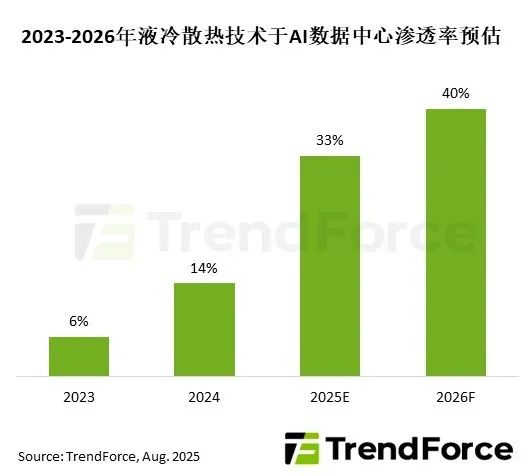
Core Insights - The report by TrendForce indicates a significant shift towards liquid cooling technology in AI data centers, with penetration expected to rise from 14% in 2024 to 33% in 2025, driven by the release of NVIDIA's GB200NVL72 server [1] - AI servers are increasingly utilizing GPU and ASIC chips with high power consumption, necessitating the adoption of liquid-to-air (L2A) cooling technology, as traditional air cooling systems cannot handle the thermal design power (TDP) of 130kW-140kW [1] - The transition to liquid-to-liquid (L2L) cooling architecture is anticipated to accelerate from 2027 onwards, as new data centers are completed and AI chip power consumption continues to rise [1] Industry Developments - Major cloud service providers (CSPs) in North America are expanding AI infrastructure, with new data center constructions in North America, Europe, and Asia, incorporating liquid cooling compatible facilities [2] - Companies like Google and AWS have initiated modular buildings with liquid cooling capabilities in various European countries, while Microsoft plans to standardize liquid cooling systems by 2025 [2] - The demand for cooling modules, heat exchange systems, and related components is increasing due to the rising penetration of liquid cooling technology [2] Key Components - The fluid distribution unit (CDU) is crucial for heat transfer and coolant distribution in liquid cooling systems, with the market currently dominated by Sidecar CDU, led by Delta [3] - In-row CDU, supplied by Vertiv and BOYD, is gaining traction due to its superior cooling capabilities for high-density AI cabinet deployments [3] - Quick disconnect (QD) connectors are essential for the reliability and safety of liquid cooling systems, with major players like CPC, Parker Hannifin, Danfoss, and Staubli leading the NVIDIA GB200 project [3] Product Trends - NVIDIA's Blackwell platform, including products like GB200Rack and HGX B200, is ramping up production, with the new B300 and GB300 series entering sample validation [4] - The new Blackwell GPU is expected to account for over 80% of NVIDIA's high-end GPU shipments this year [4] - New data centers are increasingly designed with a "liquid cooling ready" concept to enhance thermal management efficiency and flexibility [4]
TrendForce集邦咨询:预估今年液冷散热技术在AI数据中心的渗透率将大幅提升至33%
智通财经网· 2025-08-21 06:23
Group 1 - The core viewpoint of the article highlights the increasing adoption of liquid cooling technology in AI data centers, driven by the upcoming release of NVIDIA's GB200 NVL72 server in 2025, which is expected to significantly enhance the penetration rate of liquid cooling from 14% in 2024 to 33% in 2025, with continued growth in subsequent years [1][3] Group 2 - TrendForce indicates that the power consumption of GPUs and ASIC chips in AI servers has significantly increased, with the NVIDIA GB200/GB300 NVL72 system having a thermal design power (TDP) of 130kW-140kW, surpassing the limits of traditional air cooling systems, leading to the initial adoption of Liquid-to-Air (L2A) cooling technology [3] - Due to the limitations of existing data center structures and water circulation facilities, L2A will serve as the mainstream transitional cooling solution in the short term, while Liquid-to-Liquid (L2L) architecture is expected to accelerate in popularity starting in 2027, providing higher efficiency and stable thermal management capabilities [3] - Major cloud service providers (CSPs) in North America are ramping up AI infrastructure, initiating a new wave of data center expansions in North America, Europe, and Asia, with companies like Google and AWS already implementing liquid cooling-capable modular buildings in various locations [3] Group 3 - The rising penetration of liquid cooling is driving demand for cooling modules, heat exchange systems, and peripheral components, with cold plates being a core component, supplied by companies such as Cooler Master, AVC, BOYD, and Auras, with three of them expanding liquid cooling capacity in Southeast Asia to meet high demand from US CSP clients [4] - Fluid distribution units (CDUs) are critical modules in liquid cooling systems responsible for heat transfer and coolant distribution, categorized into In-row and Sidecar types, with Sidecar CDU currently being the market leader, and Delta being the leading supplier [4] - Quick disconnects (QDs) are essential components in liquid cooling systems, ensuring the safety and stability of the cooling architecture, with the NVIDIA GB200 project being led by major international companies such as CPC, Parker Hannifin, Danfoss, and Staubli, leveraging existing certification systems and advanced application experience [5]

研报 | AI数据中心将规模化导入液冷散热技术,预估2025年渗透率逾30%
TrendForce集邦· 2025-08-21 06:04
Core Insights - The article discusses the rapid adoption of liquid cooling technology in AI data centers, driven by the release of NVIDIA's GB200 NVL72 server, with penetration rates expected to rise from 14% in 2024 to 33% in 2025 [2][4]. Group 1: Liquid Cooling Technology Adoption - The introduction of NVIDIA's GB200/GB300 NVL72 systems, which have a thermal design power (TDP) of 130kW-140kW, necessitates the use of liquid-to-air (L2A) cooling technology due to the limitations of traditional air cooling systems [4]. - Liquid-to-liquid (L2L) cooling architecture is anticipated to gain traction starting in 2027, as new data centers are completed and AI chip power consumption increases, gradually replacing L2A technology [4]. Group 2: Market Expansion and Key Players - Major cloud service providers (CSPs) in North America are expanding AI infrastructure, with companies like Google and AWS implementing liquid cooling-compatible facilities in Europe and Asia [5]. - The demand for cooling modules, heat exchange systems, and peripheral components is expected to grow as liquid cooling penetration increases [5]. - Key suppliers of cold plates, a core component of contact heat exchange, include Cooler Master, AVC, BOYD, and Auras, with several expanding production capacity in Southeast Asia to meet demand from U.S. CSPs [5]. Group 3: Critical Components in Liquid Cooling Systems - The fluid distribution unit (CDU) is essential for heat transfer and coolant distribution, with the market currently favoring sidecar CDU configurations, led by Delta [6]. - Quick disconnects (QDs) are crucial for the reliability and safety of liquid cooling systems, with major manufacturers like CPC, Parker Hannifin, Danfoss, and Staubli involved in the NVIDIA GB200 project [6].
AI Expands Latin America Presence With Eletrobras Partnership
ZACKS· 2025-08-20 17:51
Core Insights - C3.ai, Inc. has partnered with Eletrobras to implement its Grid Intelligence solution across the utility's entire transmission network, marking a significant step in Eletrobras' Eletro.ia program aimed at integrating AI into operations [1][7] - The deployment will utilize C3.ai's technology for real-time fault detection and operational reporting, enhancing efficiency and service reliability in Brazil's energy sector [2][3] Strategic Partnerships - C3.ai's growth is significantly driven by its expanding partner ecosystem, with 73% of agreements in fiscal 2025 being collaborations, including deepened ties with major hyperscalers like Microsoft, AWS, and Google Cloud [4] - The renewal of the partnership with Baker Hughes, which has generated over $0.5 billion in revenues since 2019, further emphasizes the importance of strategic alliances for C3.ai's growth trajectory [5] Market Performance - In the last three months, C3.ai's shares have decreased by 20.5%, contrasting with a 9% decline in the Zacks Technology Services industry [6]


A Nuclear Showdown: OKLO's Bold Vision vs. CEG's Proven Power
ZACKS· 2025-08-20 13:36
Core Viewpoint - The nuclear energy sector is gaining attention amid the AI revolution, with significant backing from the U.S. government, tech giants, and Wall Street, presenting investment opportunities in both established companies like Constellation Energy (CEG) and speculative newcomers like Oklo Inc. (OKLO) [1][2] Group 1: Company Profiles - Constellation Energy is the largest U.S. nuclear power plant operator, characterized as a mature and dominant force in the industry [2] - Oklo is a next-generation fission company focused on developing micro nuclear reactors and is currently a pre-revenue firm [3][4] Group 2: Business Models - Oklo plans to sell power directly to customers through long-term contracts, aiming to create recurring revenue streams [3] - Constellation has secured long-term power purchase agreements with major companies like Microsoft and Meta, ensuring revenue stability [6] Group 3: Financial Health - Oklo has raised over $400 million to fund its plans, projecting $5 billion in annual revenues by 2028 from a 14 GW order pipeline [4] - Constellation's free cash flow is approximately $2 billion negative due to capital expenditures and acquisitions, but it has a strong dividend growth outlook [8] Group 4: Market Performance - Oklo's stock has surged over 822% in the past year, reflecting speculative interest, while CEG has seen a more modest gain of 61% [9] Group 5: Valuation Metrics - Oklo trades at a high price-to-book (P/B) ratio of 13.11, indicating heavy investor optimism despite being pre-revenue [10] - Constellation trades at a more reasonable P/B ratio of 7.2, reflecting its established business model and earnings track record [10] Group 6: Earnings Outlook - Oklo is projected to have a loss of 50 cents per share in 2025, with further declines expected in 2026 [11] - Constellation is expected to see a 9% year-over-year gain in EPS for 2025, with estimates of $9.41 and $11.86 for 2025 and 2026, respectively [14] Conclusion - Constellation Energy is viewed as a more prudent investment due to its stable business, strong earnings profile, and strategic partnerships, while Oklo presents a high-risk, high-reward opportunity [15]