南京银行

Search documents
南京银行2025年业绩快报:总资产超3万亿,较上年末增长16.63%
Bei Jing Shang Bao· 2026-01-22 11:17
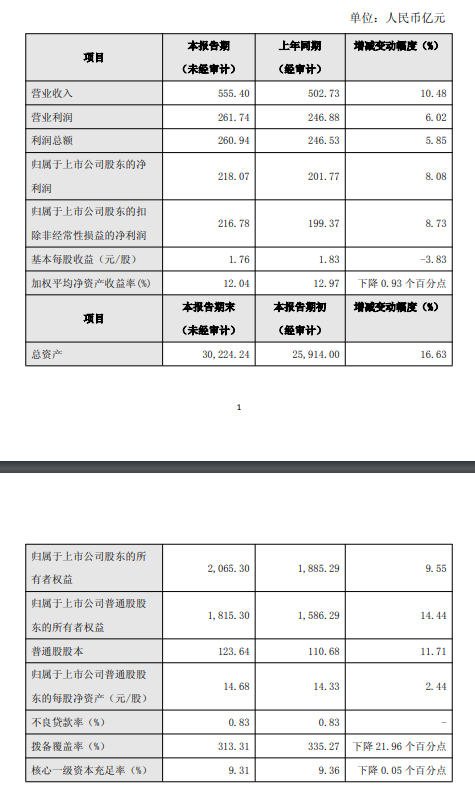
报告期内,南京银行实现营业收入555.40亿元,同比增长10.48%;实现归属于上市公司股东的净利润 218.07亿元,同比增长8.08%;实现利息净收入349.02亿元,同比增长31.08%。 北京商报讯(记者 宋亦桐)1月22日,南京银行发布2025年度业绩快报显示,截至报告期末,该行总资 产超3万亿元,达到30224.24亿元,较上年末增长16.63%;各项存款总额16707.89亿元,较上年末增长 11.67%;各项贷款总额14243.56亿元,较上年末增长13.37%。 ...

南京银行(601009.SH):2025年归母净利润218.07亿元,同比增长8.08%
Xin Lang Cai Jing· 2026-01-22 10:59
格隆汇1月22日丨南京银行(601009.SH)公布2025年度业绩快报,报告期内,本公司实现营业收入555.40 亿元,同比增长10.48%;实现归属于上市公司股东的净利润218.07亿元,同比增长8.08%;实现利息净 收入349.02亿元,同比增长31.08%。 ...
南京银行业绩快报:2025年净利润218.07亿元 同比增长8.08%
Zheng Quan Shi Bao Wang· 2026-01-22 10:55
人民财讯1月22日电,南京银行(601009)1月22日披露2025年度业绩快报,公司2025年实现营业收入 555.4亿元,同比增长10.48%;归属于上市公司股东的净利润218.07亿元,同比增长8.08%。截至报告期 末,公司不良贷款率0.83%,拨备覆盖率313.31%。 ...
南京银行(601009) - 2025 Q4 - 年度业绩
2026-01-22 10:50
证券简称: 南京银行 证券代码: 601009 编号: 2026-003 南京银行股份有限公司 2025 年度业绩快报公告 优先股简称:南银优 2 优先股代码:360024 特别提示: 本公司董事会及全体董事保证本公告内容不存在任何虚假记载、误导性陈述 或者重大遗漏,并对其内容的真实性、准确性和完整性承担法律责任。 本公告所载2025年度主要财务数据为初步核算数据,未经会计师事务所审 计,具体数据以南京银行股份有限公司(以下简称"本公司")2025年度的定期 报告中披露的数据为准,提请投资者注意投资风险。 一、2025年度主要财务数据和指标 单位:人民币亿元 | 项目 | 本报告期 | 上年同期 | 增减变动幅度(%) | | --- | --- | --- | --- | | | (未经审计) | (经审计) | | | 营业收入 | 555.40 | 502.73 | 10.48 | | 营业利润 | 261.74 | 246.88 | 6.02 | | 利润总额 | 260.94 | 246.53 | 5.85 | | 归属于上市公司股东的净 利润 | 218.07 | 201.77 | 8.08 | ...
南京银行:2025年净利润同比增长8.08%
2 1 Shi Ji Jing Ji Bao Dao· 2026-01-22 10:43
南财智讯1月22日电,南京银行发布2025年度业绩快报,报告期内公司实现营业收入555.40亿元,同比 增长10.48%;归属于上市公司股东的净利润218.07亿元,同比增长8.08%;基本每股收益1.76元,同比 下降3.83%。 ...
南京银行:2025年实现净利润218.07亿元,同比增长8.08%
Xin Lang Cai Jing· 2026-01-22 10:38
| 项目 | 本报告期 | 上年同期 | 增减变动幅度(%) | | | --- | --- | --- | --- | --- | | | (未经审计) | (经审计) | | | | 营业收入 | 555. 40 | 502. 73 | | 10. 48 | | 营业利润 | 261. 74 | 246. 88 | | 6. 02 | | 利润息额 | 260. 94 | 246. 53 | | 5. 85 | | 归属于上市公司股东的净 | 218. 07 | 201. 77 | | 8.08 | | 利润 | | | | | | 归属于上市公司股东的扣 | 216. 78 | 199. 37 | | 8.73 | | 除非经常性损益的净利润 | | | | | | 基本每股收益(元/股) | 1. 76 | 1.83 | | -3.83 | | 加权平均净资产收益率(%) | 12. 04 | 12. 97 | 下降 0.93个百分点 | | | 项目 | 本报告期末 | 本报告期初 | 增减变动幅度(%) | | | | (未經审计) | (經审计) | | | | 息资产 | 30, 224. 2 ...

南京银行:2025年净利润218.07亿元,同比增长8.08%
Xin Lang Cai Jing· 2026-01-22 10:37
南京银行公告,2025年度实现营业收入555.4亿元,同比增长10.48%;净利润218.07亿元,同比增长 8.08%。 ...
数字人民币2.0:从M0到M1的质变
GF SECURITIES· 2026-01-22 05:07
Investment Rating - The report provides a "Buy" rating for all major banks analyzed, indicating a positive outlook for the banking sector [7]. Core Insights - The digital renminbi has entered its 2.0 era, transitioning from a central bank liability (M0) to a commercial bank liability (M1), allowing it to earn interest and be included in deposit insurance and reserve requirements [6][14]. - This transformation positions China as the first economy to offer interest on its central bank digital currency (CBDC), fundamentally altering its monetary attributes and creating a new financial paradigm in the digital economy [27]. - The digital renminbi's interest-bearing feature enhances user motivation to hold it, shifting its perception from a mere payment tool to a viable store of value, thus promoting its integration into everyday financial activities [27][28]. Summary by Sections 1. Digital Renminbi 2.0 Era - The digital renminbi (e-CNY) is now classified as a digital deposit currency, which can earn interest and is managed under a new regulatory framework [14]. - Major state-owned banks have begun offering interest on digital renminbi wallet balances, marking a significant shift in its utility and appeal [14][27]. 2. Development Progress and Application Status - The development of the digital renminbi began in 2014, with significant milestones including pilot tests in various cities and the establishment of a comprehensive operational framework by 2025 [32][33]. - As of November 2025, the digital renminbi has processed 34.8 billion transactions amounting to 16.7 trillion yuan, with extensive coverage across multiple provinces and cities [37]. 3. Global CBDC Development Trends - The report identifies three main trends in global CBDC development: active retail CBDC initiatives, innovation in payment systems, and cautious approaches in some countries like the U.S. [6]. - China's proactive stance in developing its CBDC positions it favorably in the global digital economy landscape, particularly in cross-border trade applications [30].




【银行】“一揽子”贷款财政贴息政策影响几何?——1月20日贷款财政贴息四项政策点评(王一峰/赵晨阳)
光大证券研究· 2026-01-21 23:07
Core Viewpoint - The article discusses a series of financial subsidy policies aimed at promoting consumption and investment, particularly focusing on small and micro enterprises, personal consumption loans, and service industry loans [4][5]. Group 1: Policy Overview - On January 20, the Ministry of Finance, in collaboration with other departments, released a comprehensive set of financial subsidy policies to support small and micro enterprises, optimize personal consumption loans, and enhance service industry loans [4]. - The policies are designed to be "convenient and efficient," "precise and effective," and "standardized and efficient," with a focus on increasing subsidy amounts, broadening support areas, extending subsidy periods, and simplifying processes [5]. Group 2: Impact on Investment and Consumption - The new subsidy policies are expected to significantly enhance the scale of financial support compared to previous measures, thereby stimulating loan demand in relevant sectors and promoting effective investment and consumption [5][6]. - Specific measures include reducing financial burdens on small and micro enterprises, extending loan terms for service industry operators, and optimizing personal consumption loan subsidies to alleviate residents' interest payment pressures [6][7]. Group 3: Financial Projections - The estimated scale of the new subsidy policies is projected to be between 100 billion to 200 billion by 2026, with a significant portion allocated to small and micro enterprise loans and optimized personal consumption loans [8]. - The actual disbursement of subsidies may vary due to factors such as the scope of supported industries, the structure of client bases, and the willingness of the private sector to expand [8]. Group 4: Implications for the Banking Sector - The coordinated policies are expected to positively influence the banking sector's performance, particularly in small and micro finance and retail sectors, potentially catalyzing a favorable market environment for banks [9]. - As of January 20, A-share banks have seen a cumulative decline of 4.3%, underperforming the HS300 index by approximately 6.2 percentage points, indicating a potential opportunity for recovery in the banking sector due to these new policies [9].

尾盘,又有大动作
Sou Hu Cai Jing· 2026-01-21 11:29
Market Overview - The market experienced a high and then a pullback, with the STAR 50 Index rising over 3%, indicating a mixed sentiment among investors [1] - Large funds are actively managing the market to prevent rapid index increases, aiming for a slow bull market [2] Index and Sector Performance - The Shanghai Composite Index is expected to fluctuate around the 4100-point mark, with an upper limit of 4190 points and a lower limit of 4000 points, suggesting a range-bound trading environment [3] - Key sectors showing strong performance include metals, gold, chips, and lithography machines, with the STAR 50 Index catching up after lagging behind other indices [3] Stock Performance - Traditional consumer stocks, particularly in the liquor sector, are experiencing a decline, while other sectors remain active [4] - A detailed table shows various banks' stock performance, with significant declines noted for major banks like Agricultural Bank (-9.51%) and Industrial and Commercial Bank (-7.44%) [5] Liquor Industry Insights - The liquor sector is anticipated to enter a new cycle around 2026, driven by economic recovery and potential monetary easing from the Federal Reserve [6][7] - Historical cycles of the liquor industry since 2003 indicate that demand has been influenced by various economic factors, suggesting a pattern that could repeat [6] Investment Strategy - The current market sentiment suggests a preference for sectors like chips and aerospace, while traditional sectors like liquor are viewed with skepticism [8] - The concept of contrarian investing is highlighted, emphasizing the challenges and potential rewards of investing in underperforming sectors [9]