华润三九

Search documents
华润换帅!华润三九连续冲高,中药ETF(560080)收涨近1%强势两连阳,资金连续10日净流入!机构:积极布局中药创新转型
Sou Hu Cai Jing· 2025-10-15 09:00
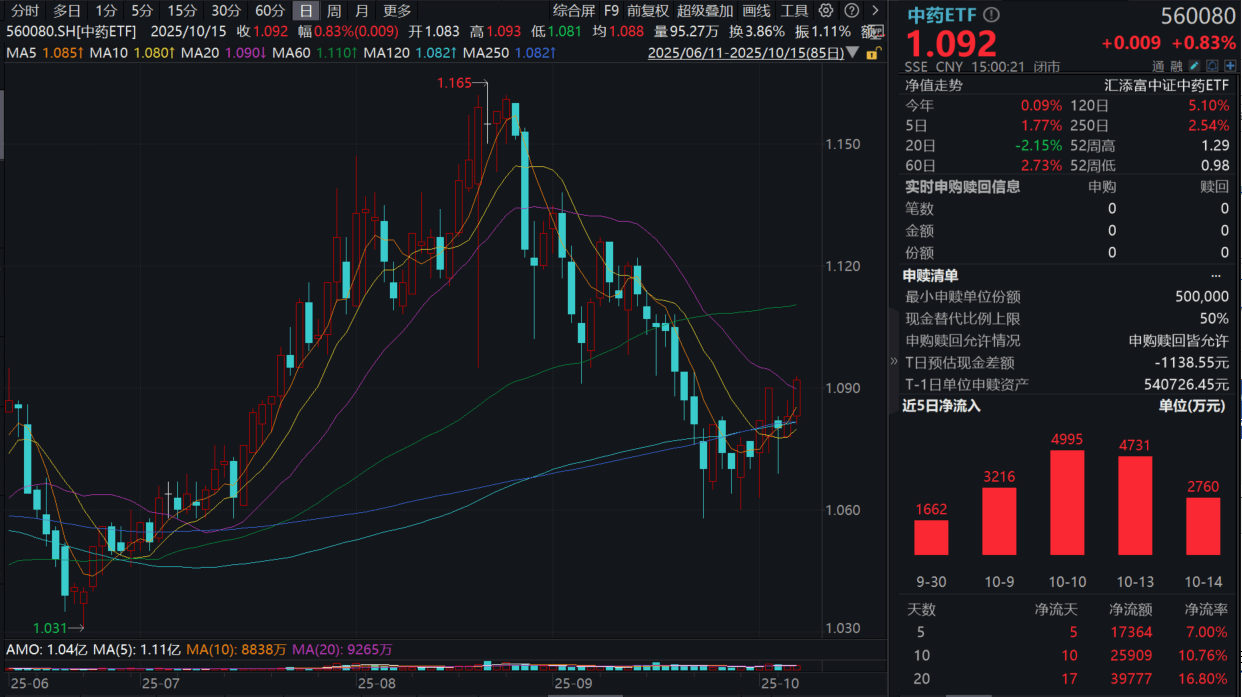
Core Viewpoint - The Chinese traditional medicine sector is experiencing a resurgence, with the Chinese Medicine ETF (560080) showing strong performance and attracting significant capital inflows, indicating investor confidence in the sector's growth potential [1][6]. Market Performance - The Chinese Medicine ETF (560080) rose by 0.83%, marking a two-day consecutive increase, with total trading volume exceeding 1 billion yuan [1]. - The ETF has seen a net inflow of over 250 million yuan in the last 10 days, bringing its total size to over 2.6 billion yuan, leading its peers significantly [1]. - Despite the recent gains, the traditional medicine index remains in negative territory for the year, with a year-to-date decline of 1.92% and a drop of 8.13% projected for 2024 [2]. Component Stocks - Key stocks within the Chinese Medicine ETF showed positive movements, with notable gains from Zhaoli Pharmaceutical (up 4.21%), Zhongsheng Pharmaceutical (up 3.99%), and Jilin Aodong (up 2.73%) [4]. - The overall performance of component stocks reflects a mixed sentiment, with some stocks experiencing slight declines [4]. Valuation Metrics - The TTM price-to-earnings ratio for the Chinese Medicine ETF is 24.97, which is at the 21.38% percentile of the past decade, suggesting a favorable valuation compared to historical levels [5]. Investment Trends - Leveraged funds are increasingly using the ETF to invest in the high-value Chinese traditional medicine sector, with the latest financing balance exceeding 88 million yuan, maintaining historical highs [6]. - Institutional investors are actively seeking opportunities in the sector, focusing on innovation and transformation strategies to create new growth avenues [8]. Regulatory Environment - The ongoing adjustments to the National Essential Medicines List are expected to favor traditional Chinese medicine, with potential increases in the number of TCM products included [9]. - The adjustments are anticipated to enhance the market presence of TCM, aligning with the government's focus on integrating traditional and modern medicine [9].


中药板块10月15日涨0.84%,振东制药领涨,主力资金净流入3.78亿元
Zheng Xing Xing Ye Ri Bao· 2025-10-15 08:37
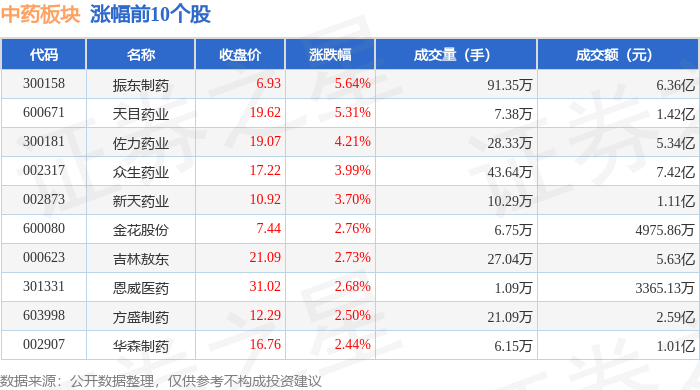
Market Overview - The Chinese traditional medicine sector rose by 0.84% on October 15, with Zhendong Pharmaceutical leading the gains [1] - The Shanghai Composite Index closed at 3912.21, up 1.22%, while the Shenzhen Component Index closed at 13118.75, up 1.73% [1] Stock Performance - Zhendong Pharmaceutical (300158) closed at 6.93, with a gain of 5.64% and a trading volume of 913,500 shares, amounting to a transaction value of 636 million yuan [1] - Tianmu Pharmaceutical (600671) closed at 19.62, up 5.31%, with a trading volume of 73,800 shares [1] - Zuoli Pharmaceutical (300181) closed at 19.07, increasing by 4.21%, with a trading volume of 283,300 shares [1] - Other notable performers include Zhongsheng Pharmaceutical (002317) and Xintian Pharmaceutical (002873), with gains of 3.99% and 3.70% respectively [1] Capital Flow - The traditional medicine sector saw a net inflow of 378 million yuan from institutional investors, while retail investors experienced a net outflow of 276 million yuan [2] - The overall capital flow indicates a mixed sentiment, with institutional investors showing confidence while retail investors withdrew funds [2] Individual Stock Capital Flow - Zuoli Pharmaceutical (300181) had a net inflow of 76.71 million yuan from institutional investors, while retail investors saw a net outflow of 38.14 million yuan [3] - Zhendong Pharmaceutical (300158) experienced a net inflow of 56.45 million yuan from institutional investors, with retail investors withdrawing 51.44 million yuan [3] - Yunnan Baiyao (000538) had a net inflow of 52.53 million yuan from institutional investors, but retail investors withdrew 56.48 million yuan [3]


“少壮派”程杰掌舵,华润医药这艘巨舰将驶向何方
2 1 Shi Ji Jing Ji Bao Dao· 2025-10-15 00:14
Core Insights - The appointment of Cheng Jie as the new president of China Resources Pharmaceutical signifies a strategic shift as the company faces challenges in traditional business growth and profitability amidst industry transformation [1][2][11] - The company reported a "revenue growth without profit increase" in its recent half-year report, with total revenue reaching 131.87 billion yuan, a 2.5% year-on-year increase, while net profit dropped by 20.3% to 2.08 billion yuan [2][7] - Cheng Jie, who has a strong background within the company, is expected to leverage his experience to navigate the current challenges and drive innovation and growth [4][19] Company Performance - China Resources Pharmaceutical's revenue has shown steady growth, increasing from 232.20 billion yuan in 2022 to 257.67 billion yuan in 2024, with an average annual growth rate of over 5% [7] - However, net profit has fluctuated, with a 13.06% decline in 2024 to 3.35 billion yuan and a further drop of 20.25% in the first half of 2025 [7][8] - The decline in profit is attributed to one-time impairment losses and rigid expense growth, with a net loss of 1.09 billion yuan in other income and losses reported for the first half of 2025 [7][8] Strategic Initiatives - The company has been actively pursuing mergers and acquisitions, with significant transactions including the acquisition of 100% of Green Cross Hong Kong for 1.82 billion yuan and a 28% stake in Tian Shi Li Pharmaceutical for 6.21 billion yuan [9][10] - Despite the expansion through acquisitions, the company is now shifting focus towards optimizing its asset structure by divesting non-core and loss-making businesses to enhance operational efficiency and profitability [10][15] - Cheng Jie is tasked with balancing the expansion from acquisitions with the need for profit growth, as well as addressing potential impairment risks associated with goodwill from these acquisitions [11][19] Industry Context - The Chinese pharmaceutical distribution market is experiencing maturation and differentiation, presenting structural opportunities for leading companies like China Resources Pharmaceutical [12] - Collaborations with multinational pharmaceutical companies are increasing, as these companies seek to focus on core products and leverage local distribution expertise [12][13] - The industry is transitioning from a phase of scale expansion to one of high-quality development, emphasizing the need for new products, channels, and innovative service models [14][15] Innovation and R&D - China Resources Pharmaceutical is enhancing its pharmaceutical business through initiatives such as establishing a 1 billion yuan investment fund focused on innovative drugs and high-end medical devices [17] - The company is also pursuing partnerships for innovative drug development, such as a collaboration with Nanjing Ai Er Pu for a heart failure treatment [17][19] - However, the company faces challenges in its R&D efforts, with a significant portion of its pipeline still focused on generic drugs rather than innovative products, which may hinder its competitive edge in a rapidly evolving market [18][19]



华润三九:公司高度重视市值管理工作
Zheng Quan Ri Bao· 2025-10-14 14:08
(文章来源:证券日报) 证券日报网讯华润三九10月14日在互动平台回答投资者提问时表示,公司高度重视市值管理工作,围绕 公司发展战略,聚焦主业发展,持续提升公司核心竞争力,重视股东回报,持续现金分红,努力推动高 质量发展。公司如有相关计划,将严格按照监管要求履行信息披露义务。 ...
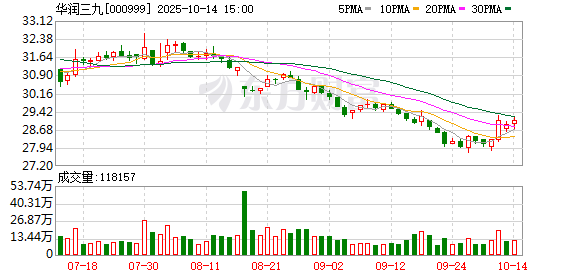
中药逆市收红!东阿阿胶、太极集团涨超1%!中药ETF(560080)收涨0.28%,连续9日“吸金”!融资余额接连攀升!机构盘点产业两大发展趋势
Sou Hu Cai Jing· 2025-10-14 09:45
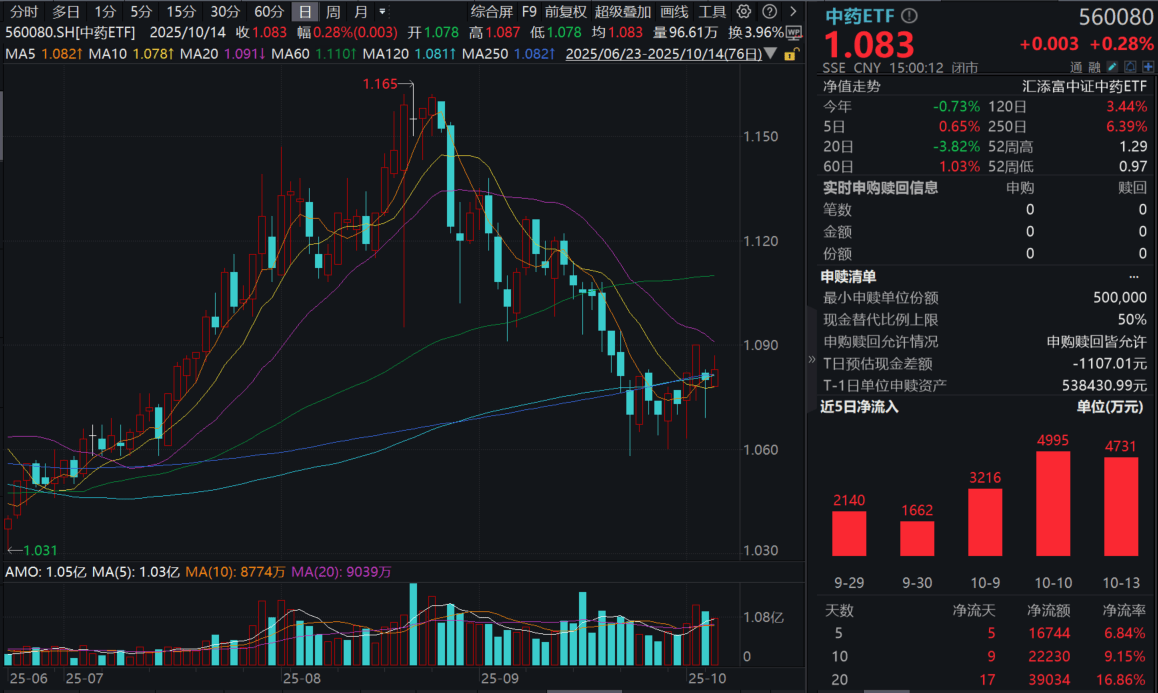
Core Viewpoint - The Chinese medicine sector shows resilience with the Chinese Medicine ETF (560080) rising by 0.28% despite market fluctuations, indicating strong investor interest and a net inflow of over 220 million yuan in the past 10 days [1][3]. Market Performance - The Chinese Medicine ETF (560080) has maintained a premium, closing with a premium rate of 0.14%, and has seen a total trading volume exceeding 1 billion yuan [1]. - Major stocks within the ETF, such as Dong'e Ejiao and Yunnan Baiyao, have shown positive performance, with Dong'e Ejiao increasing by over 1% [3][4]. Index Performance - The Chinese medicine index has experienced a negative return of -2.86% year-to-date, with a decline of 8.13% projected for 2024 [4]. - The index has shown a pattern of alternating performance, with three consecutive years of gains from 2019 to 2021, followed by three years of declines from 2016 to 2018 [4]. Valuation Metrics - The TTM price-to-earnings ratio for the Chinese Medicine ETF (560080) stands at 24.86, placing it at the 20.6% percentile of the past decade, suggesting a favorable valuation [6]. Financing and Investment Trends - Leveraged funds are increasingly utilizing the ETF for exposure to the higher-value Chinese medicine consumer sector, with the latest financing balance exceeding 91 million yuan, maintaining historical highs [7]. - The overall sentiment in the Chinese medicine sector is expected to improve, driven by stable market demand and accelerated innovation [9]. Future Outlook - The Chinese medicine sector is anticipated to benefit from innovation and transformation, with a focus on new product development and cost reductions in raw materials [9][10]. - The sector is positioned to leverage its advantages in preventive healthcare and as a complementary treatment alongside Western medicine [10]. Corporate Governance and Incentives - Recent corporate governance improvements and incentive plans in state-owned enterprises are expected to drive growth in the Chinese medicine sector, with companies like Huaren Sanjiu and Jiangzhong Pharmaceutical implementing effective incentive programs [11][12]. Dividend Yield - Several Chinese medicine companies are projected to have dividend yields exceeding 3% in 2024, with state-owned enterprises leading in this regard, indicating strong cash flow and shareholder returns [13][14].


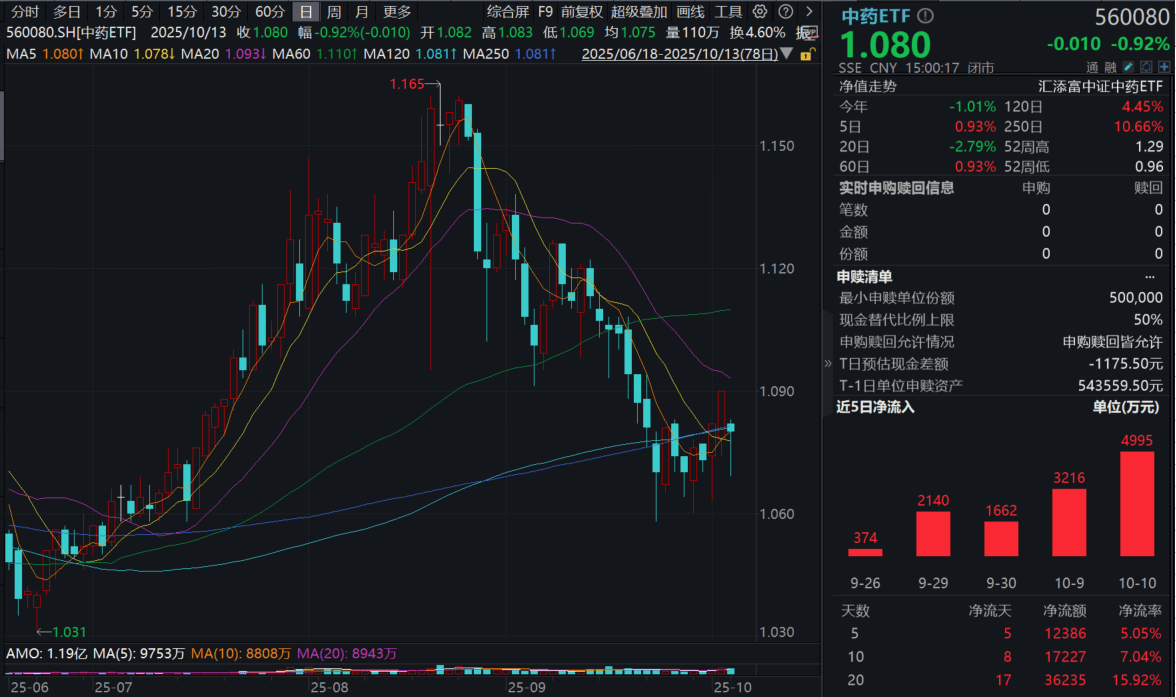
云南白药、片仔癀跌超1%,中药ETF(560080)跌近1%,连续8日"吸金"!融资余额逼近历史新高!机构:渠道调整接近尾声,看好年底旺季需求回暖
Sou Hu Cai Jing· 2025-10-13 10:06
Core Viewpoint - The Chinese Medicine ETF (560080) has shown resilience despite a recent market downturn, with significant capital inflow and a leading position in its category [1][7]. Market Performance - The Chinese Medicine ETF (560080) experienced a nearly 1% decline after a significant opening drop, with a total trading volume exceeding 110 million yuan [1]. - The ETF has seen a net inflow of over 170 million yuan in the last 10 days, bringing its total size to nearly 2.4 billion yuan, leading its peers [1]. Component Stocks - Most component stocks of the Chinese Medicine ETF (560080) closed in the red, with notable declines including Jilin Aodong (-1.44%), Yunnan Baiyao (-1.01%), and Dong'e Ejiao (-1.22%) [3][4]. Yearly Index Performance - The Chinese Medicine Index has shown negative returns year-to-date, with a decline of 3.27% this year and an 8.13% drop in 2024, marking a four-year streak of negative annual performance [4]. Valuation Metrics - The TTM price-to-earnings ratio for the Chinese Medicine ETF (560080) stands at 25.11, which is at the 22.28% percentile of the past decade, indicating a more favorable valuation [6]. Leverage and Financing - Financing activities remain robust, with the latest financing balance for the ETF exceeding 84 million yuan, maintaining historical highs [7]. Industry Outlook - According to CITIC Securities, channel adjustments in the Chinese medicine sector are nearing completion, with expectations for demand recovery in the fourth quarter [9]. - The demand for traditional Chinese medicine products is anticipated to stabilize, with a gradual recovery expected as external pressures ease [9]. New Drug Developments - The number of new drug applications in the Chinese medicine sector is on the rise, with 92 new IND applications and 42 NDA applications reported in the first nine months of 2025 [10][12]. - Recent approvals for new drugs from companies like Fangsheng Pharmaceutical and Tianzhihui are expected to contribute positively to their growth [12].

“少壮派”程杰掌舵,华润医药这艘巨舰将驶向何方?
2 1 Shi Ji Jing Ji Bao Dao· 2025-10-13 09:03
Core Viewpoint - China Resources Pharmaceutical is undergoing leadership changes and self-reform to navigate industry transformation challenges, as traditional business growth shows signs of fatigue and merger-related issues emerge [1][2]. Company Overview - China Resources Pharmaceutical, a major player in the pharmaceutical industry with annual revenue exceeding 250 billion yuan, has appointed Cheng Jie as the new president, marking a significant leadership transition [1][2]. - Cheng Jie has a long history within the China Resources system, having progressed from product manager to president, showcasing the company's internal talent development model [1][3]. Financial Performance - In the first half of 2025, China Resources Pharmaceutical reported total revenue of 131.87 billion yuan, a year-on-year increase of 2.5%, but net profit attributable to shareholders fell by 20.3% to 2.08 billion yuan [2][6]. - The company's revenue has shown steady growth, increasing from 232.2 billion yuan in 2022 to 257.7 billion yuan in 2024, with an average annual growth rate exceeding 5% [6]. Challenges and Strategic Focus - The company faces a critical challenge of "increasing revenue without increasing profit," largely due to ongoing drug procurement policies affecting overall industry profitability [2][4]. - Cheng Jie is tasked with stabilizing existing business while driving breakthroughs in performance, which is essential for overcoming the current growth bottleneck [4][10]. Mergers and Acquisitions - China Resources Pharmaceutical has been active in mergers and acquisitions, including the acquisition of 100% of Green Cross Hong Kong for 1.82 billion yuan and a 28% stake in Tianjin Tasly Pharmaceutical for 6.21 billion yuan [8][9]. - The frequent mergers have led to scale expansion but have not yet translated into profit growth, with goodwill increasing to 24.29 billion yuan, raising concerns about potential impairment risks [8][9]. Asset Optimization - The company is shifting its strategy from aggressive acquisitions to optimizing its asset structure, focusing on divesting non-core and loss-making businesses to enhance operational efficiency [9][10]. Innovation and Future Growth - To address the challenges, China Resources Pharmaceutical is looking to innovate and enhance its pharmaceutical business through initiatives like establishing a 1 billion yuan investment fund focused on innovative drugs and high-end medical devices [13][15]. - The company aims to improve its competitive edge in the pharmaceutical sector by increasing R&D investment and pursuing strategic partnerships, particularly in the innovative drug space [13][15].
AH医药再陷调整,医疗ETF止步三连阳,港股通创新药ETF(520880)失守所有均线,该抄底还是离场?
Xin Lang Ji Jin· 2025-10-12 11:48
Core Viewpoint - The A-share and Hong Kong stock markets experienced significant fluctuations, with the A-share medical sector facing downward pressure, particularly in the CXO segment, while the innovative drug sector remains a focal point for investors despite recent adjustments [1][5][7]. Group 1: A-share Market Performance - The A-share medical sector opened lower and continued to decline, with major player WuXi AppTec leading the drop at 7.2%, and the largest medical ETF (512170) falling by 2.03% [1]. - The overall trend for the medical sector has been a recent upward movement, indicating potential for rebound despite short-term corrections [1]. Group 2: Hong Kong Market Performance - The Hong Kong medical sector initially showed signs of recovery but faced renewed selling pressure, with innovative drug stocks like Rongchang Bio and Innovent Biologics dropping over 11% [1][5]. - The Hong Kong innovative drug ETF (520880) experienced a decline of 2.25%, losing all moving averages, with a trading volume of 3.69 billion [1][5]. Group 3: Innovative Drug Sector Insights - The innovative drug sector, despite entering a phase of adjustment since September, continues to attract significant investor interest, with the Hong Kong innovative drug ETF (520880) raising over 675 million in the last 20 days [5][7]. - Analysts suggest that the innovative drug sector may see renewed opportunities in Q4, driven by upcoming academic conferences and policy implementations that could support domestic innovation [7]. Group 4: Investment Strategies - Investment strategies in the medical sector are focusing on two main lines: identifying companies with strong Q3 performance and exploring opportunities in innovative drugs for potential rebounds [7]. - The fund manager of the Hong Kong innovative drug ETF (520880) emphasizes the importance of balancing investments within the sector, including medical devices and services that may gain market attention [7].


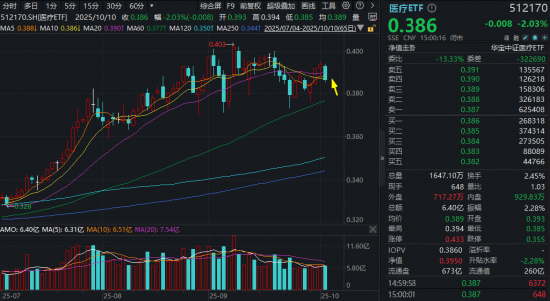
风险还是机遇?AH医药集体杀跌!药明康德重挫,医疗ETF下穿3根均线!创新药反攻未果,520880溢价飙逾1%
Xin Lang Ji Jin· 2025-10-10 12:54
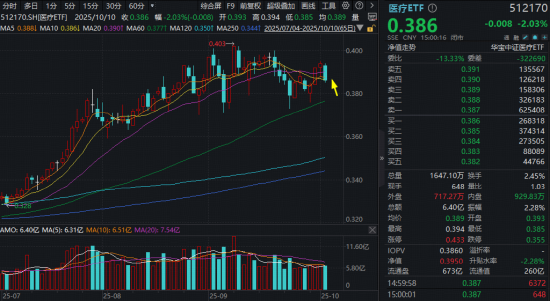
Market Overview - A-shares and Hong Kong stocks experienced synchronized fluctuations, with the Shanghai Composite Index falling below 3900 points and the ChiNext Index dropping by 4.55% [1] - The AH pharmaceutical sector declined across the board, with major players like WuXi AppTec leading the drop at 7.2% [1] - The largest medical ETF (512170) saw a decrease of 2.03%, halting its three-day upward trend, with a total trading volume of 640 million yuan [1] Pharmaceutical Sector Performance - The A-share pharmaceutical sector showed relative resilience, primarily due to traditional Chinese medicine stocks performing well, with companies like China Resources Sanjiu and Jilin Aodong rising over 2.5% [3] - Innovative drug stocks faced more declines than gains, with BeiGene (BGNE) leading the drop at 6.2% [3] - The only drug ETF in the market (562050) fell by 1.07%, indicating increased buying interest as evidenced by 2.23 million yuan of funds entering on dips [3] Innovation Drug Sector Insights - The innovative drug sector, previously a strong performer, has entered a phase of adjustment since September, but investor interest remains high [5] - The Hong Kong Innovation Drug ETF (520880) has attracted over 675 million yuan in the last 20 days, indicating strong buying momentum despite recent declines [5] - Analysts suggest that the short-term adjustment is due to profit-taking after significant gains and a lack of catalysts, but the long-term outlook remains positive [7] Future Catalysts and Strategies - Upcoming academic conferences, such as ESMO and ASH, are expected to reignite interest in the innovative drug sector [8] - The fourth quarter will see the implementation of various policies, including adjustments to medical insurance directories, which may accelerate support for domestic innovations [8] - Investment strategies focus on identifying companies with strong Q3 performance and exploring opportunities in the innovative drug sector for potential rebounds [8] ETF Performance and Characteristics - The Hong Kong Innovation Drug ETF (520880) is fully invested in innovative drug development companies, while the drug ETF (562050) balances innovative and traditional Chinese medicine stocks [9] - The medical ETF (512170) includes medical devices and services, with a significant portion allocated to CXO [9] - As of September 30, 2025, the medical ETF has a scale of 26.4 billion yuan, making it the largest in the pharmaceutical category [10]
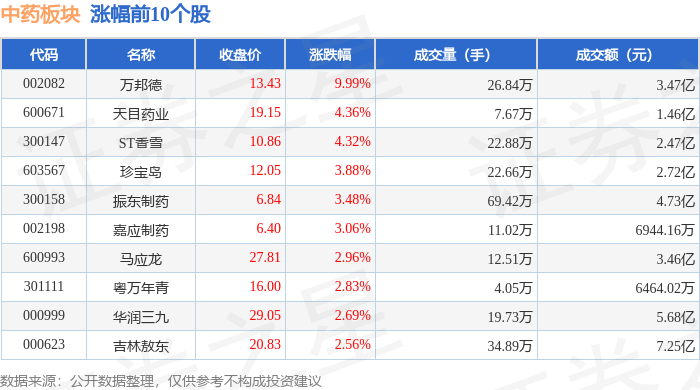
中药板块10月10日涨0.96%,万邦德领涨,主力资金净流入2.12亿元
Zheng Xing Xing Ye Ri Bao· 2025-10-10 08:46
Core Insights - The traditional Chinese medicine sector saw a rise of 0.96% on October 10, with Wanbangde leading the gains. In contrast, the Shanghai Composite Index fell by 0.94% and the Shenzhen Component Index dropped by 2.7% [1] Group 1: Market Performance - The closing price of Wanbangde was 13.43, with a significant increase of 9.99% and a trading volume of 268,400 shares, amounting to a transaction value of 347 million yuan [1] - Other notable performers included Tianmu Pharmaceutical, which closed at 19.15 with a 4.36% increase, and ST Xiangxue, which rose by 4.32% to close at 10.86 [1] - The overall trading volume for the traditional Chinese medicine sector was substantial, with individual stocks showing varied performance in terms of price changes and trading volumes [1] Group 2: Capital Flow - The traditional Chinese medicine sector experienced a net inflow of 212 million yuan from institutional investors, while retail investors saw a net outflow of 153 million yuan [2] - The capital flow data indicates that while some stocks attracted institutional investment, others faced significant selling pressure from retail investors [3] - Wanbangde had a net outflow of 64.05 million yuan from institutional investors, despite its price increase, indicating a complex market sentiment [3]