南极电商

Search documents
利好!这一板块快速走高,多股涨停!
Zheng Quan Ri Bao Wang· 2026-01-12 05:47
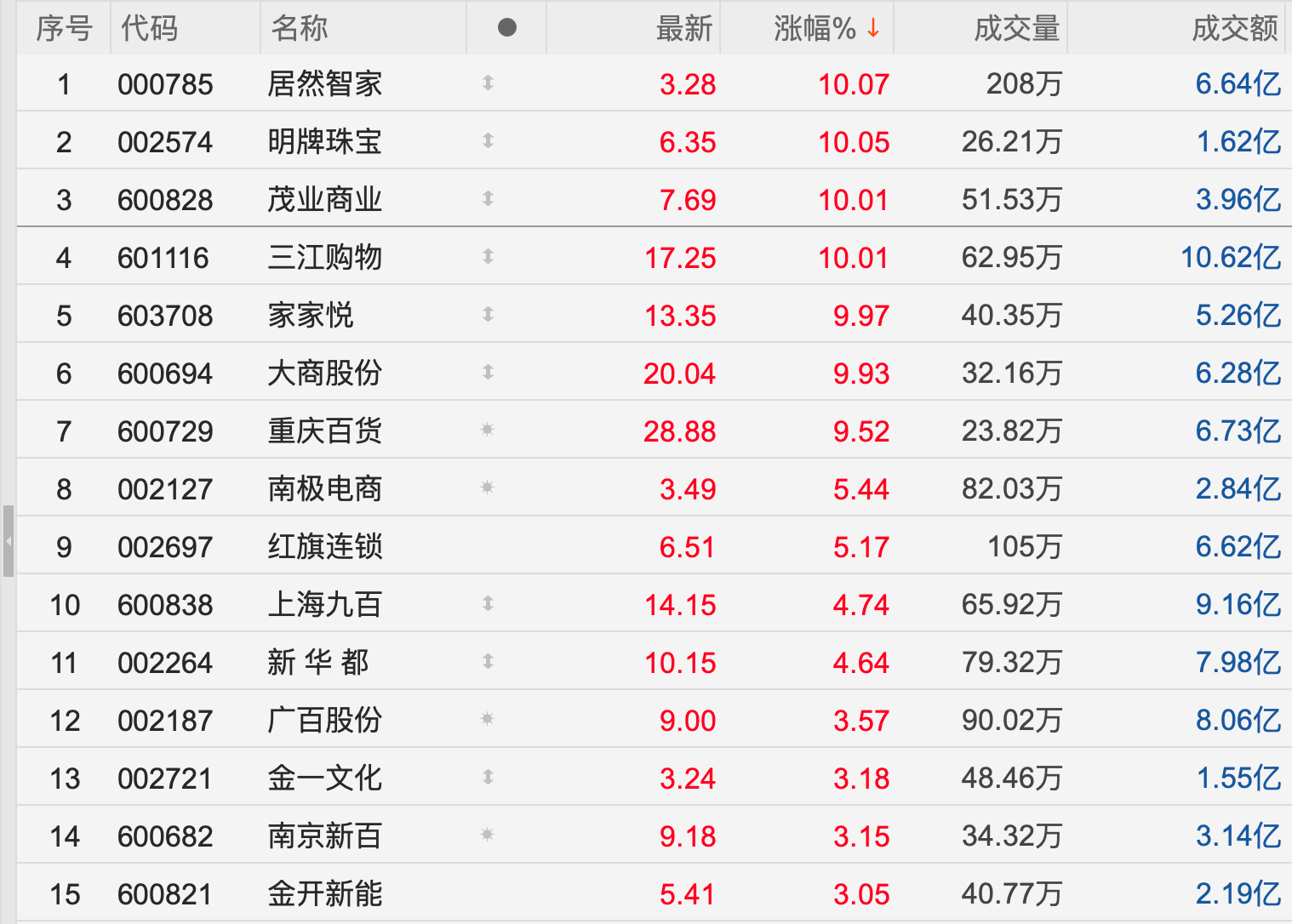
Core Viewpoint - The retail sector in the A-share market experienced a strong rally, with multiple retail stocks hitting the daily limit up, driven by supportive government policies aimed at boosting consumption [1][3]. Group 1: Market Performance - Several retail stocks, including Juran Smart Home, Mingpai Jewelry, and Maoye Commercial, saw significant price increases, with Maoye Commercial closing at 7.69 yuan after hitting the limit up for two consecutive days [1][2]. - Other notable performers included Dazhong Shares, Chongqing Department Store, and Antarctic E-commerce, contributing to a collective upward movement in the retail sector [1]. Group 2: Policy Support - The National Business Work Conference held on January 10-11 emphasized the implementation of special actions to boost consumption by 2026, which is expected to inject strong momentum into the retail industry [3]. - The conference outlined plans to cultivate new growth points in service consumption and optimize policies for upgrading consumer goods, directly benefiting traditional department stores and chain supermarkets [3]. Group 3: Consumer Behavior Trends - According to a report by NielsenIQ, the Chinese retail market is entering a critical restructuring phase, where the focus will shift from foot traffic and price subsidies to meeting consumers' relevant product and emotional needs [3][4]. - Consumer behavior is evolving from "buying products" to "buying lifestyles," with an increasing emphasis on experience and quality, as 68% of respondents value atmosphere in stores and 54% are willing to pay a premium for quality [4]. Group 4: Future Outlook - The retail industry is expected to accelerate its transformation towards a more intelligent, personalized, and experiential model, driven by policy support, consumption upgrades, and technological innovation [4][5]. - Experts suggest that as the special actions to boost consumption are implemented, the retail sector may enter a new phase of development, highlighting the importance of companies that align with industry trends and actively pursue transformation [5].


南极电商股价涨5.14%,南方基金旗下1只基金位居十大流通股东,持有1572.68万股浮盈赚取267.36万元
Xin Lang Cai Jing· 2026-01-12 02:48
Group 1 - The core viewpoint of the news is that Nanjing E-commerce has seen a stock price increase of 5.14%, reaching 3.48 CNY per share, with a trading volume of 154 million CNY and a turnover rate of 2.25%, resulting in a total market capitalization of 8.543 billion CNY [1] - Nanjing E-commerce, established on July 12, 1999, and listed on April 18, 2007, primarily operates in e-commerce channels, focusing on brand authorization and integrating supply chain resources to provide efficient services to the industry and cost-effective products to consumers [1] - The revenue composition of Nanjing E-commerce includes: 86.86% from mobile internet media placement, 5.55% from comprehensive brand services, 3.88% from product sales, 1.70% from authorized brand distribution, 1.58% from factoring services, and 0.44% from other services [1] Group 2 - From the perspective of the top ten circulating shareholders, Nanjing E-commerce has seen the Southern Fund's Southern CSI 1000 ETF (512100) enter the top ten shareholders, holding 15.7268 million shares, which is 0.79% of the circulating shares, with an estimated floating profit of approximately 2.6736 million CNY [2] - The Southern CSI 1000 ETF (512100) was established on September 29, 2016, with a latest scale of 76.63 billion CNY, achieving a year-to-date return of 7.05% and a one-year return of 45.31% [2]

南极电商卖吊牌卖出5亿多元诉讼,南极电商的授权模式走到末路?
Sou Hu Cai Jing· 2026-01-09 20:54
Core Viewpoint - The legal disputes between Nanji E-commerce Co., Ltd. and Shanghai Xinhengzhao Enterprise Development Co., Ltd. involve a total amount exceeding 640 million yuan, primarily concerning trademark authorization issues related to the "Cartier Crocodile" brand [2][3]. Group 1: Legal Disputes - Nanji E-commerce announced two lawsuits involving the same partner, with Shanghai Xinhengzhao's claim amounting to 565 million yuan and Nanji's counterclaim for approximately 80 million yuan [2]. - The lawsuits stem from a trademark authorization contract signed in 2018, allowing Shanghai Xinhengzhao to use the Cartier series trademarks until December 31, 2027 [2]. - Shanghai Xinhengzhao allegedly breached the contract by sublicensing the trademarks to downstream distributors and modifying the trademark styles, leading to infringement lawsuits against Nanji E-commerce [2][3]. Group 2: Timeline and Legal Proceedings - The disputes escalated after Nanji E-commerce sent a termination notice to Shanghai Xinhengzhao in 2023, which was deemed a significant trigger for the lawsuits [3]. - The initial lawsuit from Shanghai Xinhengzhao was filed in January 2025, with a request for 20 million yuan, which was later increased to 565 million yuan in December of the same year [3]. - Nanji E-commerce filed a counterclaim in April 2025, seeking approximately 80 million yuan for economic losses and damage to brand reputation due to Shanghai Xinhengzhao's actions [3]. Group 3: Company Statements and Future Actions - Nanji E-commerce's representatives stated that Shanghai Xinhengzhao's high lawsuit amount appears to be an attempt to evade responsibility and harm Nanji's commercial interests [4]. - The cases are currently in judicial proceedings, with the hearing for Nanji's lawsuit scheduled for January 22, 2026, and Shanghai's lawsuit set for March 3, 2026 [3]. - Nanji E-commerce indicated that they would disclose any significant developments in accordance with legal regulations [5].
涉近6亿商标授权纠纷 南极电商转型难题待解
Zhong Guo Jing Ying Bao· 2026-01-09 20:16
Core Viewpoint - The ongoing trademark litigation between Nanji E-commerce and Shanghai Xinhengzhao highlights the challenges and risks associated with brand licensing in the apparel industry, as the company shifts from a licensing model to a self-operated and licensed approach amid declining performance [2][3][8]. Group 1: Litigation Details - Shanghai Xinhengzhao initiated a lawsuit against Nanji E-commerce in January 2025, initially claiming 95.25 million yuan, which was later increased to 560 million yuan in January 2026 [3][4]. - Nanji E-commerce counter-sued for 81.69 million yuan due to losses and breach of contract [3][4]. - The disputes arose from multiple breaches by Shanghai Xinhengzhao, including unauthorized sublicensing and failure to pay licensing fees [3][4]. Group 2: Business Model and Financial Performance - Nanji E-commerce has historically relied on brand licensing for revenue, but has begun transitioning to a "self-operated + licensed" model due to declining performance [2][8]. - The company's revenue grew from 521 million yuan in 2016 to 4.172 billion yuan in 2020, but faced a decline to 3.358 billion yuan in 2024, with a net loss of 237 million yuan [8][9]. - In the first half of 2025, revenue decreased by 13.07% to 1.353 billion yuan, with a significant drop in net profit by 82.52% [8][9]. Group 3: Industry Insights - The apparel industry has seen a proliferation of brands, leading to confusion among consumers regarding brand authenticity, particularly with the "Crocodile" brand [5][6]. - Brand licensing is common in the industry, but many companies prioritize short-term profits over long-term brand value, leading to potential legal and operational issues [6][9]. - The transition to a self-operated model is seen as a necessary step for Nanji E-commerce to enhance brand image and product quality, although it presents significant challenges [9][10].

互联网电商板块1月9日涨3.1%,青木科技领涨,主力资金净流入440.08万元
Zheng Xing Xing Ye Ri Bao· 2026-01-09 09:00
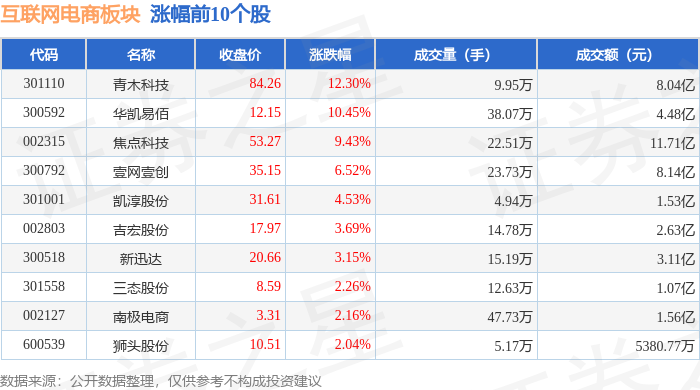
Group 1 - The internet e-commerce sector increased by 3.1% on January 9, with Qingmu Technology leading the gains [1] - The Shanghai Composite Index closed at 4120.43, up 0.92%, while the Shenzhen Component Index closed at 14120.15, up 1.15% [1] - Key stocks in the internet e-commerce sector showed significant price increases, with Qingmu Technology rising by 12.30% to a closing price of 84.26 [1] Group 2 - The net inflow of main funds in the internet e-commerce sector was 4.4 million yuan, while retail investors saw a net inflow of 16.4 million yuan [2] - The stock "Jiaodian Technology" had a main fund net inflow of 1.12 billion yuan, but experienced a net outflow from retail and speculative funds [3] - "Xinxinda" had a main fund net inflow of 23.27 million yuan, while retail investors faced a significant net outflow of 22.19 million yuan [3]





互联网电商板块1月8日涨2.21%,壹网壹创领涨,主力资金净流入1400.64万元
Zheng Xing Xing Ye Ri Bao· 2026-01-08 08:56
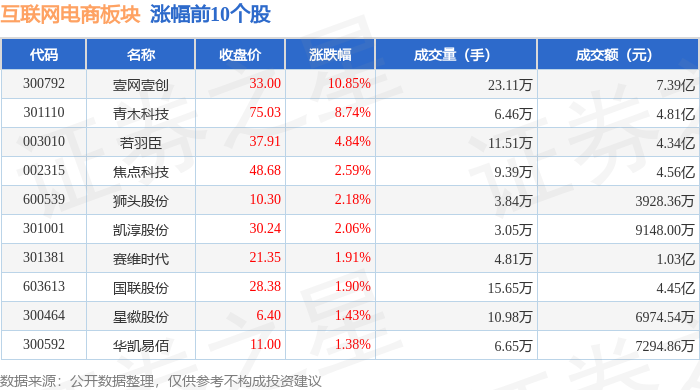
证券之星消息,1月8日互联网电商板块较上一交易日上涨2.21%,壹网壹创领涨。当日上证指数报收于 4082.98,下跌0.07%。深证成指报收于13959.48,下跌0.51%。互联网电商板块个股涨跌见下表: | 代码 | 名称 | 主力净流入(元) | 主力净占比 游资净流入 (元) | | 游资净占比 散户净流入(元) | | 散户净占比 | | --- | --- | --- | --- | --- | --- | --- | --- | | 003010 | 若刚臣 | -3885.86万 | 8.96% | 32.65万 | 0.08% | -3918.51万 | -9.04% | | 002315 焦点科技 | | 3832.81万 | 8.40% | 236.43万 | 0.52% | -4069.24万 | -8.92% | | 300518 新迅达 | | 2535.78万 | 10.23% | 30.31万 | 0.12% | -2566.10万 | -10.36% | | 300792 壹网壹创 | | 1474.46万 | 1.99% | 1617.08万 | 2.19% | -309 ...
多家*ST公司花式保壳 监管紧密跟踪防违规
Zheng Quan Shi Bao· 2026-01-06 18:21
Core Viewpoint - Many *ST companies are engaged in a "shell protection" battle as they face strict regulatory scrutiny, utilizing various methods such as bankruptcy restructuring, asset mergers, and debt restructuring to survive, but the difficulty of compliance is increasing [1][4] Group 1: Self-Rescue Strategies - Companies are attempting to recover by divesting loss-making assets, with examples including *ST Nan Zhi selling assets for 1 yuan to eliminate negative net assets and *ST Lvkang selling subsidiaries for 0 yuan [2][3] - Mergers and acquisitions are also being used as a strategy to turn losses into profits, as seen with *ST Hui Ke acquiring a 51% stake in Yi Zheng Tong [2] - Bankruptcy restructuring is a key path for shell protection, with several companies like You Ke Shu and Wen Tou Holding undergoing restructuring processes [3] Group 2: Regulatory Environment - Regulatory bodies are closely monitoring shell protection actions, with increased scrutiny on companies suspected of data manipulation, as demonstrated by inquiries into *ST Guandian's financial reports [4] - Investigations into information disclosure violations have become a significant variable for companies attempting to protect their shells, with multiple companies facing regulatory actions [4] Group 3: Market Dynamics - A normalized delisting mechanism is gradually forming in the A-share market, with 32 companies having left the market in 2025, indicating a trend towards "survival of the fittest" [5][6] - Experts emphasize that companies must focus on their core business and enhance competitiveness to avoid temporary shell protection measures, advocating for a thorough transformation to address governance issues [6]

南极电商涉5亿余元诉讼,还是“卖吊牌”惹的祸
经济观察报· 2026-01-06 09:57
Core Viewpoint - The article discusses the ongoing legal disputes faced by Nanjing E-commerce Co., Ltd. (南极电商) related to its brand licensing model, particularly with its partner Shanghai Xinhe Zhao Enterprise Development Co., Ltd. (上海新和兆), highlighting the decline of its once profitable licensing business and the associated risks [1][2][9]. Group 1: Legal Disputes - Nanjing E-commerce announced two lawsuits involving Shanghai Xinhe Zhao, with one case amounting to 565 million yuan, primarily concerning the unauthorized use of the "Cardi Le Crocodile" brand [2][4]. - The timeline of the lawsuits shows that Shanghai Xinhe Zhao initially filed a claim for approximately 20 million yuan in January 2025, which was later increased to 565 million yuan in December 2025 [4]. - Nanjing E-commerce claims that Shanghai Xinhe Zhao violated the licensing agreement by unauthorized modifications and sublicensing, leading to multiple trademark infringement lawsuits against both companies [5][6]. Group 2: Decline of Licensing Model - The licensing model, once a significant revenue driver for Nanjing E-commerce, has seen a drastic decline, with revenues from brand licensing dropping from 747 million yuan in 2021 to 235 million yuan in 2023, a decrease of over 70% [9]. - In 2020, the licensing business contributed 30% of Nanjing E-commerce's total revenue, but by 2024, the overall revenue fell to 3.358 billion yuan, with a net loss of 237 million yuan [9][10]. - The rapid expansion of authorized dealers from 6,079 in 2020 to 10,311 in 2021 has led to quality control issues, resulting in multiple products being listed as substandard by regulatory authorities [9][10]. Group 3: Strategic Transformation - In response to the challenges posed by the licensing model, Nanjing E-commerce initiated a strategic transformation in 2023, focusing on "fashion licensing + strategic cooperation licensing + self-operated retail" [10]. - The company aims to shift from merely selling licenses to building its own brand, with self-operated products targeting the "affordable alternatives" market [10]. - In the first half of 2025, self-operated revenue reached 52.54 million yuan, a year-on-year increase of 152.01%, although overall sales expenses rose significantly, indicating ongoing financial challenges [11].

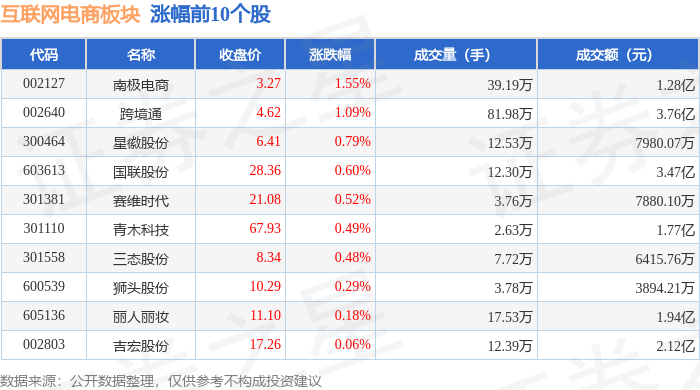
互联网电商板块1月6日涨0.19%,南极电商领涨,主力资金净流出1.23亿元
Zheng Xing Xing Ye Ri Bao· 2026-01-06 09:00
Market Overview - The internet e-commerce sector increased by 0.19% on January 6, with Nanji E-commerce leading the gains [1] - The Shanghai Composite Index closed at 4083.67, up by 1.5%, while the Shenzhen Component Index closed at 14022.55, up by 1.4% [1] Stock Performance - Key stocks in the internet e-commerce sector showed varied performance, with Nanji E-commerce closing at 3.27, up by 1.55%, and Kuaijingtong at 4.62, up by 1.09% [1] - Other notable stocks included Xinghui Co., which rose by 0.79% to 6.41, and Guolian Co., which increased by 0.60% to 28.36 [1] Trading Volume and Value - The trading volume and value for Nanji E-commerce reached 391,900 shares and 128 million yuan, respectively [1] - Kuaijingtong had a trading volume of 819,800 shares with a transaction value of 376 million yuan [1] Capital Flow - The internet e-commerce sector experienced a net outflow of 123 million yuan from institutional investors, while retail investors saw a net inflow of 155 million yuan [2] - The overall capital flow indicates a mixed sentiment, with institutional investors withdrawing funds while retail investors increased their positions [2] Individual Stock Capital Flow - Xinghui Co. had a net inflow of 10.24 million yuan from institutional investors, while retail investors showed a net outflow of 9.05 million yuan [3] - Nanji E-commerce saw a net inflow of 2.46 million yuan from institutional investors, with retail investors contributing a net inflow of 1.11 million yuan [3]


南极电商涉5亿余元诉讼,还是“卖吊牌”惹的祸
Jing Ji Guan Cha Wang· 2026-01-06 01:26
Core Viewpoint - Nanji E-commerce Co., Ltd. is involved in two lawsuits with Shanghai Xinhe Zhao Enterprise Development Co., Ltd., with claims related to trademark usage of the "Cardi Le Crocodile" brand, including a significant claim of 565 million yuan [2][3]. Group 1: Lawsuit Details - The first lawsuit was initiated by Shanghai Xinhe Zhao in January 2025, initially seeking approximately 20 million yuan, which was later increased to 565 million yuan in December 2025 [3]. - Nanji E-commerce filed a counter lawsuit in April 2025, seeking compensation of around 80 million yuan from Shanghai Xinhe Zhao [3]. - The lawsuits are set to be heard in January and March 2026, respectively [6]. Group 2: Background of the Dispute - Nanji E-commerce and Shanghai Xinhe Zhao began their partnership in 2018, signing a trademark licensing agreement that allowed the latter to use the Cardi Le series trademarks until December 31, 2027 [3]. - Nanji E-commerce alleges that Shanghai Xinhe Zhao violated the agreement by sublicensing the trademarks to downstream distributors and modifying the trademark styles, leading to quality management issues [3][5]. - The disputes have resulted in Nanji E-commerce being implicated in third-party trademark infringement lawsuits, affecting its business reputation and financial standing [3][5]. Group 3: Financial Impact and Business Model - The brand Cardi Le, acquired for nearly 600 million yuan in 2016, was a significant revenue driver for Nanji E-commerce, contributing 10.80% of total GMV in 2021 [7]. - However, revenue from brand licensing has declined sharply from 747 million yuan in 2021 to 235 million yuan in 2023, indicating a more than 70% decrease over three years [7][8]. - In 2024, Nanji E-commerce reported total revenue of 3.358 billion yuan with a net loss of 237 million yuan, reflecting a significant drop in profitability compared to previous years [7]. Group 4: Strategic Response - In response to the challenges posed by the licensing model, Nanji E-commerce has initiated a strategic transformation, focusing on "fashion licensing + strategic cooperation licensing + self-operated retail" [8][9]. - The company has also begun to restructure its supply chain and enhance product quality control, aiming to improve its self-operated product offerings, which saw a revenue increase of 152.01% in the first half of 2025 [9]. - Despite these efforts, the overall financial performance remains under pressure, with sales expenses rising significantly [9].