
Kazatomprom

Search documents
X @Bloomberg
Bloomberg· 2025-10-02 01:26
Company Strategy - Kazatomprom, the world's largest uranium producer, is considering a new listing to boost its valuation [1]
铀:正在形成的核领域瓶颈与地缘政治压力点-Uranium_ A nuclear bottleneck and geopolitical pressure point in the making_
2025-09-28 14:57
Summary of J.P. Morgan's Uranium Market Conference Call Industry Overview - **Industry**: Uranium Market - **Key Analysts**: Bill Peterson (U.S. Clean Tech & Metals Mining) and Milan Tomic (Australia Metals & Mining) [1] Key Points Supply Dynamics - The uranium market is facing tight supply, with spot and term prices increasing approximately 5% year-to-date [3] - Major producers are reducing output: - Kazatomprom plans to cut 2026 production by 10% to 77 million pounds [3] - Cameco is reducing MacArthur River output from 18 million to 13 million pounds [3] - Operational issues at smaller mines in Australia are contributing to supply tightness [3] - Secondary supply from government stockpiles has decreased from 50% of total supply in 2021 to about 15% in 2025, expected to decline further by 2030 [3] - Uranium prices are projected to remain supported over the next few years due to the need for higher prices to incentivize new supply [3] Demand Growth - Global uranium demand is expected to rise from 188 million pounds in 2025 to 230 million pounds by 2030, driven primarily by China [3] - China's demand is projected to grow at a 6.7% CAGR to 2030, while the rest of the world is expected to grow at 2.7-3% [3] - China is building about six new reactors annually, increasing its fleet from 62 to 93 reactors by 2030 [3] U.S. Policy and Energy Security - The U.S. government is focusing on building strategic uranium reserves and supporting a domestic nuclear supply chain [3] - President Trump's executive order aims to expand U.S. nuclear capacity from approximately 100 GW to over 400 GW by 2050 [3] - Increased electricity demand from AI and data centers is driving interest in nuclear power [3] - Utilities are exploring new reactor builds and extending existing plant lifespans, supported by the IRA production tax credits [3] Enrichment Capacity and Geopolitical Factors - Global enrichment demand is expected to rise from 50 million SWU today to 75-100 million SWU per year by 2040 [4] - Russia accounted for over 25% of foreign-origin SWU in 2023, but trade flows are being limited by regulatory frameworks [4] - Potential loss of Russian supply post-2028 could create a 15-20 million SWU deficit, impacting U.S. customers [4] - Congress has allocated $2.7 billion to enhance U.S. enrichment capacity, alongside $700 million from the IRA for HALEU programs [4] Geopolitical Dynamics - Uranium mine supply is concentrated in Kazakhstan (~40%), Canada (~20%), and Africa (~12%) [4] - Kazatomprom faces reserve depletion post-2030, while Canada is expected to increase its role with new projects [4] - Geopolitical issues, such as asset seizures in Niger, add uncertainty to African supply [4] - Key investment catalysts include U.S. strategic reserve announcements, financial activities, production cuts, and new enrichment technologies [4] Additional Insights - The uranium market is at a critical juncture, becoming increasingly reliant on miners' ability to ramp up new supply sources [3] - U.S. and EU utilities currently hold around three years' worth of inventory, reducing the urgency to contract aggressively [3] - Balance in the uranium market is projected around 2028-29 [3] This summary encapsulates the critical insights from the conference call regarding the uranium market's supply-demand dynamics, geopolitical factors, and investment opportunities.
Uranium EXPLAINED: Why It Could Soon Run Out!
Coin Bureau· 2025-09-28 12:45
Supply and Demand Dynamics - Global uranium demand is projected to increase by 30% from 67,000 tons to 87,000 tons by 2030, and further to over 150,000 tons annually by 2040 [35] - Current uranium mines are expected to start depleting after 2030, leading to a potential supply shortfall for import-dependent countries [35][36] - The United States imports 95% of its uranium, requiring 18,000 tons annually while producing only 100 tons domestically [20] - China's uranium demand is forecasted to quadruple to 40,000 tons annually by 2035, while domestic production is only 1,700 tons [21] Geopolitical and Market Concentration - Kazakhstan produces 43% of the world's uranium, and together with Canada (15%) and Namibia (11%), controls nearly 70% of global production [18][19] - Russia's Rosatom controls 38% of global uranium enrichment capacity, posing a geopolitical risk for Western nations [7][43] - The top 10 uranium producers control 85% of global supply, and four entities (Rosatom, Uranko, Orano, and CNNC) control 96% of global enrichment capacity [32] Challenges and Bottlenecks - Uranium enrichment is a critical bottleneck, with Russia and China controlling nearly two-thirds (62.7%) of global capacity [7][44] - The uranium cycle takes 12 to 18 months from mine to reactor, and disruptions can cascade through the system [17] - Lead times for new uranium projects range from 10 to 20 years, encompassing exploration, feasibility studies, permitting, and construction [37] Historical Context and Strategic Implications - The US privatized its enrichment infrastructure in the 1990s, leading to a decline in domestic capacity and increased reliance on imports [45][46][47][48] - China has systematically secured uranium supply through equity stakes in mines across Africa and Central Asia, ensuring resource security [22]

核电股走高,小摩:AI数据中心正推动核电需求强劲增长
Zhi Tong Cai Jing· 2025-09-26 07:18
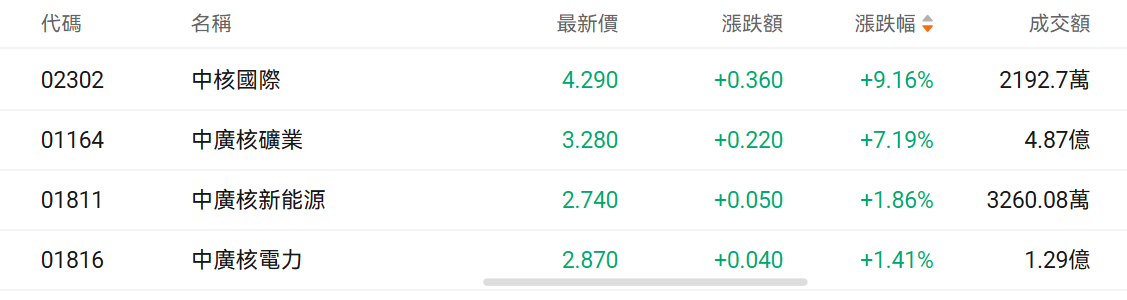
Group 1 - Nuclear power stocks have risen significantly, with increases of over 9% and 7% for specific companies [1] - Major companies such as China National Nuclear Corporation and China General Nuclear Power Corporation have seen notable stock price increases, with China National Nuclear Corporation rising by 9.16% to 4.290 and China General Nuclear Mining rising by 7.19% to 3.280 [1] - The rise in uranium prices, approximately 5% this year, is attributed to production cuts by major suppliers and increasing demand from nuclear power construction and AI data centers in China [1] Group 2 - Morgan Stanley reports that the global uranium market is undergoing significant changes, with a tight supply and strong demand leading to an optimistic price outlook [2] - The forecast predicts uranium prices will reach $87 per pound by Q4 2025, supported by supply challenges, stable spot demand, and potential increases in contract volumes [2] - The structural support from the "nuclear renaissance" is strengthening the fundamentals of the uranium market, indicating further price potential [2]

港股异动 | 核电股今日走高 中核国际(02302)涨超9% 中广核矿业(01164)涨超8%
智通财经网· 2025-09-26 05:46
Core Insights - Nuclear stocks have risen significantly, with China National Nuclear Power (02302) up 9.67% to HKD 4.31 and China General Nuclear Power (01164) up 7.84% to HKD 3.3 [1] - A recent report from JPMorgan highlights a growing market tension between the explosive demand driven by nuclear energy revival and AI revolution, and the supply bottlenecks caused by major producers reducing output and geopolitical factors [1] - Uranium spot and futures prices have increased by approximately 5% this year, driven by production cuts from major suppliers like Kazatomprom and Cameco, alongside strong demand from China's rapid nuclear power construction and AI data centers [1] Supply and Demand Dynamics - Morgan Stanley's report indicates significant changes in the global uranium market, with evolving supply-demand dynamics making the market outlook increasingly favorable [1] - The optimistic price outlook is supported by tightening supply, stable spot demand, and an increase in potential contract volumes, alongside structural support from the nuclear energy revival [1] - Morgan Stanley projects uranium prices to reach USD 87 per pound by Q4 2025, reflecting a solid fundamental backdrop for the uranium market with further upward price potential [1]
核电股今日走高 中核国际涨超9% 中广核矿业涨超8%
Zhi Tong Cai Jing· 2025-09-26 05:42
Core Viewpoint - Nuclear stocks have risen significantly, driven by a combination of increasing demand from nuclear energy revival and AI revolution, alongside supply constraints from major producers [1] Group 1: Market Performance - China National Nuclear Corporation International (02302) increased by 9.67%, reaching 4.31 HKD; China General Nuclear Power Corporation (01164) rose by 7.84%, reaching 3.3 HKD [1] Group 2: Supply and Demand Dynamics - A report from JPMorgan highlights a tightening market reality, with uranium spot and futures prices rising approximately 5% this year due to reduced production from major suppliers like Kazatomprom and Cameco [1] - The rapid construction of nuclear power plants in China and the substantial electricity demand from AI data centers are driving strong growth in uranium demand [1] Group 3: Future Price Outlook - Morgan Stanley indicates that the global uranium market is undergoing significant changes, with a positive price outlook due to tightening supply and strong demand [1] - Uranium prices are expected to reach 87 USD per pound by Q4 2025, supported by supply challenges, stable spot demand, and an increase in potential contract volumes [1] - The structural support from the "nuclear energy revival" contributes to a solid fundamental outlook for the uranium market, indicating further price upside potential [1]
铀:正在形成的核能瓶颈与地缘政治压力点?
Hua Er Jie Jian Wen· 2025-09-25 02:53
全球铀市场正经历一个关键转折点,供应削减、需求飙升和地缘政治紧张共同作用,可能使其成为核能 发展的瓶颈和地缘政治压力点。 据追风交易台消息,摩根大通9月23日的最新报告揭示了一个日益紧张的市场现实:一边是核能复兴和 AI革命带来的爆炸性需求,另一边却是主要生产商的减产和地缘政治引发的供应瓶颈。 今年以来,铀的现货和期货价格已上涨约5%。价格上涨的背后,是全球主要生产商如Kazatomprom和 Cameco纷纷削减产量,而中国迅猛的核电建设与AI数据中心带来的巨大电力需求,正推动需求强劲增 长。 深层次的风险潜藏在核燃料供应链和地缘政治的风险中。报告强调,西方国家在铀浓缩服务方面严重依 赖俄罗斯,而美国旨在摆脱这种依赖的法案可能在2028年后造成严重的供应短缺。 供应缺口扩大,价格获强力支撑 此外,一个全新的需求驱动因素正在出现:人工智能和数据中心。这些高耗能产业正推动科技巨头转向 核能。报告提到,Meta已与星座能源公司(Constellation)签订了一份为期20年的虚拟电力购买协议 (PPA),而亚马逊则从Talon Energy锁定了近2吉瓦的核电供应,为其AWS数据中心供电。 "去俄化"与地缘政治 ...
超级巨头,大举扫货!
证券时报· 2025-09-07 09:51
Core Viewpoint - The global uranium market is undergoing significant changes due to a substantial increase in demand driven by the expansion of nuclear power, with projections indicating a 33% rise in uranium demand by 2030 and a doubling of global nuclear power capacity by 2040 [2][5][4]. Supply and Demand Dynamics - The World Nuclear Association reports that uranium demand will rise to 86,000 tons by 2030 and 150,000 tons by 2040, while existing uranium mines are expected to deplete, leading to a potential supply shortfall [4][5]. - The current uranium spot price has surged from $30 per pound in 2020 to around $80 per pound, with predictions of further price increases due to supply constraints and rising demand [10][9]. Market Trends - The Sprott Physical Uranium Trust has raised $200 million to purchase physical uranium, indicating strong demand in the market [9]. - Major uranium producers are facing challenges, with some announcing production cuts due to aging mines and resource depletion [6][5]. Future Projections - Analysts predict that uranium prices could reach $87 per pound by Q4 2025 and potentially $100 per pound by 2026, driven by supply challenges and increasing energy demands [10][9]. - The development of small modular reactors (SMRs) is expected to account for 20% of total uranium demand by 2040, further influencing market dynamics [10].

利好突袭!超级巨头,大举扫货!
券商中国· 2025-09-07 08:13
Core Viewpoint - The global uranium market is undergoing significant changes due to a substantial increase in demand driven by the expansion of nuclear power, with projections indicating a 33% rise in uranium demand by 2030 and a potential supply gap due to depleting existing mines [2][4][5]. Group 1: Demand and Supply Dynamics - The World Nuclear Association forecasts that uranium demand will rise to 86,000 tons by 2030 and reach 150,000 tons by 2040, while existing uranium mines are expected to face depletion, leading to a potential 50% reduction in global uranium production [4][5]. - The current spot price of uranium has surged from $30 per pound in 2020 to around $80 per pound, with a peak exceeding $100 per pound, reflecting a significant supply-demand imbalance [2][7]. - The demand for nuclear energy is being bolstered by geopolitical factors, such as the desire of European countries to reduce dependence on Russian gas, and the increasing energy needs driven by the growth of data centers and electric vehicles [5][6]. Group 2: Market Trends and Future Outlook - Major players like Sprott's Physical Uranium Trust are actively purchasing uranium, having raised $200 million for this purpose, which is further driving up spot demand [7]. - Analysts from Morgan Stanley and Citigroup predict a bullish outlook for uranium prices, with expectations of reaching $87 per pound by Q4 2025 and potentially $100 per pound by 2026, supported by stable demand and supply challenges [8]. - The development of small modular reactors (SMRs) is anticipated to account for 20% of total uranium demand by 2040, adding another layer of complexity to the market dynamics [8].

Production Cuts At Major Uranium Mines Help URNJ
Seeking Alpha· 2025-09-06 19:08
Group 1 - The two largest uranium producers, Kazatomprom and Cameco, have made announcements that have impacted the market, with Kazatomprom lowering their 2026 production numbers and Cameco reporting issues at one of their facilities [1] - The market reaction to these announcements indicates a potential shift in uranium supply dynamics, which could affect pricing and investment opportunities in the sector [1] Group 2 - The article mentions the author's investment focus on commodities, particularly uranium, and highlights a few companies of interest in the sector, suggesting a positive outlook on uranium investments [1]
