
科华数据

Search documents
科华数据:截至2025年10月20日公司股东户数约为5.9万户
Zheng Quan Ri Bao Wang· 2025-10-21 11:12
Core Insights - The company Keda Data (002335) reported that as of October 20, 2025, the number of shareholders is expected to be approximately 59,000 [1] Company Summary - Keda Data is actively engaging with investors through interactive platforms, indicating a focus on shareholder communication and transparency [1] - The projected number of shareholders reflects the company's growth and potential interest from the investment community [1]

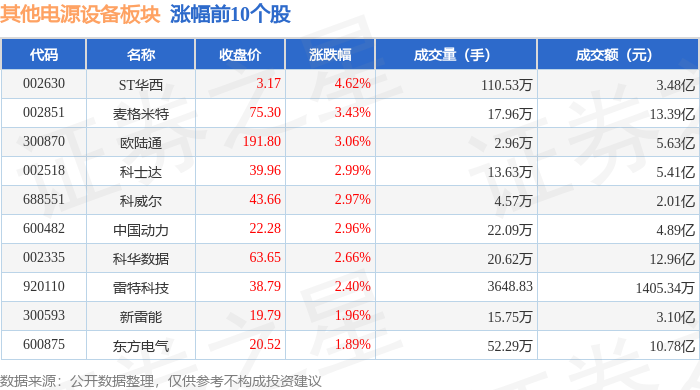
其他电源设备板块10月21日涨1.76%,ST华西领涨,主力资金净流入6888.37万元
Zheng Xing Xing Ye Ri Bao· 2025-10-21 08:29
Market Performance - The other power equipment sector increased by 1.76% on the previous trading day, with ST Huaxi leading the gains [1] - The Shanghai Composite Index closed at 3916.33, up 1.36%, while the Shenzhen Component Index closed at 13077.32, up 2.06% [1] Stock Performance - ST Huaxi (002630) closed at 3.17, with a rise of 4.62% and a trading volume of 1.1053 million shares, totaling a transaction value of 348 million yuan [1] - Magpower (002851) closed at 75.30, up 3.43%, with a trading volume of 179,600 shares and a transaction value of 1.339 billion yuan [1] - Other notable stocks include Oulu Tong (300870) at 191.80 (+3.06%), Keda (002518) at 39.96 (+2.99%), and China Power (600482) at 22.28 (+2.96%) [1] Capital Flow - The other power equipment sector saw a net inflow of 68.8837 million yuan from main funds, while retail investors experienced a net outflow of 36.6678 million yuan [2] - Main funds showed significant net inflows in stocks like Keda (002335) with 12 million yuan and Oulu Tong (300870) with 47.653 million yuan [3] Individual Stock Analysis - Keda (002335) had a main fund net inflow of 12 million yuan, but retail investors had a net outflow of 10.3 million yuan [3] - Oulu Tong (300870) experienced a main fund net inflow of 47.653 million yuan, with retail investors also showing a net outflow of 31.3134 million yuan [3] - ST Huaxi (002630) had a main fund net inflow of 35.7524 million yuan, while retail investors had a net outflow of 14.1131 million yuan [3]




科华数据涨2.23%,成交额2.04亿元,主力资金净流入1767.37万元
Xin Lang Cai Jing· 2025-10-21 01:58
Core Viewpoint - KWH Data's stock price has shown significant volatility and growth, with a year-to-date increase of 119.92% and a recent market capitalization of 32.67 billion yuan [1] Financial Performance - For the first half of 2025, KWH Data reported a revenue of 3.733 billion yuan, reflecting a year-on-year growth of 0.06%, and a net profit attributable to shareholders of 244 million yuan, which is a 7.94% increase [2] - Cumulative cash dividends since the company's A-share listing amount to 1.385 billion yuan, with 130 million yuan distributed over the past three years [3] Stock Market Activity - As of October 21, KWH Data's stock price was 63.38 yuan per share, with a trading volume of 204 million yuan and a turnover rate of 0.72% [1] - The stock has appeared on the "Dragon and Tiger List" six times this year, with the most recent occurrence on September 12 [1] Shareholder Structure - As of October 10, the number of KWH Data's shareholders was 58,000, a decrease of 6.45% from the previous period, with an average of 7,839 circulating shares per shareholder, an increase of 6.90% [2] - Major shareholders include Hong Kong Central Clearing Limited and various mutual funds, with some experiencing changes in their holdings [3] Business Segments - KWH Data's main business revenue breakdown includes: 49.62% from new energy products, 21.01% from data center products, 16.43% from IDC services, 11.77% from smart power products, and 1.17% from other sources [1]
科华数据涨2.07%,成交额1.49亿元,主力资金净流入476.10万元
Xin Lang Cai Jing· 2025-10-20 01:52
Core Viewpoint - KWH Data's stock price has shown significant volatility, with a year-to-date increase of 115.34%, but a recent decline over the past five and twenty trading days [1][2] Company Overview - KWH Data, established on March 26, 1999, and listed on January 13, 2010, is located in Xiamen, Fujian Province. The company specializes in the production and sales of UPS power supplies for information equipment and industrial power [1] - The company's revenue composition includes: 49.62% from new energy products, 21.01% from data center products, 16.43% from IDC services, 11.77% from smart energy products, and 1.17% from other sources [1] Financial Performance - For the first half of 2025, KWH Data reported a revenue of 3.733 billion yuan, reflecting a year-on-year growth of 0.06%, and a net profit attributable to shareholders of 244 million yuan, up 7.94% year-on-year [2] - Cumulatively, KWH Data has distributed 1.385 billion yuan in dividends since its A-share listing, with 130 million yuan distributed over the past three years [3] Shareholder Information - As of October 10, 2025, KWH Data had 58,000 shareholders, a decrease of 6.45% from the previous period, with an average of 7,839 circulating shares per shareholder, an increase of 6.90% [2] - The top ten circulating shareholders include significant entities such as Hong Kong Central Clearing Limited and various mutual funds, with notable changes in shareholdings among these investors [3]
中国数据中心设备:英伟达发布 800VDC 架构白皮书-China Data Center Equipment_ NVIDIA released white paper for 800VDC architecture
2025-10-19 15:58
Summary of Key Points from the Conference Call Industry Overview - **Industry**: Data Center Equipment in China - **Key Company**: NVIDIA Core Insights and Arguments - **Transition to 800VDC Architecture**: NVIDIA released a white paper detailing the transition to an 800VDC power distribution model for AI infrastructure, confirming a phased approach to this transition [2][4] - **Phase 1**: Retrofit with an 800VDC side rack to convert from 480VAC to 800VDC - **Phase 2**: Replace UPS with high power density rectifiers - **Phase 3**: Utilize Medium Voltage rectifiers or Solid State Transformers (SST) for direct conversion from medium voltage to 800VDC - **Energy Storage as Essential Component**: Energy storage is highlighted as a critical part of the 800VDC architecture, addressing load swings and enhancing compatibility with DC environments [4] - **Short Duration Storage**: High power capacitors and super capacitors for high frequency power volatility - **Long Duration Storage**: Located at grid interconnections for managing larger power shifts - **Commercialization Timeline**: Anticipated delivery of HVDC systems starting from the second half of 2026, with mass production scaling from 2027 and SST commercialization ramping up from 2029 [2] Key Suppliers and Partnerships - **NVIDIA's Ecosystem**: Key industry partners aiding the development of the 800VDC system include major power system component providers and data center power system providers such as ABB, Eaton, and Siemens [3] Investment Insights - **Top Pick**: Kehua Data is identified as a top pick within the Chinese AIDC supply chain due to its potential for overseas HVDC market penetration and technological advantages [5] - **Valuation Risks**: Major downside risks for the data center equipment sector include slower-than-expected AI data center capacity growth and market share gains in overseas AIDC equipment supply chain [10][11] Valuation Methodology - **Price Target for Kehua**: Based on a DCF methodology, with potential risks including slower IDC capacity expansion and lower-than-expected overseas shipments of energy storage systems [11][23] Additional Considerations - **Market Dynamics**: The report emphasizes the importance of energy storage in the evolving data center landscape, driven by increasing capital expenditures in the sector [4] - **Analyst Contact Information**: Analysts involved in the report include Yishu Yan, Ken Liu, and Anna Yuan, providing insights into the sector [6] This summary encapsulates the critical points discussed in the conference call, focusing on the transition to 800VDC architecture, the role of energy storage, key partnerships, and investment insights regarding Kehua Data.

电力设备:产业周跟踪:充电桩倍增政策落地,OCP大会聚焦800v直流和液冷
Huafu Securities· 2025-10-19 12:48
Investment Rating - The report maintains an "Outperform" rating for the industry [6] Core Insights - The report highlights significant developments in various sectors, including electric vehicles, solar energy, wind energy, energy storage, power equipment, industrial control, robotics, and hydrogen energy [2][3][4][5][9][18][28][36][50][59] Electric Vehicle and Lithium Battery Sector - Six departments issued a three-year plan to double the number of charging stations, aiming to add over 28 million new charging facilities by 2027, with a retail penetration rate of 57.8% for new energy vehicles in September [9][10] - The retail sales of new energy passenger vehicles reached a historical high of 1.296 million units in September, marking a year-on-year increase of 15.5% [10] Solar Energy Sector - Anticipation of two major favorable policies aimed at curbing price competition in the solar industry, with a focus on high-quality development [18][19] - The report emphasizes the need for effective policies to eliminate outdated production capacity and rejuvenate the solar industry [19] Wind Energy Sector - Multiple key offshore wind projects are undergoing intensive bidding, with a notable procurement of 1.52GW wind turbines by State Power Investment Corporation at competitive prices [28][30] - The report indicates that these projects will lay a solid foundation for installed capacity in 2026 and 2027 [28] Energy Storage Sector - Strong demand for energy storage batteries is expected to approach 600GWh by 2025, with a significant increase in shipments in Q3 2025 [36][37] - The first self-regulatory practice guidelines for energy storage systems have been released, focusing on safety and quality standards [38] Power Equipment Sector - The third batch of bidding for State Grid metering products has commenced, with a total of 16.96 million electric meters up for bid [52] - The Qinggui DC project has entered the feasibility study stage, which will enable the transmission of 36 billion kWh of electricity annually to Guangxi [56] Industrial Control and Robotics Sector - The establishment of a new intelligent transmission system headquarters in Hefei, with a planned investment of 1 billion yuan, aims to enhance the competitiveness of the robotics industry [59][60] - The listing of Yunji Technology on the Hong Kong Stock Exchange marks a significant milestone, with a first-day increase of 49% [61][62] Hydrogen Energy Sector - The National Development and Reform Commission has introduced investment measures to support five key areas, while General Motors has halted the development of the next-generation hydrogen fuel cell [5]
“AI+储能”站上风口:宁德等企业抢滩,算力与数据安全瓶颈待破
Di Yi Cai Jing· 2025-10-18 13:51
Core Insights - The integration of AI with energy has been officially included in the national strategic framework, with specific goals set for 2027 and 2030 [1] - The application of AI in energy storage is expected to enhance operational efficiency, safety, and economic returns across the industry [2][3] Group 1: National Strategy and Goals - The National Development and Reform Commission and the Energy Administration have issued implementation opinions that include "AI + Energy Storage" in the national energy strategy [1] - By 2027, the goal is to establish over five specialized large models in the energy sector and over ten replicable demonstration projects, with a target of achieving world-leading AI technology in energy by 2030 [1] Group 2: AI Applications in Energy Storage - AI technology is recognized for its potential to improve the operational efficiency and safety of energy storage systems, with companies increasing investments in AI [2] - Companies like Haibo Shichuang are planning to expand independent energy storage projects and leverage AI and big data for backend operations [2] - Cross-industry collaborations, such as the partnership between Nenghui Technology and Ant Group, aim to develop AI applications for energy project management [2] Group 3: Operational Efficiency and Safety - AI is crucial for optimizing energy dispatch decisions in large power plants, directly impacting revenue maximization [3] - AI diagnostic technologies can accurately identify battery faults and provide early warnings, enhancing the safety and lifespan of energy storage systems [3] - The shift from reactive to proactive maintenance through AI can significantly improve operational efficiency [4] Group 4: Market Potential and Economic Returns - The overall service market for energy storage is projected to reach between 40 billion to 50 billion yuan by 2030 [5] - AI-driven algorithms can optimize trading strategies, enhance energy utilization efficiency, and maximize operational returns [6] - Major companies are launching their own AI solutions, indicating a consensus on the importance of AI in the energy storage sector [6][7] Group 5: Challenges and Bottlenecks - Despite the potential of AI, challenges such as data security and the need for robust computational power remain significant [8][9] - The development of AI in energy storage may exacerbate existing power supply and demand issues, particularly in the context of renewable energy integration [8] - The collaboration between AI and energy storage faces commercial viability challenges due to high energy consumption and uncertain returns [9] Group 6: Future Outlook - The industry views the application of AI in renewable energy as an opportunity that outweighs the challenges, with a focus on data security and effective data management [10]


独家调查|“AI+储能”站上风口:宁德等企业抢滩,算力与数据安全瓶颈待破
Di Yi Cai Jing· 2025-10-18 13:40
Core Insights - AI technology can enhance the operational efficiency, safety, and economic viability of energy storage systems, and its integration into national energy strategies has been formalized [1][3][9] Group 1: National Strategy and Goals - The National Development and Reform Commission and the Energy Administration have issued implementation opinions that include "AI + Energy" as part of the national energy strategy, aiming to establish over five specialized large models and ten replicable demonstration projects by 2027 [1] - By 2030, the overall AI technology in energy is expected to reach a world-leading level, with a fully developed synergy between computing power and electricity [1] Group 2: Industry Applications and Investments - Energy companies are increasing investments in AI from perspectives of safety assurance, operational efficiency, and revenue enhancement [3] - HaiBoSiChuang plans to expand independent energy storage projects over the next 3-5 years, leveraging its existing AI and big data capabilities [3] - A strategic partnership between NengHui Technology and Ant Group aims to develop "Energy AI Intelligent Agents" to reconstruct management paradigms in renewable energy projects [3] Group 3: Operational Efficiency and Safety - AI can significantly improve operational efficiency in energy storage, transitioning from reactive maintenance to proactive monitoring [5][6] - AI technologies can predict battery health and lifespan, reducing failure rates and enhancing safety through precise diagnostics [4][5] - The integration of AI in operational processes allows for real-time monitoring and predictive maintenance, optimizing energy management and maximizing returns [6][7] Group 4: Market Potential and Economic Impact - The overall service market for energy storage is projected to reach between 40 billion to 50 billion yuan by 2030 [6] - AI-driven algorithms can enhance trading operations by providing accurate price forecasts and optimizing charging and discharging strategies [6][8] Group 5: Challenges and Bottlenecks - Despite the potential of AI, challenges such as data security, privacy protection, and the need for robust computational power remain [9][10] - The development of AI in energy storage is constrained by the need for advanced data centers (AIDC) and the associated high energy consumption [10][11] - The synergy between AI and energy storage must overcome commercial viability challenges due to the uncertain returns of storage projects [10][11]



算力高速公路:一切皆有可能
2 1 Shi Ji Jing Ji Bao Dao· 2025-10-17 11:33
Core Insights - The Chinese computing power industry is receiving significant policy support, marking a transition from the first phase of scale expansion to a second phase focused on deep integration with the real economy and value creation [1] - The national strategy emphasizes the construction of new information infrastructure and the application of computing power in various industries, with a focus on security and data protection [1][10] Policy and Infrastructure Development - On October 11, a joint implementation plan was released by multiple government departments to promote service-oriented manufacturing innovation, setting a new direction for the computing power industry [1] - Shanghai has responded with its own action plan for high-quality development of the intelligent terminal industry, aiming to create a cluster for intelligent computing servers and promote the large-scale application of core components [1] - The establishment of a national computing power network is underway, with various cities forming alliances to meet regional computing demands [3][4] Industry Growth and Company Initiatives - Companies like Dongfang Guoxin and Qidi Design are actively investing in intelligent computing center construction, with significant project investments reported [5][6] - The computing power infrastructure is expanding rapidly, with cities like Ceyuan and Langfang leading in data center operations and service provision [4][5] Technological Advancements - The domestic computing power industry is experiencing a historic shift from "usable" to "well-used" due to policy guidance and technological breakthroughs [7] - Major companies like Huawei are advancing their AI chip development, with plans for continuous product iterations and high-performance cluster solutions [7][8] AI Commercialization and Industry Integration - The integration of computing power with various industries is accelerating, with a focus on creating high-quality industry data sets and promoting the commercialization of AI applications [10][11] - Companies are forming strategic partnerships to enhance AI capabilities in sectors such as finance, education, and security, indicating a trend towards deeper industry integration [11][12] Future Outlook - The demand for computing power is expected to grow significantly as AI applications become more widespread, with emerging sectors like low-altitude economy poised for rapid development [13]
科华数据股价跌5.05%,华安基金旗下1只基金重仓,持有20.92万股浮亏损失69.04万元
Xin Lang Cai Jing· 2025-10-17 02:38
Group 1 - The stock price of Kehua Data dropped by 5.05% to 62.08 CNY per share, with a trading volume of 581 million CNY and a turnover rate of 2.01%, resulting in a total market capitalization of 31.997 billion CNY [1] - Kehua Data, established on March 26, 1999, and listed on January 13, 2010, specializes in the production and sales of UPS power supplies for information equipment and industrial power [1] - The revenue composition of Kehua Data includes 49.62% from new energy products, 21.01% from data center products, 16.43% from IDC services, 11.77% from smart power products, and 1.17% from other sources [1] Group 2 - Huazhong Fund holds a significant position in Kehua Data through its fund, Huazhong Carbon Neutral Mixed A (015989), which maintained 209,200 shares in the second quarter, accounting for 4.24% of the fund's net value [2] - The fund has experienced a floating loss of approximately 690,400 CNY as of the latest report [2] - Huazhong Carbon Neutral Mixed A was established on February 7, 2023, with a current scale of 173 million CNY, achieving a year-to-date return of 48.97% and a one-year return of 62.93% [2]