春秋航空

Search documents
江苏省消保委调查相关航司有偿选座服务
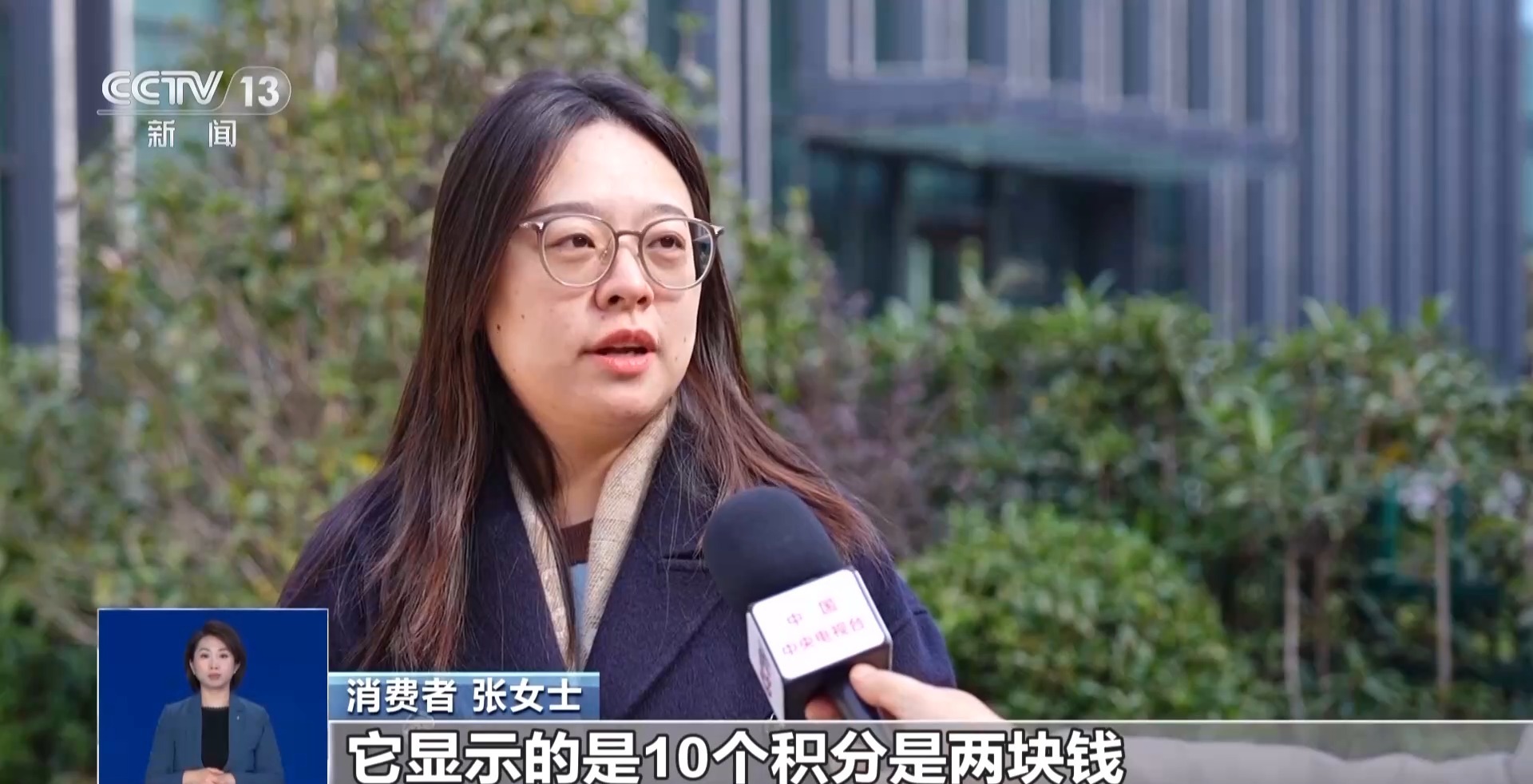
Zheng Quan Ri Bao· 2025-12-02 16:13
Core Viewpoint - The investigation by Jiangsu Consumer Protection Committee reveals that domestic airlines are locking a significant percentage of economy class seats, which raises concerns about consumer rights and fair pricing practices [1][2][3]. Group 1: Investigation Findings - The investigation found that all surveyed airlines exhibit varying degrees of "seat locking," with the percentage of locked seats ranging from 19.9% to 62.1%, averaging 38.7% [1]. - Spring Airlines and Shenzhen Airlines have particularly high locking rates, exceeding 60% and 50% respectively on specific routes [1]. - The locked seats are primarily located in preferred areas such as the front rows, window, and aisle seats, while available free seats are often in less desirable locations [2]. Group 2: Consumer Rights and Legal Perspectives - According to legal experts, the practice of charging for seat selection may violate consumer rights, as it transforms basic services into additional fees without proper disclosure [2]. - The Consumer Protection Law grants consumers the right to fair trading, which includes being informed about any additional charges related to seat selection [2]. Group 3: Industry Implications and Recommendations - The practice of "seat locking" is viewed as a method for airlines to increase revenue at the expense of customer experience, potentially harming long-term industry growth [3]. - Experts suggest that airlines should maintain a balance between commercial interests and consumer rights, ensuring that a majority of seats remain available for free selection while allowing a small percentage for premium pricing [4]. - Future regulatory scrutiny will focus on how airlines address these issues, emphasizing the need for a balance between market operations and public service responsibilities [4].
东京飞上海一航班中途返航,航空公司回应
Bei Jing Ri Bao Ke Hu Duan· 2025-12-02 14:02
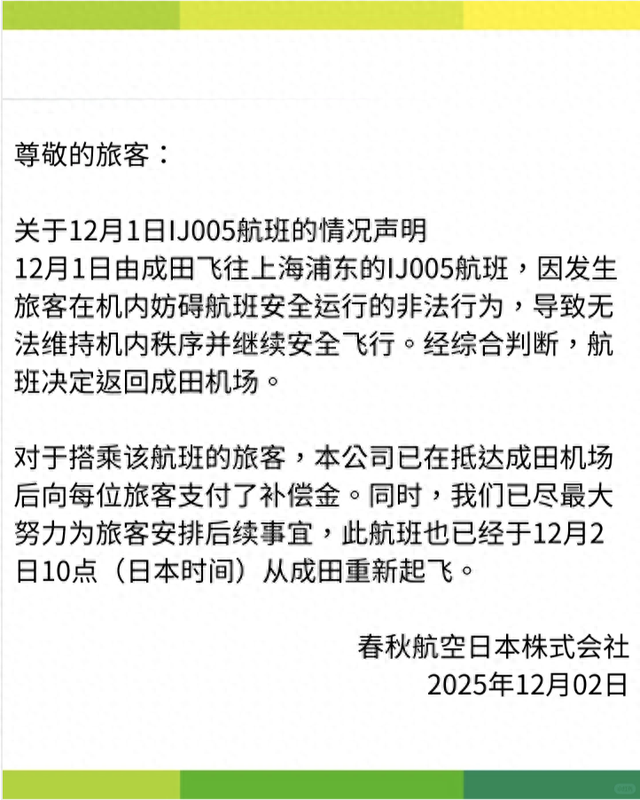
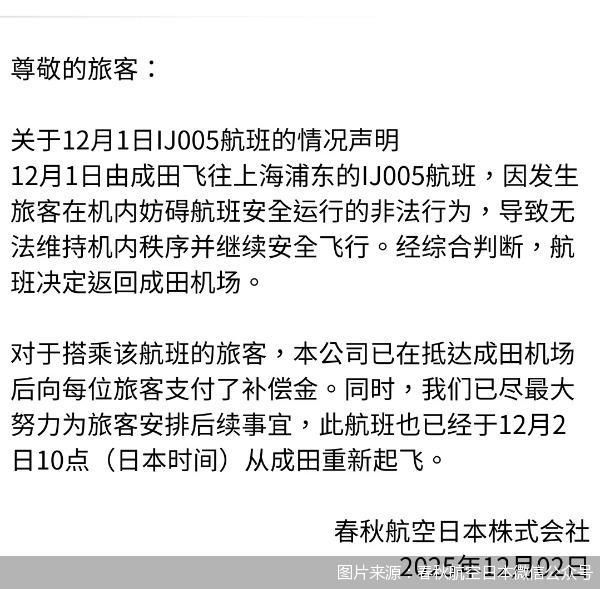
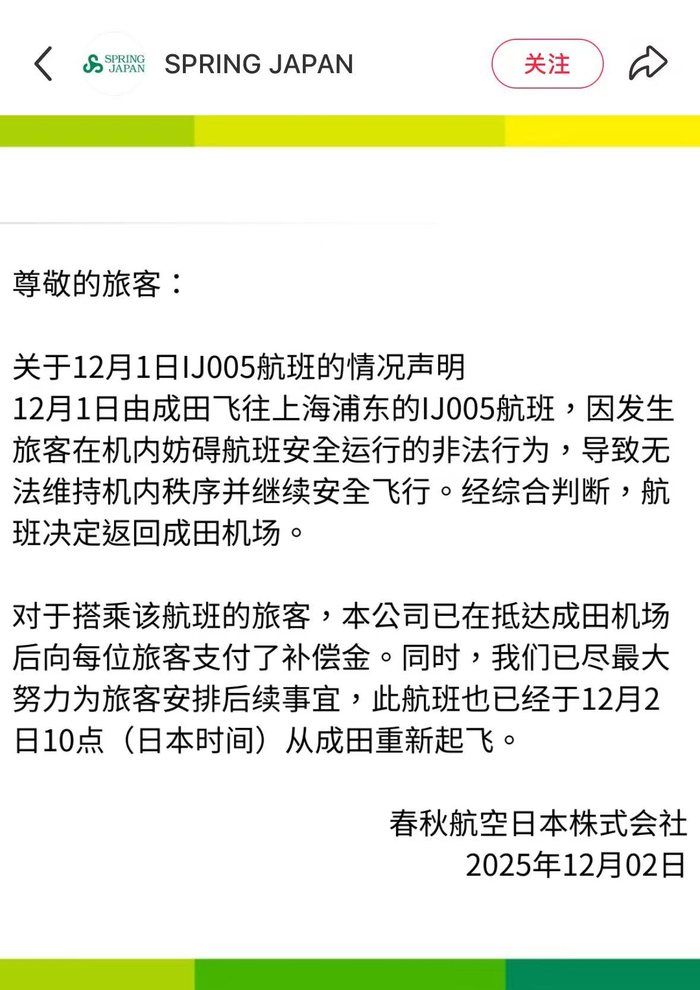
据媒体此前报道,有乘客介绍飞机返航的原因称,一对同行的男女没有分到一起的座位,登机后男方想 让空乘帮他们换到一起,空乘没有同意,于是发生了言语争论,空乘选择报警,飞机开始返航。在飞机 转自:北京日报客户端 12月2日,春秋航空日本合资公司发布"关于12月1日IJ005航班的情况声明": 12月1日,由成田飞往上海浦东的IJ005航班,因发生旅客在机内妨碍航班安全运行的非法行为,导致无 法维持机内秩序并继续安全飞行。经综合判断,航班决定返回成田机场。 对于搭乘该航班的旅客,航空公司已在抵达成田机场后向每位旅客支付了补偿金。同时,已尽最大努力 为旅客安排后续事宜,此航班也已经于12月2日10点(日本时间)从成田重新起飞。 返航落地后,该男子被当地警方带走。 航班管家APP显示,该航班原计划当地时间晚7时43分从日本东京飞往中国上海。 网友发布 的视频截图 据公开资料,春秋航空日本合资公司成立于2012年9月,总部位于日本千叶县成田市,目前的控股公司 是日本航空,中国的春秋航空公司对其为财务投资关系,不参与实际运营决策。 来源:长安街知事微信公众号 ...

一日本飞上海航班返航,春秋航空日本回应:有旅客妨碍航班安全
Bei Jing Shang Bao· 2025-12-02 10:29
Core Viewpoint - Spring Airlines Japan faced a significant incident on December 1, where flight IJ005 from Narita to Shanghai Pudong had to return to Narita due to a passenger's disruptive behavior that compromised flight safety [1][2] Group 1: Incident Details - The flight IJ005, which took off from Narita, returned approximately 1 hour and 40 minutes into the flight due to an argument over a seat change request that escalated [2] - The flight returned to Narita at around 22:40 Japan time on December 1 [2] Group 2: Company Response - Spring Airlines Japan compensated each passenger upon arrival at Narita Airport and made efforts to arrange subsequent travel for them [2] - The flight successfully took off again from Narita at 10:00 Japan time on December 2 [2]

春秋航空日本从东京飞上海的航班返航!称有旅客妨碍安全运行
Nan Fang Du Shi Bao· 2025-12-02 10:05
Core Viewpoint - The incident involving Spring Airlines' flight IJ005 from Tokyo to Shanghai, which had to return to Narita Airport due to a passenger's disruptive behavior, has sparked significant discussion. The airline has compensated affected passengers and arranged for a subsequent flight to Shanghai [2][3]. Group 1: Incident Details - The flight IJ005 was originally scheduled to depart from Narita Airport on December 1 at 19:20 local time but actually took off at 19:43. After approximately 1 hour and 40 minutes in the air, the flight returned to Narita due to safety concerns caused by a passenger's illegal actions [2][3]. - Following the incident, the flight was delayed, and it successfully took off again from Narita Airport on December 2 at around 10:00 local time, landing in Shanghai at 12:21 [2]. Group 2: Airline Response - Spring Airlines Japan issued a statement confirming that the flight returned to Narita due to the inability to maintain onboard order and ensure safe flight operations. The airline has taken steps to compensate each passenger and assist with subsequent arrangements [3].
旅客妨碍航班安全运行导致航班返航,春秋航空日本株式会社通报
Bei Jing Ri Bao Ke Hu Duan· 2025-12-02 09:21
Group 1 - The IJ005 flight from Narita to Shanghai Pudong on December 1 was forced to return to Narita due to illegal behavior by a passenger that disrupted flight safety [1] - The company compensated each passenger upon arrival at Narita Airport and made efforts to arrange subsequent travel for them [1] - The flight successfully took off again from Narita at 10 AM (Japan time) on December 2 [1]
春秋航空日本回应东京飞上海航班紧急返航
Xin Lang Cai Jing· 2025-12-02 09:05
Core Points - On December 1, Spring Japan's IJ005 flight from Narita to Shanghai Pudong had to return to Narita due to illegal behavior by a passenger that disrupted flight safety [1][4] - The company compensated each passenger upon arrival at Narita and made efforts to arrange subsequent travel for them [1][4] - The flight successfully took off again from Narita at 10 AM Japan time on December 2 [1][4]
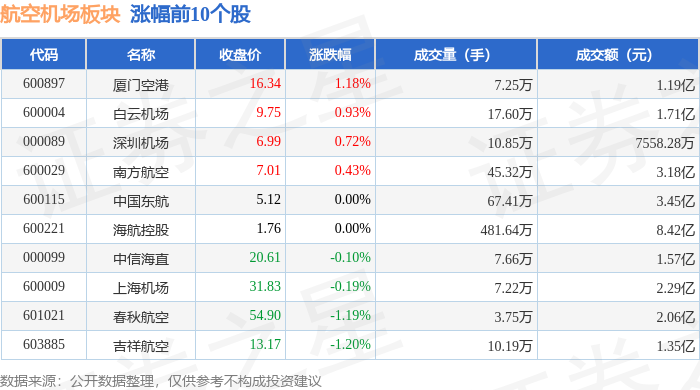
航空机场板块12月2日跌0.34%,华夏航空领跌,主力资金净流出8229.36万元
Zheng Xing Xing Ye Ri Bao· 2025-12-02 09:03
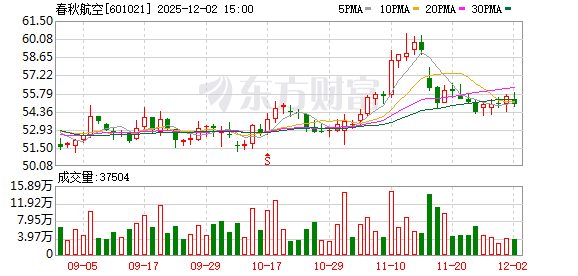
Core Insights - The aviation and airport sector experienced a decline of 0.34% on December 2, with Huaxia Airlines leading the drop [1] - The Shanghai Composite Index closed at 3897.71, down 0.42%, while the Shenzhen Component Index closed at 13056.7, down 0.68% [1] Stock Performance - Xiamen Airport (600897) closed at 16.34, up 1.18% with a trading volume of 72,500 shares and a turnover of 119 million yuan [1] - Baiyun Airport (600004) closed at 9.75, up 0.93% with a trading volume of 176,000 shares and a turnover of 171 million yuan [1] - Shenzhen Airport (000089) closed at 6.99, up 0.72% with a trading volume of 108,500 shares and a turnover of 7.56 million yuan [1] - China Eastern Airlines (600115) remained unchanged at 5.12 with a trading volume of 674,100 shares and a turnover of 345 million yuan [1] - Huaxia Airlines (002928) closed at 9.93, down 2.36% with a trading volume of 206,800 shares and a turnover of 207 million yuan [2] Capital Flow - The aviation and airport sector saw a net outflow of 82.29 million yuan from institutional investors and 44.87 million yuan from retail investors, while individual investors had a net inflow of 127 million yuan [2] - Notable capital flows included: - Southern Airlines (600029) had a net inflow of 15.42 million yuan from institutional investors [3] - Spring Airlines (601021) saw a net inflow of 9.77 million yuan from institutional investors [3] - China Eastern Airlines (600115) experienced a net outflow of 5.52 million yuan from institutional investors [3]




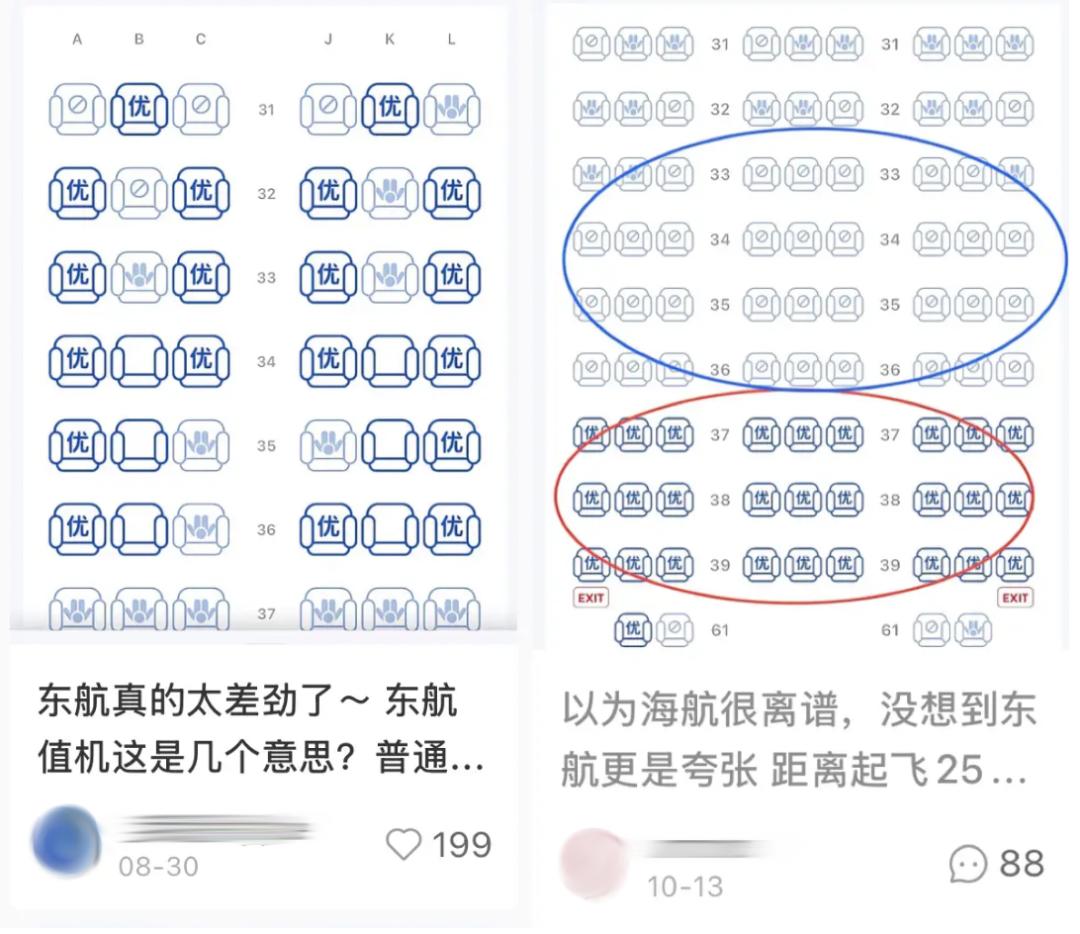
“经济舱第一排宁可空着航司也不会免费给你”,买完机票还要再花500选座位是在欺负人吗?
3 6 Ke· 2025-12-02 08:14
Core Viewpoint - The increasing trend of paid seat selection in the airline industry is criticized for limiting consumer choice and infringing on their rights, with some airlines locking a significant percentage of seats for additional fees, leading to a perception of a caste system in seating arrangements [1][4][10] Group 1: Paid Seat Selection Practices - Paid seat selection, initially a strategy for low-cost carriers, has now become widespread among all airlines, with some airlines being humorously suggested to rename themselves as "low-cost" carriers [3][4] - The practice of charging for seat selection has evolved into a complex system where even economy class seats are categorized into multiple tiers, with limited free options available [1][4][5] - Reports indicate that some airlines have seat lock rates exceeding 50%, with fees for seat selection ranging from 50 to 500 yuan [5][12] Group 2: Consumer Experience and Perception - Consumers are increasingly frustrated with the lack of available seats during the selection process, often left with undesirable options, leading to comparisons with social hierarchies [4][7] - The complexity of seat classifications and the inconsistency in naming conventions across airlines contribute to consumer confusion and dissatisfaction [7][10] - The perception of inequality in seating arrangements has been likened to a caste system, where better seats are reserved for those who can afford to pay more [4][5] Group 3: Financial Implications for Airlines - Airlines are increasingly relying on ancillary revenue from seat selection and other services, with reports indicating that such services contribute over 50% of their ancillary income [19][21] - Despite efforts to boost revenue through paid seat selection, many airlines are still facing significant financial losses, with major carriers projecting net losses in the range of 12 to 22 billion yuan for the first half of 2025 [22][23] - The competitive landscape has led airlines to prioritize high-tier members for better seating options, further complicating the experience for regular travelers [21][23]
10家航司被调查 揭开乘机选座“潜规则”
2 1 Shi Ji Jing Ji Bao Dao· 2025-12-02 01:55
Core Viewpoint - The issue of "seat locking" and paid seat selection services by airlines has sparked widespread discussion among consumers, with many reporting that desirable seats in economy class are often locked and require additional fees to select [1] Group 1: Investigation Results - The Jiangsu Provincial Consumer Rights Protection Committee conducted a survey of 10 domestic airlines, including China Southern Airlines, Air China, Hainan Airlines, Xiamen Airlines, Shenzhen Airlines, Shandong Airlines, Sichuan Airlines, Eastern Airlines, Spring Airlines, and Juneyao Airlines [1] - The survey revealed that all 10 airlines engage in seat locking practices, with Xiamen Airlines having a seat locking rate as high as 42.5%, while most airlines reported seat locking rates exceeding 30%, and some even surpassing 50% [1] - The Jiangsu Provincial Consumer Rights Protection Committee has issued clear rectification requirements to the 10 airlines regarding the seat locking issue, demanding written reports on corrective actions within 15 working days [1]


优质座位大量被“锁” 10家航司被调查 揭开乘机选座“潜规则”
Yang Shi Xin Wen· 2025-12-01 19:11
Core Viewpoint - The recent practice of airlines locking seats and charging for seat selection has sparked widespread consumer dissatisfaction, with many feeling that their rights to choose seats are being unfairly restricted [1][19]. Group 1: Consumer Feedback - Many consumers, like Ms. Zhang, have experienced locked seats and expressed frustration over the additional costs required to select preferred seats, which they believe should be included with the purchase of an economy class ticket [3][19]. - The investigation revealed that consumers are often required to use points or pay extra fees to unlock desirable seats, which they feel is an unfair practice [11][13]. Group 2: Investigation Findings - The Jiangsu Provincial Consumer Protection Committee conducted an investigation into 10 domestic airlines, finding that all had locked seats in economy class, with the locking rate ranging from 19.9% to 62.1%, averaging 38.7% [4][5]. - The investigation highlighted that the locked seats are primarily located in the front rows and preferred window or aisle positions, limiting consumer choices to less desirable seats [9][11]. Group 3: Airline Justifications - Airlines have provided various justifications for locking seats, such as reserving them for special passengers or maintaining flight balance, but these reasons have been contradicted by the investigation results showing high locking rates [15][16]. - The lack of a unified standard for seat locking across airlines has led to significant discrepancies in how and why seats are locked [16]. Group 4: Legal and Regulatory Concerns - The practice of locking seats has been deemed to infringe upon multiple consumer rights, including the right to know, the right to choose, and the right to fair trade [19][22]. - Experts have pointed out that airlines' failure to clearly communicate seat selection policies and locking criteria violates consumer protection laws [20][22]. Group 5: Regulatory Actions - The Jiangsu Provincial Consumer Protection Committee has called for the 10 airlines to rectify their practices, specifically addressing the excessive locking of seats and the imposition of fees for seat selection [23][24]. - Airlines are required to ensure transparency in their policies, provide equal selection opportunities for all passengers, and respect consumer rights [27][29].