
SoftBank

Search documents
突发,日韩股市跳水!韩国综合指数跌超6%,一度暂停程序化交易卖单!软银跌13%,三星电子跌超6%,发生了什么?
Sou Hu Cai Jing· 2025-11-05 03:05
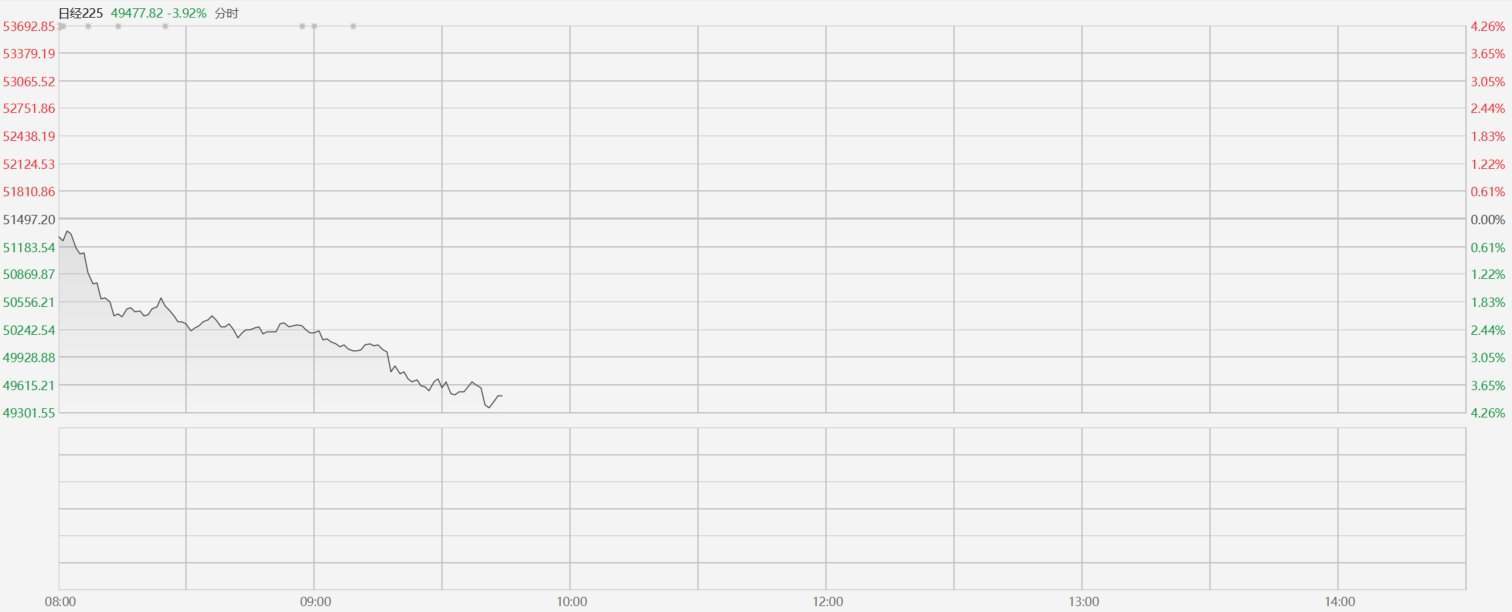
11月5日,日韩股市低开低走。截至发稿,韩国综合指数跌超6%,日经225指数向下跌破50000点,最新下跌3.74%。 在全球人工智能估值担忧之际,韩国芯片股走低,截至发稿,SK海力士股价下跌7.85%,报540000韩元。三星电子股价下跌6.67%,报97900韩元。韩国已 暂停KOSPI市场的程序化交易卖单,韩国交易所暂停KOSDAQ期货程序化交易。 每经编辑|陈柯名 | 153.1700 -0.5100 -0.3300% | | | | | | | | | 与 查看反向汇率 | | --- | --- | --- | --- | --- | --- | --- | --- | --- | --- | | 交易中 11-05 09:36 北京时间 | | | | | | | | | | | 今开 | 153.6800 | | | 最高 | 153.7500 | | | 买入价 | 153.1400 | | 昨收 | 153.6800 | | | 最低 | 153.0000 | | | 卖出价 | 153.1900 | | 分时 | | 日K | 周K | | 月K | 室K | 年K | | 更多い | ...



日韩股市今日暴跌!日经225指数跌4%,软银集团跌13%,铠侠控股跌10%
Ge Long Hui· 2025-11-05 02:31
Group 1 - The Nikkei 225 index has dropped by 4% [1] - SoftBank Group's stock fell by 13% [1] - Kioxia Holdings' stock decreased by 10% [1]

软银集团日股股价跌13%
Mei Ri Jing Ji Xin Wen· 2025-11-05 01:58
Group 1 - The core point of the article is that SoftBank Group's stock price dropped by 13% on November 5 [1]
日韩股市跳水 半导体重挫 软银跌10% 三星电子跌4%
2 1 Shi Ji Jing Ji Bao Dao· 2025-11-05 01:05
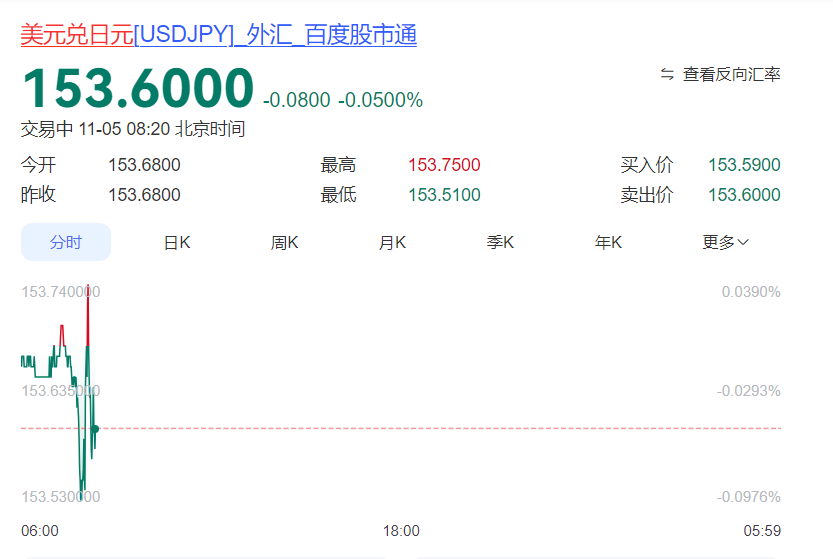
11月5日,日韩股市低开低走,截至8:16,日经225指数跌超2%,韩国综合指数跌超3%,失守4000点。 在全球人工智能估值担忧之际,韩国KOSPI指数下跌4%。芯片股走低,SK海力士股价下跌5.5%,报 554,000韩元。三星电子股价下跌4.6%,报100,100韩元。截至8:47,韩国已暂停KOSPI市场的程序化交 易卖单。 日本芯片相关股票也不例外,多股大幅下跌,此前美国科技股遭抛售。软银集团股价下跌10%,爱德万 测试下跌8.6%。 10年期日本国债收益率下跌1个基点,至1.66%。 11月4日,美元兑日元一度向下触及154,截至发稿,已跌至153.6。 但到了近两日,日韩股市均走低。对此,李徽徽认为,日韩股市下跌的核心原因是"高位拥挤交易+美 元再走强"共同作用,一方面,日经与KOSPI此前连创新高,午后触发获利了结与量化平仓,技术性回 撤放大;另一方面,美元指数抬头、美元/日元再度逼近154,市场担心干预与政策不确定性,风险偏好 降温;韩国则叠加AI链涨幅过大、对美股AI波动高度敏感,放大波动性。 展望未来,李徽徽表示,若日本政府的财政方案与改革清单推进,或带动日本东证股价指数(Topix)的 ...
日韩股市跳水,半导体重挫,软银跌10%,三星电子跌4%
2 1 Shi Ji Jing Ji Bao Dao· 2025-11-05 01:03
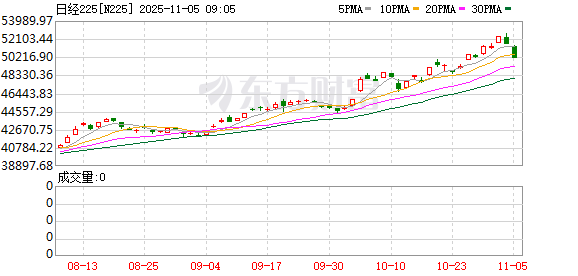
Market Performance - Japanese and Korean stock markets experienced significant declines, with the Nikkei 225 index dropping over 2% and the KOSPI index falling more than 3%, losing the 4000-point mark [1] - The KOSPI index saw a 4% drop amid global concerns over AI valuations, with major chip stocks like SK Hynix and Samsung Electronics declining by 5.5% and 4.6% respectively [1] - The Nikkei 225 index had previously reached a six-day high above 50,000 points, accumulating a 15% increase since early October and a 29.8% rise year-to-date [3] Factors Influencing Market Trends - Three main factors affecting the Asia-Pacific stock markets include the strengthening US dollar, recent sell-offs in high-flying assets, and ongoing trade uncertainties despite some positive signals [3] - The strong performance of the Japanese stock market was attributed to three pillars: improved corporate governance, the new NISA tax scheme, and expectations of fiscal expansion [4] - The Korean stock market's rise was linked to the recovery of the AI industry and improved order volumes, alongside anticipated corporate governance reforms [4] Recent Market Corrections - The recent downturn in Japanese and Korean markets is attributed to "crowded trades at high levels" and a strengthening dollar, leading to profit-taking and technical pullbacks [5] - Concerns over potential currency intervention and policy uncertainties have dampened risk appetite, particularly in the context of the Korean market's sensitivity to fluctuations in US AI stocks [5] Future Outlook - Future performance of the Japanese market may depend on the government's fiscal plans and reforms, which could bolster value stocks and domestic demand [5] - The Korean market faces overheating risks and will be influenced by the US AI cycle and domestic capital expenditure trends [5] - There is an increasing risk of Japanese authorities intervening in the currency market, although actual intervention is not expected in the short term [5]
Synchronoss Technologies(SNCR) - 2025 Q3 - Earnings Call Transcript
2025-11-04 22:30
Financial Data and Key Metrics Changes - Revenue for Q3 2025 was $42 million, slightly down from $43 million in the prior year due to delays in customer contracts and lower subscriber growth [15][16] - Net income was $5.8 million, translating to diluted earnings per share of $0.51, driven by a one-time interest income event from a tax refund [2][18] - Adjusted EBITDA was $12 million, with an adjusted EBITDA margin of 28.5%, consistent with the company's high-margin model [6][18] - Recurring revenue represented 93.8% of total revenue, underscoring the stability of the business model [6][15] Business Line Data and Key Metrics Changes - The cloud-based business model showed sustained growth, with recurring revenue being a significant portion of total revenue [3][6] - Subscriber growth rate was approximately 1% year-over-year, with expectations for improvement in future quarters [5][15] - Operating expenses decreased by 3.5% year-over-year, contributing to improved profitability [17] Market Data and Key Metrics Changes - AT&T showed positive momentum with subscriber growth, with less than 2% penetration in their total subscriber base, indicating significant growth potential [7] - Verizon faced subscriber growth pressure due to a transition in their bundled cloud users, but initiatives are in place to strengthen the value proposition [8] - SoftBank is expected to see increased adoption through the MySoftBank app integration, with significant room for growth in 2026 [9] Company Strategy and Development Direction - The company is focusing on solidifying its balance sheet to enable operational flexibility and exploring new product adjacencies to maximize its total addressable market [4][5] - Strategic initiatives are in place to drive growth through core offerings while exploring additional market opportunities [13][14] - The company is making significant advancements in AI-driven transformation to enhance product features and operational efficiency [11][12] Management's Comments on Operating Environment and Future Outlook - Management acknowledged that subscriber growth weakness is temporary and expects improved performance in 2026 [13][14] - The company is adjusting its full-year revenue guidance to between $169 million and $172 million, reflecting anticipated challenges in subscriber growth [13][19] - Management remains confident in the company's strategy and market position, emphasizing a disciplined approach to cost management [14][19] Other Important Information - The company completed a strategic $200 million term loan refinancing, strengthening its capital structure and extending debt maturities to 2029 [4][19] - Free cash flow was reported at $36 million, largely driven by the tax refund received during the quarter [19] Q&A Session Summary Question: Is growth mainly driven by higher wallet share rather than subscriber growth? - Management indicated slight growth in subscriber revenue, attributing challenges to a long sales cycle for new customer contracts [22][23] Question: How does the rest of the pipeline look? - The pipeline remains healthy with opportunities for growth in both existing and new customers, including branded clouds and Capsule [24][25] Question: What are the capital allocation priorities with the improved balance sheet? - The focus is on investing in current products and exploring inorganic growth opportunities before considering stock buybacks [26][27] Question: Can you elaborate on interest income and expense related to the IRS payment? - Interest income was derived from the federal tax refund, while interest expense related to the term loan and issuance costs [29][30] Question: What happened to subscriber growth between Q2 and Q3? - Subscriber growth decreased from 3% in Q2 to 1% in Q3, impacted by lower one-time license fees and professional services [35][38]

OpenAI and Amazon ink $38B cloud computing deal
TechCrunch· 2025-11-03 15:21
Core Insights - OpenAI has secured a $38 billion deal with Amazon for cloud computing services over the next seven years, aimed at scaling its AI infrastructure [1] - The company plans to deploy all capacity from AWS by the end of 2026, with potential expansion into 2027 and beyond [1] - This agreement follows OpenAI's recent restructuring, which allows it to procure computing services from various providers without needing Microsoft's approval [2] Investment Strategy - OpenAI's deal with Amazon is part of a broader strategy to enhance its computing power, with plans to invest over $1 trillion in the next decade [2] - The company is also collaborating with other tech firms, including Oracle, SoftBank, and the United Arab Emirates, for new data center buildouts [2] - OpenAI has established partnerships with chipmakers such as Nvidia, AMD, and Broadcom to support its growth [2] Industry Perspective - Analysts express concerns that the significant investments from OpenAI and other tech companies may indicate the onset of an AI bubble, characterized by substantial spending on unproven technologies without clear returns [3]


Intel in talks to acquire AI chip startup SambaNova
BusinessLine· 2025-10-31 03:57
Core Insights - Intel Corp. is in preliminary discussions to acquire AI chip startup SambaNova Systems Inc., with a potential valuation below $5 billion, which was the amount raised in a 2021 funding round [1][2] - The talks are at an early stage, and there is no guarantee of a deal, with the possibility of other buyers emerging [2] - SambaNova, founded in 2017 by Stanford professors, designs custom AI chips to compete with Nvidia, focusing on inference systems rather than training models [3][5] Company Background - SambaNova was co-founded by a MacArthur Genius Award winner and has received significant funding, including a $676 million round led by SoftBank in 2021 [4] - The company has shifted its strategy to provide AI cloud services on its own hardware, moving away from selling equipment to other providers [6] - In April, SambaNova laid off approximately 15% of its workforce, indicating potential restructuring amid changing market dynamics [6]

X @Bloomberg
Bloomberg· 2025-10-29 21:15
Masayoshi Son’s big wager on artificial intelligence has paid off — propelling the SoftBank founder past Uniqlo billionaire Tadashi Yanai to become Japan’s richest person https://t.co/2NPH8AQf6q ...
Microsoft, OpenAI (Finally) Finalize Terms of Not-Quite Divorce
Yahoo Finance· 2025-10-29 10:30
Microsoft and OpenAI are staying together for the kids. Sort of. After lengthy deliberations en route to its transformation from a non-profit entity into a for-profit company, OpenAI finally came to terms Tuesday with its Big Tech incubator, Microsoft. It won’t exactly be a clean split. SUBSCRIBE: Receive more of our free The Daily Upside newsletter. READ ALSO: Wall Street GOAT: Nvidia Rides Deal Bonanza to $5 Trillion Market Cap and Amazon Job Cuts Broaden Big Tech’s Layoff Barrage Now Without Azure-anc ...
