Paxos

Search documents
“木头姐”年度重磅:ARK 2026 Big Idea
Hua Er Jie Jian Wen· 2026-01-24 07:09
Core Insights - The central theme of the report is "The Great Acceleration," highlighting the rapid convergence of five major innovation platforms centered around artificial intelligence (AI) that are expected to drive significant global economic growth by the end of the decade [1][4]. Group 1: Economic Growth Projections - The report predicts that the global GDP growth rate could reach 7.3% by 2030, significantly higher than the International Monetary Fund's forecast of 3.1% [4]. - Capital investment in innovation assets is expected to increase from approximately $5 trillion in 2025 to around $28 trillion by 2030, with the market share of innovation assets rising from about 20% to 50% [9][14]. Group 2: Technological Convergence - ARK identifies a 35% increase in the "Convergence Network Strength" by 2025, indicating a significant acceleration in the inter-catalysis of different technologies [7]. - AI is described as a "Central Dynamo" that drives multiple technology curves simultaneously, leading to a shift from linear to highly coupled technological relationships [4][12]. Group 3: Investment in Data Centers - Investment in data center systems is projected to grow from approximately $500 billion in 2025 to about $1.4 trillion by 2030, with a compound annual growth rate of 30% [20][17]. - The demand for AI is driving this investment surge, with the cost of inference dropping over 99% in the past year, leading to exponential growth in AI usage [22]. Group 4: AI and Consumer Behavior - AI is reshaping consumer interaction with digital platforms, with AI chatbots achieving a 25% penetration rate among smartphone users within seven years, faster than the internet's adoption rate [23]. - The share of AI-related search traffic is expected to increase from 10% in 2025 to 65% by 2030, with a projected annual growth rate of 50% in AI-related search advertising spending [26]. Group 5: Robotics and Automation - The global robotics market is estimated to present a revenue opportunity of approximately $26 trillion, with significant potential in both manufacturing and household services [32]. - The report emphasizes the transformative potential of humanoid robots, which could convert significant amounts of unpaid household labor into measurable GDP contributions [34]. Group 6: Autonomous Vehicles - The market for autonomous taxis is projected to create about $34 trillion in enterprise value by 2030, with autonomous technology providers capturing approximately 98% of the EBIT [37]. - The cost of autonomous taxi services is expected to drop significantly, with projections suggesting a price of $0.25 per mile by 2035 [35]. Group 7: Multiomics and AI in Healthcare - The integration of multiomics with AI is expected to revolutionize biology, with the cost of whole genome sequencing potentially dropping to $10 by 2030 [41]. - AI-driven drug development could reduce time to market by 40%, from 13 years to 8 years, while significantly lowering overall drug costs [45]. Group 8: Space Economy - The use of reusable rockets is anticipated to propel the economy into the space age, with SpaceX leading the market and significantly reducing launch costs [50][52]. - The market opportunity for satellite connectivity is projected to exceed $160 billion annually by 2030, driven by cost reductions and performance improvements [55]. Group 9: Energy and Infrastructure - The report highlights the need for a substantial increase in capital investment in the energy sector, estimating a requirement of about $10 trillion by 2030 to meet global electricity demand [60]. - Distributed energy systems are becoming crucial for supporting the energy needs of AI data centers, with ongoing declines in energy intensity across major economies [57].


X @MetaMask 🦊
MetaMask.eth 🦊· 2026-01-23 22:06
Your top swaps this week on MetaMask:$PAXG - @Paxos$XAUT - @tethergold$LINK - @chainlink$PEPE - @pepecoineth$WLFI - @worldlibertyfi🦊 https://t.co/hDN1kVGRJR ...
Tokenized gold volumes beat most ETFs as metal rallies toward $5,000
Yahoo Finance· 2026-01-20 17:16
Group 1 - Gold's price has surged 70% over the past year, marking its strongest performance in nearly 50 years, leading to increased demand for exposure to the metal, particularly in tokenized forms [1] - Tokenized gold trading reached $178 billion in 2025, with $126 billion occurring in the last quarter, surpassing most traditional gold ETFs except for SPDR Gold Shares (GLD) [2] - If tokenized gold were classified as an ETF, it would rank as the second-largest by trading volume [3] Group 2 - Tether's XAUT accounted for 75% of the fourth-quarter trading volume in the tokenized gold market, which saw a market capitalization increase of 177% to over $4.4 billion [4] - Retail demand is a significant driver for tokenized gold, allowing fractional ownership and no minimum investment, thus enabling broader participation, especially in emerging markets [5] - Gold's price recently hit $4,750, with expectations of reaching $5,000 as capital shifts towards defensive assets amid renewed tariff concerns [6]
X @MetaMask 🦊
MetaMask.eth 🦊· 2026-01-16 21:04
Your top swaps this week on MetaMask:$LINK - @chainlink$PAXG - @Paxos$PEPE - @pepecoineth$RAIL - @RAILGUN_Project$xaut - @tethergold🦊 https://t.co/E3yMTOmMx3 ...
2026全球数字货币新格局:三极分化与秩序重构丨未来实验室
Di Yi Cai Jing· 2026-01-12 12:40
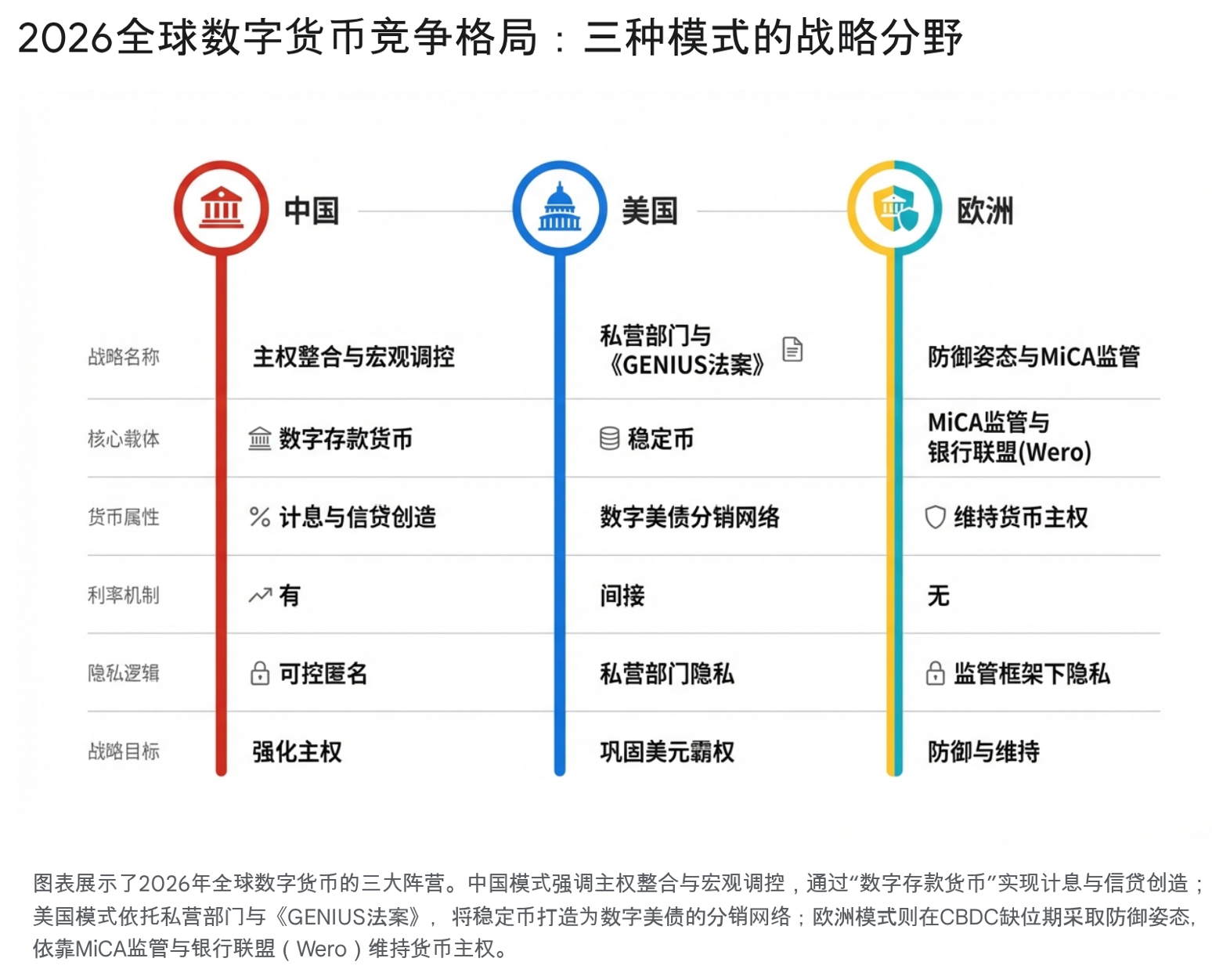
Core Viewpoint - The global monetary financial system has entered a new phase of "triple differentiation" as of January 2026, driven by the implementation of China's digital yuan (e-CNY), the U.S. GENIUS Act, and Europe's defensive alliances, marking a shift from mere payment efficiency improvements to a profound restructuring of the post-World War II Bretton Woods system [1] Group 1: China's Paradigm - The new digital yuan framework effective from January 1, 2026, signifies an expansion of monetary banking theory, transitioning from "M0 replacement" to a more financially expansive "digital deposit currency" paradigm [4] - The new framework introduces a dual balance sheet structure, where e-CNY balances are legally defined as commercial bank liabilities, allowing digital currency to participate in the fractional reserve system and enabling banks to use e-CNY as a stable source of liabilities for credit issuance [5] - The introduction of a market-based interest rate mechanism allows commercial banks to pay interest on e-CNY wallets, transforming e-CNY into a high-liquidity interest-bearing asset, enhancing its appeal for global trade partners seeking asset preservation [6] Group 2: U.S. Strategy - The U.S. GENIUS Act establishes a unique digital currency strategy by abandoning retail CBDC development and instead regulating private digital currencies to serve as digital extensions of U.S. dollar hegemony [8] - The Act mandates that compliant digital currencies maintain a 1:1 liquidity asset reserve, effectively converting global demand for liquidity into a rigid demand for U.S. Treasury securities, creating a decentralized "digital treasury bond" distribution network [8][9] - The U.S. retains control through stringent regulations on centralized issuers, allowing for immediate and irreversible actions against specific blockchain addresses, enhancing its regulatory reach [9] Group 3: Europe's Dilemma - Europe is in a defensive phase, delaying the digital euro until 2029 due to privacy concerns and legislative challenges, adopting a mixed strategy of regulatory barriers and banking alliances [10] - The MiCA regulation establishes strict localization requirements for digital currencies, driving out non-compliant offshore entities while creating space for compliant institutions [10] - The digital euro's legislative focus has shifted towards a conservative "offline-first" principle, limiting its programmability and online compatibility, while public debates continue regarding the necessity of a robust public digital euro [11] Group 4: Core Variables Reshaping Competition - Interest rate competition is emerging as a key variable, with the introduction of interest-bearing e-CNY challenging the traditional dominance of non-interest-bearing digital dollars [12] - Infrastructure is critical, with China's mBridge creating a decentralized network that bypasses traditional SWIFT structures, while the U.S. attempts to upgrade existing systems [12] - The rise of smart contracts is leading to a contest over the definition of rules, with China promoting state-defined codes and the U.S. favoring private sector standards [12] Conclusion - The year 2026 marks a significant differentiation in global digital currencies, where currency transcends mere value measurement to become an extension of state will, necessitating adaptation to these profound changes for future survival and development [13]
Vitalik 关联地址向 Paxos 充值 330 枚 ETH,价值约 102 万美元
Xin Lang Cai Jing· 2026-01-11 03:47
吴说获悉,据 @ai_9684xtpa 监测,Vitalik 关联地址 11 小时前向 Paxos 充值 330 枚 ETH,价值约 102 万 美元。该地址曾在两年前收到 Vitalik 公开地址 vitaliketh 转移的 50.1 枚 ETH,这是 2025 年 1 月以来第 二次向 Paxos 充值代币。 (来源:吴说) ...
BNY Debuts Tokenized Deposits for Institutions and 'Digital Natives'
Yahoo Finance· 2026-01-09 17:33
Core Viewpoint - BNY, the world's largest custodian bank, is set to issue digital representations of customer deposits on the blockchain, marking a significant step in enhancing its digital cash capabilities [1] Group 1: Digital Asset Initiatives - BNY's tokenized deposits will serve as digital book entries that clients can withdraw through traditional means, initially focusing on collateral and margin applications [2] - The introduction of tokenized deposits aims to reduce settlement friction and improve liquidity efficiency, showcasing how traditional financial institutions are integrating digital assets into their operations [3] Group 2: Institutional Trust and Scale - BNY has safeguarded $57.8 trillion in assets for clients as of September and manages $2.1 trillion in assets, emphasizing the trusted nature of its banking services [4] - The bank's digital infrastructure will include a tokenized money-market fund in collaboration with Goldman Sachs, further solidifying its position in the digital finance landscape [4] Group 3: Industry Response and Collaboration - The formation of BNY's digital assets unit in 2021 led to the management of private keys and the launch of custody services for Bitcoin and Ethereum [5] - Statements from various crypto-native firms, including Anchorage Digital and Circle, highlight the significance of BNY's move towards tokenized deposits as a milestone for digital cash adoption [6]
Why the Latest Wave of Crypto Firms Seeking US Bank Charters Raises Red Flags
Yahoo Finance· 2026-01-08 21:14
Core Viewpoint - World Liberty Financial (WLFI) has applied for a national trust bank charter, aiming to expand its stablecoin services, amidst concerns from established banks regarding regulatory compliance and systemic risk [1][2][5]. Group 1: Company Developments - WLFI's affiliate, WLTC Holdings LLC, submitted a de novo application to the Office of the Comptroller of the Currency (OCC) to establish the World Liberty Trust Company, National Association (WLTC) [2]. - The planned institution will focus on stablecoin-related activities and will operate under a single federal framework, eliminating the need for individual state licenses [3]. - WLFI anticipates that WLTC will comply with the GENIUS Act, implementing strict anti-money laundering (AML), sanctions screening, and cybersecurity standards [4]. Group 2: Industry Reactions - Banking industry groups have expressed concerns that the issuance of trust charters to crypto firms could increase systemic risk and undermine the integrity of the charter framework [5][6]. - There are warnings about regulatory and supervisory gaps, as crypto firms may not be subject to the same comprehensive regulations that traditional banks face, including capital, liquidity, and risk-management standards [6]. - Rebeca Romero Rainey, president and CEO of the Independent Community Bankers of America, criticized the conditional approvals of national trust bank charters, stating it stretches the charter's purpose and endangers consumers [7].
特朗普旗下加密企业World Liberty(WLFI.US)申请银行牌照 拟拓展30亿美元稳定币业务
Zhi Tong Cai Jing· 2026-01-08 02:40
由美国总统唐纳德.特朗普共同创立的加密企业World Liberty Financial(WLFI.US),正为其旗下一家实体 申请美国银行牌照,此举将助力其拓展市值达30亿美元的稳定币USD1业务。 World Liberty在其官网上将特朗普列为"荣誉共同创始人"。该公司通过发售WLFI代币进行融资,该代币 最初设计为不可转让的治理代币,后转为可交易代币。根据追踪机构CoinGecko数据,其稳定币 USD1(曾被某基金用于投资加密货币交易所币安)市值已达34亿美元。 World Liberty周三发布声明称,其旗下公司WLTC Holdings LLC已向美国货币监理署提交全新申请,计 划设立一家专门提供稳定币服务的全国性信托银行——World Liberty Trust。 该公司表示,若获批牌照,World Liberty Trust将可为加密交易所等机构客户提供服务,同时提供数字资 产托管和稳定币转换服务,使其他稳定币持有者能将其资产转换为USD1。 World Liberty成为最新一家申请银行牌照的加密公司,这一动向引发传统金融机构警觉。传统银行认 为,这是加密企业试图在不承担全国性银行全部监管 ...
Trump crypto venture World Liberty applies for bank charter
American Banker· 2026-01-08 00:58
Core Viewpoint - World Liberty Financial, co-founded by President Donald Trump, is applying for a national trust bank charter to expand its USD1 stablecoin operations [1][2]. Group 1: Company Developments - WLTC Holdings LLC has submitted a de novo application to the Office of the Comptroller of the Currency for establishing World Liberty Trust, a national trust bank focused on stablecoin services [2]. - World Liberty has raised funds through the sale of its WLFI token, which transitioned from a non-transferable governance token to a tradable asset [4]. - The USD1 stablecoin has a market capitalization of $3.4 billion, and if the charter is granted, it will enable World Liberty Trust to serve institutional clients and offer digital asset custody and stablecoin conversion services [4]. Group 2: Industry Context - The application for a bank charter by World Liberty is part of a broader trend among crypto firms seeking federal legitimacy while avoiding full regulatory obligations of national banks [3]. - Other crypto firms, including Coinbase, Ripple, Paxos, and BitGo, have also pursued bank charters, indicating a growing interest in regulatory frameworks for digital assets [3]. - The national trust charter aims to provide a federal framework for custody, reserve management, and fiduciary oversight, potentially enhancing institutional participation and consumer protections in the crypto space [5].