
Samsung Electronics

Search documents
X @Bloomberg
Bloomberg· 2026-02-19 03:22
Samsung Electronics shares jump to a fresh record high, after local media reported that the firm is negotiating a price for its latest AI memory chip that’s up to 30% higher than the previous generation https://t.co/rovoG2ckHO ...
内存 “闪崩” 传闻刷屏,真实情况是这样
是说芯语· 2026-02-18 01:03
Core Viewpoint - Recent reports of "memory price flash crash" in the domestic market have attracted significant attention from the capital market and the industry, although investigations indicate that current spot prices for memory have shown slight declines, the extent is limited and has not led to a systematic industry downturn [1][4]. Group 1: Market Dynamics - In the North American market, some leading storage companies have experienced high-level stock price corrections, and rumors of price softening at the channel level have intensified discussions about an "early cycle turning point" [1]. - Some subcategories have even seen a phase of "rebound" in prices [2]. - Channel feedback indicates that market speculation has cooled, but the overall supply-demand structure has not fundamentally reversed [3]. Group 2: Supply and Demand Analysis - The current "flash crash" rumors are primarily concentrated in the channel spot market rather than the original factory contract market, with inventory management and cash flow needs among channel vendors contributing to short-term price fluctuations [4]. - On the supply side, major manufacturers like Samsung Electronics, SK Hynix, and Micron Technology are maintaining a cautious capacity strategy, focusing on high-end product lines driven by AI computing demand, while traditional DRAM and NAND capacity expansions remain controlled [4][5]. - The absence of significant supply increases is a key reason for the industry's belief that a "flash crash" is unlikely [5]. Group 3: Market Sentiment and Valuation - The high-level adjustments in the North American capital market for storage stocks have amplified market sentiment, with previous AI narratives driving significant valuation recovery in the storage sector [6]. - Short-term profit-taking and cautious sentiment ahead of the holiday season have led to the rapid spread of "flash crash" narratives, but from a fundamental perspective, there are no signs of significant inventory accumulation or proactive price cuts by manufacturers to gain market share [6].



AM/NS India targets import substitution with new value-added steel for appliances
MINT· 2026-02-16 15:18
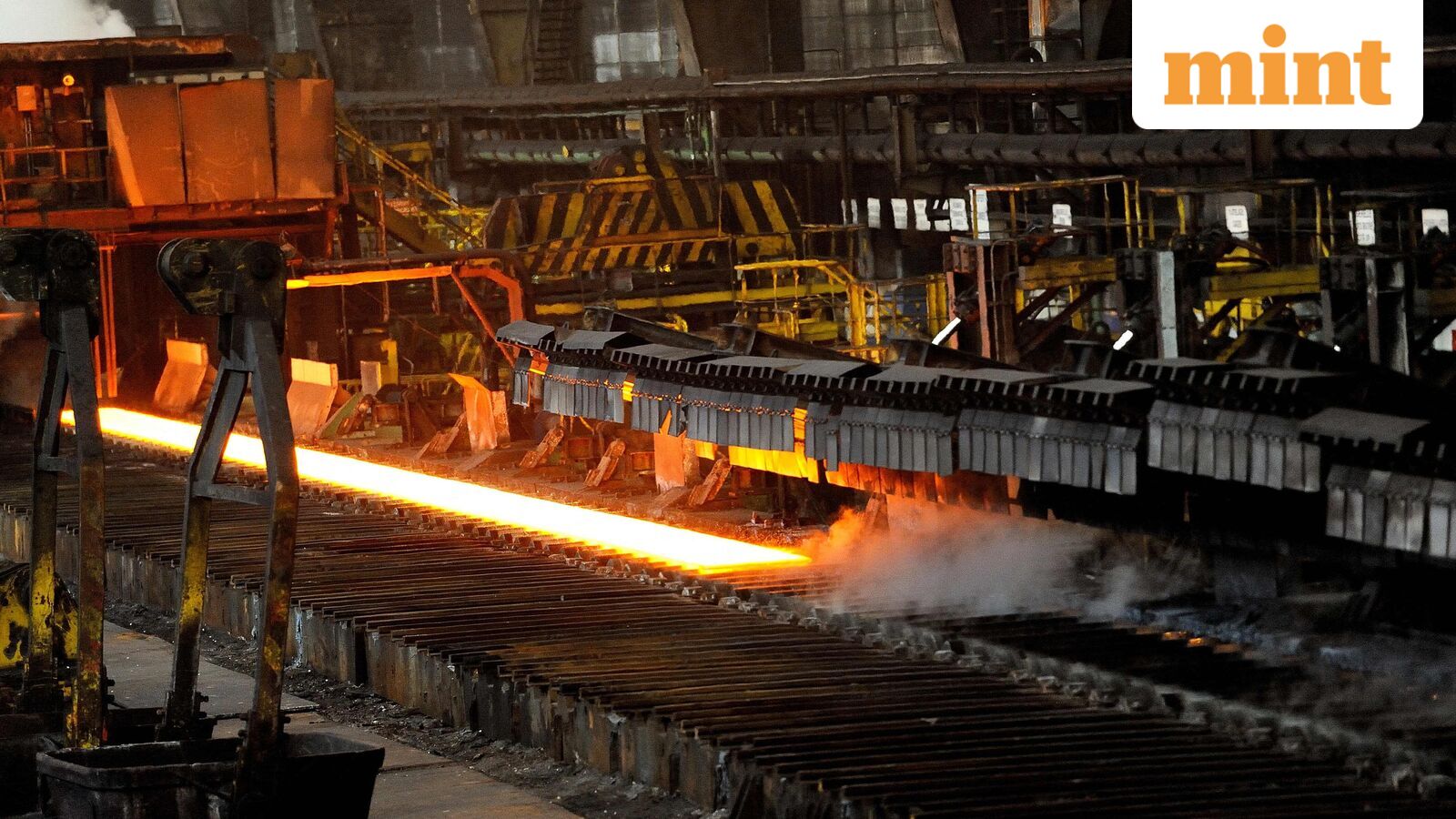
Core Insights - ArcelorMittal Nippon Steel India (AM/NS India) is expanding its value-added steel portfolio with two new products targeting the consumer appliance sector to reduce imports [1][5] Company Strategy - The company aims to increase its value-added steel portfolio contribution from 60-65% to over 70-75% in the next two to three years through new product launches [3] - AM/NS India's strategy focuses on downstream steel, which includes higher-value products for industries such as automobiles, appliances, and construction [2] Product Launch - The two new products are AM/NS Vibrance, a premium colour-coated steel for appliances, and AM/NS Optima, a non-colour-coated galvanized steel for outdoor units and panels [5] - These products are designed to meet the design-led needs of original equipment manufacturers (OEMs) in the appliance and industrial manufacturing sectors [7] Market Context - India imports approximately 100,000 tonnes of steel for appliances annually, and AM/NS India plans to substitute these imports at a lower cost [3][5] - The Indian consumer durables market is projected to become the world's fourth largest by FY27, with a demand for coated steel expected to grow at 8-10% annually [6] - Coated steel demand in the appliance segment is growing at roughly 10% per year, driven by consumer aspirations, urbanization, and government initiatives like the Production-Linked Incentive (PLI) scheme [6]

These markets have been ‘bangers’ this year. Here’s why they have further to rally, says Goldman Sachs.
Yahoo Finance· 2026-02-16 12:49
Core Viewpoint - The South Korean KOSPI index has experienced significant growth, driven primarily by major companies like Samsung Electronics and SK Hynix, amid strong demand linked to AI technology [2][3][4]. Group 1: Market Performance - The KOSPI index rose 8% in the last week, marking its best week in five years, and has more than doubled since the end of 2024, with a year-to-date increase of 31% [3][4]. - SK Hynix's stock surged 35% and Samsung Electronics' stock increased by 51% this year, contributing significantly to the KOSPI's performance [4]. Group 2: Investment Outlook - Goldman Sachs' global head of hedge-fund coverage believes it is too early for investors to reduce their South Korean positions, maintaining an overweight stance and raising the KOSPI target to 6,400, indicating over 20% upside potential [4]. - Aggregate earnings growth is projected to be remarkably strong, with a forecast of 120% growth in 2026 following a 36% increase last year [4]. Group 3: Valuation and Positioning - The South Korean market is trading at attractive valuations, with a 12-month forward price-to-earnings multiple of 8.7 and a 24-month forward P/E ratio of 7.8, making it more appealing compared to other regional markets [5]. - Foreign ownership of the South Korean equity market is below the midpoint of the long-term range, with foreign institutional investors net selling $6 billion of South Korean stocks year-to-date [6]. Group 4: Future Catalysts - Retail-brokerage accounts hold record cash balances of around 100 trillion Korean won ($70 billion), indicating potential future buying activity [7]. - South Korea is making progress in improving corporate governance under the Value Up program, with additional catalysts expected in the coming quarters [7].
Big tech stocks lose billions as AI spending fears hit valuations
Reuters· 2026-02-16 09:38
Core Insights - Major technology stocks have experienced significant declines in market value due to concerns over the return on investment from heavy AI spending, leading to a shift in investor sentiment from long-term ambitions to a demand for near-term earnings visibility [1] Company Performance - Microsoft shares have decreased by approximately 17% year-to-date, resulting in a market value loss of about $613 billion, bringing its valuation to around $2.98 trillion [1] - Amazon's stock has fallen by about 13.85%, erasing roughly $343 billion in market value, leaving it valued at approximately $2.13 trillion; the company anticipates a capital spending increase of over 50% this year [1] - Nvidia, Apple, and Alphabet have also seen declines in market value, with losses of $89.67 billion, $256.44 billion, and $87.96 billion, respectively, resulting in valuations of $4.44 trillion, $3.76 trillion, and $3.7 trillion [1] Market Trends - The decline in major tech stocks indicates a broader market shift, as investors are moving away from speculative enthusiasm for AI towards a focus on immediate financial performance [1] - In contrast, companies like TSMC, Samsung Electronics, and Walmart have gained market value, adding $293.89 billion, $272.88 billion, and $179.17 billion, respectively, with valuations reaching $1.58 trillion, $817 billion, and $1.07 trillion [1]

The Big Tech losers as AI fears wipe billions of dollars off valuations
Yahoo Finance· 2026-02-16 09:38
Group 1 - The world's most valuable technology stocks have experienced significant declines in market value this year, raising concerns about the return on heavy AI investments [1] - Microsoft shares have dropped approximately 17% year-to-date, resulting in a market value loss of about $613 billion, bringing its valuation to around $2.98 trillion [2] - Amazon's stock has decreased by about 13.85% this year, erasing roughly $343 billion in market value, leaving it valued at approximately $2.13 trillion [2] Group 2 - Capital spending for Amazon is expected to increase by more than 50% this year [3] - Other major companies like Nvidia, Apple, and Alphabet have also seen declines in market value, totaling $89.67 billion, $256.44 billion, and $87.96 billion, respectively [3] - The shift in market psychology indicates a move from long-term AI ambitions to a demand for near-term earnings visibility [4] Group 3 - Companies such as TSMC, Samsung Electronics, and Walmart have gained market value, adding $293.89 billion, $272.88 billion, and $179.17 billion, respectively [4] - The current valuations for TSMC, Samsung Electronics, and Walmart stand at $1.58 trillion, $817 billion, and $1.07 trillion [4]





What We’re Reading (Week Ending 15 February 2026) : The Good Investors %
The Good Investors· 2026-02-15 01:00
Group 1: AI in Legal and Medical Fields - AI tools for contract review in regulated environments like clinical trials and financial services must meet high reliability standards, as any missed clause can lead to significant liabilities [3][4] - A comparison between AI systems shows that a purpose-built system (TCN) made 163 substantive changes to a clinical trial agreement, while a general-purpose AI (Claude) made only 11 changes, indicating a significant performance gap [5][8] - The complexity of clinical trial agreements exacerbates the limitations of single-pass AI systems, which struggle to manage multiple provisions and regulatory contexts simultaneously [6][8] Group 2: AI in Medical Devices - The integration of AI into medical devices, such as Johnson & Johnson's TruDi Navigation System, has led to a significant increase in reported malfunctions, with at least 100 adverse events reported since AI implementation [12][13] - Legal actions have been initiated against Acclarent, the distributor of the TruDi system, alleging that the AI component contributed to surgical errors and patient injuries [14][15] - The FDA's regulatory framework for medical devices does not require extensive testing for AI-enabled technologies, raising concerns about their safety and effectiveness [17][18] Group 3: Economic Implications of AI - The rapid development of AI technology is expected to flood the market with new software solutions, potentially leading to a commoditization of software and a decline in the value of companies unable to innovate [19][20] - Historical trends indicate that while earnings may remain stable in the short term, disruptions from AI could take longer to manifest, similar to the decline of newspaper stocks despite initial earnings growth [20] - The relationship between productivity growth driven by AI and median wage growth raises concerns about rising income inequality, which could be addressed through income redistribution policies [30][32]


Memory-chip stocks are still quite cheap — especially if you look overseas
MarketWatch· 2026-02-14 14:27
Core Viewpoint - Samsung Electronics and SK Hynix shares, despite strong gains this year, are still less expensive compared to their U.S. counterparts [1] Company Analysis - Samsung Electronics and SK Hynix have shown significant stock price increases in the current year [1] - The valuation of these companies remains lower than that of similar companies in the U.S. market [1] Industry Context - The semiconductor industry, represented by Samsung and SK Hynix, is experiencing a competitive landscape where pricing and valuation are critical factors [1]

NVMe-oF 存储区域网络系统市场七年黄金投资战略,年复合增长率(CAGR)为27.6%
Sou Hu Cai Jing· 2026-02-14 11:26
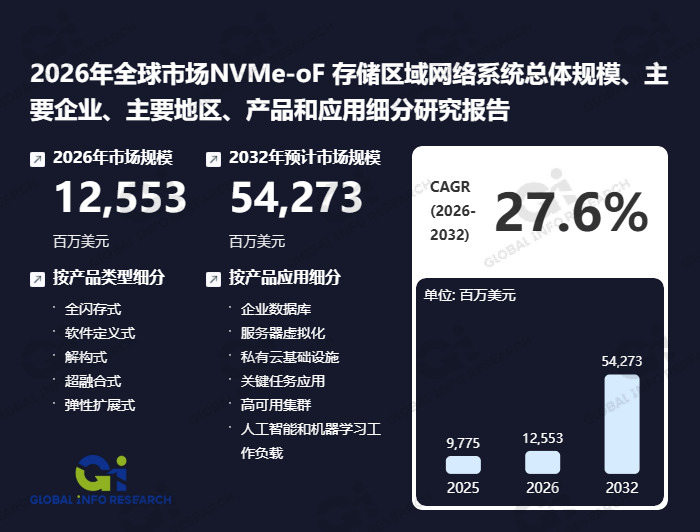
Core Insights - The report by Global Info Research focuses on the global NVMe-oF storage area network systems market, providing comprehensive analysis and insights into market size, key regions, major manufacturers, and industry trends [1][4] - The global NVMe-oF storage area network systems revenue is projected to reach approximately $9,775 million by 2025 and is expected to grow to $54,273 million by 2032, with a compound annual growth rate (CAGR) of 27.6% from 2026 to 2032 [1][3] Market Size and Growth Potential - The report aims to determine the total market size of NVMe-oF storage area network systems globally and in key countries/regions [3] - It assesses the growth potential of the NVMe-oF storage area network systems market and forecasts future growth for various products and end markets [3] Competitive Landscape - The report analyzes major participants in the NVMe-oF storage area network systems market based on parameters such as company profile, sales volume, revenue, pricing, gross margin, product portfolio, geographic distribution, and key developments [3] - Key companies covered in the report include Dell Technologies, Hewlett Packard Enterprise, Netapp, IBM, Huawei, Hitachi Vantara, Pure Storage, Inspur, Lenovo, Fujitsu, Oracle, Broadcom, Marvell, Micron Technology, Samsung Electronics, Western Digital, Kioxia, Vast Data, Weka, and Lightbits Labs [3][4] Market Drivers and Challenges - The report provides insights into the driving factors, constraints, opportunities, and key developments such as new product launches or approvals affecting the NVMe-oF storage area network systems market [4]
Competition Is Heating Up for Micron. Should You Buy, Sell, or Hold MU Stock Now?
Yahoo Finance· 2026-02-13 20:02
Group 1 - Artificial intelligence (AI) is significantly impacting the technology sector, with Micron Technology (MU) emerging as a major beneficiary due to increased demand for memory chips from AI hyperscalers [1][2] - Micron's stock has seen substantial returns over the past year, driven by the surge in memory chip demand as companies expand their data center capacities [1] - Recent developments indicate that Samsung Electronics is nearing certification for its next-generation HBM4 chips, which could alter competitive dynamics in the AI memory market [2][3] Group 2 - Micron Technology is a key supplier of advanced memory products, including DRAM, NAND, and NOR memory, essential for data centers and AI infrastructure [5][6] - The company has a market capitalization of approximately $465 billion, positioning it as a significant player in the semiconductor industry [6] - Micron's engineering expertise and manufacturing scale are critical for supporting AI workloads and other compute-intensive applications across various platforms [6]