Tempus AI

Search documents
SL Green Completes $1.4 Billion Refinancing of 11 Madison Avenue
Globenewswire· 2025-09-22 11:40
Core Insights - SL Green Realty Corp. has successfully completed a $1.4 billion refinancing of 11 Madison Avenue, with a fixed-rate mortgage carrying a coupon of 5.625% [1][2] - The refinancing replaces the previous debt structure, which included a senior mortgage of $1.075 billion and mezzanine loans totaling $325 million [2] - The transaction was supported by major financial institutions, indicating strong demand for high-quality office assets [1][3] Company Overview - SL Green Realty Corp. is Manhattan's largest office landlord and operates as a fully integrated real estate investment trust (REIT) focused on acquiring and managing commercial properties [5] - As of June 30, 2025, the company held interests in 53 buildings totaling 30.7 million square feet, with a significant portion located in Manhattan [5] Property Details - 11 Madison Avenue is a 2.3 million-square-foot, 30-story office tower, currently 93% occupied, featuring prestigious tenants such as UBS, Sony, and Fidelity [3] - The building is strategically located near Madison Square Park, enhancing its appeal to tenants and investors alike [3]



SL Green Completes $1.4 Billion Refinancing of 11 Madison Avenue
Globenewswire· 2025-09-22 11:40
Core Insights - SL Green Realty Corp. has successfully completed a $1.4 billion refinancing of 11 Madison Avenue, with a fixed-rate mortgage carrying a coupon of 5.625% [1][2] - The refinancing replaces the previous debt structure, which included a senior mortgage of $1.075 billion and mezzanine loans totaling $325 million [2] - The transaction was supported by major financial institutions, indicating strong demand from global institutional bond investors [1][3] Company Overview - SL Green Realty Corp. is Manhattan's largest office landlord and operates as a fully integrated real estate investment trust (REIT) focused on acquiring and managing commercial properties [5] - As of June 30, 2025, the company held interests in 53 buildings totaling 30.7 million square feet, with 27.2 million square feet located in Manhattan [5] Property Details - 11 Madison Avenue is a 2.3 million-square-foot, 30-story office tower, currently 93% occupied, featuring prestigious tenants such as UBS, Sony, and Fidelity [3] - The building is strategically located near Madison Square Park, enhancing its appeal due to proximity to restaurants and upscale shopping [3]

人工智能步入业绩兑现阶段 基金仍看好估值提升潜力
Zheng Quan Shi Bao· 2025-09-14 18:10
Group 1 - Artificial Intelligence (AI) has become the core driver of public fund performance, shifting the focus of fund managers from static metrics like valuation and earnings to dynamic changes and future monetization potential [1][2] - As of September 14, 2023, nearly all top-performing funds have core positions in AI, with the best-performing fund, Yongying Technology Smart Selection, achieving nearly 190% returns this year, primarily due to its over-allocation in the AI industry chain [2] - Traditional funds are adjusting their strategies to include AI, as seen with Changsheng Urbanization Theme Fund, which has shifted from low-valuation sectors to heavy investments in AI, resulting in an 85% return this year [2] Group 2 - Major fund companies are making significant investments in AI companies despite their current unprofitability, as evidenced by the recent increase in holdings of Fourth Paradigm by Fuguo Fund, which now owns 6.37% of the company [3] - The AI sector is transitioning from a conceptual phase to a monetization phase, with increasing commercial orders indicating strong market demand and rapid revenue growth for key players [3][4] - AI companies like Jintai Holdings have attracted significant investments despite initial losses, demonstrating the market's recognition of their potential for future profitability [4] Group 3 - Fund managers are optimistic about the valuation potential of AI companies, with increasing orders and improved earnings expectations driving this sentiment [6][7] - The AI industry is expected to maintain high growth due to supportive policies and infrastructure development, with major companies in the computing power sector still showing attractive valuations for 2026 [7] - The rapid development of AI applications across various industries is anticipated to enhance the valuation potential of AI companies, driven by policy support and strong market demand [7]

Tempus AI stock is cheap as Murrey Math Lines points to more gains
Invezz· 2025-09-12 17:09
Group 1 - Tempus AI stock price surged to a record high following a major breakthrough from the Food and Drug Administration (FDA) [1] - The breakthrough is expected to significantly enhance the company's position in the healthcare-focused artificial intelligence sector [1] - This development reflects growing investor confidence in the potential of AI technologies within the healthcare industry [1] Group 2 - The FDA's announcement is seen as a pivotal moment for Tempus AI, potentially leading to increased market share and revenue growth [1] - The healthcare AI market is experiencing rapid advancements, with companies like Tempus AI at the forefront of innovation [1] - Investors are closely monitoring the implications of regulatory approvals on the overall performance of AI companies in the healthcare space [1]


Tempus AI: Is TEM Stock A 10x Growth Story?
Forbes· 2025-09-12 13:59
Core Insights - Tempus AI has received FDA approval for its upgraded Tempus Pixel platform, a cardiac imaging system utilizing advanced AI for accurate heart imaging [2] - The stock has seen significant growth, climbing over 33% in a month, with potential for even greater returns, possibly up to 10x [3] Company Overview - Tempus is likened to the "Google of healthcare data," possessing the largest library of clinical and molecular data, and applying AI for precision medicine across various fields including oncology, cardiology, and mental health [4][9] - The company transforms data into real-time insights, aiding physicians in making informed treatment decisions [5] Financial Performance - Tempus has achieved an average revenue growth rate of 50% over the past three years, with Q2 2025 revenue increasing by 90% year-over-year, and a full-year revenue outlook raised to $1.26 billion, indicating over 80% growth from the previous year [6] - The company is nearing EBITDA profitability, showcasing accelerating growth and improving margins [6] Market Potential - The AI healthcare market is projected to exceed $800 billion by 2030, with Tempus positioned as a significant player by personalizing treatments through AI [8] - Tempus has generated nearly $1 billion from pharmaceutical partnerships, indicating strong demand for its data and AI capabilities [17] Growth Drivers - Tempus benefits from a growing clinical sequencing volume and a robust database, which enhances its AI capabilities and attracts more clients, creating a "virtuous cycle" [17] - The company has multiple revenue streams, including diagnostic tests, pharma partnerships, data licensing, and custom AI models [17] - Expansion into new areas such as cardiology and mental health significantly increases its addressable market [17] Valuation Insights - If Tempus scales its revenue to $20 billion, it could achieve substantial profitability, with potential net margins of 22-25%, leading to a valuation of approximately $175 billion based on a median earnings multiple of 35 [11] - The company’s current market cap stands at $15 billion, suggesting significant upside potential if it captures a portion of the growing AI healthcare market [10][11]


AI医疗,迎来DeepSeek时刻了吗?
3 6 Ke· 2025-09-05 08:46
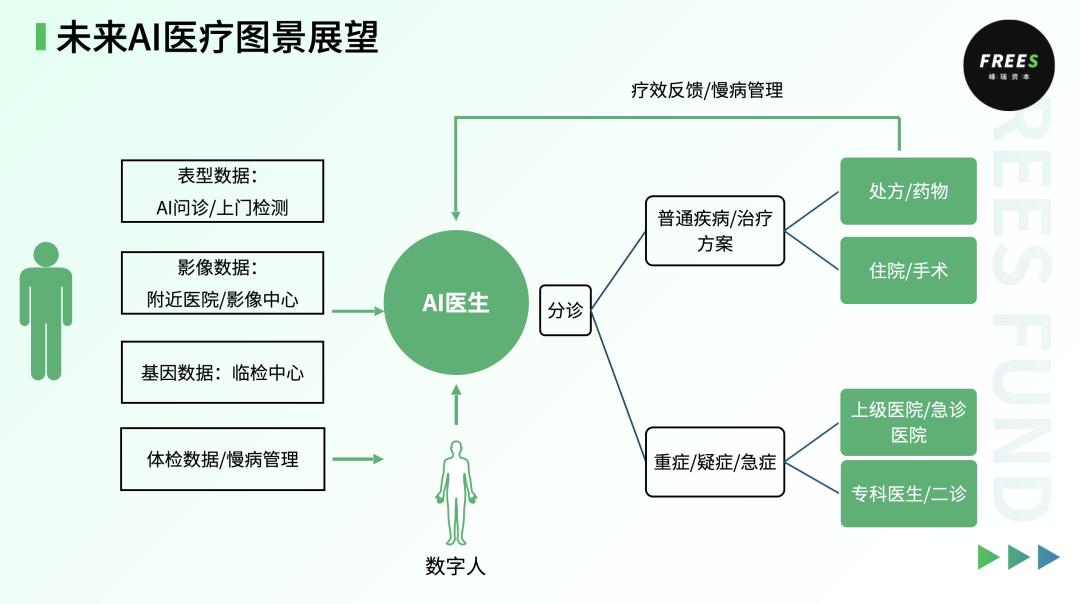
Core Insights - The Chinese government is promoting the "AI+" initiative to enhance healthcare services through AI applications in diagnosis, health management, and insurance services, aiming to significantly improve the efficiency of grassroots healthcare [1] - Major tech companies like Ant Group, JD, Huawei, and ByteDance are entering the AI healthcare sector, focusing on core areas such as consultations, medication, and health management [1] - The AI healthcare market in China is projected to grow from 8.8 billion yuan in 2023 to 315.7 billion yuan by 2033, with a compound annual growth rate of 43.1% [1] - Globally, the AI healthcare market is expected to exceed $491 billion by 2032 [1] Group 1: AI Healthcare Potential - AI has the potential to become a "super entry point" in healthcare by integrating various services and managing family health needs, leveraging the high digitalization of the healthcare industry [4] - The introduction of AI could help address the core issue of insufficient quality healthcare providers, particularly in grassroots settings, by acting as a "smart doctor" to enhance diagnosis and management [2][12] - AI healthcare could reshape the existing medical system by systematically increasing the supply of doctors and improving the capabilities of grassroots healthcare providers [12][16] Group 2: Challenges in the Healthcare System - The global healthcare system faces challenges such as insufficient supply, resource imbalance, and high costs, with no country having a perfect model [5][6] - In China, despite reforms aimed at improving equity in healthcare access, the shortage of quality healthcare resources remains a significant issue [7][8] - Internet healthcare has struggled to address the core supply issues, often remaining on the periphery of the healthcare system without solving the fundamental problem of limited access to quality doctors [10][11] Group 3: AI Healthcare Development Conditions - Current advancements in AI technology, particularly in language models, have improved the potential for AI to assist in medical diagnosis and treatment [15] - The accumulation of high-quality healthcare data over the past two decades in China provides a solid foundation for the development of AI healthcare solutions [15] - AI is better positioned to serve as a replacement for general practitioners in grassroots settings rather than challenging specialized clinical roles [16] Group 4: Future Outlook for AI Healthcare - If widely adopted, AI could transform patient interactions with healthcare, enabling online consultations, automated data analysis, and efficient triage processes [19][20] - AI's integration into healthcare could lead to systematic data accumulation, improved medication practices, and potential changes in insurance and payment models [21][22][24] - Regulatory challenges remain a significant barrier to the widespread implementation of AI in healthcare, particularly concerning accountability and the legal implications of AI decision-making [25][26]

全球科技大厂争相布局AI医疗,投资机会几何
2025-08-27 15:19
Summary of Key Points from Conference Call Industry Overview - The conference call discusses the rapid development of AI in the healthcare sector, highlighting significant investments and advancements by major global tech companies in AI medical applications [1][8]. Core Insights and Arguments - **GPT-5's Role**: GPT-5 enhances decision-making for C-end users during medical consultations by providing detailed analyses of risks and benefits, improving accuracy and reducing patient rates [2][4]. - **Microsoft's Dragon CO-pilots**: This tool significantly boosts B-end clinical documentation efficiency, processing 13 million patient interactions in Q2 2025, a sevenfold increase year-over-year, saving 5-10 minutes per consultation [3][6]. - **Google's Med-PaLM**: This model has passed the US medical licensing exam and is used for medical knowledge retrieval and clinical documentation, improving efficiency and reducing burnout among healthcare professionals [4][5]. - **Multi-modal Models**: Google and DeepMind's GENINA model integrates various clinical data types, enhancing diagnostic accuracy and medical training effectiveness [5][9]. - **Palantir's Solutions**: AI-driven systems developed for HCA improve nurse scheduling and task allocation, optimizing workflow and ensuring accurate information transfer [6][12]. - **Tempus AI's Business Model**: Tempus AI leverages data from its operations to enhance service offerings, ensuring data reliability and sustainable growth in the AI healthcare sector [7][9]. - **Domestic AI Healthcare Growth**: The domestic AI healthcare industry is thriving, supported by policies that encourage AI technology integration in medical applications, with nearly 100 large models expected by the end of 2024 [8][9]. Additional Important Insights - **Challenges in AI Development**: The healthcare sector faces challenges such as data compliance, high-quality data acquisition, and the risk of inaccurate diagnostic results, necessitating a focus on improving multi-modal capabilities [12][13]. - **Future Prospects**: Despite current challenges, advancements in technology and regulatory frameworks are expected to enhance AI's role in electronic health records, diagnostic support, and drug development, accelerating its integration into the healthcare industry [13][14].
5.8亿收购!AI医疗巨头加码肿瘤大模型
思宇MedTech· 2025-08-25 04:08
Core Viewpoint - The acquisition of Paige by Tempus AI for approximately $81.25 million is a strategic move that significantly enhances Tempus's capabilities in the AI medical field, particularly in oncology, by integrating Paige's extensive pathology data and FDA-approved applications into Tempus's existing multi-modal model strategy [2][11]. Group 1: Paige's Unique Assets - Paige has accumulated nearly 7 million digital pathology slides and corresponding clinical data, making it a leader in pathology AI with exclusive data resources [3][5]. - The company has developed one of the world's first foundational pathology models based on 2.3 million whole slides and has partnered with Microsoft to create PRISM2, which connects pathology images with language models [5]. - Paige's AI tools have received FDA 510(k) approval and breakthrough device designation, allowing them to integrate into clinical workflows effectively [5][10]. Group 2: Tempus's Ambitions - Tempus has built a vast multi-modal database, including genomic testing results and real-world clinical data from over 5 million patients, as well as imaging resources [6][8]. - The company aims to create a comprehensive multi-modal foundational model that covers the entire cancer diagnosis and treatment chain, with a recent $200 million collaboration with AstraZeneca and Pathos AI to achieve this goal [8][10]. Group 3: Industry Observations - The acquisition signals a shift in the AI medical landscape towards resource integration, where data and compliance are becoming more critical than algorithm performance [11][12]. - The combination of Paige's pathology data and Tempus's molecular and clinical data creates a complete tumor database, establishing a "data loop" that will be difficult for competitors to replicate [12][13]. - The case highlights the challenges faced by domestic companies in the AI medical field, emphasizing the need for long-term data accumulation, clinical integration, and compliance to achieve commercial value [14][15].

佩洛西投资版图:苹果+英伟达+谷歌,全是科技巨头!
Jin Rong Jie· 2025-08-22 02:56
Group 1 - Nancy Pelosi's investment strategy focuses heavily on sectors such as artificial intelligence, energy, and cybersecurity, indicating a strong belief in these areas as future growth drivers [1][2][3] - The technology sector remains a significant part of her portfolio, with substantial holdings in NVIDIA and Broadcom, both key suppliers of AI server GPUs and high-speed network chips [1][2] - In cybersecurity, Pelosi has invested in Palo Alto Networks, a leading company in the field, benefiting from increased government and corporate spending on security [1][2] Group 2 - Pelosi's recent options strategy includes long-term bullish options on tech giants like Amazon and Alphabet, highlighting her confidence in their AI monetization capabilities [2] - The energy sector is represented by Vistra, which is expected to benefit from the rising electricity demand driven by AI data centers, while Tempus AI reflects her belief in the future of AI in healthcare [2] - Overall, Pelosi's investment logic is clear, covering the entire AI industry chain from hardware to applications, as well as related energy sectors, creating a comprehensive and forward-looking portfolio [2][3]

First Leveraged ETFs on MDB and LRCX Set to Trade Next Week
Prnewswire· 2025-08-15 10:46
Core Insights - Tradr ETFs is set to launch two new leveraged single-stock ETFs focused on MongoDB (MDB) and Lam Research (LRCX), expanding its offerings to a total of 23 funds, with 18 being single-stock strategies [1][2] - The new funds are part of Tradr's strategy to cater to sophisticated investors and professional traders, particularly in the context of the growing AI infrastructure market [2] - As of August 13, 2025, the assets under management for Tradr's recently launched 2X long daily leveraged ETFs have surpassed $400 million [2] Company Overview - Tradr ETFs specializes in providing ETFs designed for sophisticated investors and professional traders, focusing on high conviction investment strategies [4] - The company has recently launched fourteen 2X long daily leveraged ETFs targeting key players in the tech sector [2] Market Context - The introduction of the new ETFs aligns with the increasing interest in AI-related stocks, positioning Tradr ETFs to capitalize on market trends [2] - The leveraged ETFs are intended for short-term trading, reflecting the company's focus on active management and high-risk investment strategies [4]