
可孚医疗

Search documents
可孚医疗(301087) - 关于召开公司2025年第二次临时股东大会的通知
2025-08-08 12:15
证券代码:301087 证券简称:可孚医疗 公告编号:2025-053 可孚医疗科技股份有限公司 关于召开 2025 年第二次临时股东大会的通知 本公司及董事会全体成员保证信息披露的内容真实、准确和完整,没有虚 假记载、误导性陈述或重大遗漏。 一、召开会议的基本情况 1、股东大会届次:2025年第二次临时股东大会 2、会议召集人:公司董事会 3、本次股东大会的召集、召开符合有关法律、行政法规、部门规章、规范 性文件和公司章程的相关规定。 4、会议召开时间: (1)现场会议召开时间:2025年8月26日(星期二)14:30; (2)网络投票时间:通过深圳证券交易所交易系统进行网络投票的时间为 2025年8月26日的交易时间,即9:15 - 9:25,9:30 - 11:30和13:00 - 15:00;通过深圳 证券交易所互联网投票系统(http://wltp.cninfo.com.cn)投票的具体时间为:2025 年8月26日9:15 - 15:00。 5、会议召开方式:采取现场投票与网络投票相结合的方式。 公司将通过深圳证券交易所交易系统和互联网投票系统向公司股东提供网 络形式的投票平台,股东可以在网络投票 ...
可孚医疗(301087) - 第二届监事会第十五次会议决议公告
2025-08-08 12:15
一、会议召开情况 可孚医疗科技股份有限公司(以下简称"公司")第二届监事会第十五次会 议于 2025 年 8 月 3 日以电话方式发出会议通知,会议于 2025 年 8 月 7 日上午 11:00 在公司六楼会议室以现场会议方式召开。会议应出席监事 3 人,实际出席 监事 3 人,公司董事会秘书列席了会议。本次会议由监事会主席曾子云先生主 持。会议的召集和召开符合《中华人民共和国公司法》等法律法规和《公司章程》 的有关规定。 证券代码:301087 证券简称:可孚医疗 公告编号:2025-046 可孚医疗科技股份有限公司 第二届监事会第十五次会议决议公告 本公司及监事会全体成员保证信息披露的内容真实、准确、完整,没有虚 假记载、误导性陈述或重大遗漏。 二、监事会会议审议情况 与会监事对本次会议需审议的议案进行了充分讨论,审议通过了以下议案: 1、审议通过了《关于公司发行 H 股股票并在香港联合交易所有限公司主板 上市的议案》 为加快推进公司全球化战略布局,提升公司海外业务拓展能力,进一步提升 公司品牌形象及知名度,根据相关法律法规、规范性文件的要求,公司拟发行境 外上市外资股(H 股)并申请在香港联合交易所有 ...
医疗器械行业8日主力净流出6.11亿元,安必平、东富龙居前
Sou Hu Cai Jing· 2025-08-08 07:56
Core Viewpoint - The medical device industry experienced a slight increase of 0.93% on August 8, with a net outflow of 611 million yuan in main capital, indicating a mixed performance among constituent stocks [1] Group 1: Market Performance - A total of 59 constituent stocks rose while 39 fell, reflecting a generally positive sentiment despite the capital outflow [1] - The main capital outflow was led by Anbiping with 11.75 million yuan, followed by Dongfulong with 10.71 million yuan, and Anjiasi with 9.95 million yuan [1] Group 2: Notable Stocks - Mindray Medical (code: 300760) had a latest price of 230.71 yuan with a slight decrease of 0.03% and a net inflow of 107 million yuan, accounting for 7.18% of the main capital [1] - Lepu Medical (code: 300003) saw a price of 17.27 yuan, an increase of 6.93%, with a net inflow of 107 million yuan, representing 5.73% of the main capital [1] - Meihua Medical (code: 300136) reported a price of 20.03 yuan, up by 7.17%, with a net inflow of 559.96 million yuan, which is 11.04% of the main capital [1] - Kangdelai (code: 603987) had a price of 9.23 yuan, increasing by 5.73%, with a net inflow of 485.15 million yuan, making up 12.43% of the main capital [1] - Other notable stocks include Baikang (code: 688068) with a price of 42.58 yuan and a net inflow of 394.93 million yuan, and Sainuo Medical (code: 688108) with a price of 20.44 yuan, up by 20.02%, and a net inflow of 2762.62 million yuan [1]


三伏贴乱象追踪:“医院同款”仅为日用品
Bei Jing Shang Bao· 2025-08-06 23:42
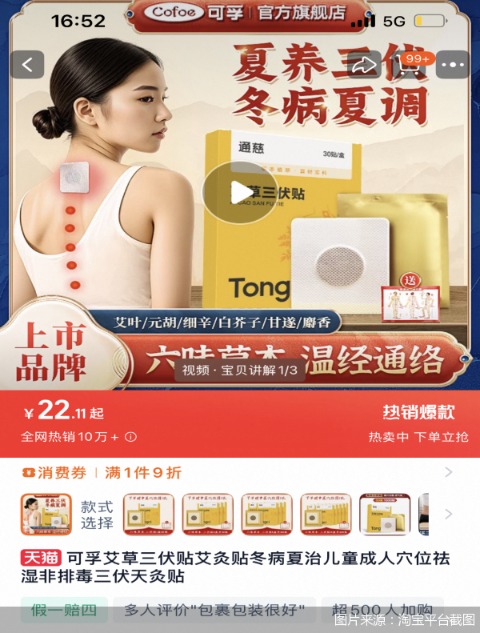
Core Viewpoint - The article highlights the misleading marketing practices surrounding "Sanfu Ties" (summer acupuncture patches), revealing that many products marketed as "hospital versions" are actually ordinary consumer goods lacking medical efficacy [1][2][3]. Group 1: Misleading Marketing Practices - Many online sellers exaggerate the efficacy of Sanfu Ties, claiming they can treat various ailments, despite being classified as daily necessities rather than medical products [2][5]. - A specific product, "Ai Cao Sanfu Tie," has sold over 100,000 units on platforms like Taobao, yet it is labeled as a daily necessity and not a substitute for medical treatment [2][4]. - The term "hospital version" is frequently used as a deceptive marketing tactic, with sellers claiming their products are used in hospitals, which is often untrue [7][8]. Group 2: Regulatory and Safety Concerns - The standards for these products, such as Q/NJJJ016, are company-specific and do not meet national or industry medical standards, raising concerns about safety and efficacy [4][9]. - The lack of clear labeling and the use of vague language in product descriptions contribute to consumer confusion regarding the safety and effectiveness of these products [6][9]. - There is a significant gap in regulatory oversight for online sales of Sanfu Ties, making it difficult to ensure product safety and compliance with medical standards [8][9]. Group 3: Consumer Misunderstanding - Many consumers struggle to differentiate between various product classifications, such as "medical device" and "enterprise standard," leading to misconceptions about safety and efficacy [9]. - The marketing strategies employed by sellers exploit consumer trust in traditional medicine, often leading to adverse health effects from using substandard products [6][9]. - Reports indicate that hospitals frequently treat patients for skin reactions and other issues caused by the use of low-quality Sanfu Ties [9].
三伏贴市场乱象追踪:10万+销量仅为日用品 商家称“和医院差不多” 大夫反驳“纯属误导”
Bei Jing Shang Bao· 2025-08-06 16:56
Core Viewpoint - The article highlights the misleading marketing practices surrounding "Sanfu Ties" (summer patches) sold online, which are often misrepresented as medical products despite being ordinary consumer goods [1][3][10]. Group 1: Misleading Marketing Practices - Many online sellers exaggerate the efficacy of Sanfu Ties, claiming they are similar to hospital versions, despite being classified as daily necessities [3][5]. - A specific product, "Aicao Sanfu Tie," has sold over 100,000 units on Taobao, yet it is labeled as a daily necessity and not a medical product [3][5]. - The marketing strategies often include terms like "hospital version" and "non-heritage inheritance," which mislead consumers into believing these products have medical backing [10][11]. Group 2: Regulatory and Standard Issues - The product standards for these Sanfu Ties are often based on company standards (Q/NJJJ016), which are less stringent than national or industry standards for medical devices or drugs [6][8]. - The lack of clear national standards for Aicao products allows companies to market them without rigorous safety and efficacy verification [8][11]. - The confusion between "medical device registration" and "company standards" creates a market where consumers are misled about the safety and effectiveness of these products [14]. Group 3: Consumer Misunderstanding - Many consumers struggle to differentiate between various product classifications, such as "drug approval" and "medical device registration," leading to misconceptions about product safety [14]. - The article notes that consumers often trust labels like "hospital version," which can lead to adverse health effects, including skin allergies and burns from low-quality Sanfu Ties [14].

可孚医疗股价微跌0.97%,公司赴港IPO计划引关注
Jin Rong Jie· 2025-08-06 14:40
Group 1 - The core viewpoint of the article highlights that Kefu Medical's stock price has decreased by 0.97% to 37.59 yuan as of August 6, 2025, with a trading volume of 24,400 hands and a turnover of 92 million yuan [1] - Kefu Medical specializes in the research, production, and sales of medical devices, covering areas such as rehabilitation care, medical electronics, and consumables [1] - The company is planning to list in Hong Kong, with a current market value of approximately 7.9 billion yuan [1] Group 2 - Market rumors suggest that regulatory authorities may raise the market capitalization threshold for A-share companies to list in Hong Kong to 20 billion yuan, which could impact smaller companies [1] - On August 6, a block trade occurred involving 230,500 shares, amounting to 8.31 million yuan, at a discount of 4.07% [1] - On the same day, the net outflow of main funds was 16.38 million yuan, accounting for 0.22% of the circulating market value, while the net inflow over the past five days was 11.95 million yuan, representing 0.16% of the circulating market value [1]
三伏贴市场乱象追踪:10万+销量仅为日用品,商家称“和医院差不多”,大夫反驳“纯属误导”
Bei Jing Shang Bao· 2025-08-06 13:04
Core Viewpoint - The article highlights the misleading marketing practices surrounding "Sanfu Ties" (summer patches) sold online, which are often misrepresented as medical products despite being ordinary consumer goods [1][3][10]. Group 1: Misleading Marketing Practices - Many online sellers exaggerate the efficacy of Sanfu Ties, claiming they can treat various ailments, which is a common phenomenon in e-commerce [3][10]. - A specific product, "Ai Cao Sanfu Tie," sold on Taobao, has over 100,000 sales and claims to be suitable for both adults and children, yet it is classified as a consumer good and not a medical product [4][6]. - The product's packaging states it cannot replace medical devices or drugs, but sellers still imply it has similar effects to hospital-grade patches [4][6]. Group 2: Lack of Regulatory Standards - The standard Q/NJJJ016, under which many of these products are produced, is a corporate standard and not a national or industry standard, indicating lower quality control [8][10]. - The absence of clear national standards for these products allows for significant consumer confusion, as many do not understand the difference between corporate standards and medical regulations [10][15]. Group 3: Consumer Misunderstanding - Consumers often struggle to differentiate between various product classifications, such as "drug approval" and "medical device registration," leading to misconceptions about safety and efficacy [15]. - Many consumers mistakenly believe that any product with an execution standard is safe and effective, which has been exploited by sellers [15]. Group 4: Misuse of Traditional Medicine Concepts - Sellers misuse traditional Chinese medicine concepts, such as "winter disease summer treatment," to market their products, simplifying complex medical theories into misleading claims [10][12]. - The marketing often includes vague disclaimers about contraindications, leaving consumers unaware of potential risks associated with using these products [11][12]. Group 5: Regulatory Challenges - The regulatory environment for these products is weak, with oversight primarily focused on packaging and labeling rather than the actual efficacy or safety of the products [13][14]. - The online sales channels, such as Taobao and Douyin, present additional challenges for regulation, as many products are sold by individual sellers, complicating enforcement [13][14].
三伏贴乱象:从“妇科”到“风湿”都能治?本质竟是日用品
Bei Jing Shang Bao· 2025-08-06 12:52
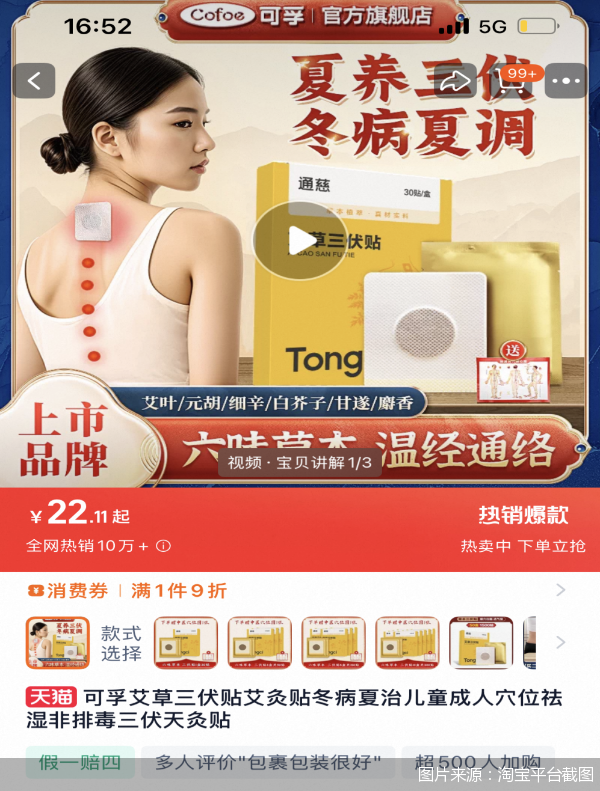
Core Viewpoint - The article highlights the misleading marketing practices surrounding "Sanfu Ties" (summer patches) sold online, which are often misrepresented as medical products despite being ordinary consumer goods. The claims made by sellers about their efficacy are largely unfounded and exploit consumer ignorance regarding traditional Chinese medicine and product labeling [2][11]. Group 1: Misleading Marketing Practices - Many online sellers exaggerate the efficacy of "Sanfu Ties," with some products claiming to be "hospital versions" while actually being ordinary consumer items [4][11]. - A specific product, "Ai Cao Sanfu Tie," has sold over 100,000 units but is classified as a consumer good, not a medical product, and is produced under a company standard rather than a national or industry standard [4][9]. - The marketing often includes vague language about symptom relief, misleading consumers into thinking these products have similar effects to those used in hospitals [6][9]. Group 2: Regulatory and Safety Concerns - The company standard Q/NJJJ016, which governs the "Ai Cao Sanfu Tie," was established by a single company and does not meet the rigorous requirements of national medical standards [7][9]. - The lack of clear labeling and the use of ambiguous terms in product descriptions contribute to consumer confusion, leading them to mistakenly believe these products are safe and effective [9][15]. - There is a significant gap in regulatory oversight for these products, as many are sold through online platforms without adequate checks on their actual ingredients or claims [12][15]. Group 3: Consumer Awareness and Education - Many consumers struggle to differentiate between various product classifications, such as "drug approval number" and "company standard," which allows sellers to exploit these misunderstandings [15]. - The article notes that consumers often trust labels like "hospital version" without understanding the implications, leading to adverse health effects from using substandard products [15][16]. - The misuse of traditional Chinese medicine concepts in marketing further complicates consumer understanding, as sellers simplify complex medical theories into misleading claims [10][12].
赴港IPO市值门槛或提至200亿元,小盘股如何下好市值管理“先手棋”
Hua Xia Shi Bao· 2025-08-06 03:13
Group 1 - The core viewpoint of the article highlights the increasing trend of A-share companies, led by industry giants like CATL, pursuing IPOs in Hong Kong, while smaller companies face pressure due to low market capitalization [1][2] - Regulatory authorities are considering setting a minimum market capitalization requirement for A-share companies seeking to list in Hong Kong, potentially raising the threshold from 10 billion RMB to 20 billion RMB [1][5] - As of now, over 40 A-share companies have officially submitted applications to the Hong Kong Stock Exchange, with 30 more announcing related processes, indicating a significant interest in the A+H listing model [1][2] Group 2 - A notable trend is the surge of small-cap stocks announcing plans for A+H listings, with at least 30 A-share companies revealing their intentions, many of which have market capitalizations between 5 billion RMB and 8 billion RMB [2][3] - The majority of these small-cap companies are from sectors such as technology, pharmaceuticals, and artificial intelligence, reflecting a shift towards internationalization and access to global capital [3][6] - Analysts suggest that the potential increase in market capitalization requirements could lead to a more selective process for companies pursuing Hong Kong listings, ensuring that only stronger firms participate [4][7] Group 3 - The article discusses the mixed stock price performance of small-cap companies following their announcements to pursue Hong Kong listings, with some experiencing slight increases while others saw declines [3] - Experts argue that setting a market capitalization threshold is reasonable as it would filter for higher-quality companies, enhancing the attractiveness of the Hong Kong market to global investors [5][6] - The emphasis on industry leaders for Hong Kong listings aligns with the regulatory focus on supporting robust companies, which may lead to a more sustainable IPO environment [6][7]




可孚医疗(301087)8月5日主力资金净流出1343.95万元
Sou Hu Cai Jing· 2025-08-05 23:24
可孚医疗最新一期业绩显示,截至2025一季报,公司营业总收入7.38亿元、同比减少8.59%,归属净利 润9142.51万元,同比减少9.68%,扣非净利润6852.25万元,同比减少25.34%,流动比率2.887、速动比 率2.419、资产负债率23.52%。 天眼查商业履历信息显示,可孚医疗科技股份有限公司,成立于2009年,位于长沙市,是一家以从事专 用设备制造业为主的企业。企业注册资本20909.2万人民币,实缴资本20909.2万人民币。公司法定代表 人为张敏。 金融界消息 截至2025年8月5日收盘,可孚医疗(301087)报收于37.96元,下跌1.43%,换手率1.64%, 成交量3.18万手,成交金额1.21亿元。 资金流向方面,今日主力资金净流出1343.95万元,占比成交额11.08%。其中,超大单净流出480.90万 元、占成交额3.97%,大单净流出863.05万元、占成交额7.12%,中单净流出流入598.14万元、占成交额 4.93%,小单净流入745.80万元、占成交额6.15%。 通过天眼查大数据分析,可孚医疗科技股份有限公司共对外投资了30家企业,参与招投标项目267次, ...