
Snowflake Inc.

Search documents
国办点名AI场景应用,产业落地进入大规模加速期
Cai Fu Zai Xian· 2025-11-12 07:39
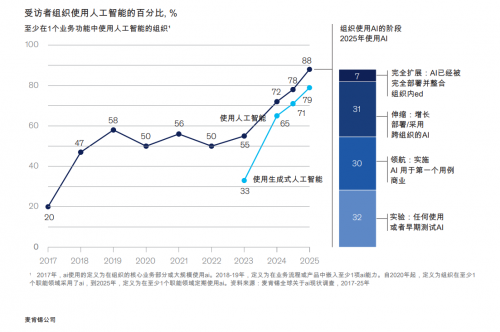
Core Insights - The focus of the AI industry is shifting from technological breakthroughs to practical applications, driven by increasing policy support and market demand [1][5][6] - The release of the recent government policy is expected to accelerate the commercialization of AI technologies and products, marking a transition in capital markets from speculative investments to tangible applications [1][6][9] Industry Development - 2023 is seen as a pivotal year for AI application deployment, with McKinsey predicting that by 2025, inference will account for over 80% of AI computing power consumption, while training will drop below 20% [2] - The AI industry is transitioning from general application layouts to deep exploration of specific scenarios, with leading companies like Lenovo making significant advancements in various sectors such as healthcare [10][16] Market Trends - The demand for AI applications is evolving, with a shift from cloud and platform investments to AI-native solutions that deliver measurable business outcomes [12] - The market for AI technology applications in China is projected to reach approximately 580 billion yuan by 2025, with a compound annual growth rate of over 25% [5] Company Innovations - Lenovo has upgraded its AI capabilities significantly, launching the Tianxi personal super intelligent agent and enhancing its functionalities to better meet user needs [3][13] - The company is adopting a "service-first" model for GPU services, which is expected to reduce deployment costs by 20-30% over three years while improving AI workload performance by up to 30% [15] Investment Opportunities - The recent policy changes are expected to create a favorable environment for companies focusing on AI application scenarios, potentially leading to improved profitability and increased capital interest [6][9] - Companies that align their strategies with the newly defined application scenarios in the policy are likely to attract more investment and achieve higher valuations [9][16]


Jefferies' Brent Thill: CoreWeave setback ‘shows you the danger of the AI trade'
Youtube· 2025-11-11 17:23
Core Insights - The company is experiencing delays in its third-party data center, leading to a stock decline of approximately 14% after guidance was lower than expected [1] - Analysts suggest that the current situation reflects broader challenges in the AI sector, where multiple components must align for success, akin to assembling a complex Lego set [3] - There is a consensus that the industry is undergoing a temporary setback, with expectations of a rebound in business performance over time [6][8] Company Performance - The company must focus on recovering from the current delays and effectively delivering results in Q1 [4] - The performance of major players like Microsoft and Amazon is also being scrutinized, indicating that the issues are not isolated [4] - Analysts believe that the recent stock declines represent a "mini timeout" rather than a long-term trend, suggesting potential for recovery [7] Market Dynamics - The AI infrastructure sector is still in a growth phase, with significant investments expected over the next 20 years [6] - There is a notable divide in performance between infrastructure companies (e.g., Snowflake, Microsoft, Oracle) and application software companies (e.g., Salesforce, Adobe), with the latter facing significant declines [16][18] - The current market environment indicates that application names are not expected to recover until at least 2026 or 2027, as the infrastructure trade remains strong [18][19] Government Involvement - There is an emerging dialogue about the role of government as a partner in AI development, particularly in maintaining competitive advantages against countries like China [9][10] - The government is expected to play an active role in supporting AI initiatives, which could influence the overall landscape of the industry [9][11] Future Outlook - The infrastructure sector is anticipated to continue outperforming, with a focus on building foundational elements before application development can take off [17][19] - Investors are advised to remain cautious about shifting focus from infrastructure to application stocks until a clear inflection point is observed [19]


The Zacks Analyst Blog Palantir, Snowflake, Datadog, Atlassian and Zoom Communications
ZACKS· 2025-11-11 07:21
Core Insights - The article highlights five AI-focused stocks in the Internet Software and Services sector that are expected to perform well in 2026, driven by increased IT spending and the growing demand for web-based infrastructure and applications [2][4]. Company Summaries Palantir Technologies Inc. (PLTR) - Palantir's AI strategy integrates its Foundry and Gotham platforms, promoting AI adoption in government and commercial sectors, with a focus on processing large datasets for real-time insights [5][6]. - The company is aligning its AI initiatives with U.S. defense priorities, showcasing its capabilities in high-profile projects like the Department of Defense's Open DAGIR [6]. - Palantir's AI Platform (AIP) has shown adaptability across various industries, with a strong customer base in government and large corporations [7][8]. - Expected revenue and earnings growth rates for Palantir are 41.1% and 43% respectively for the next year, with a 20.9% improvement in earnings estimates over the past week [9]. Snowflake Inc. (SNOW) - Snowflake is positioned to benefit from the rising demand for cloud-based data platforms, with its AI Data Cloud unifying structured and unstructured data [11]. - The cloud analytics market is projected to grow from $35.39 billion in 2024 to $130.63 billion by 2030, indicating a 25.5% CAGR, which supports Snowflake's growth trajectory [12]. - Snowflake's platform is gaining traction among large enterprises, enhancing their ability to manage data and improve customer experiences [13][14]. - Expected revenue and earnings growth rates for Snowflake are 22.3% and 33.9% respectively for the next year, with a 4% improvement in earnings estimates over the last 60 days [15]. Datadog Inc. (DDOG) - Datadog is experiencing growth due to new customer additions and increased adoption of its cloud-based monitoring platform amid digital transformation [16]. - The company unveiled over 125 new products at DASH 2025, including AI observability tools, which enhance customer engagement and competitive positioning [17][18]. - Datadog's expected revenue and earnings growth rates are 19% and 15.4% respectively for the next year, with a 0.9% improvement in earnings estimates recently [20]. Atlassian Corp. (TEAM) - Atlassian is benefiting from the demand for remote working tools, with significant adoption of its AI-powered features, showing a 25X year-over-year increase in AI interactions [21][22]. - The company's focus on generative AI features is expected to drive long-term revenue growth, particularly through collaborations with OpenAI [23]. - Expected revenue and earnings growth rates for Atlassian are 20.8% and 27.7% respectively for the current year, with a 0.6% improvement in earnings estimates recently [24]. Zoom Communications Inc. (ZM) - Zoom is capitalizing on the hybrid work trend, with AI-driven solutions like Zoom Doc and AI Companion seeing significant user growth [25][26]. - The AI Companion has achieved a fourfold increase in monthly active users year-over-year, enhancing operational efficiencies for customers [26][27]. - Expected revenue and earnings growth rates for Zoom are 3% and 0.1% respectively for the next year, with a 3.9% improvement in earnings estimates over the last 60 days [28].



Nvidia's $1 In AI Chips Fuels $10 in Tech Growth, Palantir, Snowflake, MongoDB Poised To Ride Next AI Growth Wave
Benzinga· 2025-11-10 17:25
Core Viewpoint - Recent turbulence in tech stocks is attributed to short-term investor anxiety rather than a long-term shift in the AI-driven bull market [1] - Despite concerns about an "AI bubble," the underlying fundamentals of the tech sector remain strong [1] Group 1: Market Outlook - Tech stocks are expected to rise by 8%–10% by year-end as investors position for the next phase of the AI revolution [2] - Continued growth in AI spending is anticipated to support the tech sector's bull market for at least the next two years [6] Group 2: Capital Expenditure Trends - The technology sector is entering a multiyear capital expenditure supercycle, which is a key component of the "fourth industrial revolution" [3] - Big Tech capital expenditures could increase to between $550 billion and $600 billion by 2026, up from approximately $380 billion this year [3] Group 3: Company-Specific Insights - Palantir Technologies is identified as a key barometer for enterprise AI adoption, with strong U.S. commercial growth indicating widespread corporate investment in AI [4] - Nvidia is highlighted as the foundational company enabling AI infrastructure globally, with a significant value creation ratio of $8–$10 for every $1 spent on its technology [5] Group 4: Competitive Landscape - The current environment is described as an "AI arms race," driven by aggressive investments from Big Tech [4] - Companies like Snowflake Inc and MongoDB Inc are expected to experience similar momentum in AI integration as more businesses adopt these technologies [4]



5 AI-Powered Internet Software Giants to Power Your Portfolio in 2026
ZACKS· 2025-11-10 15:57
Industry Overview - The Internet Software and Services sector is experiencing growth due to increased IT spending on hybrid operating environments and mobile device penetration, prompting businesses to invest in web-based infrastructure and security software [1] - The Internet Software industry is ranked in the top 28% of Zacks Industry Rank, indicating expected outperformance in the market over the next three to six months [2] Company Highlights Palantir Technologies Inc. (PLTR) - Palantir's AI strategy integrates its Foundry and Gotham platforms, focusing on AI adoption in government and commercial sectors, with an expected revenue growth rate of 41.1% and earnings growth rate of 43% for next year [6][10] - The company is involved in significant government projects, such as the Department of Defense's Open DAGIR initiative, enhancing military operations through AI [7] - Palantir's AIP boot camps have attracted over 1,000 companies, showcasing its platform's capabilities across various industries [8] Snowflake Inc. (SNOW) - Snowflake is set to benefit from rising demand for cloud-based data platforms, with an expected revenue growth rate of 22.3% and earnings growth rate of 33.9% for next year [11][15] - The cloud analytics market is projected to grow from $35.39 billion in 2024 to $130.63 billion by 2030, with a CAGR of 25.5%, supporting Snowflake's growth trajectory [12] - Snowflake's AI Data Cloud is gaining traction across multiple industries, enhancing enterprise capabilities in data management and analytics [14] Datadog Inc. (DDOG) - Datadog is experiencing growth from new customer acquisitions and increased adoption of its cloud-based monitoring platform, with an expected revenue growth rate of 19% and earnings growth rate of 15.4% for next year [16][20] - The company unveiled over 125 new products at DASH 2025, including AI observability tools, enhancing its competitive position [17][18] - Datadog's solutions are increasingly used to monitor AI-powered applications, driving broader product usage [19] Atlassian Corp. (TEAM) - Atlassian is benefiting from the demand for remote working tools, with a 25X year-over-year increase in AI interactions among over 1 million monthly active users [22] - The company's AI-powered Rovo platform and automation tools are driving growth in premium and enterprise editions [23] - Atlassian's collaboration with OpenAI to enhance its software with generative AI features is expected to boost revenue [24] Zoom Communications Inc. (ZM) - Zoom is capitalizing on the hybrid work trend, with its AI Companion achieving a fourfold increase in monthly active users year-over-year [26][27] - The platform's integration with third-party applications and custom AI functionalities is enhancing operational efficiencies for customers [28] - Zoom has an expected revenue growth rate of 3% and earnings growth rate of 0.1% for next year [29]

AI投资狂潮再起? 逢低买盘正在用真金白银守护“AI牛市叙事”
Zhi Tong Cai Jing· 2025-11-10 14:35
Core Viewpoint - The AI investment frenzy is driving a tech stock bull market in 2023, with predictions of approximately 10% upside remaining for U.S. tech stocks for the rest of the year, despite short-term disturbances [1][3]. Group 1: Market Sentiment and Predictions - Wedbush predicts that the current tech stock bull market is experiencing normal short-term fluctuations due to the AI investment craze, and investors are eager to adopt a "buy the dip" strategy [1]. - Major Wall Street firms, including Goldman Sachs and Morgan Stanley, reject the notion of an AI bubble, asserting that the bull market driven by AI is far from over [1][7]. - Analysts emphasize that recent market volatility, particularly in stocks like Palantir and Nvidia, presents significant buying opportunities, as historical data shows that performance is key and short-term factors do not hinder long-term bullish trends [2][3]. Group 2: Financial Performance and Growth - The third quarter earnings season for global tech stocks highlighted strong cloud computing revenue from companies like Microsoft, Amazon, and Alphabet, reinforcing the narrative of a long-term AI bull market [3]. - Predictions indicate that capital expenditures by large tech companies could rise significantly from approximately $380 billion in 2023 to nearly $550 billion to $600 billion by 2026, driven by the next wave of AI spending [4]. - Palantir is identified as a key indicator of enterprise AI demand, with its U.S. commercial business growth exceeding Wall Street expectations, reflecting a broader trend of accelerated AI investments by businesses and government organizations [4]. Group 3: Market Reactions and Opportunities - Following strong earnings reports from AI chip leaders like AMD and major financial institutions refuting the AI bubble theory, market concerns about an AI bubble have diminished, leading to significant stock price increases among Asian tech giants linked to AI [5]. - Major buying activity is observed in AI leaders like Nvidia and TSMC, as the market rebounds from recent downturns, indicating investor confidence in the long-term fundamentals of AI [6]. - Analysts from Morgan Stanley note clear signs of recovery in corporate earnings driven by AI, with a significant shift in earnings expectations indicating a turning point [7].

Monday.com (MNDY) Surpasses Q3 Earnings and Revenue Estimates
ZACKS· 2025-11-10 14:16
Core Insights - Monday.com (MNDY) reported quarterly earnings of $1.16 per share, exceeding the Zacks Consensus Estimate of $0.89 per share, and up from $0.85 per share a year ago, representing an earnings surprise of +30.34% [1] - The company achieved revenues of $316.86 million for the quarter ended September 2025, surpassing the Zacks Consensus Estimate by 1.55% and increasing from $251 million year-over-year [2] - The stock has underperformed the market, losing about 19.5% since the beginning of the year compared to the S&P 500's gain of 14.4% [3] Earnings Outlook - The current consensus EPS estimate for the upcoming quarter is $0.88 on revenues of $333.24 million, and for the current fiscal year, it is $3.97 on revenues of $1.23 billion [7] - The estimate revisions trend for Monday.com was favorable ahead of the earnings release, resulting in a Zacks Rank 2 (Buy) for the stock, indicating expected outperformance in the near future [6] Industry Context - The Internet - Software industry, to which Monday.com belongs, is currently ranked in the top 28% of over 250 Zacks industries, suggesting a favorable outlook for stocks within this sector [8] - Empirical research indicates a strong correlation between near-term stock movements and trends in earnings estimate revisions, which can be tracked by investors [5]


起底红杉资本两位新老板:Sarah Guo 丈夫、硅谷知名华裔投资人,曾一同主导投资 OpenAI
Founder Park· 2025-11-09 04:34
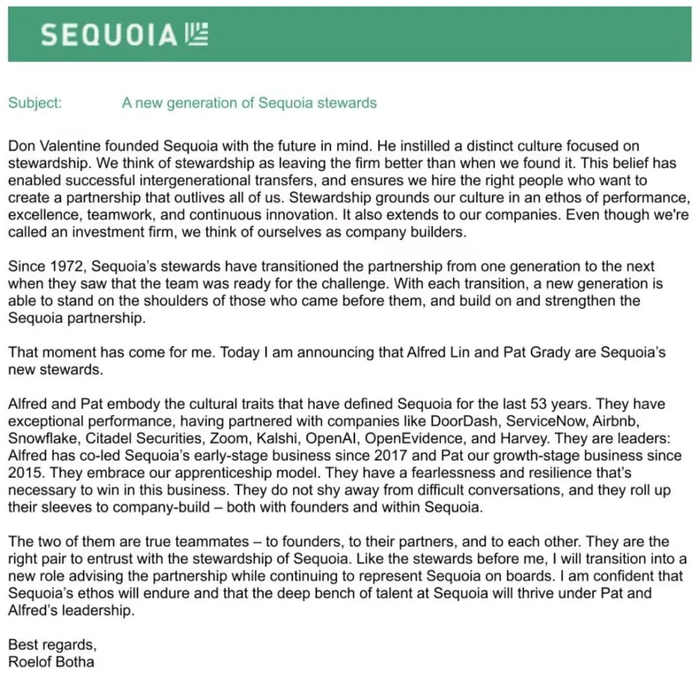
Group 1 - The leadership of Sequoia Capital has changed, with Roelof Botha stepping down as Senior Steward and being succeeded by partners Alfred Lin and Pat Grady as the new co-leaders [1][4][11] - During Botha's tenure, Sequoia returned over $50 billion to its investors, and he was instrumental in early investments in companies like YouTube and Instagram [4][25] - Botha's leadership was marked by concerns from some partners regarding his management style and missed investment opportunities in the AI sector, including OpenAI and Anysphere [7][8][27] Group 2 - Alfred Lin, who joined Sequoia in 2010, is known for leading significant investments in companies such as Airbnb and DoorDash, and he emphasizes the importance of long-term impact in investments [12][15] - Lin's investment philosophy focuses on companies with clear values and the ability to evolve over time, aiming for sustained growth [15][16] - Pat Grady, who has been with Sequoia since 2007, has a strong track record in B2B and cloud services, with successful investments in Snowflake and Zoom [18][20][21] Group 3 - Sequoia Capital manages assets totaling $56 billion and has invested in notable startups like OpenAI and SpaceX [25] - Recently, Sequoia announced the launch of two new funds, one focused on early-stage companies with a size of $750 million and another seed fund of $200 million [26] - The firm has faced turbulence in recent years, including failed investments and partner departures, but the leadership change may revitalize the company [27][28]

红杉资本“掌门人”突遭罢免!“这是‘起义’”,知情人士:他的情商与智力并不匹配!
Xin Lang Cai Jing· 2025-11-08 23:24
Core Insights - Roelof Botha has stepped down as the global leader of Sequoia Capital after just over three years, with Alfred Lin and Pat Grady taking over the management of the firm [1][3][5] Group 1: Leadership Changes - Botha's resignation was reportedly due to a revolt by three senior partners against his management style, which was described as domineering [3][5] - The unique governance structure of Sequoia Capital allows partners to vote on leadership changes, which was utilized in this instance [5][6] - Lin and Grady will jointly manage the firm, with Andrew Reed taking over Grady's previous role focused on growth-stage startups [5][7] Group 2: Investment Strategy and Focus - Sequoia Capital has historically invested in major tech companies, including Apple, Google, and Alibaba, and has a strong presence in the AI sector [3][4] - Under Botha's leadership, Sequoia returned over $50 billion to its partners since 2017, but there were concerns about the firm's AI investment strategy being too cautious [5][9] - The new leadership aims to increase investments in AI, having recently raised a $750 million early-stage fund and a $200 million seed fund focused on AI startups [9][10] Group 3: Cultural and Governance Issues - The firm faced a "crisis of trust" due to internal conflicts and public controversies, including a partner's offensive social media comments that led to a resignation [6][5] - The management changes reflect broader concerns about the firm's culture and values, particularly in relation to its treatment of diversity and inclusion [6][5]
McDonald’s Stock Challenged By a Tougher Economy, Analyst Says. Plus, Marriott, Snowflake, and More.
Barrons· 2025-11-07 22:36
Group 1: Targa Resources - Targa Resources reported a solid third-quarter performance driven by volume growth in the gathering and processing segment, and plans to meet the high end of the previous fiscal 2025 adjusted EBITDA guidance [3] - The company bought back approximately $156 million of stock during the quarter and announced a 25% dividend increase for 2026, which is expected to be viewed positively by investors [3] Group 2: Bio-Techne - Bio-Techne reported first-quarter 2026 revenue of $286.6 million, down 1% year over year, and flat adjusted earnings of $0.42 compared to the same quarter in 2025 [5] - The company faced headwinds in its GMP proteins business and funding delays for emerging biotech customers, leading to results below expectations [5] - A Buy rating is maintained with a price target of $75, reflecting the long-term potential of the company's diversified life science product portfolio [6] Group 3: McDonald's - McDonald's reported U.S. comparable sales growth of 2.4%, slightly below expectations, with earnings falling short due to heavy marketing investments [7] - The company anticipates U.S. comps to accelerate in the fourth quarter, driven by easier comparisons from last year's food safety incident and promotions [8] - A price target of $315 is set, but the company remains cautious due to challenges in consumer transactions and a bifurcated consumer base [8] Group 4: Docebo - Docebo is initiated with an Outperform rating and a price target of $35, as it has outpaced the broader LMS market by displacing legacy vendors and moving upmarket [9] - The company is expected to benefit from its push into the public sector after achieving FedRAMP status in April 2025 [10] Group 5: Marriott International - Marriott International's third-quarter results were a surprise positive, while the fourth-quarter guidance is considered neutral/slightly positive, reflecting macro uncertainty [11] - The preliminary outlook for 2026 indicates similar growth compared to 2025, suggesting an attractive growth path for the lodging sector [11] - A Neutral rating is maintained with a price target of $297, indicating a balanced risk/reward scenario [11] Group 6: Snowflake - Snowflake's annual developer and product conference highlighted its evolution from a "Data Cloud" to an "Enterprise Intelligence Cloud," focusing on helping customers build and reason with their data [12] - Key product announcements included the launch of Snowflake Intelligence and expanded AI capabilities, which are expected to drive future growth [13][14] - A price target of $280 is set, reflecting the company's strategic direction and product enhancements [15]


