AWS云计算服务

Search documents
8点1氪:椰树集团再陷擦边营销风波被约谈;电影难看20分钟内可退款40%,一影院试行“观影后悔权”;中欧航线票价暴涨
36氪· 2026-03-03 00:34
Group 1 - Hainan Coconut Group faced public backlash due to vulgar advertisements displayed in their factory, prompting the Haikou Market Supervision Administration to request rectification [4][5] - The controversial ads included phrases that objectified female employees, leading to widespread complaints and discussions about social decency [5] - The company has not provided a clear response regarding the specific details of the advertisements when contacted by media [5] Group 2 - The international oil prices surged significantly due to escalating tensions in the Middle East, with Brent crude oil rising nearly 13% to around $82 per barrel, marking a year-to-date increase of approximately 17% [18] - Gold prices also spiked, with spot gold reaching $5,350 per ounce, as investors sought safe-haven assets amid geopolitical risks [18] - The stock market reacted negatively, with major U.S. indices showing declines, indicating a drop in market risk appetite [18] Group 3 - Xiaomi's robots have begun practical applications in automotive factories, with plans for mass deployment of humanoid robots in the next five years [19] - The company is set to release new robotic products that integrate self-developed chips, operating systems, and AI models [19] Group 4 - Alibaba has unified its AI branding under "Qwen," aiming to streamline its AI offerings and avoid confusion from multiple names previously used [20][21] - The new branding encompasses both foundational and specialized models, with the Qwen app serving as the flagship AI application for consumers [20][21] Group 5 - The Chinese telecommunications company, China Telecom, has invested in AI company Mianbi Intelligent, which focuses on AI public data platforms and intelligent robotics [22] - This investment reflects a growing trend of traditional companies entering the AI sector to enhance their technological capabilities [22]






美股反弹,苹果涨超3%,标普500始终难上7000点,美股开始还“AI债”?
Di Yi Cai Jing· 2026-02-18 00:16
Core Viewpoint - The U.S. stock market is currently facing a dilemma characterized by "good fundamentals but poor technicals," with concerns over technology stocks and their capital expenditures in AI [3]. Group 1: Market Performance - After a significant drop last week, the U.S. stock market stabilized on the first trading day post-long weekend, with the S&P 500 closing at 6843.22 points, up 0.10% [2]. - The S&P 500 technology sector has declined by 6% this year, while sectors like energy, materials, and consumer staples have seen gains of 21%, 16%, and 16% respectively [5]. - The S&P 500 index has been unable to break the 7000-point barrier, reflecting ongoing concerns from institutional investors regarding technology stocks [8]. Group 2: Technology Sector Concerns - Major technology companies, including Google, Amazon, and Meta, have committed to spending over $500 billion on AI by 2026, raising investor concerns about the sustainability of such capital expenditures [3][5]. - Amazon's recent earnings report showed a significant drop in free cash flow by 71%, leading to a post-earnings stock drop of over 11% due to fears surrounding its high capital spending plans [6]. - Meta's financing strategy, involving a $27 billion private debt issuance for data center construction, has raised alarms about potential risks if the AI bubble bursts [6][7]. Group 3: Investor Sentiment and Future Outlook - Institutional investors have been selling off technology stocks, while retail investors are buying the dips, indicating a divergence in market sentiment [8]. - Despite the current market volatility, the overall earnings performance of the S&P 500 remains strong, with approximately 75% of companies reporting earnings growth of about 12% year-over-year [8][10]. - Concerns about the sustainability of profits and the impact of AI on traditional industries are leading to a compression in valuations, even as earnings forecasts for the next two years remain positive [9].




巨头合谋AI未来:亚马逊(AMZN.US)拟百亿美元注资OpenAI 加速挑战英伟达(NVDA.US)芯片霸权
Zhi Tong Cai Jing· 2025-12-17 04:28
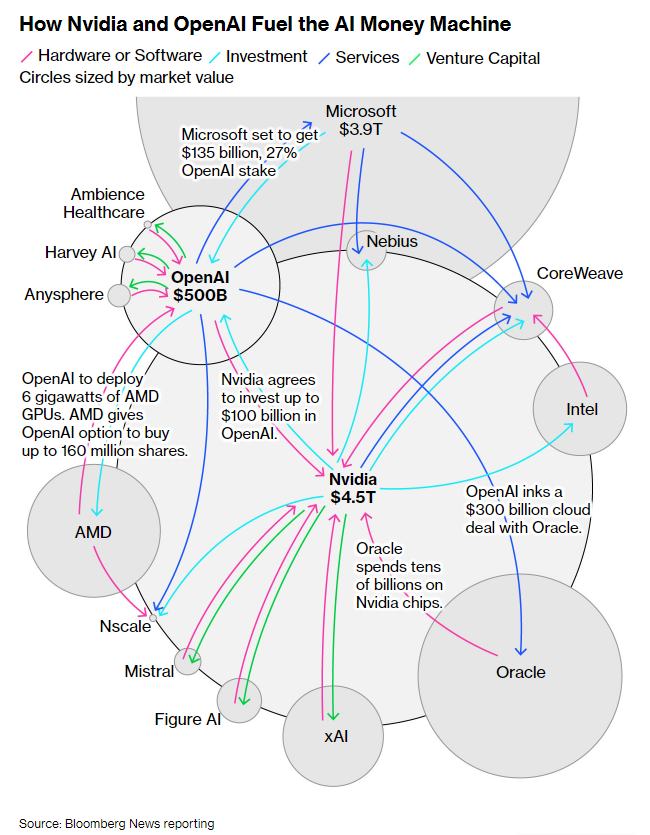
Group 1 - OpenAI is in investment talks with Amazon, aiming to raise $10 billion or more and considering the use of Amazon's AI chips [1] - OpenAI announced plans to spend $38 billion over the next seven years to lease server resources from Amazon's AWS [1] - The financing will help OpenAI fulfill its long-term commitment to lease servers from at least five cloud service providers, including AWS, for AI model development [1] Group 2 - The discussions began after OpenAI's corporate restructuring last October, which paved the way for a potential public listing [1] - If an agreement is reached, Amazon's Trainium AI training chips will gain a new customer, enhancing Amazon's influence in the AI sector and competing with Nvidia [1] - Analysts note that Trainium chips are a strategic key for Amazon in the AI field, complementing its cloud computing business [2] Group 3 - Amazon aims to attract enterprise customers with cost-effective advantages, stating that Trainium chips can drive AI models with lower costs and higher efficiency compared to Nvidia GPUs [2] - OpenAI has indicated it will obtain Nvidia AI chip computing power through AWS but may integrate more chip solutions in the future [2] - OpenAI's valuation reached $500 billion in a recent employee share sale, making it the highest-valued startup globally, surpassing SpaceX [5] Group 4 - The rapid rise of OpenAI highlights the investment frenzy surrounding AI technology, which is seen as having the potential to reshape industries and economic landscapes [5] - However, Wall Street analysts have warned of potential bubble risks due to cyclical investment transactions, where companies invest heavily in potential customers to maintain spending on their products [5]

投AI-小帮投研
小帮投研· 2025-12-12 04:00
Group 1 - The report highlights the financial performance and analysis of major tech companies such as Meta, Western Digital, AMD, and Amazon, indicating a mixed outlook with some companies exceeding expectations while others show signs of slowing growth [10][28][31][39]. - A key indicator in the A-share technology sector is signaling alarm, suggesting potential challenges ahead for the industry [10]. - China's PMI and real estate data have declined again in October, reflecting ongoing economic pressures [10]. Group 2 - Nvidia's GTC conference revealed strong demand for its Blackwell chips, with expectations to ship 20 million units and a cumulative order value of $500 billion, significantly surpassing the previous generation's performance [17][20][21]. - Nvidia's data center business has shown impressive growth, with quarterly revenues reaching $41.1 billion, marking a 70% increase based on projected future deliveries [21]. Group 3 - Meta's quarterly earnings exceeded expectations, with revenues of $51.2 billion, a 26% year-over-year increase, and an adjusted EPS of $7.25, surpassing market forecasts [28][29]. - Meta's capital expenditures are projected to reach $70-72 billion in 2025, indicating a commitment to expanding AI capabilities [30]. Group 4 - Microsoft's quarterly revenue was $77.67 billion, an 18% increase year-over-year, with cloud business growth slightly below some expectations [31][33]. - Microsoft plans to increase its AI capacity by 80% this year, reflecting strong demand signals in the market [33]. Group 5 - Google's cloud revenue reached $15.16 billion, a 34% increase year-over-year, with significant growth in backlog orders [35][37]. - Google has raised its capital expenditure forecast for the year from $85 billion to $91-93 billion, indicating ongoing investment in capacity expansion [38]. Group 6 - Amazon reported quarterly sales of $180.2 billion, a 13% increase, with AWS cloud revenue growing 20%, marking the highest growth rate in nearly three years [39][40]. - Amazon's cash capital expenditures are expected to be around $125 billion in 2025, reflecting a strong commitment to infrastructure and capacity growth [40]. Group 7 - AMD's third-quarter revenue was $9.246 billion, a 36% year-over-year increase, with data center revenue also showing strong growth [43][45]. - AMD has entered a multi-year agreement with OpenAI to deploy 6GW of GPUs, potentially generating over $100 billion in revenue in the coming years [45]. Group 8 - Western Digital's quarterly revenue was $2.82 billion, a 27% increase year-over-year, with a focus on enhancing storage density rather than expanding production capacity [47][48]. - The company is optimistic about AI driving future storage demand, with significant orders already secured for 2026 [48].


高盛拉响警报:“1997年的崩盘正在重演”
Sou Hu Cai Jing· 2025-11-21 19:50
Core Insights - The current AI hype is being compared to the internet bubble of the late 1990s, with Goldman Sachs highlighting five warning signals that resemble those seen before the internet bubble burst [5][10]. Group 1: Warning Signals Identified by Goldman Sachs - The first signal is peak investment spending, with capital expenditures for the five major tech giants projected to reach $533 billion by 2026, up from 3% of GDP in 1995 to 4.5% in 2000 [5]. - The second signal indicates a decline in corporate profits, with macro-level profit growth showing signs of fatigue despite stable profit margins [5]. - The third signal is the rapid rise in corporate debt, exemplified by Meta raising $30 billion through bond issuance to support its AI spending plans [6]. - The fourth signal is the Federal Reserve's interest rate cuts, with a 25 basis point cut in October and expectations for another cut in December [7]. - The fifth signal is the widening credit spread, which has increased from 2.76% to 3.15% for U.S. high-yield bonds, indicating a trend despite still being at low levels [8]. Group 2: Comparison with the Internet Bubble - Unlike the internet bubble, the current AI hype does not exhibit key macroeconomic imbalances, as corporate profitability remains solid and financial health is relatively stable [10]. - The net profit margin for the AI industry stands at 27.7%, contrasting sharply with the 14% profitability of ".com" companies during the internet bubble [10]. - Valuation metrics differ significantly, with the forward P/E ratio for the Nasdaq 100 at 26.7 compared to 60 during the internet bubble [10]. Group 3: Historical Lessons from the Internet Bubble - The internet bubble saw 68% of Nasdaq tech stocks unprofitable, while 72% of private AI companies are currently unprofitable [11]. - The average valuation for private AI companies is 35 times sales, compared to 28 times during the internet bubble [11]. - Companies that survived the internet bubble, like Amazon, adapted through innovation and diversification, highlighting the importance of sustainable business models [13]. Group 4: Current AI Investment Landscape - Despite significant investments in generative AI, 95% of organizations report negligible returns, indicating a disconnect between investment and actual benefits [15]. - Many companies treat AI as a plug-and-play tool, failing to recognize its need for continuous learning and adaptation [15]. - Investors are advised to use options for risk management while being cautious of the dual risks in the interest rate market [17]. Group 5: Conclusion on AI Investment - AI is recognized as a major technological shift, but not all participants will benefit, as evidenced by the 95% of AI investments yielding no returns [19]. - Companies that thrive in the AI landscape will likely share traits such as continuous technological advancement, sustainable profit models, and robust governance [19][20]. - The current AI wave presents opportunities, but investors should remain vigilant and selective in their investments [20][21].

AI投资狂潮再起? 逢低买盘正在用真金白银守护“AI牛市叙事”
Zhi Tong Cai Jing· 2025-11-10 14:35
Core Viewpoint - The AI investment frenzy is driving a tech stock bull market in 2023, with predictions of approximately 10% upside remaining for U.S. tech stocks for the rest of the year, despite short-term disturbances [1][3]. Group 1: Market Sentiment and Predictions - Wedbush predicts that the current tech stock bull market is experiencing normal short-term fluctuations due to the AI investment craze, and investors are eager to adopt a "buy the dip" strategy [1]. - Major Wall Street firms, including Goldman Sachs and Morgan Stanley, reject the notion of an AI bubble, asserting that the bull market driven by AI is far from over [1][7]. - Analysts emphasize that recent market volatility, particularly in stocks like Palantir and Nvidia, presents significant buying opportunities, as historical data shows that performance is key and short-term factors do not hinder long-term bullish trends [2][3]. Group 2: Financial Performance and Growth - The third quarter earnings season for global tech stocks highlighted strong cloud computing revenue from companies like Microsoft, Amazon, and Alphabet, reinforcing the narrative of a long-term AI bull market [3]. - Predictions indicate that capital expenditures by large tech companies could rise significantly from approximately $380 billion in 2023 to nearly $550 billion to $600 billion by 2026, driven by the next wave of AI spending [4]. - Palantir is identified as a key indicator of enterprise AI demand, with its U.S. commercial business growth exceeding Wall Street expectations, reflecting a broader trend of accelerated AI investments by businesses and government organizations [4]. Group 3: Market Reactions and Opportunities - Following strong earnings reports from AI chip leaders like AMD and major financial institutions refuting the AI bubble theory, market concerns about an AI bubble have diminished, leading to significant stock price increases among Asian tech giants linked to AI [5]. - Major buying activity is observed in AI leaders like Nvidia and TSMC, as the market rebounds from recent downturns, indicating investor confidence in the long-term fundamentals of AI [6]. - Analysts from Morgan Stanley note clear signs of recovery in corporate earnings driven by AI, with a significant shift in earnings expectations indicating a turning point [7].

“AI泡沫”引发市场恐慌之际 花旗高呼逢低买入“AI贝塔+周期贝塔”
智通财经网· 2025-11-07 03:28
Group 1 - The core viewpoint of the articles suggests that the recent stock market pullback, attributed to concerns over an "AI bubble," is seen as a healthy adjustment rather than a sign of a looming crisis [1][3][2] - Analysts from UBS believe that while conditions for an AI bubble are emerging, the market is still in the early stages and far from a critical peak similar to the 2000 internet bubble [2][3] - Drew Pettit from Citigroup emphasizes that the market's long-term bullish narrative driven by AI fundamentals remains intact, providing significant buying opportunities during the pullback [1][5] Group 2 - Nvidia's CEO Jensen Huang highlighted a projected revenue visibility of $500 billion from data center business for 2025-2026, which excites Wall Street analysts [4] - Pettit recommends maintaining exposure to both growth and cyclical investment sectors, suggesting a strategy of buying small-cap ETFs during market pullbacks [6][5] - Specific investment opportunities identified include Nvidia (NVDA), Amazon (AMZN), and various semiconductor ETFs, with Amazon's recent $38 billion AI computing agreement with OpenAI being a notable highlight [7][8] Group 3 - In the cyclical investment sector, Pettit points out companies that could benefit from significant productivity gains, including Boston Scientific (BSX), Capital One (COF), and Equifax (EFX), anticipating improvements in the mortgage market by 2026 [8]
投资50亿美元,亚马逊将在韩国新建一座AI数据中心
Sou Hu Cai Jing· 2025-10-30 04:21
Group 1 - AWS announced an investment of approximately $5 billion in new AI data centers in South Korea from 2025 to 2031, raising its total investment in the country to over $9 billion, marking the largest green investment plan in South Korea's cloud services sector [2] - The new AI data centers will be located in Incheon and Gyeonggi Province, complementing a $400 million AI facility in collaboration with SK Group, which is expected to be operational by 2027 with an initial capacity target of 100 megawatts (MW) and a long-term goal of expanding to 1 gigawatt (GW) [2] - AWS's investment reflects its long-term commitment to establishing South Korea as a global AI hub and aims to support local enterprises in utilizing advanced AI hardware for a stable and scalable AI computing platform [2][3] Group 2 - South Korean President Lee Jae-myung stated that this initiative will strengthen the national AI ecosystem and promote the construction of an "AI highway," facilitating broader applications of AI technology in industries and research [3] - Since 2017, AWS has trained over 300,000 cloud professionals in South Korea and has reinforced the foundation for the next generation of tech talent through various educational collaborations [3] - This investment is part of a broader $40 billion investment plan across 14 countries in the Asia-Pacific region, expected to generate over $45 billion in economic benefits for the region [3]
所有人都在谈“人工智能+”,到底怎么落地?
腾讯研究院· 2025-09-02 08:23
Core Viewpoint - The article discusses the transition from "Internet+" to "Artificial Intelligence+" as a new phase in technological integration, emphasizing the transformative potential of AI in reshaping industries and societal operations [5]. Group 1: Differences Between "Artificial Intelligence+" and "Internet+" - The technological stage differs, with "Internet+" being based on mature digital technologies while "Artificial Intelligence+" is characterized by rapid iteration and uncertainty in technology and applications [7]. - The value creation mechanism varies; "Internet+" enhances connectivity, while "Artificial Intelligence+" focuses on computational enhancement, improving productivity at each node and expanding the network's value [10]. - The diffusion paths are distinct; "Internet+" follows a consumer-to-producer model, while "Artificial Intelligence+" is more producer-focused, requiring deep integration into business processes before reaching consumers [12]. Group 2: Economic Impact of AI - AI's productivity effects are expected to grow exponentially, with predictions that AI could contribute to a 15% increase in global economic growth over the next decade [11]. - The rapid evolution of AI capabilities, with task completion abilities doubling approximately every seven months, indicates a significant potential for economic value creation [11]. Group 3: Practical Exploration of "Artificial Intelligence+" - Companies should prioritize high-value AI use cases that are data-rich and core to their business, as demonstrated by Pfizer's use of AI to enhance drug development efficiency [17]. - The engineering of AI systems is crucial, with companies needing to adapt general models to specific business needs through techniques like prompt engineering and retrieval-augmented generation [18]. - Building AI datasets should focus on business needs rather than data collection for its own sake, ensuring that data strategies are integrated throughout the AI application lifecycle [19]. Group 4: Recommendations for Promoting "Artificial Intelligence+" - A top-level design is necessary to create an innovative environment for "Artificial Intelligence+", similar to the strategic guidance that supported "Internet+" [22]. - Encouraging a diverse range of developers and startups in AI applications can foster innovation and investment in the sector [23]. - Establishing a comprehensive data element market and promoting open industry application scenarios can enhance the sustainable development of AI applications [25].

亚马逊广告生态扩张,AI基础设施落地,Q2财报释放哪些信号?
Jing Ji Guan Cha Bao· 2025-08-05 14:20
Group 1 - Amazon reported a comprehensive growth in Q2 2025, with total revenue increasing by 13% year-over-year to $167.7 billion, driven by double-digit growth in advertising, cloud computing, and subscription services [2] - Advertising revenue reached $15.7 billion, up 22% year-over-year, solidifying its position as a core growth engine for Amazon [2][3] - The company is expanding its advertising reach into streaming, live sports, and gaming, with a new partnership with Roku to cover over 80 million U.S. households [3] Group 2 - Amazon Web Services (AWS) generated $30.9 billion in revenue, reflecting a 17.5% year-over-year growth, as demand for AI applications accelerates [4] - The company is investing heavily in AI infrastructure, with capital expenditures reaching $31.4 billion, primarily for AWS-related AI investments [4] - AWS currently faces a backlog of $195 billion in orders, a 25% increase year-over-year, indicating a surge in demand for AI model deployment and data applications [5] Group 3 - Other revenue segments, including subscription services and third-party seller services, also showed robust growth, with subscription revenue increasing by 11% to $12.2 billion and third-party seller services reaching $40.3 billion, up 10% [6] - Despite a conservative profit forecast for Q3, which led to a 2.5% drop in stock price, this approach is seen as a strategy to allow for future large-scale investments [6] - The company has not experienced significant impacts from global trade uncertainties, demonstrating flexibility and resilience in its supply chain and pricing strategies [6] Group 4 - Amazon is evolving into a "technology infrastructure company," with a balanced focus on retail, advertising, and cloud computing, particularly in the context of the AI revolution [7] - The company's advertising system is becoming a comprehensive ecosystem that connects content, scenarios, and conversions, enhancing its value to brand advertisers [7] - With a solid revenue growth and diversified business structure, Amazon is well-positioned to navigate economic cycles and capitalize on the accelerating adoption of AI technologies [7]