
China Steel

Search documents
2025年7月中国钢铁板材出口数量和出口金额分别为613万吨和39.81亿美元
Chan Ye Xin Xi Wang· 2025-09-13 02:25
Core Insights - In July 2025, China's steel plate exports reached 6.13 million tons, representing a year-on-year increase of 19% [1] - The export value for the same period was $3.981 billion, showing a year-on-year growth of 7.2% [1] Export Data Summary - The export quantity of steel plates from China in July 2025 was 6.13 million tons, which is an increase of 19% compared to the previous year [1] - The corresponding export value was $3.981 billion, reflecting a growth of 7.2% year-on-year [1]


2025年7月中国钢铁线材出口数量和出口金额分别为24万吨和1.96亿美元
Chan Ye Xin Xi Wang· 2025-09-13 02:25
Core Insights - The report by Zhiyan Consulting highlights the growth in China's steel wire rod exports, with a notable increase in both quantity and value in July 2025 compared to the previous year [1]. Export Data Summary - In July 2025, China's steel wire rod export volume reached 240,000 tons, representing a year-on-year increase of 18.2% [1]. - The export value for the same period was $19.5 million, which reflects a year-on-year growth of 2.2% [1]. Industry Analysis - Zhiyan Consulting is recognized as a leading industry consulting firm in China, specializing in comprehensive industry research and providing tailored consulting services [1]. - The firm emphasizes its commitment to delivering in-depth industry research reports, business plans, feasibility studies, and customized services to empower investment decisions [1].

第三国转口贸易解析,中国钢铁和铝材如何应对埃及壁垒
Sou Hu Cai Jing· 2025-09-12 06:53
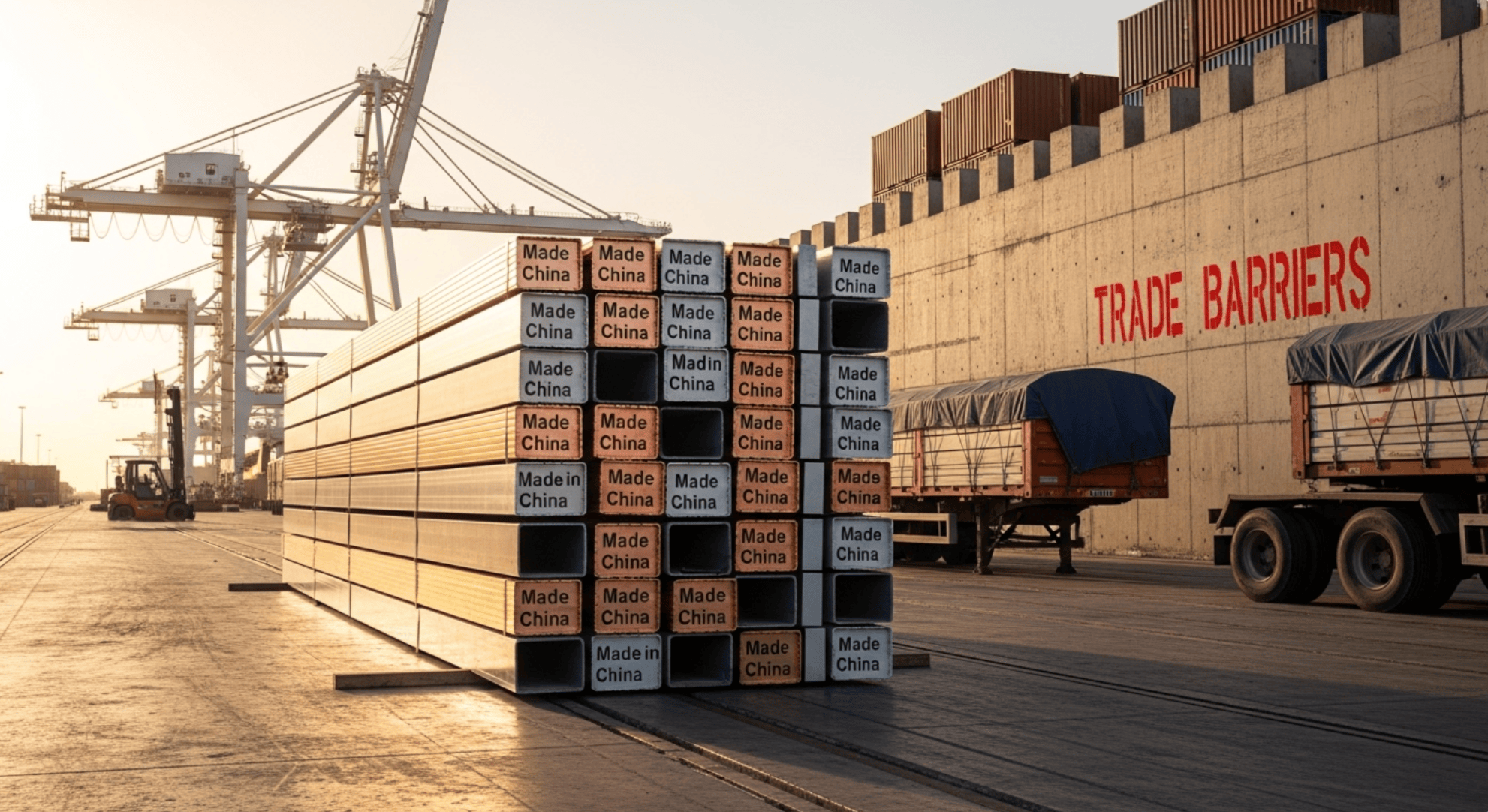
Group 1: Core Insights - Egypt has escalated anti-dumping measures against Chinese steel and aluminum products, imposing anti-dumping duties of up to 29% on cold-rolled, galvanized, and painted steel products [1] - Since 2021, Egypt has gradually imposed anti-dumping taxes on aluminum products, starting at 16.5% and currently reduced to 10.5%, significantly impacting exporting companies [1] Group 2: Trade Strategies - In the complex international trade environment, third-country transshipment trade has become a crucial strategy for Chinese companies, allowing them to circumvent high tariffs through neutral countries like Malaysia and Turkey [3] - Steel export companies are particularly affected by anti-dumping measures on cold-rolled and galvanized steel, and transshipment through Malaysia or Turkey can mitigate direct impacts [5] Group 3: Future Outlook - The future of Egypt's trade protection measures is expected to remain stringent, prompting Chinese steel and aluminum companies to diversify markets, ensure compliance in transshipment operations, and upgrade their industries to enhance competitiveness [5][6] - While third-country transshipment provides a temporary buffer, long-term success will depend on optimizing industry structure and adjusting market strategies [6]
中国钢铁 - 反内卷 = 仅控制产量-China Steel_ Anti-involution = production control only_
2025-09-11 12:11
Summary of Conference Call on China Steel Industry Industry Overview - The conference call primarily discusses the **China Steel Industry** and its current dynamics, particularly focusing on supply-side reforms and market conditions for steel production and consumption. Key Points and Arguments Supply Discipline and Production Cuts - Steel supply discipline year-to-date (YTD) is estimated to be behind previous forecasts, with a projected **5%** supply cut for the full year 2025 [1] - A meaningful supply cut is expected in **4Q25**, driven by seasonal factors and rising raw material costs, which may pressure gross profit per ton (GP/t) [3][15] - The anticipated supply-side reform is lagging behind expectations in terms of timeline and execution, with **15 million tons** of crude steel cuts reported in the first seven months of 2025 [2][11] Export Resilience - Steel exports have exceeded expectations, with a projected **70 million tons** for FY25, despite rising anti-dumping measures and geopolitical risks [2][16] - As of July 2025, net steel exports reached approximately **67 million tons**, marking a **12.6%** year-over-year increase [17] - Export dynamics have shifted, with notable increases in shipments to the Middle East and South America, while exports to Vietnam and South Korea have decreased due to tariff risks [22] Apparent Consumption Trends - Apparent consumption is largely in line with forecasts, showing a decline of approximately **2.3%** year-over-year when excluding crude steel production impacts [26] - Construction demand remains weak, with new property starts down **19%** year-over-year, contributing to the overall decline in steel consumption [26] Anti-Involution Efforts - The concept of "anti-involution" in the steel sector is highlighted as a long-term challenge, focusing on improving quality and environmental standards rather than merely cutting supply [3][31] - The Ministry of Industry and Information Technology (MIIT) has introduced new normative conditions for the steel industry, emphasizing high-end product mixes and ultra-low carbon emissions [32] Company-Specific Insights - **Angang Steel (000898.SZ)** is identified as a strong investment opportunity due to its valuation and potential for profit margin improvement as supply cuts take effect [53] - Despite narrowing losses in 1H25, Angang's results fell short of initial forecasts, prompting a revision of earnings estimates for 2025 [54] - The target price for Angang Steel is maintained at **Rmb 3.00** per share, reflecting a price-to-book (P/B) ratio of **0.6x** [55] Market Outlook - The overall sentiment indicates cautious optimism regarding the steel market, with expectations of improved margins and ASP (average selling price) in the long term due to supply-side reforms and anti-involution measures [54][59] Additional Important Content - The call emphasizes the need for sustained government efforts to enforce supply cuts, which may be challenging as margins recover [3][31] - The discussion includes detailed data on production capacity, utilization rates, and historical performance metrics for the steel industry, providing a comprehensive view of market dynamics [34][36] This summary encapsulates the critical insights from the conference call, focusing on the current state and future outlook of the China steel industry, along with specific company analyses.



2025年6月中国钢铁线材出口数量和出口金额分别为24万吨和1.91亿美元
Chan Ye Xin Xi Wang· 2025-08-28 01:13
Core Insights - The report by Zhiyan Consulting highlights the export performance of China's steel wire rod, indicating a slight increase in export volume but a decrease in export value [1] Export Performance - In June 2025, China's steel wire rod export volume reached 240,000 tons, representing a year-on-year increase of 3% [1] - The export value for the same period was $19.1 million, which reflects a year-on-year decline of 10.4% [1] Industry Analysis - Zhiyan Consulting is recognized as a leading industry consulting firm in China, specializing in comprehensive industry research and providing tailored consulting services [1] - The firm emphasizes its commitment to delivering in-depth industry reports and market insights to support investment decisions [1]

2025年6月中国钢铁棒材出口数量和出口金额分别为152万吨和8.47亿美元
Chan Ye Xin Xi Wang· 2025-08-28 01:13
Core Insights - The report by Zhiyan Consulting highlights the significant growth in China's steel bar exports, with a quantity of 1.52 million tons in June 2025, representing a year-on-year increase of 45.5% [1] - The export value for the same period reached 847 million USD, marking a year-on-year growth of 20.9% [1] Industry Overview - The data is sourced from Chinese customs, indicating a robust performance in the steel industry, particularly in the export segment [1] - Zhiyan Consulting is recognized as a leading industry consulting firm in China, specializing in comprehensive industry research and providing tailored consulting services [1]

2025年6月中国钢铁板材出口数量和出口金额分别为593万吨和37.42亿美元
Chan Ye Xin Xi Wang· 2025-08-28 01:13
Core Insights - In June 2025, China's steel plate exports reached 5.93 million tons, marking a year-on-year increase of 2.1% [1] - The export value for the same period was $3.741 billion, which represents a year-on-year decline of 7.4% [1] Export Data Summary - The export quantity of steel plates from China in June 2025 was 5.93 million tons [1] - The export value decreased to $3.741 billion compared to the previous year [1] - The year-on-year growth in export quantity contrasts with the decline in export value, indicating potential pricing pressures in the market [1]

中国钢铁:产量全世界第一,但挣钱能力与日企比,那就差远了
Sou Hu Cai Jing· 2025-08-27 00:07
Group 1 - In 2024, China's crude steel production is projected to reach 1.005 billion tons, accounting for over 50% of global output, solidifying its position as the world's largest producer [1] - Despite high production levels, Chinese steel companies lag significantly in profitability compared to Japanese firms, with the top four Chinese steel companies' net profits combined being less than that of Nippon Steel [3] - Nippon Steel, despite producing only 39.64 million tons of crude steel in 2024, has managed to achieve higher profits than Chinese counterparts, highlighting a stark contrast in profitability [3] Group 2 - Cost control is a critical factor, with iron ore accounting for 40% to 50% of steelmaking costs; Nippon Steel has secured long-term low-price contracts with major miners, while Chinese companies rely heavily on imported iron ore, leading to higher costs [5] - Japanese steel companies focus on high-value specialty steel, with over 20% of Nippon Steel's production being specialty steel, while Chinese companies have only 12.31% of their production in this category, primarily producing lower-margin ordinary steel [5] - Chinese steel companies are making efforts to innovate, with advancements in producing specialized steel products, supported by government initiatives aimed at improving the industry [7] Group 3 - The current situation of "large but weak" and low profits in the Chinese steel industry indicates a need for transformation, emphasizing the importance of profitability over sheer production volume [8] - To compete effectively in the global steel market, Chinese steel companies must learn from Nippon Steel and transition from being "large producers" to "profit-making experts" [8]
全球金属与矿业:中国钢铁生产趋势,分化可解释
2025-08-25 01:40
Summary of Key Points from the Conference Call Industry Overview - The focus is on the **Metals & Mining** industry, specifically the **steel and cement production trends in China** [1][2][7]. Core Insights 1. **Cement Production Decline**: China's cement production is annualizing at the lowest levels since 2009, while steel production is approximately 65% higher than 2009 levels [1][2]. 2. **Net Exports Impact**: The increase in steel net exports is a significant factor in the production divergence. In 2009, steel net exports were 3 million tonnes, while in 2025, they are projected to be 112 million tonnes, which is equivalent to 12% of current steel production [3][4]. 3. **Data Quality Issues**: Historical data quality has affected steel production statistics, with hidden or unreported production being a significant issue from 2009 to 2019. The ratio of cement to steel production dropped from approximately 3x to 2.2x between 2005 and 2016, and further to 1.8x by 2018 [4][5]. 4. **Cement vs. Steel Demand**: Steel is considered a later-cycle material compared to cement, with demand driven more by consumer durables and advanced infrastructure rather than construction. This suggests that steel demand may remain more resilient than cement demand as economies develop [5][6]. Additional Important Points - **Production Ratios**: The cement to steel production ratio has been declining, indicating a shift in the production landscape in China [4]. - **Economic Implications**: The resilience of steel demand in the context of economic development in China suggests potential investment opportunities in the steel sector compared to cement [5][6]. This summary encapsulates the critical insights and data points discussed in the conference call regarding the current state and future outlook of the steel and cement production industry in China.
“AI+钢铁”如何赋能中国钢铁业智能化发展?
Zhong Guo Xin Wen Wang· 2025-08-20 00:13
Core Insights - The Chinese steel industry is transitioning from digitalization to intelligence, with AI expected to drive high-quality development [1] - The integration of AI in the steel sector is seen as a best practice for deep empowerment, given the industry's scale and urgent need for quality improvement [1][2] - The application of AI in steel production has shown positive results in optimizing processes, quality control, and supply chain management, with significant future potential [1][2] Group 1 - The steel industry is a crucial foundation for China's economy, characterized by complex processes and a need for real-time data acquisition [2] - Experts emphasize the importance of combining AI technology with the steel industry to leverage big data and enhance operational efficiency through a human-machine collaborative approach [2] - The "AI+Steel" model developed by Northeast University aims to predict performance and reduce energy consumption and carbon emissions in steel production [2] Group 2 - The development of "AI+Steel" is expected to promote sustainable practices in the steel industry, focusing on energy conservation and environmental protection [3] - The trend towards building an AI ecosystem across enterprises and industries will foster collaboration and innovation among steel companies, research institutions, and technology service providers [3]